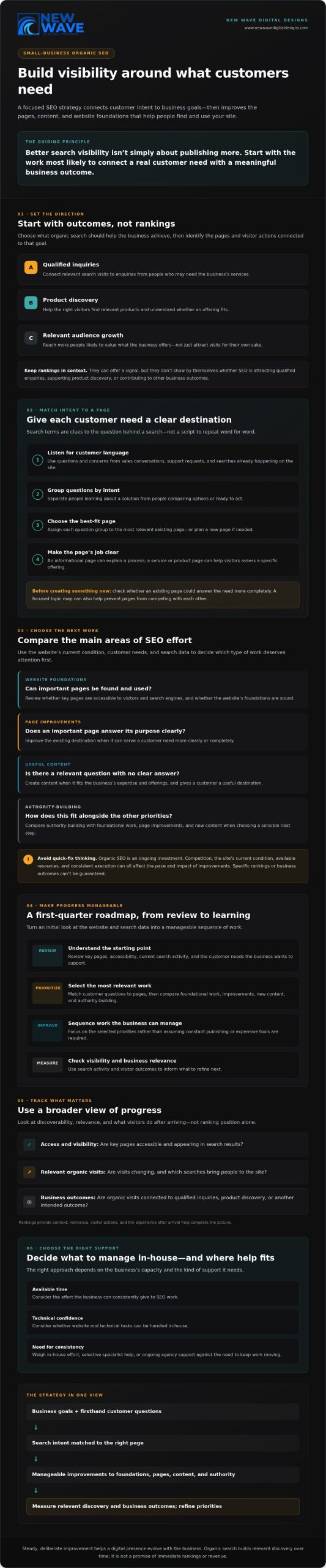
Signs Your Business Has Outgrown Its Website and How to Decide What Comes Next

A polished website can still be the wrong fit for a growing business. The clearest signs your business has outgrown its website include outdated messaging, difficulty reaching the customers you want, a poor mobile experience, and updates or inquiries that are harder than they should be. Several signs together are a reason to consider an upgrade, but the right next step depends on what no longer works.

It’s natural to think a new look will solve the problem, but a redesign works best when it addresses the site’s structure and purpose as well as its visuals. Your website should reflect what your business offers today, guide the right visitors to useful information, and make the next step clear.

This article will help you assess whether your brand and website still fit your business, spot friction in your content and customer journey, and decide whether a focused refresh or a complete redesign makes sense. You’ll also find practical questions to help shape a site that supports your next stage of growth.

Key Takeaways

  • Compare your current brand, offerings, and goals with what your website communicates to spot where the message has fallen out of step.
  • Review whether your content speaks to the customers you want to reach today and guides them toward a clear next step.
  • Identify which DIY limitations are slowing updates, restricting flexibility, or making the site harder to manage as the business grows.
  • Separate visual updates from deeper structural needs before deciding whether to refresh existing pages or plan a broader redesign.
  • Use visitor behavior, mobile usability, content priorities, and future business needs to shape a practical redesign plan.

Evaluating whether a brand reflects the current business

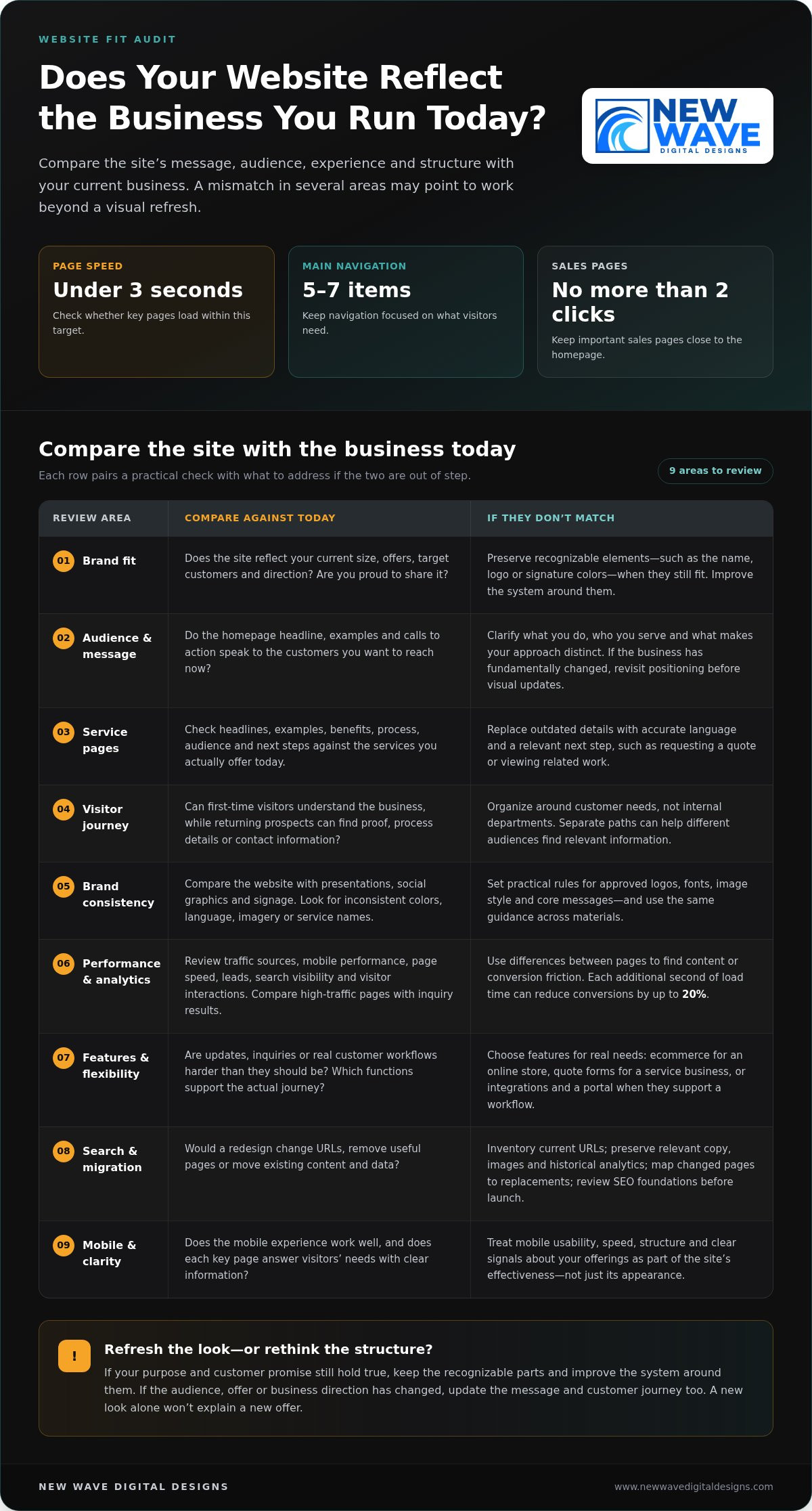
Start by comparing your website with the business you run today. A strong brand helps visitors understand what you do and what sets your business apart. Review your current size, offers, target customers, brand consistency, and whether you’re proud to share the site. A mismatch across several areas can signal that the website no longer reflects your direction.

Growth doesn’t always call for a complete rebrand. If customers still recognize your name, logo, or signature colors, preserve those distinctive elements while improving the system around them. For example, keep a familiar logo but refine its typography, imagery, and use across key pages. Having to repeatedly explain what your company offers now is another sign your business has outgrown its website.

Compare your website with your presentations, social graphics, and signage. When employees or suppliers create assets at different times, colors, language, and imagery can gradually become inconsistent. Set practical brand rules for approved logos, fonts, image style, and core messages. Apply the same guidance when updating pages or creating new materials.

Next, read your homepage and main service pages as a prospective customer. Do they describe your current offers, explain what makes the business distinct, and speak to the customers you want to reach? If the homepage targets an old audience or a service page describes a past offer, update its wording and images. Brand positioning includes these choices, not just visual design.

Website analytics can help reveal where the experience falls short. Review traffic sources, mobile performance, page speed, leads, search visibility, and visitor interactions. Compare pages with strong traffic but few inquiries with pages that generate useful actions. The differences can point to content or conversion friction.

Slow pages can frustrate visitors and weaken conversion opportunities; each additional second of load time can reduce conversions by up to 20%. Search engines also prioritize speed, structure, mobile performance, and clear signals about a business’s offerings. Check whether key pages load in under three seconds and whether their content answers visitors’ needs.

Choose features from actual customer journeys, not a generic checklist. An online store may need ecommerce, while a service business may benefit from quote forms; integrations or a customer portal matter when they support a real workflow. Keep navigation focused, with 5-7 main items, and place important sales pages no more than 2 clicks from the homepage.

A redesign also carries practical risks. Changing URLs or removing useful pages can disrupt search traffic, while migrating content without an inventory can leave copy, images, or historical analytics behind. Before launch, document current URLs, preserve relevant content and data, map changed pages to their replacements, and review the redesigned site’s SEO foundations.

2. Changing audiences and outdated positioning

A growing business can outpace the audience its homepage was designed to reach. For example, a company once focused on individual buyers may now serve procurement teams, business owners, and larger organizations. If the homepage still speaks to its original customer, new visitors may struggle to see whether the business fits their needs. Review the headline, examples, and calls to action against the customers you want to reach now.

Positioning can change even when the company name and core expertise remain familiar. A firm that once sold one service may now offer several related solutions or serve a different market with deeper expertise. Check whether the website explains what the business does, who it serves, and what makes its approach distinct. If visitors need a sales call to understand those points, the site’s message may be outdated.

Audit each service page for details that no longer match the actual offer. A page may still appear in search results while describing an outdated process, audience, or scope. Review its headline, examples, benefits, and next step, then compare them with current sales materials. Replace outdated claims with accurate language and guide visitors toward an action suited to the service, such as requesting a quote or viewing relevant work.

Audience changes can also expose structural problems. A site organized around internal departments may force visitors to guess which page answers their questions. Map the customer journey instead: first-time visitors need a clear explanation, while returning prospects may want proof, process details, or a direct route to contact. If your business serves both homeowners and commercial clients, separate paths can help each group find relevant information without creating competing messages.

Decide whether to refresh the existing brand or rethink its positioning by examining what still holds true. If the company’s purpose and customer promise remain sound, preserve recognizable elements such as its logo, name, or signature colors, then build a clearer system around them. If the business has fundamentally changed, revisit the core message before making visual updates. New colors alone can’t explain a new offer.

Consistency matters as the business grows. Create practical guidance for employees and suppliers covering approved logos, typography, photography, and key phrases. For example, use the same service names on the website, proposal, and presentation. A considered brand design approach can help translate updated positioning into a coherent visual language across marketing materials.

3. Moving from a DIY site to a professionally built website

A DIY website can be a practical starting point, especially when a business needs to publish essential information quickly. The strain appears when routine changes become difficult: adding a service page disrupts the layout, updating a form takes repeated effort, or the marketing team can’t publish without outside help. Track which tasks stall, who handles them, and how often they interrupt customer work.

Growth may expose limits in customization and integrations. A builder that supports a simple contact page may not adapt easily when the business needs ecommerce, quote requests, or a connection to customer-management tools. List the functions you need, identify which the current platform supports, and note where manual workarounds remain. Repeatedly copying information between systems, for example, signals workflow friction.

Search optimization can reveal another constraint. Some website builders provide basic SEO tools but limit control over technical details as a site expands. Check whether staff can edit page titles and descriptions, organize URLs, and add useful structured information. If new service pages can’t be optimized consistently with existing ones, the platform may be restricting your search strategy.

Review mobile layouts separately. DIY templates can look polished on desktop while buttons, forms, or page sections become awkward on a phone. Test the same key journey on both screen sizes: open a service page, find the main action, and complete the contact form. If a small desktop edit repeatedly breaks the mobile layout, the design system may be too fragile for your team’s needs.

A professionally built website should make ongoing content work manageable, not create a permanent queue of small changes. A content management system can let owners update text, images, blog posts, and pages without coding. Before choosing a new structure, decide who will update each content type and which reusable page patterns will keep service pages consistent.

Moving platforms also calls for a deliberate transition. Inventory current pages, forms, images, and analytics before rebuilding, then identify what still supports business goals. Map useful old URLs to their new destinations, preserve key copy and records, and test forms before launch. These steps reduce the risk of losing valuable content or sending visitors to broken pages.

Choose the next build around the opportunities your business needs to support. A growing store may prioritize ecommerce, while a service company may need clear quote forms and flexible service pages. Specify required integrations, mobile behavior, editing responsibilities, and search needs in a written brief. That clarity helps the website evolve with the business instead of reproducing the same limits in a new design.
Signs Your Business Has Outgrown Its Website and How to Decide What Comes Next

4. Outdated design and competitor comparisons

A website may feel outdated when its layout, imagery, or content no longer fits the business, or when visitors struggle to find information and take the next step. A site built several years ago can look dated as design conventions and business needs evolve. Age alone isn’t proof that you need a rebuild; persistent friction is a stronger signal.

Consider visitors’ first moments on the homepage. They can form an impression quickly, so a cluttered layout, hard-to-read text, or generic imagery can weaken trust before they explore. Check whether the page clearly explains what you offer, who you serve, and what visitors can do next. If those details are buried beneath decorative elements, simplify the visual hierarchy.

Compare your website with a few businesses serving similar audiences, but assess the experience rather than copying their style. Look at how each site presents services, organizes information, and guides visitors toward contact or purchase. Note specific gaps, such as missing project examples or unclear service descriptions. Then choose improvements that express your own strengths and brand, not another company’s visual identity.

Design patterns from more than five years ago may feel dated, but a full rebuild isn’t always necessary. If the structure still supports current needs, updating photography, typography, page layouts, and copy may be enough. If the navigation, mobile experience, or content management repeatedly creates obstacles, a broader redesign may provide a more useful foundation. Many businesses reassess their websites every 3-5 years as technology, design, and business needs change.

Test the same journey on a phone and desktop. Can visitors read the main message, use the navigation, and reach a contact form without pinching to zoom or struggling with the layout? Google uses mobile performance in ranking sites, so a usable mobile experience matters to both visitors and search visibility. Record awkward steps, then prioritize the pages customers use most.

Website analytics may help you understand which pages attract visitors and where they leave. Compare those observations with customer questions and sales feedback. A high-traffic page without a clear next step may need stronger content or a more visible action. A service page with little engagement may need clearer information, better internal navigation, or a renewed purpose.

Before choosing a rebuild, separate visual symptoms from structural problems. Create a short review with three columns: what works, what confuses visitors, and what the business needs next. For example, retain a recognizable logo, revise a dated homepage, and reorganize service pages only if customers struggle to find them. This evidence-based approach keeps a refresh focused and gives a larger redesign a clear rationale.

Questions to guide a redesign

Start with the business decision your website must support. Are you prioritizing qualified inquiries, online sales, bookings, or stronger support for sales conversations? Choose the primary outcome, then define what a useful visitor action looks like. For a service business, that might be a completed quote request; for a shop, a completed purchase.

Ask whether the current site still serves that goal. A website can look polished yet lose opportunities through unclear calls to action, confusing forms, or pages that attract the wrong audience. Compare visits, engagement, form starts, completed submissions, and sales in your analytics. If visitors reach a sales page but leave before acting, examine its message, proof, and next step.

To see whether a website is hurting conversions or generating too few leads, compare lead and sales activity with relevant traffic, then trace where visitors drop off. Review analytics and conversion tracking by page and source, and inspect the path from landing page to inquiry or purchase. The problem becomes clearer when pages attract visitors but produce few meaningful actions.

Use customer questions to shape the redesign strategy. Which offerings matter most now? What must a new prospect understand before contacting you? Where do prospects hesitate, and what proof would address their concerns? For example, a consulting firm may need current case studies near a service explanation, while an online retailer may need clearer product details before checkout.

Review existing content before deciding what to replace. A case study may no longer represent your strongest work, while a popular blog post may attract readers without supporting current goals. Keep pages that serve customers or bring relevant traffic; revise, combine, or remove content that no longer fits. Record the purpose of each important page before design work begins.

Assess mobile usability and accessibility through real tasks, not appearance alone. On a phone, test navigation, text readability, buttons, forms, and checkout. With a keyboard, move through links and form fields without a mouse. Check that images have useful text alternatives, form fields have clear labels, and text contrasts with its background. These checks reveal barriers a desktop review can miss.

Finally, decide how the site should be maintained after launch. Identify who will update text, images, blog posts, and service pages through the content management system. Set priorities for flexible page patterns, analytics review, performance, and search visibility. A redesign plan grounded in customer needs, measured behavior, and clear ownership gives the new structure room to evolve with the business.

New Wave Digital Designs: Shopify Website Design

New Wave Digital Designs helps businesses shape websites around their current goals, customer journeys, and next stage of growth. If your online store needs a more considered structure, Shopify Website Design can align the shopping experience with your brand and business needs. WordPress Website Design and SquareSpace Website Design are also available for businesses with other platform needs.

If a redesign isn’t your immediate priority, Website Maintenance can keep an existing site supported as its content and needs evolve. The right next step depends on what’s holding your website back, whether that’s a platform mismatch, an unclear customer journey, or upkeep that has become difficult to manage.

To discuss your website’s next chapter, get in touch with New Wave Digital Designs.

Build a Website for the Business You’re Becoming

The signs your business has outgrown its website point to a useful question: what should your next digital chapter make possible? Let your priorities lead. A clearer customer journey, a more flexible platform, or a stronger connection between your brand and its online experience can each shape the way forward.

New Wave Digital Designs offers Shopify Website Design, WordPress Website Design, and SquareSpace Website Design. The right platform depends on how your business serves customers and what you need your website to support. A thoughtful redesign can give your next stage a more intentional foundation, without treating change as an end in itself.

If you’re ready to explore that next step, start a conversation about your website. Your business is still evolving, and its digital presence can evolve with it.

Frequently Asked Questions

So What Now?

Turn your observations into a short, prioritized action plan. Choose one business goal, such as increasing qualified inquiries, then identify the website change most likely to support it. Assign an owner and define how you’ll measure progress, using a relevant measure like completed forms or product sales. If a small content change can solve the obstacle, start there; if the site’s structure blocks the goal, plan a broader upgrade.

What are the biggest limitations of website builders?

Common limitations involve customization, integrations, search controls, and room to scale. A builder may handle a simple brochure site well but make a specialized booking flow or connection to business software difficult. Distinguish a temporary inconvenience from a platform ceiling: note the workaround, who maintains it, and whether it prevents a necessary customer task. This comparison helps show whether the builder still fits your needs.

What does it mean to outgrow a DIY website?

It means the site’s setup or upkeep no longer matches the business’s needs. For example, a founder may have built a basic site alone, then added services, staff, and new customer journeys. If each change creates layout problems or depends on the founder’s limited technical time, the site has become a constraint. The issue isn’t that DIY is inherently wrong, but whether the current approach remains workable.

When should you upgrade your website?

Consider an upgrade when you recognize several signs, such as poor mobile usability, outdated service information, or a difficult path to inquiry. Start by documenting the affected pages and customer tasks, then determine whether updates can resolve the issues. If several problems share a cause, such as a rigid structure or platform limits, address that root issue instead of repeatedly patching individual pages.

When should a business redesign its website versus make incremental updates?

Choose incremental updates when the site’s core structure still serves customers and the problems are contained, such as stale copy or dated images on a few pages. A redesign makes more sense when navigation, page structure, or the underlying platform repeatedly obstructs essential tasks. Before deciding, map the customer journeys that must work and list the obstacles. If resolving them requires changing the site’s foundation, plan a redesign.

5 fixes to consider when your website isn’t generating leads

The first fix for a website that isn’t generating leads may not be a redesign. To decide what to do when your website isn’t generating leads, review the last 90 days of analytics and identify whether the problem is traffic, conversion, or what happens after an enquiry.

It’s frustrating when a site attracts visitors but doesn’t turn their interest into conversations. The answer is to follow the evidence: check whether the right people are arriving, whether key pages make the value clear, and whether the next step is easy to take. This article walks through five practical fixes, from refining calls to action and checking mobile performance to building trust and connecting your website with your sales process. You’ll learn how to prioritize improvements, estimate how long they may take, and focus on the changes that better match buyer needs.

Key Takeaways

  • Use recent analytics to identify whether the main obstacle is traffic, conversion, or enquiry follow-up before choosing a fix.
  • Give each priority page one clear next step that matches what visitors are ready to do.
  • Separate focused changes, such as simplifying a form, from broader work on messaging or site structure when estimating timelines.
  • Assess mobile usability, page speed, and trust-building details as part of the visitor’s path to contacting you.
  • Connect website enquiries to a defined sales process so you can see which leads progress and where prospects lose momentum.

1. Writing specific, stage-appropriate calls to action

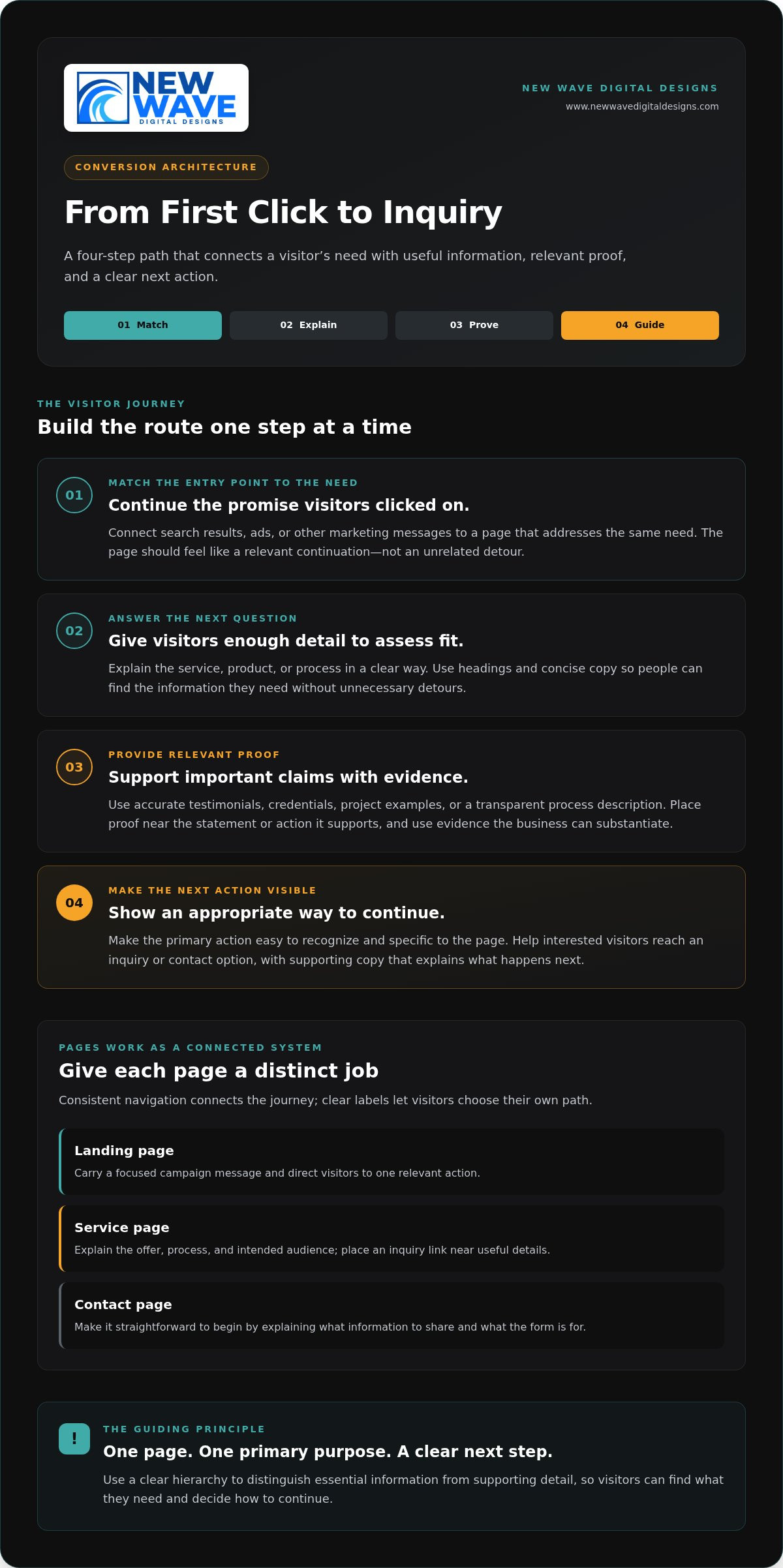
Start with the visitor’s intent, not a generic “Contact us” button. Someone reading a service overview may want to compare approaches, while someone on a service page may be ready to request a quote. Give each priority page one clear next step, and make its wording fit the decision that page helps visitors make.

For example, a page explaining a problem could invite visitors to “Explore your options.” A service page could offer “Request a project quote.” A detailed guide might direct readers to a related service page before inviting them to get in touch. Keep the message consistent from the headline to the call to action, so visitors know what to expect after clicking.

Make the action easy to find. Place the main call to action near the top of key pages, then repeat it where it fits, including on landing pages and blog posts. A long article can introduce a relevant next step beside the section that answers the reader’s question, then repeat it near the end. This creates a clear path without turning every paragraph into a sales pitch.

Reduce form friction by requesting only information your team will use. A simple starting point is three fields: name, email, and a brief description. If a form asks for 10 or more fields when three would do, remove fields that aren’t essential to responding. Keep any necessary extra questions tied to a clear purpose, such as understanding the project type or preferred contact method.

To improve website conversion rates and lead generation, review the last 90 days of analytics, choose a high-traffic page, and test one change at a time. Compare a specific call to action with the current wording, or simplify the form and observe what changes. If the page receives fewer than approximately 100 monthly visitors, prioritize attracting relevant traffic before drawing strong conclusions from small numbers of submissions.

Agency fees depend on the project’s scope, the pages involved, analytics setup, and any testing or design work. Conversion rates also vary by industry, audience intent, traffic source, and the action being measured. Rather than relying on a broad benchmark, compare similar pages and lead types on your own site.

When deciding what to do when your website isn’t generating leads, start with the page’s purpose, the visitor’s next decision, and the effort needed to act. A full redesign won’t fix a confusing call to action by itself. First try a clearer message, a more relevant next step, or a shorter form.

2. Estimating how long website lead-generation fixes take

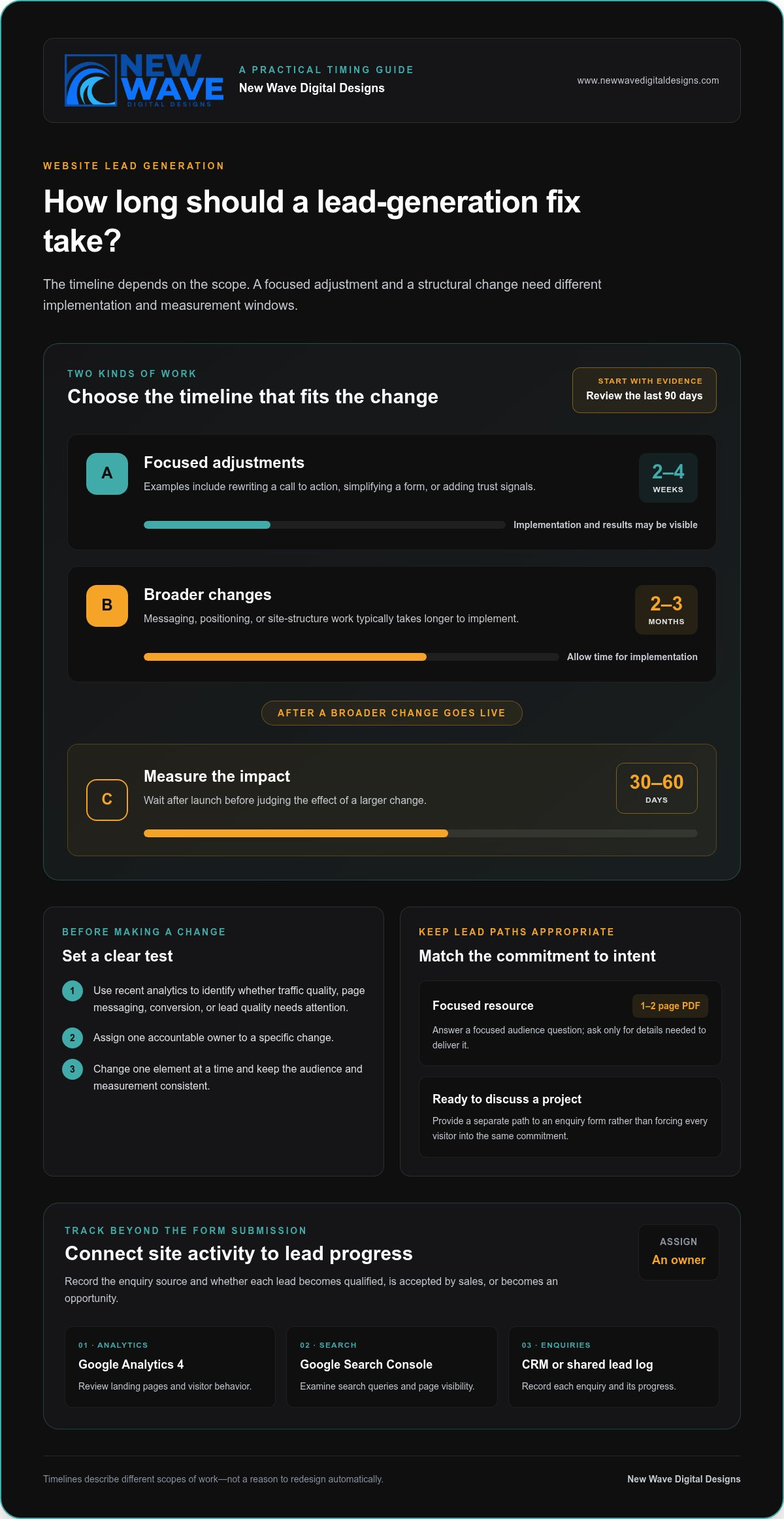
Set a realistic measurement window before changing your site. Quick adjustments, such as rewriting calls to action, simplifying forms, or adding trust signals, can produce results in 2-4 weeks. Changes to messaging, positioning, or the site’s structure typically take 2-3 months to implement. After larger changes go live, allow another 30-60 days to measure their impact.

Those timelines describe different kinds of work, not a reason to redesign automatically. First, review the last 90 days of analytics and identify whether traffic quality, page messaging, conversion mechanics, or lead quality needs attention. Then assign one accountable owner to a specific change and set its measurement window. If traffic is low or poorly matched to the offer, rebuilding pages alone won’t address the underlying reasons.

Lead magnets can give visitors different levels of commitment. A useful starting option is a 1-2 page PDF that answers a focused question for your audience. Offer it on a relevant article, and make the form request only details needed to deliver it. Visitors who are ready to discuss a project can follow a separate path to an enquiry form, rather than being pushed through the same commitment level.

Tracking should continue after submission. Use Google Analytics 4 to review landing pages and visitor behavior, Google Search Console to examine search queries and page visibility, and a CRM or shared lead log to record each enquiry. Assign an owner, record the enquiry’s source, and track whether it becomes qualified, accepted by sales, or an opportunity. A defined process makes it easier to distinguish a traffic issue from a follow-up gap.

To attract more qualified website leads, create SEO content around the questions buyers ask before choosing a service. Link each article to a relevant service page, and make sure the page delivers on the search query’s promise. When testing changes, compare versions with one element changed, such as the headline or call to action. Keep the audience and measurement consistent, then use what you learn to guide the next test.

Before beginning a redesign, check whether a targeted change can address the problem. Structural issues may justify broader work; an isolated form or message problem usually calls for a focused fix. For planned website lead-generation improvements, keep the scope tied to the evidence, the buyer’s needs, and the sales process.

3. Website speed, mobile usability, and technical performance

More than 50% of web traffic comes from mobile devices. A visitor arriving from a phone should be able to understand the page, use its navigation, and reach a useful next step without pinching or hunting. Test important pages on an actual phone, not only in a desktop preview.

Speed shapes that first interaction. A mobile page taking more than three seconds to load can lose visitors before they see its content. A one-second delay in website loading can reduce conversions by 7%. Start with your homepage, top landing pages, and contact form, then identify which elements delay their visible content.

Google’s Core Web Vitals guidance helps assess loading, responsiveness, and visual stability. Use these targets to identify technical work: Largest Contentful Paint under 2.5 seconds, Total Blocking Time under 200ms, and a mobile PageSpeed score above 70. A time to first byte above 800ms can flag an underpowered host. These measures point toward issues to investigate; they don’t replace testing the actual visitor journey.

Responsive design should do more than shrink a desktop layout. Check that headings wrap cleanly, buttons are easy to tap, and forms fit the screen without sideways scrolling. Then follow the route from a service page to its enquiry form. If phone users need to zoom, dismiss an obstructive banner, or hunt for the next step, simplify the journey.

Review how content appears on mobile, too. A long case study needs readable paragraphs, clear section labels, and visible links to related services. Keep essential details near the top, including what the business offers and whom it helps. This makes key information easier to find without forcing visitors through a dense wall of copy.

Use a practical diagnostic sequence: test your most visited pages, check mobile loading and layout, then submit each form yourself. Note where the experience slows down or breaks. If large media files make a case study slow to load, optimize them; if the mobile menu hides the enquiry route, adjust its layout. Fix the observed problem before considering a wider redesign.

  • Check mobile loading and layout on priority pages.
  • Use Core Web Vitals to locate performance issues.
  • Complete the enquiry journey on a phone, including form submission.

After each technical change, repeat the same tests and review how visitors use the page. Speed matters most when visitors can also find relevant information and complete the intended action. Track technical performance alongside enquiries, so improvements support lead generation rather than becoming an isolated score.

5 fixes to consider when your website isn’t generating leads

4. Building buyer trust and supporting decisions

Visitors need to understand your offer before they can trust it. Make the homepage messaging answer three questions: what you do, whom you help, and why visitors should keep reading. A headline should communicate what the business does, who it serves, and where within five seconds. Remove broad claims that leave people guessing, and explain the specific problem your service solves.

Support each claim with relevant evidence. Use testimonials that describe the customer’s situation, the work completed, and the outcome they experienced. A vague “great service” quote gives less context than one that explains how a project addressed a particular need. Place testimonials beside the service or decision they support, instead of gathering every quote on a disconnected page.

For a more considered purchase, case studies can show how a business approaches real challenges. Structure each one around the customer’s starting point, the decisions made, and the result. In complex B2B sales, a buying group may include multiple people who need different evidence. A technical lead may want process details, while a decision-maker may need to understand business value. Use analytics and sales conversations to learn which questions visitors seek to answer.

Local trust signals matter when customers want to know whether a business serves their area. Show the relevant location or service area clearly, and keep business details consistent across the site. Pair those details with local testimonials or case studies when available. A visitor should not have to search several pages to establish where a business works or whether its offer fits their needs.

Make proof easy to assess. Use named customer testimonials only with permission, and keep quotations faithful to the customer’s words. Label case studies clearly, distinguish examples from guarantees, and explain the scope of any result. If you display credentials or partner logos, explain what they represent. A badge without context may add visual weight without addressing a buyer’s concern.

Review the homepage from a first-time visitor’s perspective. In 10 seconds, can someone identify the business’s location, price range, and differentiator? If not, bring those details into clearer view. Ask a colleague unfamiliar with the site to describe its offer after a brief glance. Their response can reveal whether the design and messaging communicate the intended meaning.

Finally, make trust actionable. Place relevant proof near the next step, such as a testimonial beside a service enquiry form. Keep any response-time statements realistic and make promises only when you can consistently meet them. Clear evidence, accurate details, and credible expectations help buyers make informed decisions.

5. Alignment between website and sales process

A website can attract visitors and collect enquiries yet still lose potential sales. The gap often appears after the click: an ad promises one thing, the landing page says another, or no one owns the incoming enquiry. Treat lead generation as a connected path from first message to sales outcome, not just a count of form submissions.

Map the buyer’s journey from each major channel. If a Google Ads campaign promotes a specific service, send visitors to a page that continues the same promise. Explain the service, answer likely buyer questions, and offer a relevant next step. Sending everyone to the homepage makes visitors search again for the information that earned their click.

Next, write down what happens after someone submits a form. Assign an owner for reviewing each enquiry, define how it is routed, and set a clear follow-up process. Every website enquiry should trigger an immediate response. That response can acknowledge the request, explain what happens next, and give the prospect a useful way to continue the conversation.

Make the handoff visible to both marketing and sales. Track each enquiry through qualification, sales acceptance, and opportunity creation. Record its source, landing page, requested service, and outcome in a shared CRM or lead log. These stages help show whether the problem is unqualified traffic, a poor page-to-offer match, or a follow-up gap. A form fill is a starting signal, not proof of sales progress.

Use sales conversations to improve your website strategy. Ask the team which questions prospects raise, what concerns delay decisions, and which details help a lead move forward. Then update the homepage, service pages, and relevant content to answer those questions. For example, if prospects repeatedly ask what a project includes, explain the process and deliverables before the enquiry step. Useful content supports real decisions, not simply a higher page count.

Close the loop with regular reviews. Compare lead sources with qualification and opportunity outcomes, then share what you learn between marketing and sales. If a channel generates enquiries that rarely fit, refine its targeting or destination page. If qualified leads stall after submitting a form, examine who owns the response and how follow-up works. Tie each improvement to a specific stage instead of relying on traffic or form totals alone.

When your website and sales process need a more coherent structure, discuss your website strategy and how its pages can better support the buyer journey.

New Wave Digital Designs: Shopify Website Design

New Wave Digital Designs offers Shopify Website Design for businesses that need an online store with a clearer path from discovery to enquiry or purchase. If your analytics point to confusing page structure, inconsistent messaging, or a difficult visitor journey, a focused design review can help shape the site around your products and customers. Website Maintenance supports ongoing updates after launch, keeping key pages aligned as your business evolves.

A redesign makes sense when structural issues affect several parts of the customer journey. If the problem is limited to one form or page, a targeted improvement may be the better first step. Choose the change that addresses the evidence you’ve gathered and supports your sales process.

Contact New Wave Digital Designs to discuss your website goals and next steps.

Choose the next step that fits your site

Your next move doesn’t need to start with a blank canvas. Decide whether your current site needs focused refinements or a new structure that better reflects how customers explore and choose your services. This distinction keeps improvements grounded in your business priorities.

If you’re weighing what to do when your website isn’t generating leads, identify where the experience stops matching customer expectations. A new design may suit a business whose platform or page structure no longer supports its goals. New Wave Digital Designs offers Shopify Website Design, WordPress Website Design, and SquareSpace Website Design, with each project shaped around the platform and business needs.

Bring your goals, customer questions, and strongest sales insights into that conversation. They can help guide a website experience that feels cohesive and makes the path forward clearer. Contact New Wave Digital Designs to discuss your website and take the next step with confidence.

Frequently Asked Questions

How do you decide what to fix first?

Fix the earliest point where the buyer journey breaks. If the right audience never reaches relevant pages, examine acquisition; if visitors arrive but don’t engage, review the page experience; if enquiries come in but stall, inspect follow-up. Compare customer questions with the pages they visit, then make one change that addresses the clearest obstacle. This keeps your effort focused on a cause, not a cosmetic preference.

How many leads should a small business website generate?

There isn’t one useful target for every small business. Lead volume depends on audience size, traffic relevance, the offer, and how many enquiries your team can handle. A site that attracts a few highly suitable prospects may serve the business better than one that generates more unqualified requests. Set a baseline using your own enquiry and sales history, then assess whether leads meet your goals.

Is the problem my website or my marketing?

The issue may be the traffic, the page, or a disconnect between them. Compare the promise in your ads, search listings, or email campaigns with the page visitors land on. If the wording attracts people seeking something the page doesn’t address, the traffic and destination are misaligned. If the audience is appropriate but visitors leave without taking a relevant action, inspect the page itself. Review each channel separately before making broad changes.

Why is my website getting traffic but no leads?

Traffic alone doesn’t show whether visitors are potential buyers or can find a suitable next step. A blog post may attract people seeking general information, while a service page should address purchase concerns. Check which pages attract visits, what search intent brought people there, and whether the content connects naturally to an offer. Test the enquiry journey yourself, too, since a broken link or form can block interested prospects.

How do you diagnose why a website is not generating leads?

Trace a visitor’s path from the entry page through key interactions to the enquiry stage. Review landing-page behavior, traffic sources, form submissions, and where visitors exit. Then test the site as a prospective customer: follow a navigation link, complete a form, and check that the confirmation appears. Compare tracked submissions with actual enquiries to identify measurement gaps before interpreting a low conversion count.

How do you optimize landing pages, forms, and calls to action for more leads?

Make the landing page match the message that brought visitors there, then remove distractions around its main action. For example, a page promoting an estimate should explain what it covers and what information the form needs. Test one meaningful adjustment at a time, such as changing the opening message or removing an unnecessary field. Review completed enquiries as well as form starts to see whether the change attracts suitable prospects.

How does website speed and mobile usability affect lead generation?

A slow or awkward mobile experience can stop visitors before they understand your offer or finish an enquiry. Test key pages on a phone, including dropdown menus, phone links, and form fields. Check that buttons remain visible when the keyboard opens and that text can be read without zooming. If a page is difficult to use, identify whether loading, layout, or an interactive element is the obstacle, then address it.

How can you tell whether website leads are high quality and converting into sales?

Define lead quality using criteria sales can apply consistently, such as service fit, project readiness, and the information provided. Record each enquiry’s source and track its progress through qualification, sales acceptance, and opportunity stages. Review outcomes with the sales team to identify which pages and campaigns attract prospects who advance. This separates useful demand from form submissions that don’t match your offer or become sales conversations.

How to Create Effective Landing Pages for Google Ads

What if your landing page is the missing link between a promising Google Ads click and a qualified lead? When visitors arrive and can’t find the offer they expected, even a polished page can leave them unsure what to do next. Learning how to create effective landing pages for Google Ads starts with treating the page as a continuation of the ad, not a separate design exercise.

If paid clicks aren’t producing enough leads or sales, it can be difficult to know which change to make first. Start by checking whether the page matches the ad, explains the offer clearly, and makes the next step easy to take. This guide walks through how to align campaign intent with page content, create a smooth experience on desktop and mobile, and measure what happens after each click. Use these steps to bring your ad, page design, and visitor needs into closer alignment.

Key Takeaways

  • Learn how to create effective landing pages for Google Ads by carrying the ad’s promise through to a relevant page and clear next step.
  • Shape the page around one offer, one audience, and one primary action, with supporting details that build confidence without competing for attention.
  • Compare a dedicated landing page with an existing website page to choose a destination suited to your campaign and visitor journey.
  • Follow a practical process from campaign research and page planning to review and launch, keeping each page tied to a specific campaign theme.
  • Measure meaningful actions and lead or purchase quality, then use documented, focused changes to guide ongoing refinement.

What makes a Google Ads landing page effective?

A Google Ads landing page is a focused destination that continues the ad’s promise and helps visitors take a relevant action. They should recognize the offer, understand why it matters, and see what to do next without searching through unrelated content. For a basic overview, see What is a Landing Page?

A landing page doesn’t have to be a separate website or a unique URL for every campaign. A homepage introduces the broader business and gives visitors several paths to explore. A landing page puts one campaign’s message and visitor need first. A relevant service page on your existing site can also work when it provides the information the visitor needs and makes the next step clear.

Message match builds confidence: when the page reflects the ad’s offer and audience, visitors can understand what happens after the click and what to do next. That alignment is central to how to create effective landing pages for Google Ads. Focus the page, but don’t hide useful information or make it difficult to navigate.

How does a landing page connect to a Google Ad?

The journey begins with a search query, continues through the ad, and ends at a page where the visitor can take an intended action, such as submitting an enquiry or making a purchase. Each step should feel connected. If an ad promotes Google Ads management, for example, the page should identify that service, explain what the visitor can learn or do, and present a relevant next step.

Google Ads reports landing page experience as one component in its Quality Score diagnostics, alongside ad relevance and expected click-through rate. Use it as a reason to investigate the visitor experience, not as a conversion guarantee or a score to optimize in isolation. If the ad and page seem misaligned, review the wording of the offer, the intended audience, and the expectations the page sets.

When is a dedicated landing page useful?

A dedicated page is useful when a campaign promotes a distinct offer or targets a specific search intent that needs a tailored explanation. An ad about Google Ads management, for instance, may lead to a page focused on that service, while a broad search for a business name may be better served by the homepage. Choose a destination based on visitor intent, the complexity of the offer, and the quality of the relevant content already on your site.

Before creating a page, ask what the visitor needs to understand before acting. A straightforward offer may need only a concise explanation and a clear action. A more considered decision may require extra context, supporting details, and answers to likely questions. In both cases, the page should make the path from interest to action feel natural.

Evaluate the page with three questions: does it reflect the search and ad, give the visitor enough context to decide, and make the intended action easy to find? A homepage can work if it answers those questions for the campaign. A dedicated landing page can be a better fit when the wider site would force visitors to navigate through unrelated choices. The goal is a purposeful journey, not simply a shorter page.

Build the page around one offer, one audience, and one clear action

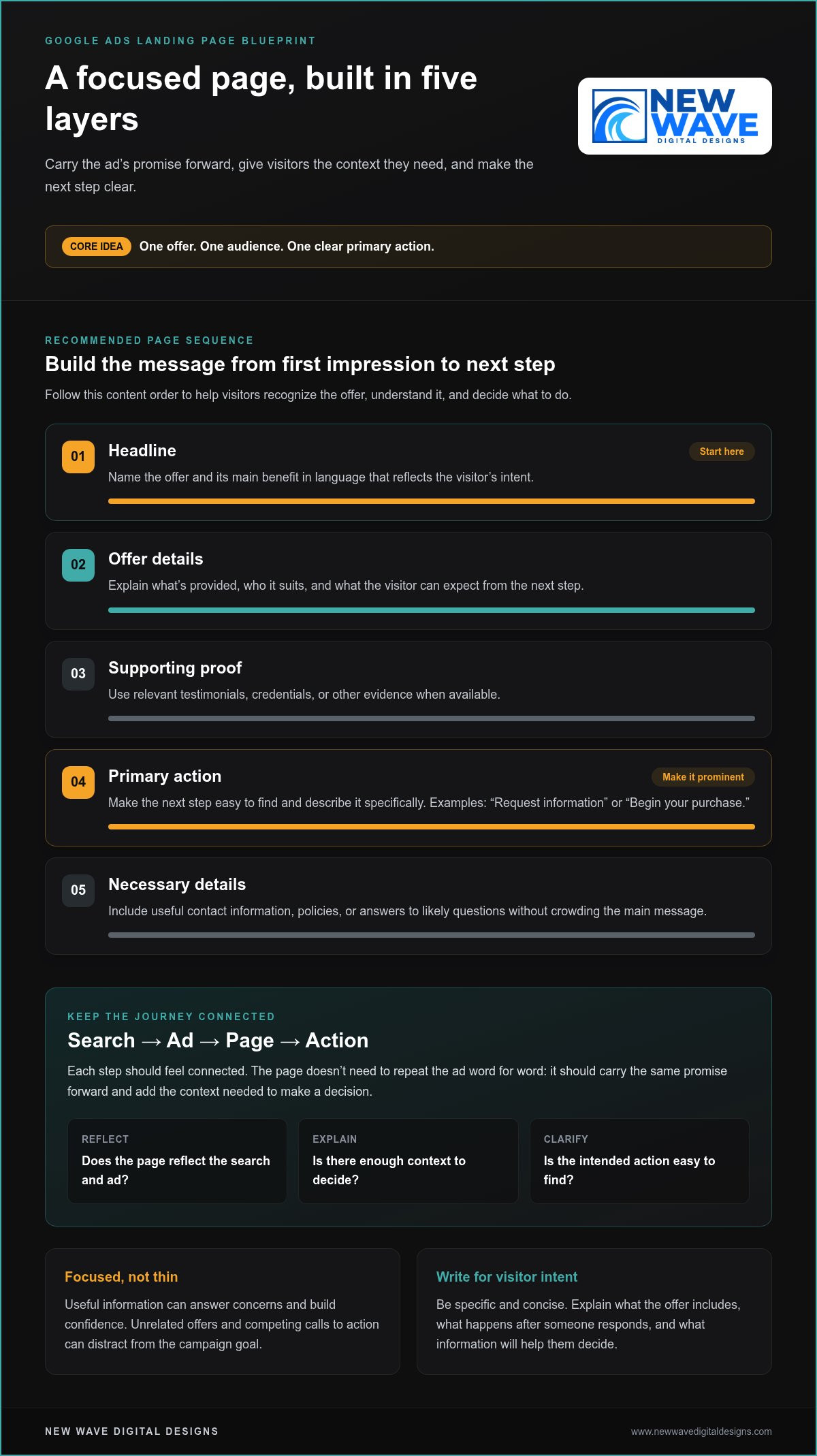
Once visitors arrive, the page structure should make their decision straightforward. Lead with a headline that names the offer and its value. Explain who it’s for and what to do next, then add concise supporting details and a prominent call to action. This order helps visitors move from recognizing the offer to understanding it and deciding whether to act.

Keep the page focused, not thin. Useful information can answer concerns and build confidence, while unrelated offers and competing calls to action can distract from the campaign goal. Use a simple content plan:

  • Headline: State the offer and its main benefit in language that reflects the visitor’s intent.
  • Offer details: Explain what’s provided, who it suits, and what the visitor can expect from the next step.
  • Supporting proof: Include relevant testimonials, credentials, or other evidence when available.
  • Primary action: Make the next step easy to find and describe it specifically.
  • Necessary details: Add useful contact information, policies, or answers to likely questions without crowding the main message.

Message match means maintaining continuity between a person’s search, the ad they choose, and the page they reach. The page doesn’t need to repeat the ad word for word. It should carry the same promise forward and add the context the visitor needs to make a decision. This is a practical foundation for how to create effective landing pages for Google Ads.

What should the headline and page copy communicate?

Write the headline for the visitor’s likely intent, not just the business’s internal description of its service. If the ad promotes Google Ads management, make that subject clear at the top of the page. Use the following copy to explain who the service is for and what the visitor can do next. Specific, concise language helps people quickly decide whether they’re in the right place.

Answer the questions that matter at this stage: What does the offer include? What happens after someone responds? What information will help them decide? Prioritize those answers over broad claims or mechanical repetition of the ad.

How should forms, calls to action, and trust elements work together?

Use a CTA that names the action, such as “Request information” or “Begin your purchase,” instead of a vague label. Make the primary action visually prominent and limit secondary links that could pull attention away. For forms, ask only for details needed for the next meaningful step. Every additional question should have a clear purpose.

Place trust details where they can help with a decision. A testimonial may support the offer, while a relevant policy or contact detail can address a concern near a form. Keep these elements clear and accurate. Thoughtful Google Ads and website design can help bring campaign intent and page structure into closer alignment.

Dedicated landing page or existing website page: which should you choose?

The best destination is the page that answers the searcher’s need with the least friction. A dedicated landing page gives a campaign more control over its message and layout. An existing product or service page may already provide the right detail and a clear path to action. Neither option is automatically better. Choose based on how closely the page fits the campaign and how much work it needs.

Consideration Dedicated landing page Existing website page
Message match Can be tailored closely to a specific ad, audience, or offer. Works well if its content already reflects the ad’s promise and search intent.
Setup effort Requires planning, writing, design, tracking, and ongoing upkeep. May be ready to use, though content or layout changes could be needed.
Page flexibility Offers more control over campaign-specific content and journey. Must fit within the existing site structure and page purpose.
Measurement Can make campaign actions easier to isolate, provided tracking is configured appropriately. Can be measured too, but shared content or multiple actions may require careful interpretation.

When does a dedicated campaign page make sense?

Consider a dedicated destination when the campaign has a distinct offer, targets a clearly defined audience, or needs a focused conversion journey. A time-sensitive promotion, for example, may need terms and a call to action that aren’t prominent on a general service page. A campaign for one service can also benefit from copy that directly addresses the visitor’s questions instead of asking them to navigate a broad menu.

That control comes with responsibility. Each additional page needs accurate content, thoughtful design, functioning measurement, and updates as the offer changes. An outdated campaign page can undermine the relevance it was created to provide.

When can an existing page be the better destination?

Use an existing page if it already answers the search query, supports the ad’s promise, and makes the intended action clear. Someone searching for a particular product may be better served by its detailed product page than by a new page that repeats the same information. A general homepage is less suitable if visitors have to sift through unrelated services to find that product.

Review the page from the visitor’s perspective. Does the main heading reflect the ad’s offer? Are competing calls to action or unrelated sections drawing attention away? Could a modest edit to the headline, opening copy, or placement of the primary action make the page more relevant? If so, refine what’s already there before building another destination.

Use this decision rule: choose a dedicated page when the campaign needs an experience the current site doesn’t provide; choose an existing page when it already fits the visitor’s intent and supports the next step. This balance is part of how to create effective landing pages for Google Ads without adding pages that have no clear purpose.

How to Create Effective Landing Pages for Google Ads

How to create and launch a Google Ads landing page step by step

A dependable launch starts before design work. Establish what the campaign promises, who it’s meant to reach, and what action the page should support. Then build and review the destination as a complete journey, from the first screen to the confirmation visitors see after submitting a form or completing a purchase.

Test the complete visitor journey before directing paid traffic. A page can look polished and still fail if its form, links, or measurement don’t work as intended.

  1. Research the campaign. Review its search themes, ad language, audience, offer, and intended action. Connect each landing page to a specific campaign theme rather than combining unrelated search intents on one destination.
  2. Write a page brief. Record the visitor’s likely need, the offer, supporting evidence, and the primary conversion action. Map the ad’s central promise to the page headline, key content, and call to action.
  3. Plan the visitor journey. Decide what a person needs to know before acting, such as what the offer involves or what happens after an enquiry. Arrange the content in a logical order and make the next step easy to find.
  4. Build the page. Create or refine the destination using the brief. Check that the layout adapts to mobile and desktop, text is readable, controls are easy to use, and links and forms work correctly.
  5. Review the experience. Check accessibility, loading issues, clear privacy information, accurate content, and distractions that could interrupt the intended journey. Confirm that the final destination URL matches the campaign plan.
  6. Verify measurement and launch. Test that the intended action, such as a form submission or purchase, is recorded accurately. Review the relevant Google Ads, Google Analytics 4, or Google Tag Manager configuration against current product documentation before relying on the data. Then direct campaign traffic to the tested page.

What belongs in the landing page brief?

Make the brief specific enough that a designer or writer can understand the campaign before building begins. Include the audience, search intent, offer, available supporting evidence, primary conversion action, and questions visitors may need answered. Note the ad’s central promise and how it should carry through to the headline, supporting content, and CTA. This gives you a clear reference for reviewing the finished page and helps keep copy and design aligned with campaign intent.

What should you check before sending Google Ads traffic?

Test common mobile and desktop screen sizes, including the full form process and what visitors see after submission or purchase. Check that buttons and links lead to the right places, text remains legible, the page loads reliably, and privacy disclosures are easy to find wherever personal information is collected. Confirm the final destination URL and verify that tracking records the action you want to measure, not just a button click that may not represent a completed conversion.

Building a strong destination takes coordinated campaign thinking, design, and measurement. New Wave Digital Designs provides website design and paid search services to help align those elements.

Measure, refine, and connect landing page design with Google Ads

A landing page’s results involve more than the number of conversions. A page may generate many enquiries but attract people who aren’t a good fit. Pair performance data with lead or purchase quality, then identify where the visitor journey works smoothly and where it creates friction. That fuller view helps distinguish useful improvements from changes that only make a dashboard look better.

Which landing page metrics can guide improvements?

Conversion rate is the share of measured visitors who complete a defined action. It’s useful for tracking a page over time, but interpret it alongside traffic sources and conversion quality. A form submission matters more when it represents a relevant prospect than when it’s an unqualified enquiry. For purchases, consider order quality as well as completed transactions.

Review multiple signals together. If visitors arrive but few begin a form, the offer, page content, or action may not be clear enough. If they start but don’t complete it, check for unnecessary questions or usability barriers. Engagement measures can show where visitors spend time or leave, but no single metric explains why. Combine the data with a careful page review and, where possible, feedback on lead or customer quality.

Use Google Ads and Google Analytics 4 reports only after checking that tracking records the intended actions accurately. Confirm that a conversion represents a completed enquiry or purchase, rather than an incidental click, and that reporting is configured consistently. Review current Google product documentation before drawing conclusions from the data.

How can design and campaign management work together?

Campaign intent sets the direction: which audience the ad reaches, what the offer promises, and what action the page should support. Website structure and visual design make that journey easier to understand, while measurement shows where it may need refinement. These elements inform one another. If visitors engage with the ad but don’t complete the intended action, review both traffic relevance and the page experience before deciding what to change.

Make each test deliberate. Write down the issue you’re investigating, the change you’ll make, and the result you expect. When practical, change one important element at a time, such as the headline or form layout. Then compare the outcome with your original hypothesis, including lead or purchase quality. If several elements change together, it’s harder to tell which adjustment mattered. Keep a record of what changed and what the evidence suggests, even when a test has no clear result.

Website design, graphic design, and Google Ads management can work together to align brand expression, campaign intent, page structure, and measurement. New Wave Digital Designs offers these services alongside organic SEO, helping businesses develop a coherent digital presence. This cycle of observing, refining, and learning is central to how to create effective landing pages for Google Ads without relying on guesswork.

Give your next campaign a clearer path forward

The next step doesn’t have to be a complete rebuild. Choose one campaign, review the experience from a visitor’s perspective, and identify the most useful improvement to explore. A thoughtful, measured approach to how to create effective landing pages for Google Ads can turn each insight into a stronger foundation for future decisions.

New Wave Digital Designs provides website design for Shopify, WordPress, and Squarespace, along with Google Ads and Bing Ads management, graphic design, hosting, and website maintenance. These services can support a coherent experience from campaign to page and ongoing site care, shaped around your business needs.

Work with New Wave Digital Designs on a landing page aligned with your campaign goals.

Frequently Asked Questions

Can I use my homepage as a Google Ads landing page?

Yes, your homepage can work if it directly addresses the ad’s subject and makes the intended action easy to find. It may suit branded searches from people looking for your business, but be less useful for an ad promoting one specific service if visitors have to search through a broad menu. Review the page on mobile, too. If the offer and next step aren’t immediately clear, a more focused destination may serve the campaign better.

How many landing pages should a Google Ads campaign have?

There’s no fixed number. Build or select pages around meaningful differences in search intent, audience, or offer, rather than creating a separate page for every keyword. Several search terms seeking the same service may fit one page, while a product promotion and a service enquiry may need distinct experiences. Keep the number of pages manageable so you can maintain accurate content, functioning tracking, and relevant information as campaigns change.

What is a good conversion rate for a Google Ads landing page?

There isn’t one conversion rate that’s good for every campaign. The right interpretation depends on the action being measured, the audience, the offer, and whether conversions lead to qualified enquiries or purchases. Compare similar traffic and actions over time, and examine quality alongside volume. A higher rate isn’t necessarily better if it comes from less relevant enquiries. Treat benchmarks as context, not as a target that overrides business value.

How long should I wait before changing a landing page?

Wait until you have enough relevant data to make a considered comparison, rather than reacting to a short-term fluctuation. The time needed depends on traffic volume, conversion frequency, and how consistent the campaign has been. Before making changes, check that tracking works and review whether visitors match the intended audience. If you find a clear technical problem, such as a broken form, fix it promptly instead of waiting for more data.

Do Google Ads landing pages need a privacy policy?

If a page collects personal information, explain clearly how that data will be used and make the relevant privacy notice easy to find near the form. This helps visitors understand what they’re sharing before they submit it. The exact disclosures that apply can depend on your business and the data collected, so avoid generic copy that doesn’t reflect your practices. Keep the notice current when your data collection or use changes.

Can I test two landing page versions with Google Ads?

Yes, you can compare page versions, but structure the test so the result is useful. Decide what you’re testing, such as a headline or form layout, and keep the audience, offer, and conversion definition consistent where practical. Confirm that both versions load correctly and that tracking records the same intended action. Review current Google Ads experiment options and setup guidance before launching, since available controls can change.

Search Marketing Services for Small Business: SEO and Paid Search in 2026

What if choosing between SEO and paid search is the wrong first decision? For a small business, search marketing services for small business work best when organic visibility, advertising, and the website experience are planned together. It’s understandable to weigh near-term campaign activity against longer-term growth when time and marketing resources are limited. But clicks and rankings alone don’t show whether a strategy is attracting the right prospects or supporting business goals.

This guide explains how organic SEO, Google Ads, and Bing Ads serve different needs, and how to prioritize them based on your goals, website readiness, and available resources. You’ll also learn what a search marketing engagement can include, from practical deliverables to reporting that connects search activity with meaningful outcomes. A campaign can bring someone to your site, but the website and measurement framework help determine what happens next. Together, these elements create a clearer path from visibility to informed decisions.

Key Takeaways

  • Search marketing services for small business can combine organic SEO with Google Ads or Bing Ads, depending on your goals, timing, and website readiness.
  • Use paid search to explore which queries and messages resonate while organic SEO develops visibility over time.
  • Compare proposed work by how it connects to customer intent and business outcomes, and by the clarity of its deliverables and reporting.
  • Prioritize in sequence: define outcomes, review your website, choose a channel focus, then measure what matters.
  • A responsive, brand-aligned website helps carry the visitor experience forward after a search result or ad earns the click.

What search marketing services for small business actually include

Search marketing brings together the work that helps a business appear when people search: organic visibility earned through SEO and paid placements purchased through advertising platforms. The Search marketing overview describes this broader discipline, which includes both routes. For a small business, the distinction matters because each channel has a different mechanism, pace, and role in reaching potential customers.

SEO develops organic visibility over time; paid search can place an ad in eligible results for selected queries, subject to an auction and platform factors. Neither a ranking nor a click is a business outcome by itself. They are signals to interpret alongside what happens next, such as a qualified inquiry, purchase, or other action that supports the business.

Organic SEO and paid search: two routes to search visibility

Organic SEO improves a site’s relevance, accessibility, and ability to appear in unpaid search results. Work can include making pages easier for search engines to understand, aligning useful content with customers’ questions, and addressing technical barriers to discovery. Results develop through sustained improvements, not through buying an ad placement for a particular search.

Paid search uses platforms such as Google Ads and Bing Ads to show ads for selected queries. Advertisers set campaign parameters, but placement depends on auction dynamics and other platform factors, so no position is assured. Ads can provide visibility while a business explores demand or promotes a timely service. SEO develops a foundation for relevant searches over time.

What small-business search marketing services can cover

Well-defined search marketing services for small business turn strategy into practical work across search discovery, campaigns, and the website. Priorities depend on business goals and site condition, but the work may include:

  • Organic SEO: keyword research to understand search intent, technical and on-page improvements, and search-focused content that answers useful customer questions.
  • Paid search: campaign planning, ad management, and performance reviews to assess which queries and messages are bringing relevant visits and actions.
  • Website support: design, maintenance, hosting, and security to help keep the destination after the click responsive, clear, and dependable.

These elements are connected. An ad may earn a visit, but a confusing page can interrupt the journey. Strong content can also be harder to find if technical issues affect important pages. A responsive, brand-aligned website on Shopify, WordPress, or Squarespace gives search visitors a more coherent next step. Ongoing maintenance and security help support that experience.

Before judging performance, define the action you want a visitor to take. Then read rankings, impressions, and clicks as indicators of visibility, not proof of growth on their own. Pair them with relevant actions and the website experience to assess search marketing as a connected system, rather than a collection of isolated tasks.

How SEO, Google Ads, and Bing Ads work together

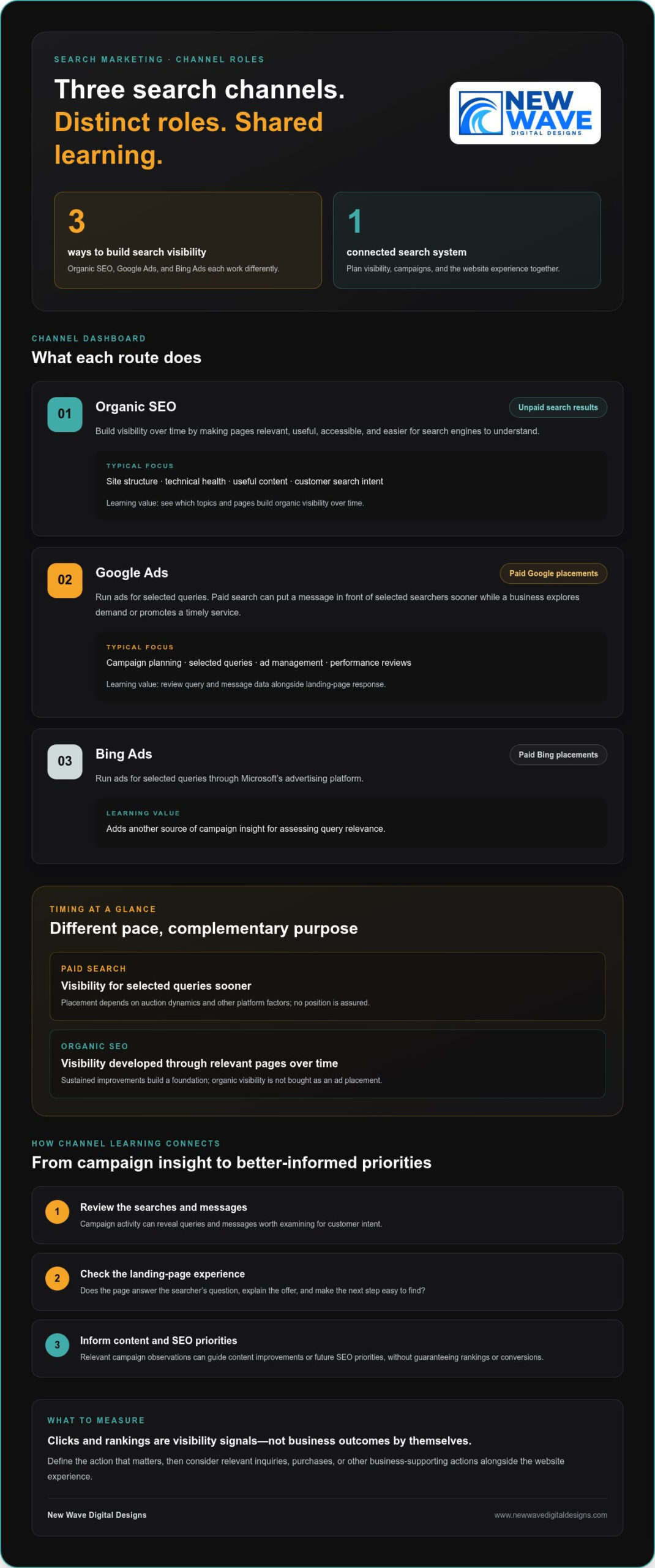
SEO and paid search can support the same business goal without doing the same job. Organic visibility develops as a site becomes more relevant and useful for important searches. Google Ads and Bing Ads can place ads for selected queries, subject to each platform’s auction and other factors. Together, they give a small business distinct ways to build visibility, observe customer intent, and refine its search presence.

Paid search can put a message in front of selected searchers sooner; organic SEO builds visibility through relevant pages over time. The channels can also inform each other: campaign activity can reveal queries and messages worth examining, while SEO develops useful pages around relevant topics.

Channel Placement Approach Learning value
Organic SEO Unpaid search results Improve site structure, page relevance, technical health, and useful content. Shows which topics and pages build organic visibility over time.
Google Ads Paid placements in Google search Set up ads for selected queries and manage campaign settings. Offers query and message data to review alongside landing-page response.
Bing Ads Paid placements in Bing search Run ads for selected queries through Microsoft’s advertising platform. Adds another source of campaign insight for assessing query relevance.

Share learning across channels thoughtfully. If a campaign attracts relevant searches for a particular service, review the landing page: does it answer the searcher’s question, explain the offer, and make the next step easy to find? That observation can inform content improvements or future SEO priorities, though it doesn’t guarantee a ranking or conversion. Effective SEM campaigns for small businesses also depend on aligning keyword choices with business objectives.

When organic SEO is the stronger priority

Organic SEO is a strong focus when a business wants to develop durable visibility around topics its customers search for. Start with a sound structure, clear and relevant pages, useful content, and technical health. These foundations help search engines interpret the site and give visitors a more coherent path through it. Organic SEO services can support a sustained visibility strategy.

When paid search can complement organic growth

Paid campaigns can complement SEO when a business wants to test selected queries or messaging while organic work develops. Review which searches bring relevant visitors, then compare the ad promise with the landing page’s content and response. Use those observations to guide testing and page refinement, not as automatic proof of what will succeed organically. Google Ads management for small business brings campaign planning and performance review into that process.

Search marketing services for small business are most useful when channel activity connects to a clear goal and a considered website experience. New Wave Digital Designs provides organic SEO and paid search support to help bring those priorities into the same conversation.

How to compare search marketing services for your small business

A useful proposal should make the connection between the work and your business goals easy to see. Start with the action you want a search visitor to take, such as requesting an estimate, booking an appointment, or completing a purchase. Then consider whether the proposed SEO or paid campaign targets the right customer intent and whether your website gives visitors a clear path to that action.

This makes comparison practical. A plan focused on paid visibility may suit a time-sensitive need, while organic SEO can support longer-term visibility around relevant topics. If key pages are hard to navigate or don’t explain your offer clearly, the website may need attention alongside search activity. A channel plan should account for that reality rather than treating clicks as the finish line.

Match services to goals, audience, and website readiness

Before comparing deliverables, describe the customer journey you want to support. What might a prospective customer search? What information would help them decide? What should they do next? Compare the proposed work against those questions. For example, a campaign aimed at people ready to request a service should lead to a page that clearly describes the service and makes the inquiry step visible.

Consider timing, too. If the business needs to promote a specific offer now, paid search may be part of the plan. If it’s building visibility for recurring customer questions, organic work may deserve greater emphasis. The right mix depends on goals, audience, and site readiness, not on the number of channels included.

Evaluate deliverables and reporting with useful questions

Look for clear descriptions of what will be done and how the work will be reviewed. Search marketing services for small business should translate technical activity into understandable tasks, priorities, and measures. Use questions like these to assess whether a proposal offers a coherent strategy:

  • Research: How will keyword and query research connect to customer intent and business priorities?
  • Execution: Which pages or technical areas will SEO work address, and what campaign planning or management is included for paid search?
  • Measurement: Which indicators will be reported, and how will relevant website actions be tracked where measurable?
  • Coordination: How might campaign observations shape future content, landing-page improvements, or channel priorities?

Reporting should distinguish leading indicators from outcomes. Impressions, rankings, clicks, and visits can show whether visibility is changing or people are reaching the site. They don’t, by themselves, show whether the business is attracting qualified inquiries or making sales. A useful report interprets those signals alongside relevant website actions, explains measurement limits, and identifies practical next steps.

It’s reasonable to want evidence of progress. A credible plan won’t promise specific rankings, traffic, leads, or revenue, because search results and customer decisions depend on factors beyond any one campaign. Instead, it should explain what will be measured, how findings will inform adjustments, and how progress relates to the outcomes the business cares about. That clarity gives the work a shared basis for decisions.

Search Marketing Services for Small Business: SEO and Paid Search in 2026

How to prioritize search marketing services on limited resources

A small business doesn’t need to pursue every search opportunity at once. Choose the first move that supports an important customer journey and fits the website’s readiness, competitive environment, and available resources. This sequence turns search marketing services for small business into a focused plan rather than a list of disconnected tasks.

  1. Define outcomes. Choose the customer action that matters most, such as a qualified inquiry, appointment request, or online purchase. Identify the products or services to prioritize.
  2. Review the site. Check whether relevant pages explain the offer, work well on mobile, and make the next step clear. Review site structure and conversion paths before expanding campaigns.
  3. Choose channel priorities. Match the opportunity to organic SEO, Google Ads, Bing Ads, or a focused combination. Account for customer intent, timing, competition, and available capacity.
  4. Measure and refine. Track indicators linked to the goal, review performance over a suitable period, and adjust priorities as search, campaign, or website data accumulates.

Build a practical first-phase search plan

Keep the first phase narrow enough to manage. Select a priority service or product, identify searches that suggest interest, then assess the page a visitor would reach. If the page needs clearer information or an easier mobile experience, address that gap before increasing campaign activity. If the page is ready but organic visibility is still developing, a focused paid campaign may complement ongoing SEO. Let the evidence guide the mix, rather than trying to be everywhere.

A simple scorecard can make the reasoning visible:

  • Activity: Improve a priority service page. Purpose: Help searchers understand the offer. Indicator: Relevant engagement or inquiry actions. Review point: After the page change has had time to be observed.
  • Activity: Run a focused paid campaign. Purpose: Reach selected searchers and assess query relevance. Indicator: Relevant clicks and qualified actions. Review point: During scheduled campaign reviews.
  • Activity: Develop organic content. Purpose: Address useful customer questions. Indicator: Relevant impressions, clicks, and page engagement. Review point: As visibility and content performance develop.

Measure progress without mistaking activity for impact

Impressions can indicate exposure; clicks show that a searcher chose to visit; landing-page engagement offers clues about what happened after the visit. Qualified inquiries or sales are closer to business outcomes. Read these measures together, and make sure reporting distinguishes what is observable from what can’t be attributed confidently.

Interpret results in context. A campaign change, revised page, or shift in targeted queries can affect what the numbers mean. Compare periods that make sense for the activity, note what changed, and use the findings to decide what to maintain, refine, or pause. A sound plan explains how progress will be assessed without promising a fixed ranking or return.

New Wave Digital Designs’ search marketing support connects channel priorities with your website and measurement needs.

How New Wave Digital Designs brings search marketing together

Search visibility is strongest when the campaign, website, and business goal work in concert. New Wave Digital Designs provides organic SEO and Google Ads or Bing Ads management, helping shape channel priorities around what the business wants search visitors to do. Each service has a distinct role, but both can support a considered path from discovery to the next step.

A coordinated approach to organic and paid search

Organic SEO develops a site’s relevance and visibility across valuable search topics. Paid campaign management supports selected queries through advertising on Google or Bing. Planning them together brings keyword opportunities, campaign observations, and business priorities into the same discussion, rather than treating each channel as an isolated task.

For example, paid campaign activity may show that a particular search phrase is attracting relevant visitors, or that a landing page needs to explain an offer more clearly. Those observations can inform future content or campaign priorities. They are useful signals, not guarantees: search positions, lead volume, and campaign returns can’t be promised. Measurement helps clarify what is happening and where adjustments may be worthwhile.

This approach keeps the focus on meaningful progress. Search marketing services for small business should reflect the customer journey, the website’s current readiness, and the resources available to sustain the work. New Wave Digital Designs provides organic SEO alongside Google Ads and Bing Ads management, so channel decisions can be considered in relation to the same business objectives.

Connect search visibility to the website experience

A search result earns attention; the destination page carries the experience forward. The page should match the visitor’s query or the promise of an ad, explain the relevant product or service, and make the next action clear. For instance, someone searching for a specific service needs a focused page with useful details, not just a general homepage.

New Wave Digital Designs creates responsive, brand-aligned websites on Shopify, WordPress, and Squarespace. Responsive design helps a site adapt across screen sizes, while clear page structure supports a consistent experience from search result to landing page. If a website refresh would strengthen that post-click journey, explore professional web design.

The work can continue beyond launch. Website maintenance, hosting, and security complement ongoing digital marketing by supporting the website that organic visitors and paid campaigns lead to. That creates a more connected foundation: visibility, a prepared destination, and continued attention to the digital experience.

A search marketing approach can bring together your business goals, website, and channel priorities, with organic SEO, paid search, and website experience considered as parts of the same plan.

Make your next search move a deliberate one

Your next step doesn’t have to be a sweeping marketing overhaul. Choose one business priority, identify the search opportunity around it, and shape a focused plan that can be reviewed and refined as you learn. The most useful search marketing services for small business give each activity a purpose and connect it to a website experience built to welcome the right visitor.

New Wave Digital Designs brings organic SEO and Google Ads or Bing Ads management together with website design, maintenance, managed hosting, and security. This combination keeps search visibility and the digital experience in view as your business evolves. The goal is a thoughtful direction, not a promise of a particular ranking or return.

Ready to explore a search approach shaped around your goals? Discuss your search marketing goals with New Wave Digital Designs and define a clear first priority for your business.

Frequently Asked Questions

What are search marketing services for a small business?

Search marketing services for small business help a company become easier to find when potential customers search online. For example, a home repair company might improve service pages for unpaid results while advertising for a specific repair query. The work can also include making sure search visitors land on a useful page with clear details and a next step. The right scope depends on business priorities, audience, website, and resources.

Are SEO and search engine marketing the same thing?

Not always. SEO generally means improving a website’s unpaid search visibility, while search engine marketing may describe the broader combination of organic and paid search. Some providers use “SEM” to mean paid advertising alone. Since terminology varies, compare the actual work behind the label: for example, whether it includes page optimization, ad management, or both, and how progress is reported.

How long does SEO take to show results for a small business?

There’s no universal timetable for SEO results. The pace depends on factors such as the site’s starting condition, the competitiveness of its topics, and the work being completed. Rather than waiting for one target ranking, review milestones along the way: whether technical issues were addressed, priority pages became more relevant, and qualified actions are being recorded. These checkpoints help guide adjustments without treating any date or position as guaranteed.

Can a small business use Google Ads and SEO at the same time?

Yes. A business can advertise for selected searches with Google Ads while developing its unpaid search presence through SEO. For instance, an ad campaign for a particular service can help assess whether a query attracts relevant visitors, while SEO work builds useful information around related customer questions. Review each channel by its own purpose, and don’t assume ad activity automatically changes organic rankings or performance.

How much do search marketing services cost for a small business?

There isn’t one universal cost for search marketing services. Scope can vary with the channels involved, the condition of the website, campaign complexity, and the amount of ongoing work. When reviewing proposals, compare the research, optimization, campaign management, and reporting included, along with each party’s responsibilities. A clear description of scope makes it easier to understand what a quoted fee covers without relying on a headline figure alone.

What should a small business track in a search marketing campaign?

Track measures that help explain whether search activity is supporting a business goal. For an online shop, that might mean reviewing relevant landing-page visits alongside completed purchases; for a service business, it could mean qualified inquiry forms rather than every form submission. Impressions and clicks provide context, but they don’t establish lead quality. Define what counts as a valuable action, then review that measure consistently alongside campaign activity.

Do small businesses need a new website before investing in search marketing?

No, a new website isn’t automatically necessary. A focused update may be enough if the existing site has a sound structure but needs a clearer service page, more prominent contact details, or simpler mobile navigation. Broader design work may make sense if important information is difficult to find across the site. Identify the specific obstacle first, then decide whether targeted improvements or a larger redesign better supports visitors.

Lead Generation Website Design: Build a Site That Turns Visits Into Inquiries

What if your website’s biggest lead-generation problem isn’t how it looks, but what it asks visitors to do next? A polished design can make a strong first impression, yet still leave people unsure what you offer, who it’s for, or how to take the next step. Effective lead generation website design looks beyond visual polish to map a clear path from a visitor’s first question to a useful action.

If visits aren’t turning into inquiries, it can be hard to tell whether the issue is your website, your traffic, or a disconnect between the two. Start by matching each page to your offer, audience, and the marketing channel that brought someone there. This article provides a practical way to assess that experience, make the next action easier to find, and build trust along the way. You’ll learn how clear messaging, intuitive paths, and alignment with SEO or paid search can help your site serve your business and the people you want to reach.

Key Takeaways

  • Build your site around the actions relevant visitors need to take, not visual appeal alone.
  • Map a clear journey from visitor need to useful information, supporting proof, and an easy-to-find contact option.
  • Assess traffic separately from qualified inquiries to understand whether the challenge is reach, relevance, or the visitor experience.
  • Use a practical planning sequence: define your audience, clarify your offer, map pages, shape actions, and measure results.
  • Thoughtful lead generation website design can align your brand, audience, and marketing channels across custom Shopify, WordPress, and Squarespace websites.

What Makes Lead Generation Website Design Different From a Standard Business Website?

A website can look polished and still leave visitors uncertain about what the business offers or where to go next. Lead generation website design treats each page as part of a purposeful journey, connecting what a visitor is looking for with relevant information and a clear way to get in touch.

Lead generation website design is the planning of a website’s audience-focused content, page structure, and conversion actions to help relevant visitors move from interest to inquiry. The goal isn’t to make every visitor submit a form. It’s to give people who may be a good fit enough clarity and confidence to take an appropriate next step. For a foundation on the marketing process behind this approach, see What is Lead Generation?

This work goes beyond choosing colours, images, or an appealing layout. Visual design expresses a brand, but it needs to work alongside understandable messaging, intuitive navigation, relevant proof, and a purposeful action. A beautiful homepage won’t do enough if the offer is vague, visitors can’t find service details, or the contact option is hard to spot. Design can support inquiries, but it can’t guarantee how many arrive or whether each one is a qualified prospect.

Which businesses benefit from a lead-focused website?

A lead-focused structure can suit service businesses and other companies whose sales process begins with a conversation, estimate request, consultation, or project inquiry. The website helps visitors understand the offer, decide whether it fits their needs, and make contact with useful context.

That journey differs from a direct ecommerce checkout, where a visitor may be able to select a product and purchase online. Neither model suits every business. A custom service may need pages that explain process and scope before a prospect reaches out; a product retailer may prioritize product details and a straightforward checkout. In either case, shape the page around what the audience needs to know, the decision they’re making, and the action that fits the offer.

What should a visitor understand within moments?

A new visitor should quickly grasp three things: who the business serves, what it offers, and what to do next. A clear headline gives the page an immediate focus. Compare a broad claim such as “Quality you can trust” with “Custom websites for growing service businesses.” The second tells visitors more about the offer and its intended audience.

Make the next action specific to the page and the visitor’s readiness. Someone comparing options may want to explore a service; someone ready to discuss a project may look for a contact form. Keep the primary action easy to recognize, and use supporting copy to explain what happens when it’s selected.

Consistent typography, colour, imagery, and tone create a cohesive experience and reinforce brand recognition. Keep visual elements focused on the offer rather than competing with it. A well-composed page combines brand expression with practical guidance, helping visitors understand what makes the business distinctive and how to continue.

How Conversion Architecture Guides Visitors From First Impression to Inquiry

Conversion architecture is the deliberate arrangement of pages, information, and actions that helps visitors move from an initial question toward a useful next step. It makes the website a connected journey rather than a collection of unrelated pages. For example, someone searching for a particular service should land on a page that addresses that need, find information supporting the business’s claims, and see a clear way to start a conversation.

Make the route easy to follow. Visitors shouldn’t have to guess which menu item leads to relevant details or scan several pages to find contact information. Give each page a primary purpose, then use headings, concise copy, and visible links to guide attention. A clear hierarchy helps people distinguish essential information from supporting detail and find what they need without unnecessary detours.

  1. Match the entry point to the need. Connect search results, ads, or other marketing messages to a page that continues the promise visitors clicked on.
  2. Answer the next question. Explain the service, product, or process in enough detail for someone to assess fit.
  3. Provide relevant proof. Support important claims with evidence related to the offer.
  4. Make the next action visible. Guide interested visitors toward an appropriate inquiry or contact option.

How should landing pages, service pages, and contact pages work together?

Give each page a distinct job. A landing page can carry a focused campaign message and direct visitors to one relevant action. A service page can explain the offer, process, and intended audience, with an inquiry link near useful details. A contact page should make it straightforward to begin by explaining what information to share and what the form is for. Consistent navigation connects the pages, while clear labels let visitors choose their own path.

Which trust signals help visitors feel ready to reach out?

Trust grows when proof is specific and relevant. Accurate testimonials, credentials, project examples, or a transparent process description can help visitors assess a claim. Place each signal near the statement or action it supports. A testimonial about a particular service, for example, is most useful beside information about that service, not buried on an unrelated page. Use evidence the business can substantiate; inflated claims and unrelated praise can weaken confidence.

Keep inquiry forms proportionate to the first conversation. Ask for the details needed to understand and respond to an initial request, such as contact information and a short description of the visitor’s needs. Avoid asking for extensive background before someone has had a chance to speak with you. Clear field labels and a brief explanation of what happens after submission can make the process easier to understand.

Thoughtful lead generation website design connects each stage, from a relevant first impression to a confident inquiry. If your pages feel disconnected, learn about New Wave Digital Designs’ approach to website design, which brings brand expression and practical visitor journeys together.

How to Tell Whether Your Website Design Is Attracting the Right Leads

More visits tell you that people are arriving. They don’t show whether those people are a good fit, whether the page answers their questions, or whether the website helps them take a useful next step. To assess lead generation website design, look at the path from visit to inquiry, then assess whether the inquiries are relevant to the business.

Start by defining a qualified lead in terms your team can apply consistently. For example, distinguish a request that matches your services and intended audience from an unrelated query. Then track key actions, such as form submissions and calls, alongside their source and what happens after the inquiry. A high number of inquiries alone doesn’t establish lead quality or business impact.

Observed symptom
Possible friction point
Data to inspect
Visitors arrive but rarely explore the page.
The page may not match their intent, or its key message may be difficult to find.
Traffic source, landing-page engagement, and the search term or campaign message where available.
Visitors view an inquiry form but don’t complete it.
The form may be unclear, ask for unnecessary details, or be difficult to use.
Form starts and completions, field-level issues where tracked, and device or page context.
Inquiries arrive, but few fit the offer.
Targeting, page messaging, or expectations may be attracting a mismatched audience.
Inquiry source, submitted details, service requested, and the team’s lead-quality classification.

Which website metrics help diagnose conversion friction?

Review landing-page engagement to see whether visitors interact with a page, form completion to spot potential breaks in the inquiry path, and inquiry sources to learn which channels bring visitors who take action. Consider these measures together: a short visit could mean a page didn’t answer the visitor’s need, or that it provided the answer quickly. Tracking setup, event definitions, and consistent reporting all affect what the numbers mean. Avoid treating a universal conversion benchmark as a verdict on your site.

How can you distinguish a design issue from a traffic issue?

Compare visitor intent with the page they land on before changing visual elements. Check whether an ad or search result promises a particular service, then confirm that the destination page clearly addresses it. If the message aligns but visitors struggle to find information or complete an inquiry, the page structure or usability may need attention. If the audience or landing-page promise is mismatched, traffic quality may be part of the problem. Performance data is a diagnostic signal, not proof of a single cause.

Review patterns over a consistent period and apply the same lead-quality definition across channels. Pair analytics with the inquiries the business actually receives. Together, they give a more grounded view of whether the website attracts relevant prospects and where their journey may be losing clarity.

Lead Generation Website Design: Build a Site That Turns Visits Into Inquiries

A Practical Blueprint for Planning Lead Generation Website Design

A considered plan gives every page a role. Before choosing layouts or refining visual details, establish who the site is for, what they need to understand, and how each page can help them move forward. This makes design decisions easier to evaluate and connects visitor needs with the business offer and marketing journey.

  1. Define the audience. Describe the people or organizations you want to reach, what they need, and how they decide whether an offer is right for them.
  2. Clarify the offer. State what you provide, who it serves, and why it’s relevant. Make the promise specific enough to guide page content and visitor expectations.
  3. Map the pages. Assign each page a purpose, from answering an early research question to explaining a service or inviting an inquiry.
  4. Shape the actions. Choose a primary action for each page, such as exploring a service or starting a conversation. Keep supporting information available without letting it obscure the main path.
  5. Measure and refine. Review how visitors use key pages and whether inquiries fit the intended audience. Use what you learn to make considered improvements over time.

How do you turn audience insight into a page plan?

Write down the audience’s main problems, likely objections, and questions at each decision stage. Assign each question to the page or section best equipped to answer it. Someone comparing services may need process details, while someone ready to act may need a direct route to an inquiry form. Give each page one primary action while retaining the context visitors need to make an informed choice.

Design for varied screens and abilities. Responsive layouts should keep text legible, navigation understandable, and important actions usable across devices. Accessible choices, including clear labels and sufficient contrast, help more people use essential content. Test pages at different screen sizes and check that key information and actions remain easy to find.

How should forms and calls to action reduce unnecessary friction?

Use action labels that make the next step clear, such as “Request a project discussion” rather than a vague “Submit.” Ask only for information needed to begin a useful conversation, and label every field plainly. Explain how submitted details will be used and what follow-up visitors can expect, keeping those statements accurate to the business’s process.

Connect the page plan to the way people arrive. Organic SEO content should address the intent behind a search and lead to a relevant next step. Paid-search landing pages should continue the message and offer that prompted the click. Aligning those elements creates a more coherent experience, but it doesn’t guarantee rankings, inquiries, or sales.

For a website shaped around your offer, audience, and visitor journey, explore lead-focused website design with New Wave Digital Designs.

How New Wave Digital Designs Brings Lead-Focused Websites to Life

A lead-focused website brings together the character of your brand, the substance of your offer, and the needs of your audience. New Wave Digital Designs creates custom websites for Shopify, WordPress, and Squarespace, with design and development tailored to each business. Those choices shape the site’s content, structure, and visual direction, helping visitors understand the offer and find a relevant next step.

What can a tailored website design project bring together?

A custom website can unite brand-aligned design, responsive development, and purposeful page structure in one coherent experience. The right platform depends on what the business needs its website to do and how its content will be organized. New Wave Digital Designs builds custom websites for Shopify, WordPress, and Squarespace, tailoring the design to the platform and project instead of treating every site as interchangeable.

Planning also considers how visitors will arrive. Organic SEO can inform how pages address relevant search topics, while Google Ads and Bing Ads can bring visitors to pages shaped around specific campaign intent. When the message and landing page work together, the experience feels consistent from click to content. These services can support a considered digital strategy, but no design or marketing approach can promise a particular volume of leads or search rankings.

Site care matters after launch, too. Maintenance helps keep a website updated and functional as content and business needs evolve, while managed hosting and security services support the site’s ongoing operation. A website maintenance plan makes site care part of the project rather than an afterthought.

What happens after a lead-focused website launches?

Launch is a beginning, not a finish line. Reviewing relevant site activity and inquiry patterns can help identify pages that need clearer content or pathways that could be easier to follow. Refinements should respond to what the business learns over time, with care taken to distinguish useful patterns from isolated results. The aim is a site that continues to reflect the offer and serve its audience as both develop.

Ongoing maintenance, managed hosting, and security services help support website functionality over time. New Wave Digital Designs brings website design together with organic SEO and paid search management, creating a connected foundation for your online presence without treating any single service as a guarantee of business outcomes.

If you’re ready to shape a website around your brand, offer, and audience, start a conversation about your website project with New Wave Digital Designs.

Give Your Website a Clearer Path Forward

Your website doesn’t need a complete rebuild to become more purposeful. Start by identifying one moment where a potential customer could lose confidence or struggle to decide what to do next. That observation can be the first step toward a more considered digital experience, one that grows alongside your business and stays grounded in what your audience needs.

Strong lead generation website design is an ongoing practice, not a promise of instant results. As your offer evolves and you learn from visitor behaviour, your pages can evolve too. A thoughtful design partner can help turn those insights into a website that reflects your brand and gives visitors a clearer way to engage.

Start a conversation about your website project with New Wave Digital Designs to discuss a website built around your brand, offer, and audience.

Frequently Asked Questions

What is lead generation website design?

Lead generation website design shapes a website to help potential customers find relevant information and express interest in an offer. For example, a consulting firm might create a page for a particular service, answer common questions there, and provide a clear inquiry route. Useful content and purposeful interactions support that journey. Design can make reaching out easier, but it can’t ensure every visitor will become a suitable lead.

How does website design help generate qualified leads?

Website design helps by setting accurate expectations and making it easier for visitors to find information that fits their needs. A page for a specific service can explain who it’s intended for, what problem it addresses, and what details to include in an inquiry. That clarity may discourage mismatched requests while helping suitable prospects feel more confident about contacting the business. Lead quality also depends on factors beyond design, including the offer, audience, and traffic source.

What pages should a lead generation website include?

Start with pages that explain the business, its main offers, and how to get in touch. Depending on the sales process, useful additions may include individual service pages, a portfolio or project examples, customer testimonials, and answers to common questions. A business with several distinct audiences may need separate pages for each group’s needs. Prioritize pages that answer real customer questions rather than adding sections simply to make the site larger.

How many fields should a lead generation form have?

There’s no universal ideal number. Include only the fields needed to understand and respond to an initial inquiry. A basic form might request a name, contact method, and brief description of the need; a project with several important requirements may call for one or two focused questions. Remove fields that don’t inform the first conversation. Check that each question serves a clear purpose, and mark optional details as optional.

Can a website generate leads without paid advertising?

Yes. A website can attract visitors through organic search, direct visits, referrals, and other unpaid sources. Helpful pages that address relevant questions can support organic visibility, while a clear inquiry route gives interested visitors a way to respond. Results depend on factors such as audience demand, competition, and the usefulness of the site’s content. Paid advertising is one way to bring visitors, not a requirement for a website to support inquiries.

How do I measure whether my website is generating leads?

Track meaningful actions, such as completed inquiry forms and calls, and record where inquiries originated when your analytics setup allows it. Then review whether each inquiry fits your services and intended audience. For example, separate requests for a service you provide from unrelated messages. Define “qualified lead” consistently with the people who assess inquiries, and ensure tracking records completed actions rather than form views or button clicks alone.

How often should a lead generation website be updated?

Update a page whenever its offer, process, contact details, or supporting information changes, and review key pages on a regular schedule that suits the business. Check that forms still work, links lead to the right destinations, and service descriptions reflect what you currently provide. Website maintenance helps keep a site functional over time. Performance reviews can also reveal when content needs refinement, even if the underlying offer remains the same.

Local SEO Services: A Practical Framework for Sustainable Visibility

If you’re searching for local seo services, you likely want to understand what this work involves, which deliverables matter, and how to assess progress without relying on promises of instant rankings. A useful starting point is to look at how your business information, website, and measurement work together.

Local SEO is an ongoing process, not a quick fix. A clear strategy connects the information people see in search with a website that explains your services and helps visitors decide what to do next. Organic SEO can also work alongside thoughtful website design, maintenance, and paid search to create a more coordinated digital presence.

This practical framework from New Wave Digital Designs covers the core elements of local discoverability, signals that can reveal meaningful progress, and why visibility is about more than website visits. You’ll also learn how to connect organic SEO with broader business goals and choose practical next steps.

Key Takeaways for a Search Like “local seo services branchburg nj”

  • Local SEO supports discovery by connecting accurate business information, relevant website content, and a sound digital foundation.
  • Assess an SEO strategy by its clear priorities, useful reporting, and collaboration, not ranking guarantees.
  • Use a flexible framework to review your current digital presence, prioritize work, measure results, and refine the approach.
  • Match organic SEO with your business goals and internal capacity. Website design, maintenance, or paid search may complement the work.

What Local SEO Services Do for a Business Seeking Nearby Customers

Local SEO helps a business become easier to discover when people search for relevant products or services in a particular area. Unlike broader organic SEO, which can support visibility for searches from anywhere, local SEO focuses on searches with geographic intent. A query such as “local seo services branchburg nj” shows how a searcher may pair a service with a location to find relevant options.

Local SEO improves how a business is represented and discovered in search results for relevant, location-focused queries. It brings together signals from a business’s online presence and website, while supporting a useful experience for people deciding where to turn. For a neutral introduction to the discipline, see Local search engine optimization.

How local search visibility differs from general SEO

Local search can reflect three broad considerations: proximity to the searcher, relevance to the query, and prominence, or how established and well-known a business appears online. These concepts help explain why results can vary by search and location. Google Search and Google Business Profile are part of this ecosystem, alongside a business’s own website.

Compare “how does roof insulation work?” with “roof insulation company near me.” The first is largely informational; the second suggests someone is looking for a relevant business nearby. A query like “local seo services branchburg nj” also expresses local intent. A sound approach considers what the searcher wants instead of treating every query as a broad keyword to target.

Which businesses may benefit from local SEO

Service-area businesses, professional firms, and organizations that serve customers face to face may all have reason to consider local visibility. Someone might search for an accountant or a repair service nearby. In either case, accurate, helpful information makes it easier to assess whether a business fits the need.

Local SEO isn’t automatically the same priority for every organization. Consider how customers search, where the business serves them, and what the business wants its digital presence to accomplish. A business serving a broad market may emphasize general organic SEO, while one seeking nearby customers may benefit from a strategy shaped around local intent. The right balance depends on its goals and starting point.

Visibility isn’t determined by one profile or page alone. Relevance, local competition, website quality, and consistent attention can all influence discoverability over time. Treat organic SEO as an ongoing part of a considered digital presence, not a promise of a particular search position.

What Local SEO Services Include: Profiles, Pages, and Technical Foundations

A local SEO strategy is a set of priorities shaped around the business, not a one-size-fits-all checklist. It considers how clearly a business is represented online, whether its website answers customer questions, and whether the site is accessible to search engines and visitors. The right emphasis depends on business goals and the digital foundation already in place. Mailchimp’s overview, Why Local SEO Matters, offers additional context on local discoverability.

Organic SEO focuses on earning visibility in unpaid search results. Paid placements, such as Google Ads or Bing Ads, are advertising. Directory profiles are separate online references to a business. These channels can complement one another, but they serve different roles. A clear plan distinguishes them so responsibilities and progress are easier to understand.

Business profiles and consistent business information

Google Business Profile and Bing Places for Business are among the profiles people may encounter while searching. Accurate, complete information helps customers understand what a business does and how to reach it. Consistency across relevant profiles and directories can also reduce confusion when details such as the business name, address, phone number, or hours appear in multiple places. Prioritize the profiles that make sense for the business and its goals.

Website content, technical SEO, and local relevance

A website gives searchers more context than a brief profile can provide. Useful service pages explain what a business does, who it serves, and what a potential customer can expect. Clear navigation helps visitors find those details. Mobile usability and a crawlable structure help people and search engines access the site. Where appropriate, structured data such as schema.org LocalBusiness can also be assessed as part of the technical picture.

Build local relevance with meaningful information, not repeated place names. Explain the services offered and the areas served in natural language, and answer real customer questions. Repeating location phrases without adding useful detail can make content harder to read.

A coordinated review may consider:

  • Business profile accuracy and consistency across relevant references
  • Service pages that address customer needs and business goals
  • Navigation, mobile usability, crawlability, and relevant technical foundations
  • Measurement that connects search visibility with meaningful customer actions

These are areas to assess, not a checklist that every business needs to follow in the same way. Organic SEO can work alongside website design, ongoing maintenance, and paid search when they support shared business objectives. To explore how those capabilities can fit together, visit organic SEO and digital design.

How to Evaluate Local SEO Services Without Ranking Guarantees

A credible SEO conversation should make the work understandable. Look for a strategy that connects business goals with clear priorities, useful reporting, and ongoing collaboration rather than a promised position in search.

Measurable progress means seeing useful changes in visibility and customer behavior, not receiving a guarantee of a specific search position. Rankings can fluctuate as search results and competitors change, so a particular spot cannot be responsibly promised. Evaluate several indicators over time and ask whether they relate to the outcomes that matter to your business.

Evaluation area What to look for
Strategic clarity Priorities explained in relation to your goals, audience, website condition, and competitive environment.
Deliverables A clear description of the planned work, why it matters, and how it supports the strategy.
Reporting Reporting that distinguishes search visibility and site activity from inquiries, conversions, and other business measures.
Collaboration Open communication, clear explanations, and room to adjust priorities as your needs evolve.

Questions that reveal whether a strategy is tailored

Ask how proposed priorities connect to your goals and customers. What does your current website make easy or difficult? Which services or audiences matter most? How might competition affect the plan? Clear answers should explain the reasoning behind the strategy, rather than rely on jargon or apply an identical checklist to every business.

New Wave Digital Designs provides organic SEO as a collaborative effort tied to business goals and a well-crafted digital presence. The focus is on what the work is intended to support, not on presenting rankings as a guaranteed outcome.

Reports that connect search activity to business goals

Different metrics answer different questions. Impressions indicate how often a page appears in search results; clicks show visits from those results. Engagement measures what visitors do on the site, while conversions track meaningful actions defined for the business, such as submitting an inquiry. Google Search Console can help assess search visibility and clicks, while Google Analytics 4 can help examine site activity and conversions.

Interpret these signals in context. A rise in impressions may indicate broader visibility, but it doesn’t by itself show that more qualified customers are getting in touch. Look for trends across reporting periods, relate them to the work completed, and compare them with business measures. A single ranking snapshot offers a narrow view; a consistent, well-explained report can reveal a more useful picture of progress.

Local SEO Services: A Practical Framework for Sustainable Visibility

How a Local SEO Strategy Develops From Audit to Ongoing Improvement

A useful organic SEO strategy develops in stages. First, understand the business and its current digital presence. Then decide which changes deserve attention, put them into practice, and review the resulting signals. This creates a shared framework for thoughtful decisions instead of a collection of disconnected tasks.

From discovery and audit to a prioritized plan

Start with context: business goals, audience needs, website structure, and current search visibility. An audit can reveal technical or content issues that make it harder for people to find useful information or for search engines to understand the site. Turn findings into a clear, practical order of work.

  • 1. Discovery: Clarify business objectives, audiences, services, and the role organic search should play.
  • 2. Audit: Review the existing site structure, content, technical foundations, and available visibility information.
  • 3. Prioritization: Weigh potential actions by relevance to customer needs, effort, and contribution to business goals.
  • 4. Implementation: Make agreed-upon improvements, which may include refining website content or addressing site issues.
  • 5. Measurement: Review changes in search visibility, qualified visits, and meaningful conversions.
  • 6. Refinement: Use what the data and business context reveal to adjust priorities and guide the next round of work.

This is a planning framework, not a fixed timeline or a promise of a particular result. The pace and emphasis depend on the website, available resources, and business priorities. Website updates and stronger content can support organic SEO when they help visitors understand services and find relevant information. Design and maintenance can also help when the site needs attention to support that experience.

Measurement, learning, and refinement

Review results over time to distinguish a brief fluctuation from a broader pattern. For example, search visibility or qualified visits may shift alongside seasonal customer demand. Interpreting those changes in context can guide sensible next steps. Conversion signals, such as meaningful inquiries, offer another perspective, but consider them alongside visibility and site activity rather than in isolation.

New Wave Digital Designs takes a collaborative, goal-led approach to organic SEO, connecting the work to business objectives and the wider digital presence. The framework supports informed adjustments, not guarantees of growth. For a closer look at how this work can fit your goals, explore organic SEO services.

Choosing Local SEO Services That Fit Your Digital Growth Goals

The right SEO direction starts with your business, not a standard package of tasks. Consider what you want organic search to support, which services matter most, how much time your team can contribute, and whether your website gives visitors a clear next step. A location-specific search query reflects a searcher’s intent; it does not define where a business must operate.

When organic SEO should work alongside other digital services

Organic SEO can support visibility over time by strengthening the connection between what people search for and the information your website provides. Paid search, including Google Ads or Bing Ads, offers campaign-based visibility. The two can complement each other, but they play distinct roles and should be assessed against the goals they’re meant to serve.

A site that’s difficult to use or maintain may need attention alongside SEO. Website design can establish a clear structure and customer journey, while ongoing maintenance can help keep the digital foundation in good order. New Wave Digital Designs brings organic SEO together with website design, maintenance, hosting, security, and paid search as related digital capabilities. To consider how organic search fits into your plans, think about what an organic SEO strategy should accomplish.

A practical readiness checklist before starting

A little preparation can make planning more focused. Before work begins, outline:

  • Business goals: What should organic visibility help you achieve?
  • Priority services: Which offerings are most important to feature?
  • Target audiences: Who are you trying to reach, and what information do they need?
  • Website constraints: Are there structural, content, or maintenance needs that could affect the work?
  • Meaningful measures: Which signals, such as qualified visits, inquiries, or conversions, would help you judge progress?

Your answers can help shape priorities around your internal capacity and existing site, rather than pushing every possible task into the plan. If the website needs a stronger foundation, reviewing its structure and customer journey through the lens of website design foundations may clarify what to address alongside SEO.

Thoughtful local SEO services connect visibility with the wider digital experience while keeping the work aligned with your goals and realistic measures of progress. If you’re ready to explore how organic SEO and related digital services can fit your plans, discuss your digital growth goals.

Build a Stronger Foundation for Lasting Visibility

Sustainable local visibility comes from connected work: clear business information, useful website content, and sound technical foundations. A thoughtful organic SEO strategy starts with your goals and current digital presence, then uses relevant indicators to guide ongoing improvement. Rankings can shift, so assess progress through a broader view of visibility, qualified visits, and customer actions.

The right approach should also fit the rest of your digital experience. New Wave Digital Designs offers organic SEO alongside website design, maintenance, hosting, security, and paid search, bringing these capabilities together in support of broader goals without promising a particular search position.

Your next step is to identify what you want your digital presence to accomplish and which priorities make sense for your business. Discuss your digital growth goals with New Wave Digital Designs and plan a considered approach to stronger discoverability.

Frequently Asked Questions

What do local SEO services include?

Local SEO services can involve reviewing business profile information, website relevance, technical foundations, and how progress is measured. The work may assess whether business details are clear and consistent, whether website pages answer customer needs, and whether search engines can access important content. Priorities depend on business goals and the site’s current condition. Measurement should distinguish search visibility from visits and meaningful customer actions.

How long does local SEO take to show results?

There isn’t a guaranteed timeline for local SEO results. The pace depends on factors such as competition, the website’s current condition, the scale of needed updates, and how consistently agreed-upon improvements are implemented. Search visibility can shift as the digital environment changes, so an isolated ranking snapshot offers limited insight. Reviewing trends over time helps show whether visibility, qualified visits, and customer actions are moving in a useful direction.

Can local SEO help a business without a storefront?

Local SEO may be relevant to a business without a customer-facing storefront, but eligibility for specific business profiles depends on the business model and current platform guidelines. Service-area businesses should represent their operations accurately and follow the rules that apply to their profile. A suitable strategy also depends on how customers find and engage with the business. The goal is to communicate relevant information clearly, not to imply a storefront exists.

How do you measure whether local SEO is working?

Measure local SEO through distinct signals: visibility, qualified traffic, and business conversions. Google Search Console can show search impressions and clicks, while Google Analytics 4 can help examine site activity and configured conversions, such as inquiry submissions. Profile interactions may provide additional context. No single metric tells the whole story, so compare trends over time and connect search activity with the customer actions that matter to the business.

Is local SEO different from regular SEO?

Local SEO focuses on searches that suggest a person wants a relevant business or service in a particular area. It considers local context, including business profile information, alongside the website. Broader organic SEO can target informational or national searches without a nearby-business intent. The disciplines overlap: useful website content and technical foundations can support both. The right emphasis depends on customer behavior, business goals, and the audiences a company wants to reach.

How much do local SEO services cost?

The cost of local SEO services depends on the scope of work, business goals, website condition, competitive environment, and priorities identified for the strategy. A business with an established website may need a different level of support from one whose digital foundations need attention. A clear proposal should explain the planned work and how it relates to objectives. There isn’t one scope or fee that fits every business.

Can local SEO work alongside paid search?

Yes. Organic SEO and paid search can support shared business goals while serving different roles. Organic SEO builds a considered foundation for visibility in unpaid search results over time, while campaigns on platforms such as Google Ads or Bing Ads provide paid placements. They can be planned together as part of a broader digital presence, with performance assessed according to each channel’s purpose rather than treating them as interchangeable.

Organic SEO Strategy for Small Business: 2026 Guide

More content isn’t always the first step toward better search visibility. An effective organic SEO strategy for small business starts with the improvements most likely to connect customer needs with business goals, then builds from there.

If you’re unsure whether to update your website, target different searches, or publish another article, you’re not alone. Limited time and resources make it important to focus on the work that can help customers find and use your site. Rankings alone won’t show whether SEO is attracting qualified enquiries or sales. A thoughtful plan can help you set priorities and measure progress without assuming you need constant publishing or expensive tools.

This guide explains how to identify what to tackle first, connect search activity to business outcomes, and decide what you can manage in-house or where expert support may help. We’ll cover customer intent, website foundations, useful content, and practical ways to track progress. The aim is steady, deliberate improvement supported by a digital presence that can evolve with your business.

Key Takeaways

  • Shape an organic SEO strategy for small business around customer intent and business goals, not a list of keywords to repeat.
  • Match customer questions to the pages best equipped to answer them clearly and completely.
  • Compare foundational website work, page improvements, new content, and authority-building to choose a sensible next step.
  • Use a first-quarter roadmap to turn an initial review of your website and search data into a manageable sequence of work.
  • Weigh in-house effort, selective specialist help, and ongoing agency support against your time, technical confidence, and need for consistency.

What an organic SEO strategy for a small business should accomplish

An organic SEO strategy for a small business improves unpaid search visibility by making useful content easier to find, pages accessible to visitors and search engines, and the website’s foundations sound. The goal isn’t simply to appear more often. It’s to help the right people discover relevant information, products, or services and take a meaningful next step.

Search engine optimization (SEO) is a broad practice that includes improving a site’s content and technical accessibility. Organic SEO focuses on unpaid search results, while paid search uses advertising to gain placement for selected searches. Each can serve a different purpose. Advertising may support a time-sensitive promotion, while organic work builds a foundation for relevant discovery over time.

A focused strategy connects search activity to a business outcome. Depending on the business, that might mean more qualified inquiries, better product discovery, or audience growth among people likely to value what it offers. Start by identifying the pages and actions that support those outcomes, so SEO doesn’t become a disconnected checklist of technical tasks and articles.

Start with business goals and the customers you serve

Begin with the service, product, or business outcome you want search to support. Then use firsthand customer knowledge: the questions people ask, concerns they raise before deciding, and words they use to describe their needs. Separate broad awareness searches, such as learning how a solution works, from searches that suggest someone is comparing options or ready to act. This helps you match each need to an appropriate page.

For example, an informational page can explain a process, while a service or product page can help visitors assess whether a specific offering fits. These pages have different jobs. Give each a clear purpose rather than expecting every page to attract every type of searcher.

Set realistic expectations for organic search

Organic SEO is an ongoing investment, not a shortcut to immediate rankings or revenue. The pace and impact of improvements depend on factors such as competition, the website’s current condition, available resources, and consistent execution. No ethical SEO approach can promise specific rankings or business outcomes. Treat projections as planning assumptions, not guarantees.

Measure progress with a broader view than ranking position alone. Useful indicators can include:

  • Whether key pages are accessible and appearing in search results.
  • Changes in relevant organic visits and the searches bringing people to the site.
  • Qualified inquiries, product discovery, or other business outcomes connected to organic visits.

These measures help show whether search visibility is reaching the intended audience and supporting the business. Rankings can offer context, but they’re most useful alongside relevance, visitor actions, and the experience people have after arriving.

Build the strategy around search intent, site structure, and useful content

A strong organic SEO strategy for small business gives each important customer need a clear destination on the website. Keyword research helps reveal how people phrase searches, but the goal isn’t to repeat a phrase as often as possible. It’s to understand the question behind it and create or improve a page that answers it accurately.

Each important search intent deserves a page designed to meet that need. Someone learning about website platforms needs different information from someone comparing website design services. Treating both searches as one topic can leave visitors without a clear answer.

Turn customer questions into a focused keyword and topic map

Gather customer language from sales conversations, support requests, and searches already happening on your site. Group similar questions by intent, then assign each group to the most relevant existing page or a planned one. Prioritize topics that fit your expertise and actual offerings. For example, a website design business could distinguish between a page explaining platform options and a service page describing its design work.

This map can also prevent pages from competing by covering the same ground. Before creating something new, check whether an existing page could serve the need more completely. Use the language customers recognize in titles and headings where it fits naturally, then write the rest for clarity. Search terms are useful signals, not a script to follow word for word.

Give every important page a clear role

Service pages explain what a business offers; product and category pages help visitors explore what’s available; educational pages answer questions and support early research. Give each page a descriptive title, useful headings, and a clear next step. Link related pages naturally so visitors can move from an explanation to a relevant service without having to search the site again.

Good structure serves people first. Clear navigation and links help visitors understand how information fits together and make related pages easier to discover. Digital.gov’s guidance connects SEO with content that enhances user experience and helps people find what they need. Content earns its place when it offers accurate, original insight and a distinct purpose, not simply because it targets a phrase.

For a broader view of how organic search work can fit into a website’s direction, explore this organic SEO services guide. If you’re considering how strategy and website design can work together, you can also learn about coordinated digital support.

Prioritize small-business SEO work without chasing quick fixes

Publishing more pages doesn’t automatically improve organic visibility. New content that repeats existing information, misses customer needs, or sits behind unclear navigation can add maintenance work without strengthening the site. A practical organic SEO strategy for small business prioritizes work by customer impact, business relevance, feasibility, and evidence, not by the number of tasks checked off.

Start with foundations that could prevent important pages from being found or used. Then review existing pages before commissioning new ones. Authority-building, such as earning relevant mentions and links, may support credibility, but it should be based on genuine value rather than shortcuts. Each opportunity has a different purpose and level of effort:

Opportunity Why it matters Effort A suitable next step
Technical foundations Search engines and visitors need to access key pages and use them effectively. Varies by site condition and platform. Check crawlability, indexability, mobile usability, page experience, and descriptive page information.
Existing-page improvements Useful pages may need clearer answers, current details, or closer alignment with search intent. Often focused, though substantial rewrites may take more time. Review important pages for outdated information, unclear explanations, or overlap with other pages.
New content A new page can address a distinct customer need not served elsewhere. Requires research, subject knowledge, writing, and upkeep. Create a page only when you can define its audience, purpose, and unique answer.
Authority-building Relevant references can help people discover and assess a business. Ongoing relationship-building and useful contribution. Look for appropriate opportunities to share expertise; avoid schemes focused on link volume.

Compare foundational improvements with new content

Use evidence to choose what comes first. If a key page isn’t indexed, adding another article may not address the real obstacle. If visitors reach a service page but can’t understand what it offers, improving that page may be more useful than creating a broad awareness post. Add new content when it answers a relevant question clearly and provides something the current site lacks.

Measure meaningful progress instead of chasing vanity metrics

Google Search Console can help you review impressions, clicks, queries, and indexing signals. Google Analytics 4 can help assess relevant organic visits and on-site actions, provided measurement is configured appropriately. Neither tool tells the whole story: attribution can be incomplete, and a click or ranking isn’t a business outcome by itself.

Interpret these signals alongside qualified leads, sales, and business context. A rise in visits matters most when it reaches the right audience or supports a useful action. Choose a small set of measures tied to your goals, review them consistently, and use what you learn to set the next priority.

Organic SEO Strategy for Small Business: 2026 Guide

Turn an organic SEO strategy into a manageable first-quarter roadmap

A useful organic SEO strategy for small business turns priorities into an ordered plan, with clear ownership and a way to check whether each task is complete. The sequence below is a planning example, not a promise of rankings or results within a quarter. Adjust the pace to your capacity, website condition, and business goals.

Use a phased plan to create momentum

Phase one: establish a baseline. Document the business goals SEO should support, review available analytics and search data, and identify key pages. Check whether those pages can be accessed and indexed. Note technical concerns that could interfere with their visibility or use. This gives you a grounded starting point instead of relying on assumptions.

Phase two: address the essentials. Tackle the most consequential site issues first, then improve existing pages that matter to customers and the business. For example, clarify an important service page before creating several new articles. If navigation or page experience needs broader attention, the website design guide offers a related perspective on the role of the site itself.

Phase three: develop and review. Refine or publish selected content where there’s a distinct customer need, then examine early indicators and revisit priorities. Early observations can inform your next steps, but they aren’t proof that a particular task caused a change.

For every priority, record an owner, a realistic cadence, and a definition of completion. “Review key service pages this month and update unclear details” is easier to act on than “improve SEO.” A small set of finished, high-value tasks is more useful than an ambitious list that never leaves the planning document.

Create a repeatable review and learning cycle

Set a review rhythm your team can sustain. At each check-in, look at relevant search queries and page performance, business outcomes such as leads or sales, and technical issues that could affect important pages. Note what changed and when, including page updates or site changes. These records help put shifts in context rather than attributing every movement to the most recent edit.

Then ask what the evidence suggests: Are the right pages being discovered? Are visitors taking useful next steps? Have customer questions or business offerings changed? Reassess priorities as the answers evolve. An organic SEO and website review can help clarify how search priorities and site improvements may fit together when you need a broader perspective.

Decide when to manage SEO in-house or work with a strategic partner

The right support model depends on your team’s time, technical confidence, strategic complexity, and ability to follow through consistently. An organic SEO strategy for small business doesn’t require every task to be outsourced. You might manage customer research and content internally, bring in specialist help for a technical challenge, or work with an agency when you need ongoing strategy and coordinated website support.

When in-house SEO may be a practical fit

In-house work can make sense when someone has relevant expertise, protected time, and access to people who understand the business and can approve changes. Assign clear ownership for research, content review, website updates, and measurement. Some tasks may need technical assistance, but that doesn’t mean every decision or routine improvement requires an agency.

Be candid about capacity. A plan that relies on busy staff to publish, update pages, and review results without dedicated time may lose momentum. Selective specialist support can address a specific skill gap while your team retains responsibility for priorities and business context.

How to evaluate an SEO partner thoughtfully

Ask prospective partners how they’ll learn about your customers, set priorities, define deliverables, and report progress. A sound discussion should connect recommendations to business goals and explain assumptions, risks, measurement limits, and what falls outside the agreed scope. Look for clear communication, not promises of guaranteed rankings or revenue.

Consider whether your needs overlap. Website design, maintenance, hosting and security, and organic SEO can influence different parts of the same digital presence. When site changes and search strategy need to work together, coordinated support may simplify planning. New Wave Digital Designs provides organic SEO alongside website design for Shopify, WordPress, and Squarespace, as well as website maintenance and hosting and security.

  • In-house: Does the team have the expertise and consistent time to carry out the work?
  • Specialist support: Is there a defined technical or strategic gap to address?
  • Agency partnership: Would ongoing guidance and coordination help maintain focus across SEO and website needs?

Use these questions to identify the support that fits your current priorities, rather than choosing a model based on assumptions. To discuss how organic SEO and website support could align with your business needs, explore New Wave Digital Designs.

Build search visibility through deliberate, steady improvements

A strong organic SEO strategy for small business isn’t a race to publish more or chase every ranking change. It’s a considered path from customer needs to useful pages, sound website foundations, and progress you can assess against business goals. Start with work that matters to customers, assign realistic ownership, and refine priorities as you learn.

Keep the focus on meaningful signals: whether the right pages are discoverable, whether visitors find what they need, and whether organic search supports valuable actions. A clear roadmap can help you sustain that work without expecting instant results or treating rankings as the whole story.

New Wave Digital Designs offers organic SEO strategies alongside custom website design, with website maintenance, hosting and security, and paid search also available. If coordinated website and search support could help shape your next steps, explore a thoughtful organic SEO partnership with New Wave Digital Designs.

Make the next improvement deliberate, useful, and aligned with where you want your business to go. Steady progress begins with a clear first step.

Frequently Asked Questions

What is an organic SEO strategy for a small business?

An organic SEO strategy for a small business is a plan to improve unpaid search visibility by helping the right audience find useful, relevant pages. It connects customer needs with website improvements, such as making key information easier to access and strengthening pages that answer real questions. The strategy should support business goals, such as qualified inquiries, product discovery, or audience growth, rather than focusing on rankings alone.

How do I start an SEO strategy for my small business?

Start by choosing a business goal, such as attracting qualified service inquiries or helping customers discover relevant products. Research the questions and language your customers use, then review your website’s key pages, search visibility, and technical accessibility to establish a baseline. Select a small set of actions based on customer impact and feasibility. Assign an owner and a way to measure completion before adding more work.

How long does SEO take to work for a small business?

There’s no fixed timeline for SEO results. Progress depends on factors such as competition, your website’s current condition, available resources, and how consistently improvements are implemented. Some changes may address access or clarity sooner, while broader visibility and business effects can take longer to assess. Set a baseline, review relevant indicators over time, and adjust your plan as evidence develops. Treat any timeline as an estimate, not a guarantee.

Can a small business do SEO without hiring an agency?

Yes. A business can handle tasks such as gathering customer questions, reviewing important pages, improving clear and accurate content, and monitoring search and website data. In-house work is most practical when someone has relevant knowledge, consistent time, and access to people who can approve site changes. Technical issues or complex strategy may call for specialist support. You can also combine internal ownership with outside help for specific needs.

How much should a small business spend on SEO?

There isn’t one appropriate SEO budget for every small business. The right investment depends on your goals, the work your site needs, your team’s capacity, and whether you’re seeking focused guidance or ongoing support. Before setting a budget, define the outcomes you want, the tasks you can handle internally, and the deliverables you expect from outside help. Compare proposals by scope, communication, and measurement, not by promises of guaranteed rankings.

What SEO metrics should a small business track?

Use Google Search Console to review impressions, clicks, search queries, and indexing signals for important pages. In Google Analytics 4, examine relevant organic visits and on-site actions, with measurement configured to reflect your goals. Compare those indicators with qualified leads, sales, or other business outcomes. Attribution has limits, so don’t assume a change in traffic caused a change in revenue. Interpret the data alongside business context and recorded site updates.

Is SEO better than Google Ads for a small business?

Is SEO better than Google Ads for a small business?

Neither is universally better. Organic SEO works toward unpaid visibility by improving relevant pages and the site over time, while Google Ads can provide paid placement for selected searches while campaigns are active. SEO may suit sustained discovery; ads may support a time-sensitive offer or a need for paid visibility. Consider your goals, timeframe, resources, and audience, then decide whether one approach or a coordinated mix fits your business. For businesses seeking specialized search marketing guidance to coordinate paid campaigns alongside organic efforts, agencies such as Digitalix offer dedicated SEM support.

Graphic Design for Digital Marketing: 2026 Visual Strategy

What if your ads aren’t being ignored because of the offer, but because the visuals aren’t giving people a reason to stop? Graphic design for digital marketing is more than decoration. It helps direct attention, make messages easier to understand, and guide people toward a next step.

Low engagement on social ads, high website bounce rates, and an inconsistent brand presence can point to a disconnect between what your business promises and what people see. Strategic design helps bring those experiences into alignment, creating a recognizable path from first impression to action. It can also support a custom website design project and complement organic SEO by making pages clearer and more consistent.

In this guide, you’ll learn how to connect design choices to campaign goals, decide which visual assets to prioritize, and evaluate a professional design partner. We’ll cover practical principles for building a cohesive visual strategy, from hierarchy and brand consistency to the role of human creative direction alongside AI tools. The goal is a more useful, recognizable brand experience, not simply more visual noise.

Key Takeaways

  • Use graphic design for digital marketing to connect visual choices with campaign goals, audience needs, and desired actions.
  • Apply color, typography, and visual hierarchy consistently so people can recognize your brand and follow your message.
  • Use custom, brand-aligned design when your business needs a distinctive identity across multiple channels.
  • Prioritize the assets your marketing actually uses, including responsive visuals for websites, e-commerce, and advertising.
  • Review visual assets as your business evolves, checking that your website and marketing materials still work together.

The Intersection of Artistry and Analytics: Defining Graphic Design for Digital Marketing

Graphic design for digital marketing is the use of visual elements to communicate a brand’s message and guide people toward actions, such as exploring a service or making a purchase. It puts composition, imagery, color, and typography to work in support of marketing goals. For a foundational overview of the discipline’s history and communication role, see Graphic design.

Digital visuals need to work across screens and platforms, adapt to different placements, and support a consistent experience on websites, search results, and ads. Think of this connected system as visual architecture: a deliberate structure that gives a digital presence clarity and direction. Design makes a brand’s promise easier to understand, while marketing defines the audience, purpose, and outcomes each asset should support.

Beyond Aesthetics: The Functional Role of Visuals

Strong design does more than attract attention. It helps guide a visitor through a marketing funnel by making each next step clear: an ad introduces an offer, a landing page explains it, and a call to action invites a response. Review each element by asking whether it clarifies the message, helps someone act, or distracts from the task.

Visual hierarchy reduces the effort needed to understand a page. Clear headings, readable text, purposeful contrast, and consistent spacing help people find what they came for. Accessibility matters, too. Use legible type, sufficient contrast, meaningful text alternatives for informative images, and layouts that remain usable across devices. These checks help more people engage with the same experience.

The Strategic Advantage of Brand Consistency

A consistent identity connects ads, social content, and a website. Reusing recognizable colors, typography, and image styles helps audiences associate each interaction with the same business, even when the format changes. Consistency doesn’t mean making every asset identical. It means giving each one a shared visual language.

Familiar visual cues can make later interactions easier to recognize and support repeat engagement. A coherent experience can also signal care and reliability. For a custom website design project, consistent visuals help pages feel connected rather than assembled from unrelated parts. Paired with useful content and organic SEO, a clear design can make the website easier to explore and understand.

The Psychology of Visual Persuasion: Why Design Drives Digital Engagement

Before visitors weigh every claim, they form an impression from what they see. A polished, coherent visual experience can signal care and credibility; cluttered or inconsistent creative may give people a reason to hesitate. There’s no universal design formula for earning trust, but thoughtful choices can make a brand feel considered and its message easier to engage with.

That’s where graphic design for digital marketing becomes a practical tool. Color, layout, imagery, and type work together to shape how an offer is perceived and whether someone feels ready to click. As Graphic Design and Digital Marketing explains, the disciplines have different roles but work together to communicate with an audience. Design brings the message into focus; marketing gives it a purpose and a way to assess results.

Professional creative can contribute to the impression of a business, but it does not prove the business will deliver. A well-composed ad, consistent product presentation, and clear website may help communicate that the business takes its work seriously. For digital advertising, give the creative one clear focal point and make the offer easy to read. Treat click-through rate as something to test, not assume: compare creative variations while keeping the audience and offer in view.

Color, Form, and Feeling: The Emotional Blueprint

Color influences tone, but its effect depends on context, audience, and contrast. A restrained palette may support a luxury impression, while vivid accents can add energy or draw attention to an offer. Neither effect is automatic. Check whether the choices fit the brand message and whether text remains readable against them.

White space is an active design choice, not wasted space. It gives important content room and can make a page easier to scan. For social graphics, pattern interruption means using a distinctive visual moment, such as an unexpected crop or strong typographic contrast, to stand out in a crowded feed without losing the connection to the brand.

Typography and the Voice of the Brand

Type communicates personality before a viewer reads the full message. An expressive headline can feel bold; a more structured type system can suggest precision. A strong identity balances personality with clarity.

On mobile, style must serve legibility. Use readable text, clear contrast, and concise headlines that still make sense on a small screen. If people notice an ad but don’t click, check whether the typography makes the offer and next step unmistakable. A professional graphic design partner can help align that visual voice with your brand goals.

Strategic Craftsmanship vs. Commodity Templates: Elevating Your Brand Above the Noise

DIY design tools make it easier to create graphics and assemble a website. The challenge is deciding what can use a familiar layout and what should distinguish your business. If a brand uses the same visual conventions as many others, its specific qualities may be harder to recognize. A polished appearance alone does not give a brand a memorable point of view.

Templates can be a practical starting point, but adapting one to a specific audience, offer, and business goal takes more than changing a logo or color palette. A thoughtful brand identity design connects visual choices to the character of the business. Before committing to a template, check that it can support the content and features you need without adding clutter or workarounds.

The Hidden Costs of “Free” Design Templates

A template may save time at the outset, but its limitations can become apparent as a brand grows. Similar layouts can make recognition harder, while a poor fit may lead to extra elements or plugins that complicate a site. The technical impact depends on the template and how it’s implemented. Review mobile usability, page speed, content flexibility, and how easily your team can make updates before choosing one.

The Artisan’s Edge: Why Customization Matters

Custom design starts with a business objective, then shapes visuals around it. Each element should have a role, whether it clarifies an offer, supports navigation, or helps a campaign stand apart. That’s craftsmanship in practice: creative choices connected to the needs of the business.

Custom assets can be built around enduring brand principles rather than a short-lived trend. They can still be refreshed as the business changes while retaining familiar elements people recognize. For impact-driven organizations, studios like The Ethical Agency demonstrate how tailored design and digital marketing help communicate authentic brand values without relying on cookie-cutter solutions. As part of a custom website design project, this approach can create a more consistent experience and complement organic SEO by helping the brand present itself clearly.

New Wave Digital Designs provides graphic design alongside website design and digital marketing services. Templates and AI tools can assist with execution, but creative direction still determines what belongs in a design and why. Graphic design for digital marketing is most useful when each asset supports a distinct, adaptable brand experience.

Graphic Design for Digital Marketing: 2026 Visual Strategy

The Digital Design Roundup: Essential Visual Assets for a High-Converting Strategy

A useful visual toolkit isn’t a pile of attractive files. It’s a coordinated set of assets, each designed for a specific place in the customer journey. Prioritize the pieces that make your brand recognizable, your offer clear, and the next step easy to find.

  • Logo and identity elements: Establish a recognizable foundation with a logo, supporting color palette, and typography that remain legible across formats.
  • Website graphics: Use hero visuals to introduce a page’s purpose, icons to clarify information, and buttons that look interactive. Treat these as part of the user experience, not decoration.
  • Reusable social templates: Create flexible layouts for announcements, educational posts, and promotions. A shared visual system maintains consistency while leaving room for different messages.
  • Campaign creative: Prepare variations for each offer and placement, keeping the central message and recognizable brand cues consistent. For channels like email marketing, partnering with a specialized team like The Better Creative ensures custom email design and development that render effectively across platforms.
  • Content visuals: Build charts and infographics around useful, original information that readers can understand and share.

Design for the Channel, Not Just the Brand

Each platform asks visuals to do different work. Graphic design for digital marketing should preserve a recognizable identity while adapting the layout, message, and level of detail to the channel.

Google and Bing search ads are primarily text-led, so carry the visual strategy through to the destination page. Match the ad’s promise, make the offer easy to scan, and give visitors a clear next step. For display placements, keep creative focused, use a strong focal point, and check that the offer is understandable at the size it will appear. Test variations instead of assuming one design will earn more clicks.

SEO and content marketing benefit from visuals that clarify information rather than simply repeat the surrounding copy. An infographic can organize research, explain a process, or make a complex idea easier to grasp. Pair it with relevant text and descriptive alternative text so the content remains useful beyond the graphic. Original, valuable visuals may give other publishers a reason to reference your content, though links are never guaranteed.

E-commerce on Shopify or Squarespace calls for product imagery that presents items clearly and consistently. Keep framing, backgrounds, and visual treatment coherent across product pages. Use lifestyle graphics to communicate context without obscuring the product. Check how each asset crops and reads on smaller screens, and balance image quality with page performance. Include these details in custom website design planning rather than treating them as last-minute decoration.

The right mix depends on your goals, channels, and audience. For a coordinated set of brand-aligned assets, explore professional graphic design services.

Forging a Visionary Future: Integrating Professional Design into Your Marketing Ecosystem

A cohesive visual presence doesn’t come from a single logo or campaign. It develops as brand touchpoints are aligned and refined in response to changes in the business, audience, and marketing goals. Design works best as an ongoing part of how a business communicates and supports customer action.

As a business grows, its visual identity may need to express new offerings, campaigns, or channels. Periodic design reviews can uncover practical opportunities for a refresh. Check whether your logo and typography remain legible, campaign assets feel consistent, and website graphics still support current content and user needs.

Let Visual Identity Evolve with the Business

A refresh doesn’t have to mean starting over. Preserve familiar brand cues while refining elements that no longer serve the message, such as outdated layouts or imagery that feels disconnected from the business. A coherent design can complement organic SEO by helping people explore useful content. Design alone doesn’t guarantee search visibility, but it can improve the experience around that content.

Choose a Digital Architect, Not Just an Executor

A design partner should ask how the work will be used, who it needs to reach, and what action it should support. Look for a process that considers visual craft alongside marketing goals, accessibility, responsive use, and consistency across channels. Ask how feedback is handled, how existing brand elements are assessed, and how updates will be approached as priorities change.

A partner with connected expertise can help align graphic design with a custom website design project and related marketing efforts. New Wave Digital Designs offers graphic design, Shopify, WordPress, and Squarespace website design, Google Ads and Bing Ads management, and organic SEO. These services can help bring the website and marketing touchpoints into a more consistent brand experience.

Build for what’s next. Graphic design for digital marketing can give your brand a clear, adaptable visual foundation that reflects your purpose today and leaves room for change. If you’re ready to explore a more cohesive direction, contact New Wave Digital Designs to discuss your brand’s visual needs.

Shape the Next Chapter of Your Brand

Graphic design for digital marketing is most useful when every visual choice serves a purpose: expressing your brand clearly, guiding people through a digital experience, and supporting your marketing goals. A cohesive identity helps connect separate ads, website pages, and content into a recognizable whole. Because businesses evolve, visual systems also need thoughtful review and refinement.

The right partner brings creative work together with strategy. New Wave Digital Designs works across Shopify, WordPress, and Squarespace, and offers graphic design, organic SEO, and paid search management. Its services can help businesses create a more consistent experience across their websites and marketing materials.

Talk with New Wave Digital Designs about graphic design for digital marketing and start with a clearer visual foundation for your brand.

Frequently Asked Questions

What is the difference between graphic design and digital marketing design?

Graphic design is the broader practice of shaping visual communication, while digital marketing design applies those skills to online marketing goals. Graphic design for digital marketing might include ad creative, landing-page graphics, or visuals for content, each tailored to its audience and purpose. Marketing design considers where people will see an asset, what they need to understand, and what action the visual should support.

How does professional graphic design improve my SEO rankings?

Professional graphic design doesn’t guarantee higher search rankings, but it can strengthen the experience around organic content. Clear layouts help visitors read and navigate pages, while relevant visuals can make information easier to understand. Descriptive alternative text can communicate an image’s content to people using assistive technology and provide search engines with context. Pair thoughtful design with useful content, sound site structure, and technical SEO.

Why should I invest in custom graphics instead of using stock photos?

Custom graphics let you express your brand’s specific message, style, and subject matter instead of relying on imagery that may also appear elsewhere. Stock photos can be practical when they fit the brief, but they may feel generic if they don’t align with your identity or audience. Choose visuals based on relevance and authenticity, not simply whether they’re custom. A consistent visual language can make your website and campaigns feel more recognizably yours.

What are the most important visual elements for a high-converting landing page?

Can good graphic design actually lower my Google Ads costs?

Good design may support a more relevant, coherent experience between an ad and its landing page, but it can’t guarantee lower Google Ads costs. Ad costs depend on factors beyond design, including campaign settings, competition, and how well the ad meets its goals. Keep the ad’s message and landing-page content aligned, then assess campaign results. Treat design variations as testable creative choices, not as a promise of reduced spending.

How often should a business update its digital visual identity?

Update your visual identity when it no longer reflects your business, audience, or current marketing goals, rather than following an arbitrary schedule. Review it when you introduce new offerings, refresh your website, or notice that visuals have become inconsistent across channels. A focused design audit can identify what still works and what needs refinement. Preserve recognizable brand elements where possible while updating assets that create confusion or feel disconnected.

What visual assets do I need to launch a new Shopify store?

Prepare a legible logo, a consistent color and typography system, clear product imagery, and branded graphics for key store pages. You may also need homepage visuals, collection graphics, icons, and promotional assets that support your launch message. Check that images display cleanly on mobile and product details remain easy to understand. Plan assets around your catalog and store structure, then review how each visual fits the customer journey.

Is graphic design included in standard website maintenance packages?

Not necessarily. Website maintenance generally focuses on keeping a site updated and functional, while graphic design creates or refines visual assets. The scope varies by provider, so confirm whether design work is included, treated as a separate service, or available by request. New Wave Digital Designs offers both website maintenance and graphic design, but don’t assume a maintenance arrangement includes new graphics unless the agreed scope says so.

E-commerce SEO Strategies: A Visionary Framework for Digital Growth in 2026

True digital visibility is never a mechanical checklist; it is the architectural craftsmanship of authority, structural clarity, and genuine discovery. If you feel trapped on the exhausting treadmill of rising ad spend while organic traffic remains stubbornly flat despite endless product uploads, you aren’t alone. The rapid rise of AI-driven search overviews has created widespread uncertainty, leaving ambitious store owners wondering how to break through the noise. To secure sustainable revenue in 2026, brands must embrace visionary e-commerce SEO strategies that transform their storefronts into cohesive environments engineered for algorithmic trust and human delight.

Your online store deserves a presence that reflects the true caliber of your craft while consistently capturing high-intent buyers. In this guide, you will master the architectural and creative strategies required to transform your online store into a high-ranking, revenue-generating digital masterpiece. We will lay out the definitive roadmap to elevate search visibility, align product data with modern engines, and cultivate frictionless shopping experiences that turn casual browsers into devoted patrons.

Key Takeaways

  • Discover how to architect structured topical silos and intuitive taxonomies that streamline crawl paths while enhancing the customer journey.
  • Implement visionary e-commerce SEO strategies that transcend simple keywords to align dynamic product catalogs with authentic commercial intent.
  • Master the technical foundations required for modern discovery, including refined Core Web Vitals benchmarks and advanced merchant schema tailored for generative AI engines.
  • Elevate standard product detail pages into compelling digital showcases by harmonizing high-performance visual media with evocative, trust-building copy.
  • Uncover how integrating robust organic search with multi-channel marketing creates a resilient digital ecosystem designed for sustainable revenue growth.

The Evolution of E-commerce SEO: Beyond Simple Keywords

E-commerce visibility has outgrown simple keyword repetition and superficial meta tags. Some mistakenly treat organic search as a passive, zero-cost channel, but sustainable digital equity demands deliberate craftsmanship and continuous technical care. Applying foundational search engine optimization principles to modern storefronts requires an architectural alignment between vast catalog data and authentic buyer intent. Traditional tactics falter when applied to dynamic catalogs with thousands of active SKUs. Without structural discipline, search crawlers lose their way in crawl bloat, faceted URL duplication, and fluctuating inventory states. Modern e-commerce SEO strategies shift the focus from chasing raw search volume to answering distinct shopper queries, establishing a resilient foundation for long-term commercial growth.

The 2026 Search Landscape: AI and Intent

Generative search engines and AI Overviews have fundamentally altered how consumers evaluate and purchase goods. Shoppers no longer browse through pages of blue links; they prompt search engines with detailed, multi-layered buying requirements. High-intent long-tail phrases now carry significantly more commercial value than broad head terms because they capture shoppers at the moment of peak purchase intent. Optimizing a storefront for generative discovery means structuring product data, authentic customer sentiment, and contextual specifications so machine-learning models can instantly parse, verify, and cite your store as the premier destination. Merchandisers looking to stay ahead can explore Revenue Generating AI Tools to unlock new opportunities for catalog intelligence and sustainable revenue growth.

E-commerce SEO vs. Lead Generation SEO

Lead generation websites typically rely on static informational pages and predictable conversion pathways. Online stores, by contrast, navigate complex technical ecosystems involving faceted filters, variant matrices, and real-time inventory adjustments. Unmanaged canonical tags on size or color variants can dilute link equity, while outdated pricing or out-of-stock items erode merchant trust signals in search engines. E-commerce SEO is the architectural bridge between a product catalog and a qualified buyer. By deploying sophisticated e-commerce SEO strategies, digital architects ensure that dynamic database updates enhance, rather than undermine, the digital storefront’s authority and revenue potential.

Architecting High-Intent Structures: Category and Product Mapping

A digital architect treats site hierarchy like the blueprint of a grand gallery. Every corridor must lead effortlessly toward value, creating a harmonious balance between search crawler logic and human intuition. Implementing topical silos organizes products into tightly grouped thematic clusters, signaling deep subject authority to search engines while preserving navigational serenity for shoppers. By grounding your catalog architecture in Google’s ecommerce SEO best practices, you ensure crawler efficiency without sacrificing aesthetic clarity. Deliberate internal links then distribute hard-earned equity down from high-traffic category hubs directly to your high-margin creations.

Mastering Category Page Authority

Category hubs represent your primary digital storefronts. They anchor competitive commercial queries while introducing visitors to the true depth of your collection. Successful e-commerce SEO strategies unite structured indexation with artful visual presentation. Instead of cluttering collection layouts with walls of dense text, weave concise, intent-driven narratives around curated product grids. Managing faceted filters with selective indexation prevents duplicate crawl traps, channels ranking signals cleanly, and creates an inviting threshold where broad searches smoothly transition into focused purchases.

Product Page Precision

If category pages spark curiosity, product detail pages seal conviction. Capturing specific SKUs and granular transactional terms requires meticulous data craftsmanship, including clear specifications, material profiles, and authentic customer reviews. User-generated content infuses pages with fresh semantic relevance, elevating buyer confidence and algorithmic relevance simultaneously. Elevating this experience through visionary custom shopify store design ensures that technical schema and compelling aesthetics work in concert. When structural precision aligns with intentional visual flow, product pages transform into high-converting showcases. For brands ready to refine their digital presence, collaborating with a dedicated organic SEO and design team turns disparate catalog listings into an enduring engine for growth.

Technical Craftsmanship: Optimizing for AI Search and Core Web Vitals

Behind every captivating digital storefront lies an invisible framework of engineering precision. Search algorithms perceive technical performance as a direct reflection of merchant credibility. Aligning your platform with the official Core Web Vitals guidelines requires mastering three critical benchmarks evaluated at the 75th percentile of real-user visits: Largest Contentful Paint (LCP) under 2.5 seconds, Interaction to Next Paint (INP) under 200 milliseconds, and Cumulative Layout Shift (CLS) under 0.1. Preserving these thresholds prevents interaction lag during faceted filtering, variant selection, and cart actions. Crawl efficiency also demands proactive care. Rather than allowing seasonal or discontinued products to produce dead ends, thoughtful canonicalization and redirection protect link equity. Entrusting these technical complexities to professional website maintenance services safeguards site health against silent performance regressions.

Structured Data for the Modern Merchant

Basic meta tags can no longer satisfy generative search systems. Modern e-commerce SEO strategies require granular Schema.org definitions that connect your storefront directly to Google’s Shopping Graph. In practice, structured data is the digital language your store uses to speak directly to AI search engines. Implementing rich merchant markup requires exact properties:

  • Offer and Return Data: Integrate shippingDetails and hasMerchantReturnPolicy to qualify for expanded merchant listings and transactional snippet badges.
  • Product Variant Hierarchies: Utilize ProductGroup markup with hasVariant and variesBy attributes, allowing complex SKU matrixes to index accurately without canonical confusion.
  • Global Identifiers: Supply validated GTIN, MPN, and brand attributes alongside genuine review ratings to establish undeniable product provenance.

Mobile-First Artistry

Responsive design is merely the baseline; modern mobile commerce demands tactile elegance and instantaneous response. With over two-thirds of digital shoppers browsing on handheld screens, friction in navigation directly depresses conversion rates. Speed, responsive layouts, and rock-solid hosting form an inseparable triumvirate. Partnering with visionary specialists for comprehensive organic SEO services provides the structural foundation required for sustainable national discovery. By fusing architectural security with responsive front-end execution, your platform delivers an effortless shopping journey that algorithms reward and customers cherish.

E-commerce SEO Strategies: A Visionary Framework for Digital Growth in 2026

The Content Masterpiece: A Blueprint for E-commerce Authority

Dry technical specifications rarely stir desire. Modern algorithms and discerning buyers alike look for evidence of depth, taste, and brand distinction. Merely pasting manufacturer descriptions creates a sterile browsing environment that search crawlers penalize as duplicate thin text. Forward-thinking e-commerce SEO strategies approach written and visual content as an immersive brand experience. By coupling meticulous dimensional details with resonant editorial narratives, you bridge the distance between functional utility and emotional resonance. Thoughtful graphic design, bespoke layouts, and engaging educational guides serve as clear indicators of quality, capturing top-of-funnel curiosity and guiding visitors smoothly into the transactional heart of your catalog.

The Product Description Template

Compelling product descriptions follow a deliberate three-tier architecture that satisfies both inquisitive shoppers and semantic search engines:

  • The Immediate Hook: Open by directly acknowledging the shopper’s core frustration or unmet aesthetic desire, immediately confirming they have found the right item.
  • The Feature-Benefit Bridge: Translate dry dimensions, raw materials, or performance specs into tangible daily enhancements that illustrate life with the product.
  • The Trust Anchor: Conclude with verified patron feedback, transparent care instructions, and explicit shipping thresholds to eliminate purchase hesitation.

Visual Storytelling and SEO

Visual presentation communicates trust long before a visitor reads a single sentence. Search engines now index images and video through visual comprehension algorithms, making media optimization essential for high-intent product discovery. Clean file names, context-rich alternative text, and responsive picture delivery ensure fast rendering without compromising visual fidelity. Short-form product videos showcase craftsmanship while extending dwell time and lowering bounce metrics. Elevating your store through bespoke Custom Squarespace website design transforms conventional templates into stunning digital showcases where visual identity actively reinforces algorithmic authority. If you want to refine your digital presence, partner with our creative specialists to build an authoritative, high-converting e-commerce experience.

Scaling Your Vision: Integrating SEO into a Holistic Strategy

Isolating search optimization within a technical silo limits its true potential. Lasting commercial growth occurs when organic discovery serves as the core anchor of an expansive, multi-channel ecosystem. Tracking keyword positions alone provides an incomplete narrative; authentic success reveals itself in qualified pipeline growth, repeat purchase rates, and escalating customer lifetime value. Visionary e-commerce SEO strategies do not merely capture sporadic clicks. They construct an enduring brand footprint that lowers blended customer acquisition costs and builds compound visibility across the entire web.

The Synergy of Paid and Organic Search

Paid advertising and organic optimization perform best as collaborative allies rather than competing disciplines. Granular conversion metrics gathered from Google Ads and targeted Bing Ads management illuminate the precise queries driving real revenue. You can immediately channel these transactional insights back into your organic content architecture, securing dual visibility for your highest-converting terms. Dominating both paid listings and organic placements builds immediate trust, deters competitors from siphoning branded traffic, and establishes undeniable category leadership across modern search landscapes.

Your Digital Evolution Partner

Sustained digital growth requires more than rigid technical routines; it demands a dedicated creative partnership. High-volume service factories often view storefronts as uniform collections of database rows, missing the unique character that defines your business. True brand evolution thrives through meticulous craftsmanship, proactive maintenance, and strategic web design tailored to your specific market position:

  • Customized Architectural Strategy: Aligning site structure, structured schema, and visual storytelling to your distinct commercial goals.
  • Agile Performance Maintenance: Safeguarding speed thresholds and server reliability as inventory expands and search algorithms advance.
  • Holistic Multi-Channel Alignment: Harmonizing paid search campaigns, graphic design, and organic optimization into a cohesive revenue engine.

Your online store is not just another website; it is an appreciating digital asset that deserves deliberate craftsmanship. By aligning comprehensive e-commerce SEO strategies with an experienced digital architect, you build a resilient, high-performing commerce experience designed to lead your industry for years to come.

Architecting the Future of Your Digital Storefront

Transforming an e-commerce platform into an authoritative industry benchmark requires treating digital discovery as an art form. By structuring clear category hierarchies, implementing exact merchant schema for generative AI engines, and harmonizing technical speed with evocative visual storytelling, your brand transcends ordinary transactional commerce. Sustainable growth demands visionary e-commerce SEO strategies that adapt gracefully as search algorithms and consumer behaviors evolve in 2026.

At New Wave Digital Designs, we reject cookie-cutter formulas in favor of dedicated craftsmanship. As a boutique studio specializing in custom storefront design across Shopify, WordPress, and Squarespace, we unite technical organic SEO with targeted SEM to elevate your catalog into an enduring revenue engine. Your brand holds immense creative and commercial potential. Take the definitive step toward digital distinction and Partner with New Wave Digital Designs for Visionary E-commerce Growth today.

Frequently Asked Questions

What are the most effective e-commerce SEO strategies for 2026?

The most effective e-commerce SEO strategies center on multi-layered Schema.org integration, optimizing for Core Web Vitals thresholds like INP under 200 milliseconds, and structuring topical category silos. Rather than stuffing keywords, visionary storefronts align machine-readable merchant feeds with high-intent conversational queries. By pairing meticulous technical maintenance with rich user-generated reviews and visual assets, stores build authentic algorithmic authority across both generative search overviews and traditional listings.

How long does it typically take to see results from an e-commerce SEO campaign?

Is Shopify better than WordPress for e-commerce SEO?

How do I optimize my product pages for AI search results?

Optimize for AI discovery by providing exhaustive, verifiable product attributes that large language models can parse with absolute confidence. Ensure your pages feature detailed Schema.org markup, including global identifiers like GTINs, precise variant arrays, shipping details, and genuine customer sentiment. Generative search engines prioritize verified facts over sales hyperbole. Writing clear, problem-solving product copy paired with authentic visual demonstrations positions your inventory directly within AI-generated shopping answers.

What is the role of structured data in e-commerce SEO?

Structured data acts as the formal bridge between your store’s database and search engine algorithms. Implementing JSON-LD schemas such as ProductGroup, Offer, and MerchantReturnPolicy translates raw catalog attributes into clear signals for Google’s Shopping Graph. This markup powers rich snippet visual enhancements, real-time pricing displays, and delivery badges in search results. Without robust schema, your products risk remaining invisible to automated discovery systems and AI query processors.

How can I improve my store’s ranking for high-competition keywords?

Elevating performance for ultra-competitive head terms requires building comprehensive topical silos around your primary category pages. Instead of targeting broad terms in isolation, support them with tightly focused long-tail product pages, buyer guides, and deliberate internal linking. Combining refined e-commerce SEO strategies with targeted pay-per-click testing provides search validation while funneling qualified engagement signals that demonstrate authority and user satisfaction to algorithmic ranking models over time.

Do I need a blog for my e-commerce site to rank well?

While not mandatory for ranking individual SKUs, an editorial blog significantly strengthens your store’s topical authority and top-of-funnel reach. Educational buying guides, care tutorials, and comparative articles attract shoppers during the early consideration phase of their buying journey. These resources earn natural backlinks and allow you to link internally to high-margin collection hubs, establishing an interconnected content ecosystem that supports higher rankings across your entire store.

How does site speed affect my e-commerce search engine rankings?

Site speed directly impacts rankings through Google’s Core Web Vitals, which evaluate performance metrics like Largest Contentful Paint and Interaction to Next Paint. Search engines prioritize storefronts that provide instantaneous, stable interactions. When slow scripts or oversized images create lag during filtering or checkout, bounce rates climb and search engines downgrade organic placements. Fast storefronts protect dwell time, reassure shoppers, and directly lift organic conversion rates.

Organic SEO Services New Jersey: A Visionary Approach to National Search Growth

A digital presence is not merely a collection of pages; it is a living architecture that either commands authority or quietly fades into the noise. Many brands find themselves trapped in a cycle of high ad spend that yields no long-term equity, feeling more like a temporary tenant of the search results than a permanent owner. If you’re seeking organic SEO services New Jersey that transcend technical jargon and “black-hat” shortcuts, you understand that true growth requires a more visionary approach.

We recognize the frustration of deciphering complex algorithms and the fear of reckless tactics that could jeopardize your brand’s integrity. This guide reveals how a meticulous blend of technical precision, creative craftsmanship, and strategic patience transforms your website into a high-performance engine for national growth. We’ll explore the vital synergy between sophisticated design and search performance, showing you how to build a sustainable, authoritative presence that reflects the true spirit of your business. From the structural integrity of your CMS to the heights of national rankings, discover how to claim your place at the top.

Key Takeaways

  • Move beyond the checklist mentality to view search visibility as a form of digital craftsmanship that builds lasting brand equity and national authority.
  • Discover how specialized organic SEO services New Jersey provide the architectural foundation needed to transition from local relevance to a high-performance national presence.
  • Master the strategic symbiosis between paid search data and organic content to capture more search real estate while lowering your overall acquisition costs.
  • Learn to navigate platform-specific challenges by optimizing the unique technical structures of Shopify, WordPress, and Squarespace for peak search performance.
  • Understand how to select a strategic partner who values meticulous detail and transparent communication, ensuring your digital presence evolves alongside your business vision.

The Essence of Organic SEO Services: Beyond the Search Result

Organic SEO is often misunderstood as a mere checklist of technical requirements or a race to the top of a specific page. In reality, it’s a form of digital craftsmanship that prioritizes relevance and authority over temporary visibility. While many agencies focus on superficial rankings, visionary Organic SEO services New Jersey look deeper. They aim to build a digital home that commands respect from both human visitors and sophisticated algorithms. This process involves more than just inserting keywords; it’s about earning your place through merit and meticulous strategy.

True authority building differs significantly from simple ranking. Anyone can optimize for a low-competition term, but establishing a brand as a national leader requires a more profound commitment to quality. By utilizing search engine optimization as a foundational tool, businesses can move beyond vanity metrics. They begin to create a digital asset that grows in value over time, providing a level of sustainability that other marketing channels simply cannot match. It is the difference between renting a temporary billboard and owning the land on which your business stands.

Why Organic SEO Matters in 2026

The search environment has evolved rapidly. With nearly 50% of U.S. Google queries now triggering AI Overviews, the focus has shifted toward deep user intent and verified brand citations. Organic equity provides a lasting foundation that outlives the fleeting spikes of paid advertising. While ads disappear the moment the budget runs out, organic search performance builds long-term trust. It establishes your brand as a credible, authoritative voice in a crowded marketplace, ensuring you remain visible even as search technologies continue to shift. If you want to explore data-driven campaigns that enhance search visibility, learn more about DGX Works.

The Partnership Model in Search

Choosing the right partner means moving away from transactional “gigs” and toward a collaborative evolution of your brand. A visionary agency doesn’t just provide a service; it acts as a digital architect. This partnership ensures that every technical decision and content narrative aligns with your long-term business goals. Organic SEO is the architectural blueprint for digital discoverability. When you invest in Organic SEO services New Jersey, you aren’t just buying traffic. You’re building a strategic partnership that treats your digital presence with the same care and meticulous attention to detail as a master artisan treats their finest work.

The Digital Architecture: Core Pillars of Organic SEO Services New Jersey

Constructing a digital presence is akin to building a cathedral. It requires a blueprint that balances structural physics with aesthetic grace. While many focus solely on superficial metrics, elite Organic SEO services New Jersey prioritize the foundational pillars that sustain national growth. This architecture isn’t just about code. It’s about creating a space where users find value and search engines find clarity. Every technical decision, from server response times to internal linking structures, contributes to a brand’s long-term resilience and visibility.

Technical Meticulousness

Technical health is the bedrock of any visionary digital strategy. If the foundation is cracked, even the most beautiful content will struggle to rank. We focus on site speed, mobile responsiveness, and clean code as non-negotiable elements of craftsmanship. Integration with Secure Website Hosting Services ensures that your technical health is supported by proactive security and performance monitoring. Schema markup and a logical architectural hierarchy act as signposts for search crawlers, ensuring your site’s intent is never lost. Following Google’s guidance on hiring an SEO helps brands realize that technical excellence is a prerequisite for earning search authority.

Content as Craftsmanship

Content shouldn’t just exist; it should resonate. We view content as a form of craftsmanship where every narrative serves a purpose. Developing a unique brand voice captures the true spirit of your business, transforming standard information into an evocative journey for the reader. This involves structuring data to answer the searcher’s deepest questions while maintaining a balance between creative storytelling and algorithmic optimization. It’s about building expertise through depth. Partnering with a team that understands the intersection of aesthetic design and technical SEO ensures your digital architecture remains resilient and inspiring.

Authority building and User Experience (UX) represent the final layers of this architectural model. Forging connections with other reputable sites signals trust to search engines, establishing your brand as a reliable source of truth. Simultaneously, the artistry of design has become a critical ranking factor. How a user moves through your site and the emotional response it evokes directly impacts search performance. A site that feels like a curated experience will always outperform a high-volume service factory because it prioritizes the human element of discovery. Ensuring your visual identity is cohesive and strategically crafted is equally essential; professional graphic design NJ services can transform fragmented visuals into a unified brand architecture that reinforces both user trust and search authority.

Strategic Symbiosis: Integrating Organic SEO with Search Engine Marketing

Dominating the search landscape requires more than a single-threaded approach. It demands a strategic symbiosis where technical precision, creative storytelling, and performance marketing exist in a state of mutualistic grace. When we deploy Organic SEO services New Jersey, we don’t view search as a zero-sum game between paid and unpaid efforts. Instead, we see them as two sides of the same visionary coin. Google Ads provides the immediate illumination of the brand, while organic efforts build the enduring architecture that stands long after the lights of a campaign dim.

The true power of this integration lies in data transparency. Paid search acts as a high-speed laboratory, allowing us to test user intent and conversion rates in real-time. By analyzing which terms drive meaningful engagement through Google and Bing Ads, we can refine our organic content strategy with surgical precision. This ensures that our efforts are guided by an essential SEO checklist that prioritizes high-value outcomes over vanity traffic. This shared intelligence protects the brand across all search channels, ensuring a consistent and authoritative presence regardless of how a user chooses to engage.

The Role of Paid Search (SEM)

Paid search serves as an immediate gateway to market understanding. While organic authority is being meticulously built, Google and Bing Ads provide the visibility needed to capture high-intent audiences today. This is particularly vital for keywords that are currently too competitive for immediate organic ranking. The New Wave approach to digital growth emphasizes this balance, ensuring that immediate visibility never comes at the expense of long-term brand equity. Beyond Google, professional Bing Ads management opens access to the Microsoft Search Network’s affluent, high-intent audience of corporate decision-makers, adding a powerful dimension to your paid search architecture. It allows for rapid testing of messaging and value propositions, ensuring that when your organic pages reach the summit, they’re already optimized for the human heart and the algorithmic mind.

Compounding Growth

The transition from paid reliance to organic dominance is a journey of increasing efficiency. As your organic rankings mature, they naturally reduce the long-term cost-per-acquisition, creating a sustainable ecosystem that protects your brand’s bottom line. We strive to create a seamless journey where an initial ad click might lead to a later organic discovery, reinforcing your authority at every touchpoint. This creates a rhythmic balance between the immediate demands of performance marketing and the steady, soulful evolution of your brand’s digital presence. It’s about protecting your name, ensuring your visibility, and defining your future in a way that is both profitable and permanent.

Organic SEO Services New Jersey: A Visionary Approach to National Search Growth

Platform Craftsmanship: Optimizing Shopify, WordPress, and Squarespace

Every visionary brand needs a foundation that supports its unique weight. The platform you choose is the soil in which your search presence grows, and it dictates the technical limits of your national growth. While some agencies treat all websites the same, elite Organic SEO services New Jersey recognize that a Shopify store requires a different technical blueprint than a WordPress portfolio. We bridge the gap between aesthetic design and technical SEO, ensuring that your choice of platform serves as a catalyst for visibility rather than a constraint.

E-commerce SEO Excellence

In the world of online retail, discovery is the lifeblood of the business. Mastering e-commerce SEO involves more than just listing products; it requires building deep category authority and optimizing collection structures to guide both users and crawlers. For those building a retail presence from the ground up, our Shopify Website Design New Jersey services integrate search-first principles into the very fabric of the site. We manage the technical challenges of large-scale stores, meticulously addressing URL bloat and canonicalization to ensure your brand’s authority remains concentrated and powerful.

For brands seeking ultimate flexibility, Custom WordPress Theme Design provides a clean slate where performance and creativity coexist. This allows for a granular level of optimization that standard templates often lack. Similarly, we transform Squarespace sites into Digital Masterpieces by moving beyond basic layouts. We focus on search-first design, ensuring that aesthetic beauty never comes at the cost of technical discoverability. Whether you’re on WordPress 7.1.1 or a hosted platform, the goal is a site that ranks well and reflects your brand’s intrinsic quality.

The Importance of Maintenance

Longevity in search results isn’t a static achievement. It’s a continuous evolution. Regular Website Maintenance Services are critical for SEO longevity, ensuring that security updates and speed optimizations are performed meticulously. We prioritize technical standards like Interaction to Next Paint (INP) staying under 200 milliseconds and Largest Contentful Paint (LCP) under 2.5 seconds. A site that is neglected will quickly lose its architectural integrity, falling behind more agile competitors who treat their digital presence as a living work of art. If you’re ready to build a digital presence that combines technical excellence with visionary design, explore our comprehensive SEO and design services to begin your transformation.

Partnering for Evolution: Selecting the Right Organic SEO Agency

Selecting a partner for your digital evolution is a profound decision that dictates the trajectory of your brand’s national authority. It requires moving beyond the transactional model of high-volume service factories that prioritize volume over value. Instead, seek a relationship rooted in deep understanding, transparent reporting, and a shared commitment to digital craftsmanship. The right provider of Organic SEO services New Jersey doesn’t just deliver data; they offer a strategic narrative that aligns your search presence with your business’s true spirit. This alignment ensures that every technical adjustment and content piece serves a higher purpose than just a momentary ranking on a results page.

Transparency is the cornerstone of this trust. A visionary partner provides clarity in communication, ensuring you understand the “why” behind every structural change. They blend artistic vision with technical expertise, recognizing that a website must be both a technical marvel and a visual masterpiece to truly succeed. This means understanding how every brand touchpoint — from your website’s architecture to the professional graphic design NJ businesses rely on for cohesive brand identity — works in concert to build lasting authority. This collaborative process transforms search strategy from a hidden technical task into a shared journey toward national growth. It’s about finding a guide who is personally invested in your long-term success.

Questions to Ask a Potential Partner

To find a guide who values meticulousness, you must look past standard sales pitches. Use these questions to evaluate their depth:

  • How do you align search strategy with our specific brand identity to maintain an authentic voice?
  • What is your approach to long-term authority building compared to superficial, short-lived quick wins?
  • How do you integrate Organic SEO services New Jersey with our overall digital architecture and design?

A visionary partner will explain how design, security, and content work as a unified engine rather than isolated silos. They should demonstrate a passion for your business’s long-term success rather than just hitting monthly quotas. Dedicated teams like KD Interactive highlight how boutique search marketing specialists focus on personalized, sustainable strategies that drive local and organic visibility. This depth of understanding is what separates a boutique partner from a standard service provider.

The New Wave Vision

Our philosophy treats digital growth as a meticulous form of architecture. We act as a Digital Architect for your national expansion, ensuring that every layer of your website is built to sustain long-term traffic and trust. This commitment to detail and artistic inspiration means we don’t settle for superficial fixes. We look at the profound synergy between technical health and creative storytelling to capture the heart of your national market. Our approach is designed for those who value quality, depth, and visual excellence.

We invite you to explore a partnership that values your business’s long-term equity over temporary metrics. By blending technical expertise with a creative soul, we help you transition from being a participant in the search results to being a national authority. It’s a journey from initial discovery to lasting realization, paced with the deliberate care and professional confidence that your brand deserves. Let’s build a digital presence that reflects the true spirit of your vision.

Realize Your Vision for National Growth

Building a digital presence that commands national authority requires more than technical adjustments; it demands a commitment to craftsmanship. By viewing your website as a resilient digital architecture, you move beyond the temporary spikes of paid advertising to establish lasting brand equity. True success lies in the synergy between aesthetic design and technical precision, ensuring your brand is both visible and inspiring to every visitor. This holistic approach transforms your site from a mere destination into a high-performance engine for growth.

As specialists in the Shopify, WordPress, and Squarespace ecosystems, we provide a design-first approach to search engine authority that honors your unique identity. Our process integrates meticulous technical security, proactive maintenance, and strategic optimization to protect your brand as it evolves. When you choose Organic SEO services New Jersey that prioritize depth over superficial fixes, you aren’t just ranking a page; you’re defining a legacy. It’s time to claim your place as a leader in your industry through a strategy that values evolution, meticulousness, and visionary thinking.

Begin your digital evolution with a visionary organic SEO strategy today. Your journey toward a transformative and authoritative digital presence is just beginning.

Frequently Asked Questions

What is the difference between organic SEO and paid search ads?

Organic SEO focuses on earning visibility through relevance and authority, creating lasting digital equity for your brand. Paid search ads, such as Google Ads, provide immediate placement but require continuous spend to maintain visibility. While ads offer a rapid market test, Organic SEO services New Jersey build a sustainable architectural foundation. This long-term strategy ensures your brand remains discoverable without the constant pressure of a per-click budget, transforming your website into a permanent asset.

How long does it typically take to see results from organic SEO services?

Meaningful results from organic SEO typically materialize within four to six months of consistent optimization. This timeline allows search engines to crawl, index, and recognize the technical and content improvements made to your digital architecture. Unlike the instant spikes of paid advertising, organic growth is a methodical journey of compounding authority. We prioritize sustainable progress over superficial quick wins, ensuring your brand builds the trust required for long-term national search dominance.

Can you provide organic SEO services for Shopify and Squarespace sites?

Yes, we provide specialized optimization for both Shopify and Squarespace platforms, treating each as a unique form of digital craftsmanship. Each ecosystem has specific technical nuances, from Shopify’s collection structures to Squarespace’s template limitations. We move beyond basic settings to implement advanced schema, speed optimizations, and search-first design. Our goal is to ensure your chosen platform supports your visionary growth rather than acting as a technical constraint for your national visibility.

Why is technical website maintenance important for search engine rankings?

Technical maintenance is the bedrock of search engine rankings because it ensures your site remains fast, secure, and reliable. Search engines prioritize websites that meet official technical standards, such as an Interaction to Next Paint (INP) under 200 milliseconds. Regular updates to hosting and security protocols prevent structural decay that could harm your visibility. By meticulously managing your site’s health, you signal to algorithms that your brand is a stable and trustworthy destination for users.

Does organic SEO work for national businesses or just local ones?

Organic SEO is a powerful engine for national growth, and our services are designed to scale businesses across the entire country. While we are a New Jersey-based agency, we leverage local search engine optimization as a springboard to compete in the broader national search landscape. Establishing a high-performance digital presence allows you to reach audiences far beyond any single geographic location. We focus on building the broad authority and relevance needed to command attention in competitive national markets.

What are the most important ranking factors for organic search in 2026?

In 2026, the most critical ranking factors include official Core Web Vitals, user intent alignment, and verified authority signals. Meeting thresholds like a Largest Contentful Paint (LCP) under 2.5 seconds is essential for technical health. Additionally, as AI Overviews now appear in roughly 50% of U.S. search queries, optimizing for direct answers and structured data is vital. Success requires a blend of technical meticulouslyness and creative storytelling that reflects your brand’s unique expertise and trustworthiness.

How do you measure the success of an organic SEO campaign?

We measure the success of a campaign through a combination of sustainable traffic growth, keyword authority, and meaningful conversions. Rather than focusing on vanity metrics, we look at how Organic SEO services New Jersey contribute to your long-term business evolution. Transparent reporting ensures you see exactly how technical improvements and content strategies translate into search real estate. Our goal is to prove ROI by demonstrating a clear integration between your site’s design and its actual search performance.