How to Create Effective Landing Pages for Google Ads

What if your landing page is the missing link between a promising Google Ads click and a qualified lead? When visitors arrive and can’t find the offer they expected, even a polished page can leave them unsure what to do next. Learning how to create effective landing pages for Google Ads starts with treating the page as a continuation of the ad, not a separate design exercise.

If paid clicks aren’t producing enough leads or sales, it can be difficult to know which change to make first. Start by checking whether the page matches the ad, explains the offer clearly, and makes the next step easy to take. This guide walks through how to align campaign intent with page content, create a smooth experience on desktop and mobile, and measure what happens after each click. Use these steps to bring your ad, page design, and visitor needs into closer alignment.

Key Takeaways

  • Learn how to create effective landing pages for Google Ads by carrying the ad’s promise through to a relevant page and clear next step.
  • Shape the page around one offer, one audience, and one primary action, with supporting details that build confidence without competing for attention.
  • Compare a dedicated landing page with an existing website page to choose a destination suited to your campaign and visitor journey.
  • Follow a practical process from campaign research and page planning to review and launch, keeping each page tied to a specific campaign theme.
  • Measure meaningful actions and lead or purchase quality, then use documented, focused changes to guide ongoing refinement.

What makes a Google Ads landing page effective?

A Google Ads landing page is a focused destination that continues the ad’s promise and helps visitors take a relevant action. They should recognize the offer, understand why it matters, and see what to do next without searching through unrelated content. For a basic overview, see What is a Landing Page?

A landing page doesn’t have to be a separate website or a unique URL for every campaign. A homepage introduces the broader business and gives visitors several paths to explore. A landing page puts one campaign’s message and visitor need first. A relevant service page on your existing site can also work when it provides the information the visitor needs and makes the next step clear.

Message match builds confidence: when the page reflects the ad’s offer and audience, visitors can understand what happens after the click and what to do next. That alignment is central to how to create effective landing pages for Google Ads. Focus the page, but don’t hide useful information or make it difficult to navigate.

How does a landing page connect to a Google Ad?

The journey begins with a search query, continues through the ad, and ends at a page where the visitor can take an intended action, such as submitting an enquiry or making a purchase. Each step should feel connected. If an ad promotes Google Ads management, for example, the page should identify that service, explain what the visitor can learn or do, and present a relevant next step.

Google Ads reports landing page experience as one component in its Quality Score diagnostics, alongside ad relevance and expected click-through rate. Use it as a reason to investigate the visitor experience, not as a conversion guarantee or a score to optimize in isolation. If the ad and page seem misaligned, review the wording of the offer, the intended audience, and the expectations the page sets.

When is a dedicated landing page useful?

A dedicated page is useful when a campaign promotes a distinct offer or targets a specific search intent that needs a tailored explanation. An ad about Google Ads management, for instance, may lead to a page focused on that service, while a broad search for a business name may be better served by the homepage. Choose a destination based on visitor intent, the complexity of the offer, and the quality of the relevant content already on your site.

Before creating a page, ask what the visitor needs to understand before acting. A straightforward offer may need only a concise explanation and a clear action. A more considered decision may require extra context, supporting details, and answers to likely questions. In both cases, the page should make the path from interest to action feel natural.

Evaluate the page with three questions: does it reflect the search and ad, give the visitor enough context to decide, and make the intended action easy to find? A homepage can work if it answers those questions for the campaign. A dedicated landing page can be a better fit when the wider site would force visitors to navigate through unrelated choices. The goal is a purposeful journey, not simply a shorter page.

Build the page around one offer, one audience, and one clear action

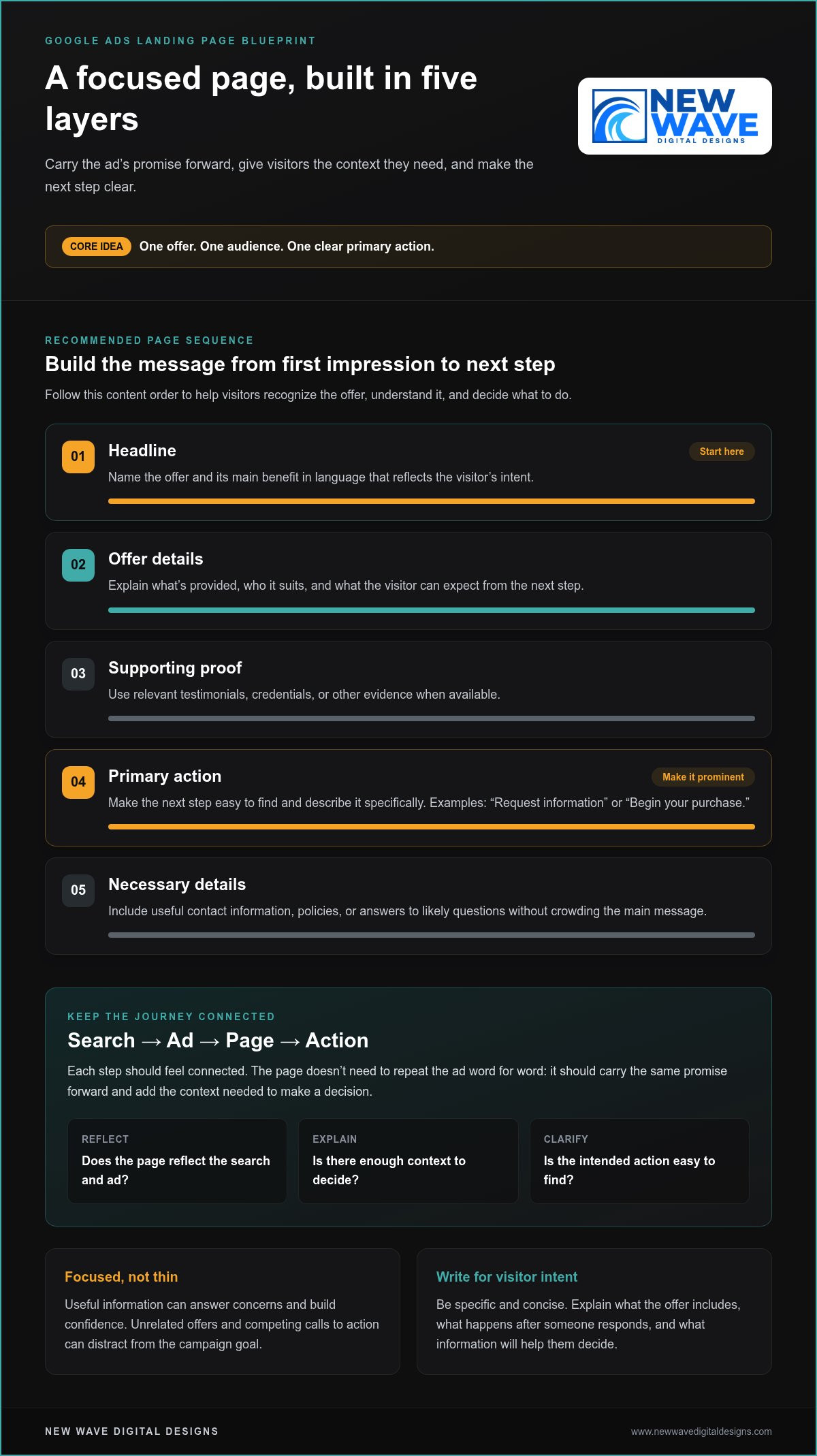
Once visitors arrive, the page structure should make their decision straightforward. Lead with a headline that names the offer and its value. Explain who it’s for and what to do next, then add concise supporting details and a prominent call to action. This order helps visitors move from recognizing the offer to understanding it and deciding whether to act.

Keep the page focused, not thin. Useful information can answer concerns and build confidence, while unrelated offers and competing calls to action can distract from the campaign goal. Use a simple content plan:

  • Headline: State the offer and its main benefit in language that reflects the visitor’s intent.
  • Offer details: Explain what’s provided, who it suits, and what the visitor can expect from the next step.
  • Supporting proof: Include relevant testimonials, credentials, or other evidence when available.
  • Primary action: Make the next step easy to find and describe it specifically.
  • Necessary details: Add useful contact information, policies, or answers to likely questions without crowding the main message.

Message match means maintaining continuity between a person’s search, the ad they choose, and the page they reach. The page doesn’t need to repeat the ad word for word. It should carry the same promise forward and add the context the visitor needs to make a decision. This is a practical foundation for how to create effective landing pages for Google Ads.

What should the headline and page copy communicate?

Write the headline for the visitor’s likely intent, not just the business’s internal description of its service. If the ad promotes Google Ads management, make that subject clear at the top of the page. Use the following copy to explain who the service is for and what the visitor can do next. Specific, concise language helps people quickly decide whether they’re in the right place.

Answer the questions that matter at this stage: What does the offer include? What happens after someone responds? What information will help them decide? Prioritize those answers over broad claims or mechanical repetition of the ad.

How should forms, calls to action, and trust elements work together?

Use a CTA that names the action, such as “Request information” or “Begin your purchase,” instead of a vague label. Make the primary action visually prominent and limit secondary links that could pull attention away. For forms, ask only for details needed for the next meaningful step. Every additional question should have a clear purpose.

Place trust details where they can help with a decision. A testimonial may support the offer, while a relevant policy or contact detail can address a concern near a form. Keep these elements clear and accurate. Thoughtful Google Ads and website design can help bring campaign intent and page structure into closer alignment.

Dedicated landing page or existing website page: which should you choose?

The best destination is the page that answers the searcher’s need with the least friction. A dedicated landing page gives a campaign more control over its message and layout. An existing product or service page may already provide the right detail and a clear path to action. Neither option is automatically better. Choose based on how closely the page fits the campaign and how much work it needs.

Consideration Dedicated landing page Existing website page
Message match Can be tailored closely to a specific ad, audience, or offer. Works well if its content already reflects the ad’s promise and search intent.
Setup effort Requires planning, writing, design, tracking, and ongoing upkeep. May be ready to use, though content or layout changes could be needed.
Page flexibility Offers more control over campaign-specific content and journey. Must fit within the existing site structure and page purpose.
Measurement Can make campaign actions easier to isolate, provided tracking is configured appropriately. Can be measured too, but shared content or multiple actions may require careful interpretation.

When does a dedicated campaign page make sense?

Consider a dedicated destination when the campaign has a distinct offer, targets a clearly defined audience, or needs a focused conversion journey. A time-sensitive promotion, for example, may need terms and a call to action that aren’t prominent on a general service page. A campaign for one service can also benefit from copy that directly addresses the visitor’s questions instead of asking them to navigate a broad menu.

That control comes with responsibility. Each additional page needs accurate content, thoughtful design, functioning measurement, and updates as the offer changes. For broader outreach initiatives, digital marketing insights from Fireheart Digital highlight how critical it is to align distinct audience needs with strategic messaging. An outdated campaign page can undermine the relevance it was created to provide.

When can an existing page be the better destination?

Use an existing page if it already answers the search query, supports the ad’s promise, and makes the intended action clear. Someone searching for a particular product may be better served by its detailed product page than by a new page that repeats the same information. A general homepage is less suitable if visitors have to sift through unrelated services to find that product.

Review the page from the visitor’s perspective. Does the main heading reflect the ad’s offer? Are competing calls to action or unrelated sections drawing attention away? Could a modest edit to the headline, opening copy, or placement of the primary action make the page more relevant? If so, refine what’s already there before building another destination.

Use this decision rule: choose a dedicated page when the campaign needs an experience the current site doesn’t provide; choose an existing page when it already fits the visitor’s intent and supports the next step. This balance is part of how to create effective landing pages for Google Ads without adding pages that have no clear purpose.
How to Create Effective Landing Pages for Google Ads

How to create and launch a Google Ads landing page step by step

A dependable launch starts before design work. Establish what the campaign promises, who it’s meant to reach, and what action the page should support. Then build and review the destination as a complete journey, from the first screen to the confirmation visitors see after submitting a form or completing a purchase.

Test the complete visitor journey before directing paid traffic. A page can look polished and still fail if its form, links, or measurement don’t work as intended.

  1. Research the campaign. Review its search themes, ad language, audience, offer, and intended action. Connect each landing page to a specific campaign theme rather than combining unrelated search intents on one destination.
  2. Write a page brief. Record the visitor’s likely need, the offer, supporting evidence, and the primary conversion action. Map the ad’s central promise to the page headline, key content, and call to action.
  3. Plan the visitor journey. Decide what a person needs to know before acting, such as what the offer involves or what happens after an enquiry. Arrange the content in a logical order and make the next step easy to find.
  4. Build the page. Create or refine the destination using the brief. Check that the layout adapts to mobile and desktop, text is readable, controls are easy to use, and links and forms work correctly.
  5. Review the experience. Check accessibility, loading issues, clear privacy information, accurate content, and distractions that could interrupt the intended journey. Confirm that the final destination URL matches the campaign plan.
  6. Verify measurement and launch. Test that the intended action, such as a form submission or purchase, is recorded accurately. Review the relevant Google Ads, Google Analytics 4, or Google Tag Manager configuration against current product documentation before relying on the data. Then direct campaign traffic to the tested page.

What belongs in the landing page brief?

Make the brief specific enough that a designer or writer can understand the campaign before building begins. Include the audience, search intent, offer, available supporting evidence, primary conversion action, and questions visitors may need answered. Note the ad’s central promise and how it should carry through to the headline, supporting content, and CTA. This gives you a clear reference for reviewing the finished page and helps keep copy and design aligned with campaign intent.

What should you check before sending Google Ads traffic?

Test common mobile and desktop screen sizes, including the full form process and what visitors see after submission or purchase. Check that buttons and links lead to the right places, text remains legible, the page loads reliably, and privacy disclosures are easy to find wherever personal information is collected. Confirm the final destination URL and verify that tracking records the action you want to measure, not just a button click that may not represent a completed conversion.

Building a strong destination takes coordinated campaign thinking, design, and measurement. New Wave Digital Designs provides website design and paid search services to help align those elements.

Measure, refine, and connect landing page design with Google Ads

A landing page’s results involve more than the number of conversions. A page may generate many enquiries but attract people who aren’t a good fit. Pair performance data with lead or purchase quality, then identify where the visitor journey works smoothly and where it creates friction. That fuller view helps distinguish useful improvements from changes that only make a dashboard look better.

Which landing page metrics can guide improvements?

Conversion rate is the share of measured visitors who complete a defined action. It’s useful for tracking a page over time, but interpret it alongside traffic sources and conversion quality. A form submission matters more when it represents a relevant prospect than when it’s an unqualified enquiry. For purchases, consider order quality as well as completed transactions.

Review multiple signals together. If visitors arrive but few begin a form, the offer, page content, or action may not be clear enough. If they start but don’t complete it, check for unnecessary questions or usability barriers. Engagement measures can show where visitors spend time or leave, but no single metric explains why. Combine the data with a careful page review and, where possible, feedback on lead or customer quality.

Use Google Ads and Google Analytics 4 reports only after checking that tracking records the intended actions accurately. Confirm that a conversion represents a completed enquiry or purchase, rather than an incidental click, and that reporting is configured consistently. Review current Google product documentation before drawing conclusions from the data.

How can design and campaign management work together?

Campaign intent sets the direction: which audience the ad reaches, what the offer promises, and what action the page should support. Website structure and visual design make that journey easier to understand, while measurement shows where it may need refinement. These elements inform one another. If visitors engage with the ad but don’t complete the intended action, review both traffic relevance and the page experience before deciding what to change. For organizations seeking a comprehensive growth partner to connect search campaigns with conversion-focused funnels, Tools N Tactics | Local SEO & Digital Marketing Solutions provides integrated marketing strategies designed to scale service businesses.

Make each test deliberate. Write down the issue you’re investigating, the change you’ll make, and the result you expect. When practical, change one important element at a time, such as the headline or form layout. Then compare the outcome with your original hypothesis, including lead or purchase quality. If several elements change together, it’s harder to tell which adjustment mattered. Keep a record of what changed and what the evidence suggests, even when a test has no clear result.

Website design, graphic design, and Google Ads management can work together to align brand expression, campaign intent, page structure, and measurement. New Wave Digital Designs offers these services alongside organic SEO, helping businesses develop a coherent digital presence. This cycle of observing, refining, and learning is central to how to create effective landing pages for Google Ads without relying on guesswork.

Give your next campaign a clearer path forward

The next step doesn’t have to be a complete rebuild. Choose one campaign, review the experience from a visitor’s perspective, and identify the most useful improvement to explore. A thoughtful, measured approach to how to create effective landing pages for Google Ads can turn each insight into a stronger foundation for future decisions.

New Wave Digital Designs provides website design for Shopify, WordPress, and Squarespace, along with Google Ads and Bing Ads management, graphic design, hosting, and website maintenance. These services can support a coherent experience from campaign to page and ongoing site care, shaped around your business needs.

Work with New Wave Digital Designs on a landing page aligned with your campaign goals.

Frequently Asked Questions

Can I use my homepage as a Google Ads landing page?

Yes, your homepage can work if it directly addresses the ad’s subject and makes the intended action easy to find. It may suit branded searches from people looking for your business, but be less useful for an ad promoting one specific service if visitors have to search through a broad menu. Review the page on mobile, too. If the offer and next step aren’t immediately clear, a more focused destination may serve the campaign better.

How many landing pages should a Google Ads campaign have?

There’s no fixed number. Build or select pages around meaningful differences in search intent, audience, or offer, rather than creating a separate page for every keyword. Several search terms seeking the same service may fit one page, while a product promotion and a service enquiry may need distinct experiences. Keep the number of pages manageable so you can maintain accurate content, functioning tracking, and relevant information as campaigns change.

What is a good conversion rate for a Google Ads landing page?

There isn’t one conversion rate that’s good for every campaign. The right interpretation depends on the action being measured, the audience, the offer, and whether conversions lead to qualified enquiries or purchases. Compare similar traffic and actions over time, and examine quality alongside volume. A higher rate isn’t necessarily better if it comes from less relevant enquiries. Treat benchmarks as context, not as a target that overrides business value.

How long should I wait before changing a landing page?

Wait until you have enough relevant data to make a considered comparison, rather than reacting to a short-term fluctuation. The time needed depends on traffic volume, conversion frequency, and how consistent the campaign has been. Before making changes, check that tracking works and review whether visitors match the intended audience. If you find a clear technical problem, such as a broken form, fix it promptly instead of waiting for more data.

Do Google Ads landing pages need a privacy policy?

If a page collects personal information, explain clearly how that data will be used and make the relevant privacy notice easy to find near the form. This helps visitors understand what they’re sharing before they submit it. The exact disclosures that apply can depend on your business and the data collected, so avoid generic copy that doesn’t reflect your practices. Keep the notice current when your data collection or use changes.

Can I test two landing page versions with Google Ads?

Yes, you can compare page versions, but structure the test so the result is useful. Decide what you’re testing, such as a headline or form layout, and keep the audience, offer, and conversion definition consistent where practical. Confirm that both versions load correctly and that tracking records the same intended action. Review current Google Ads experiment options and setup guidance before launching, since available controls can change.

Search Marketing Services for Small Business: SEO and Paid Search in 2026

What if choosing between SEO and paid search is the wrong first decision? For a small business, search marketing services for small business work best when organic visibility, advertising, and the website experience are planned together. It’s understandable to weigh near-term campaign activity against longer-term growth when time and marketing resources are limited. But clicks and rankings alone don’t show whether a strategy is attracting the right prospects or supporting business goals.

This guide explains how organic SEO, Google Ads, and Bing Ads serve different needs, and how to prioritize them based on your goals, website readiness, and available resources. You’ll also learn what a search marketing engagement can include, from practical deliverables to reporting that connects search activity with meaningful outcomes. A campaign can bring someone to your site, but the website and measurement framework help determine what happens next. Together, these elements create a clearer path from visibility to informed decisions.

Key Takeaways

  • Search marketing services for small business can combine organic SEO with Google Ads or Bing Ads, depending on your goals, timing, and website readiness.
  • Use paid search to explore which queries and messages resonate while organic SEO develops visibility over time.
  • Compare proposed work by how it connects to customer intent and business outcomes, and by the clarity of its deliverables and reporting.
  • Prioritize in sequence: define outcomes, review your website, choose a channel focus, then measure what matters.
  • A responsive, brand-aligned website helps carry the visitor experience forward after a search result or ad earns the click.

What search marketing services for small business actually include

Search marketing brings together the work that helps a business appear when people search: organic visibility earned through SEO and paid placements purchased through advertising platforms. The Search marketing overview describes this broader discipline, which includes both routes. For a small business, the distinction matters because each channel has a different mechanism, pace, and role in reaching potential customers.

SEO develops organic visibility over time; paid search can place an ad in eligible results for selected queries, subject to an auction and platform factors. Neither a ranking nor a click is a business outcome by itself. They are signals to interpret alongside what happens next, such as a qualified inquiry, purchase, or other action that supports the business.

Organic SEO and paid search: two routes to search visibility

Organic SEO improves a site’s relevance, accessibility, and ability to appear in unpaid search results. Work can include making pages easier for search engines to understand, aligning useful content with customers’ questions, and addressing technical barriers to discovery. Results develop through sustained improvements, not through buying an ad placement for a particular search.

Paid search uses platforms such as Google Ads and Bing Ads to show ads for selected queries. Advertisers set campaign parameters, but placement depends on auction dynamics and other platform factors, so no position is assured. Specialized agencies like SEO Guru Houston can help businesses manage paid campaigns to capture demand while organic SEO develops a foundation for relevant searches over time.

What small-business search marketing services can cover

Well-defined search marketing services for small business turn strategy into practical work across search discovery, campaigns, and the website. Priorities depend on business goals and site condition, but the work may include:

  • Organic SEO: keyword research to understand search intent, technical and on-page improvements, and search-focused content that answers useful customer questions.
  • Paid search: campaign planning, ad management, and performance reviews to assess which queries and messages are bringing relevant visits and actions.
  • Website support: design, maintenance, hosting, and security to help keep the destination after the click responsive, clear, and dependable.

These elements are connected. An ad may earn a visit, but a confusing page can interrupt the journey. Strong content can also be harder to find if technical issues affect important pages. A responsive, brand-aligned website on Shopify, WordPress, or Squarespace gives search visitors a more coherent next step. Ongoing maintenance and security help support that experience.

Before judging performance, define the action you want a visitor to take. Then read rankings, impressions, and clicks as indicators of visibility, not proof of growth on their own. Pair them with relevant actions and the website experience to assess search marketing as a connected system, rather than a collection of isolated tasks. For small enterprises looking to integrate digital marketing with broader organizational strategy, consultancies like contentfactory.biz help align digital transformation and marketing efforts with long-term SME growth.

How SEO, Google Ads, and Bing Ads work together

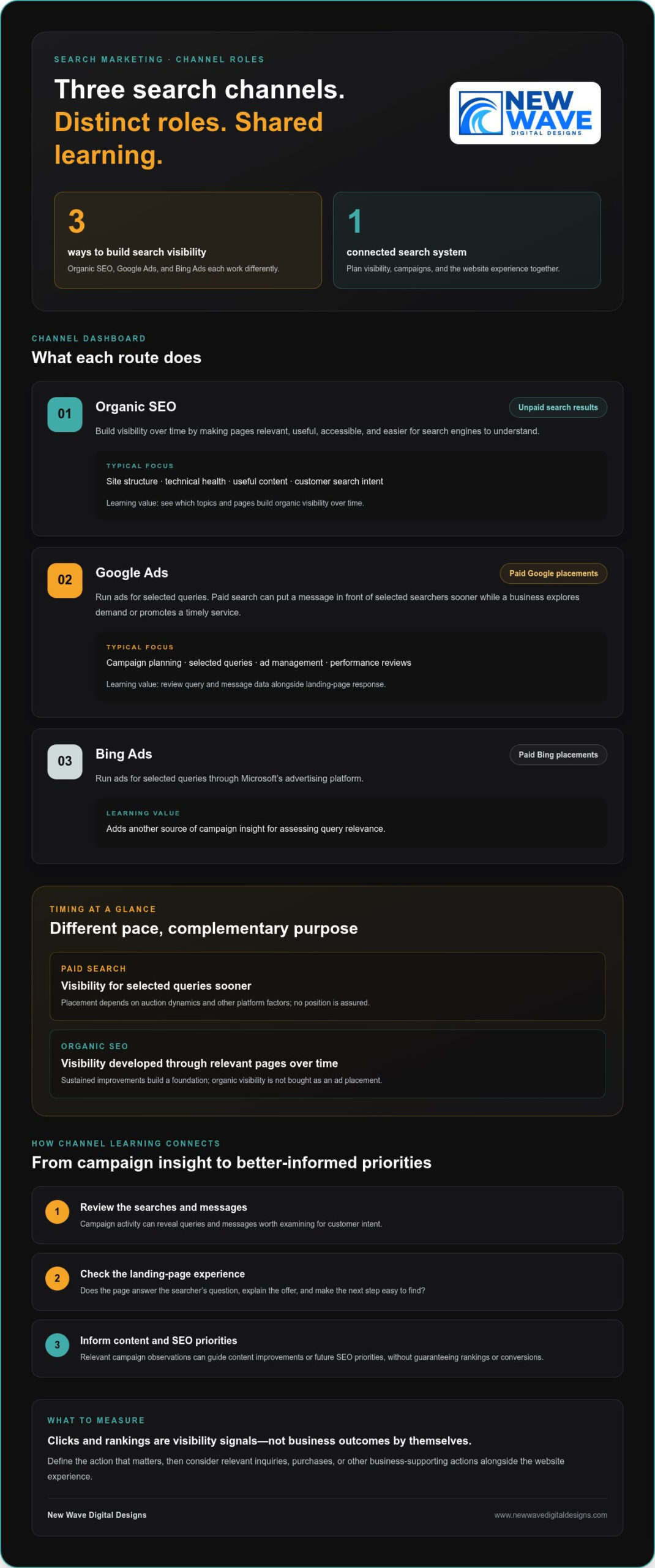
SEO and paid search can support the same business goal without doing the same job. Organic visibility develops as a site becomes more relevant and useful for important searches. Google Ads and Bing Ads can place ads for selected queries, subject to each platform’s auction and other factors. Together, they give a small business distinct ways to build visibility, observe customer intent, and refine its search presence.

Paid search can put a message in front of selected searchers sooner; organic SEO builds visibility through relevant pages over time. The channels can also inform each other: campaign activity can reveal queries and messages worth examining, while SEO develops useful pages around relevant topics.

Channel Placement Approach Learning value
Organic SEO Unpaid search results Improve site structure, page relevance, technical health, and useful content. Shows which topics and pages build organic visibility over time.
Google Ads Paid placements in Google search Set up ads for selected queries and manage campaign settings. Offers query and message data to review alongside landing-page response.
Bing Ads Paid placements in Bing search Run ads for selected queries through Microsoft’s advertising platform. Adds another source of campaign insight for assessing query relevance.

Share learning across channels thoughtfully. If a campaign attracts relevant searches for a particular service, review the landing page: does it answer the searcher’s question, explain the offer, and make the next step easy to find? That observation can inform content improvements or future SEO priorities, though it doesn’t guarantee a ranking or conversion. Effective SEM campaigns for small businesses also depend on aligning keyword choices with business objectives.

When organic SEO is the stronger priority

Organic SEO is a strong focus when a business wants to develop durable visibility around topics its customers search for. Start with a sound structure, clear and relevant pages, useful content, and technical health. These foundations help search engines interpret the site and give visitors a more coherent path through it. Organic SEO services can support a sustained visibility strategy.

When paid search can complement organic growth

Paid campaigns can complement SEO when a business wants to test selected queries or messaging while organic work develops. Review which searches bring relevant visitors, then compare the ad promise with the landing page’s content and response. Use those observations to guide testing and page refinement, not as automatic proof of what will succeed organically. Google Ads management for small business brings campaign planning and performance review into that process.

Search marketing services for small business are most useful when channel activity connects to a clear goal and a considered website experience. New Wave Digital Designs provides organic SEO and paid search support to help bring those priorities into the same conversation.

How to compare search marketing services for your small business

A useful proposal should make the connection between the work and your business goals easy to see. Start with the action you want a search visitor to take, such as requesting an estimate, booking an appointment, or completing a purchase. Then consider whether the proposed SEO or paid campaign targets the right customer intent and whether your website gives visitors a clear path to that action.

This makes comparison practical. A plan focused on paid visibility may suit a time-sensitive need, while organic SEO can support longer-term visibility around relevant topics. If key pages are hard to navigate or don’t explain your offer clearly, the website may need attention alongside search activity. A channel plan should account for that reality rather than treating clicks as the finish line.

Match services to goals, audience, and website readiness

Before comparing deliverables, describe the customer journey you want to support. What might a prospective customer search? What information would help them decide? What should they do next? Compare the proposed work against those questions. For example, a campaign aimed at people ready to request a service should lead to a page that clearly describes the service and makes the inquiry step visible.

Consider timing, too. If the business needs to promote a specific offer now, paid search may be part of the plan. If it’s building visibility for recurring customer questions, organic work may deserve greater emphasis. The right mix depends on goals, audience, and site readiness, not on the number of channels included.

Evaluate deliverables and reporting with useful questions

Look for clear descriptions of what will be done and how the work will be reviewed. Search marketing services for small business should translate technical activity into understandable tasks, priorities, and measures. Use questions like these to assess whether a proposal offers a coherent strategy:

  • Research: How will keyword and query research connect to customer intent and business priorities?
  • Execution: Which pages or technical areas will SEO work address, and what campaign planning or management is included for paid search?
  • Measurement: Which indicators will be reported, and how will relevant website actions be tracked where measurable?
  • Coordination: How might campaign observations shape future content, landing-page improvements, or channel priorities?

Reporting should distinguish leading indicators from outcomes. Impressions, rankings, clicks, and visits can show whether visibility is changing or people are reaching the site. They don’t, by themselves, show whether the business is attracting qualified inquiries or making sales. A useful report interprets those signals alongside relevant website actions, explains measurement limits, and identifies practical next steps.

It’s reasonable to want evidence of progress. A credible plan won’t promise specific rankings, traffic, leads, or revenue, because search results and customer decisions depend on factors beyond any one campaign. Instead, it should explain what will be measured, how findings will inform adjustments, and how progress relates to the outcomes the business cares about. That clarity gives the work a shared basis for decisions.

Search Marketing Services for Small Business: SEO and Paid Search in 2026

How to prioritize search marketing services on limited resources

A small business doesn’t need to pursue every search opportunity at once. Choose the first move that supports an important customer journey and fits the website’s readiness, competitive environment, and available resources. This sequence turns search marketing services for small business into a focused plan rather than a list of disconnected tasks.

  1. Define outcomes. Choose the customer action that matters most, such as a qualified inquiry, appointment request, or online purchase. Identify the products or services to prioritize.
  2. Review the site. Check whether relevant pages explain the offer, work well on mobile, and make the next step clear. Review site structure and conversion paths before expanding campaigns.
  3. Choose channel priorities. Match the opportunity to organic SEO, Google Ads, Bing Ads, or a focused combination. Account for customer intent, timing, competition, and available capacity.
  4. Measure and refine. Track indicators linked to the goal, review performance over a suitable period, and adjust priorities as search, campaign, or website data accumulates.

Build a practical first-phase search plan

Keep the first phase narrow enough to manage. Select a priority service or product, identify searches that suggest interest, then assess the page a visitor would reach. If the page needs clearer information or an easier mobile experience, address that gap before increasing campaign activity. If the page is ready but organic visibility is still developing, a focused paid campaign may complement ongoing SEO. Let the evidence guide the mix, rather than trying to be everywhere.

A simple scorecard can make the reasoning visible:

  • Activity: Improve a priority service page. Purpose: Help searchers understand the offer. Indicator: Relevant engagement or inquiry actions. Review point: After the page change has had time to be observed.
  • Activity: Run a focused paid campaign. Purpose: Reach selected searchers and assess query relevance. Indicator: Relevant clicks and qualified actions. Review point: During scheduled campaign reviews.
  • Activity: Develop organic content. Purpose: Address useful customer questions. Indicator: Relevant impressions, clicks, and page engagement. Review point: As visibility and content performance develop.

Measure progress without mistaking activity for impact

Impressions can indicate exposure; clicks show that a searcher chose to visit; landing-page engagement offers clues about what happened after the visit. Qualified inquiries or sales are closer to business outcomes. Read these measures together, and make sure reporting distinguishes what is observable from what can’t be attributed confidently.

Interpret results in context. A campaign change, revised page, or shift in targeted queries can affect what the numbers mean. Compare periods that make sense for the activity, note what changed, and use the findings to decide what to maintain, refine, or pause. A sound plan explains how progress will be assessed without promising a fixed ranking or return.

New Wave Digital Designs’ search marketing support connects channel priorities with your website and measurement needs.

How New Wave Digital Designs brings search marketing together

Search visibility is strongest when the campaign, website, and business goal work in concert. New Wave Digital Designs provides organic SEO and Google Ads or Bing Ads management, helping shape channel priorities around what the business wants search visitors to do. Each service has a distinct role, but both can support a considered path from discovery to the next step.

A coordinated approach to organic and paid search

Organic SEO develops a site’s relevance and visibility across valuable search topics. Paid campaign management supports selected queries through advertising on Google or Bing. Planning them together brings keyword opportunities, campaign observations, and business priorities into the same discussion, rather than treating each channel as an isolated task.

For example, paid campaign activity may show that a particular search phrase is attracting relevant visitors, or that a landing page needs to explain an offer more clearly. Those observations can inform future content or campaign priorities. They are useful signals, not guarantees: search positions, lead volume, and campaign returns can’t be promised. Measurement helps clarify what is happening and where adjustments may be worthwhile.

This approach keeps the focus on meaningful progress. Search marketing services for small business should reflect the customer journey, the website’s current readiness, and the resources available to sustain the work. New Wave Digital Designs provides organic SEO alongside Google Ads and Bing Ads management, so channel decisions can be considered in relation to the same business objectives.

Connect search visibility to the website experience

A search result earns attention; the destination page carries the experience forward. The page should match the visitor’s query or the promise of an ad, explain the relevant product or service, and make the next action clear. For instance, someone searching for a specific service needs a focused page with useful details, not just a general homepage.

New Wave Digital Designs creates responsive, brand-aligned websites on Shopify, WordPress, and Squarespace. Responsive design helps a site adapt across screen sizes, while clear page structure supports a consistent experience from search result to landing page. If a website refresh would strengthen that post-click journey, explore professional web design.

The work can continue beyond launch. Website maintenance, hosting, and security complement ongoing digital marketing by supporting the website that organic visitors and paid campaigns lead to. That creates a more connected foundation: visibility, a prepared destination, and continued attention to the digital experience.

A search marketing approach can bring together your business goals, website, and channel priorities, with organic SEO, paid search, and website experience considered as parts of the same plan.

Make your next search move a deliberate one

Your next step doesn’t have to be a sweeping marketing overhaul. Choose one business priority, identify the search opportunity around it, and shape a focused plan that can be reviewed and refined as you learn. The most useful search marketing services for small business give each activity a purpose and connect it to a website experience built to welcome the right visitor.

New Wave Digital Designs brings organic SEO and Google Ads or Bing Ads management together with website design, maintenance, managed hosting, and security. This combination keeps search visibility and the digital experience in view as your business evolves. The goal is a thoughtful direction, not a promise of a particular ranking or return.

Ready to explore a search approach shaped around your goals? Discuss your search marketing goals with New Wave Digital Designs and define a clear first priority for your business.

Frequently Asked Questions

What are search marketing services for a small business?

Search marketing services for small business help a company become easier to find when potential customers search online. For example, a home repair company might improve service pages for unpaid results while advertising for a specific repair query. The work can also include making sure search visitors land on a useful page with clear details and a next step. The right scope depends on business priorities, audience, website, and resources.

Are SEO and search engine marketing the same thing?

Not always. SEO generally means improving a website’s unpaid search visibility, while search engine marketing may describe the broader combination of organic and paid search. Some providers use “SEM” to mean paid advertising alone. Since terminology varies, compare the actual work behind the label: for example, whether it includes page optimization, ad management, or both, and how progress is reported.

How long does SEO take to show results for a small business?

There’s no universal timetable for SEO results. The pace depends on factors such as the site’s starting condition, the competitiveness of its topics, and the work being completed. Rather than waiting for one target ranking, review milestones along the way: whether technical issues were addressed, priority pages became more relevant, and qualified actions are being recorded. These checkpoints help guide adjustments without treating any date or position as guaranteed.

Can a small business use Google Ads and SEO at the same time?

Yes. A business can advertise for selected searches with Google Ads while developing its unpaid search presence through SEO. For instance, an ad campaign for a particular service can help assess whether a query attracts relevant visitors, while SEO work builds useful information around related customer questions. Review each channel by its own purpose, and don’t assume ad activity automatically changes organic rankings or performance.

How much do search marketing services cost for a small business?

There isn’t one universal cost for search marketing services. Scope can vary with the channels involved, the condition of the website, campaign complexity, and the amount of ongoing work. When reviewing proposals, compare the research, optimization, campaign management, and reporting included, along with each party’s responsibilities. A clear description of scope makes it easier to understand what a quoted fee covers without relying on a headline figure alone.

What should a small business track in a search marketing campaign?

Track measures that help explain whether search activity is supporting a business goal. For an online shop, that might mean reviewing relevant landing-page visits alongside completed purchases; for a service business, it could mean qualified inquiry forms rather than every form submission. Impressions and clicks provide context, but they don’t establish lead quality. Define what counts as a valuable action, then review that measure consistently alongside campaign activity.

Do small businesses need a new website before investing in search marketing?

No, a new website isn’t automatically necessary. A focused update may be enough if the existing site has a sound structure but needs a clearer service page, more prominent contact details, or simpler mobile navigation. Broader design work may make sense if important information is difficult to find across the site. Identify the specific obstacle first, then decide whether targeted improvements or a larger redesign better supports visitors.

Bing Ads Management: Architecting High-Intent Growth Beyond Google

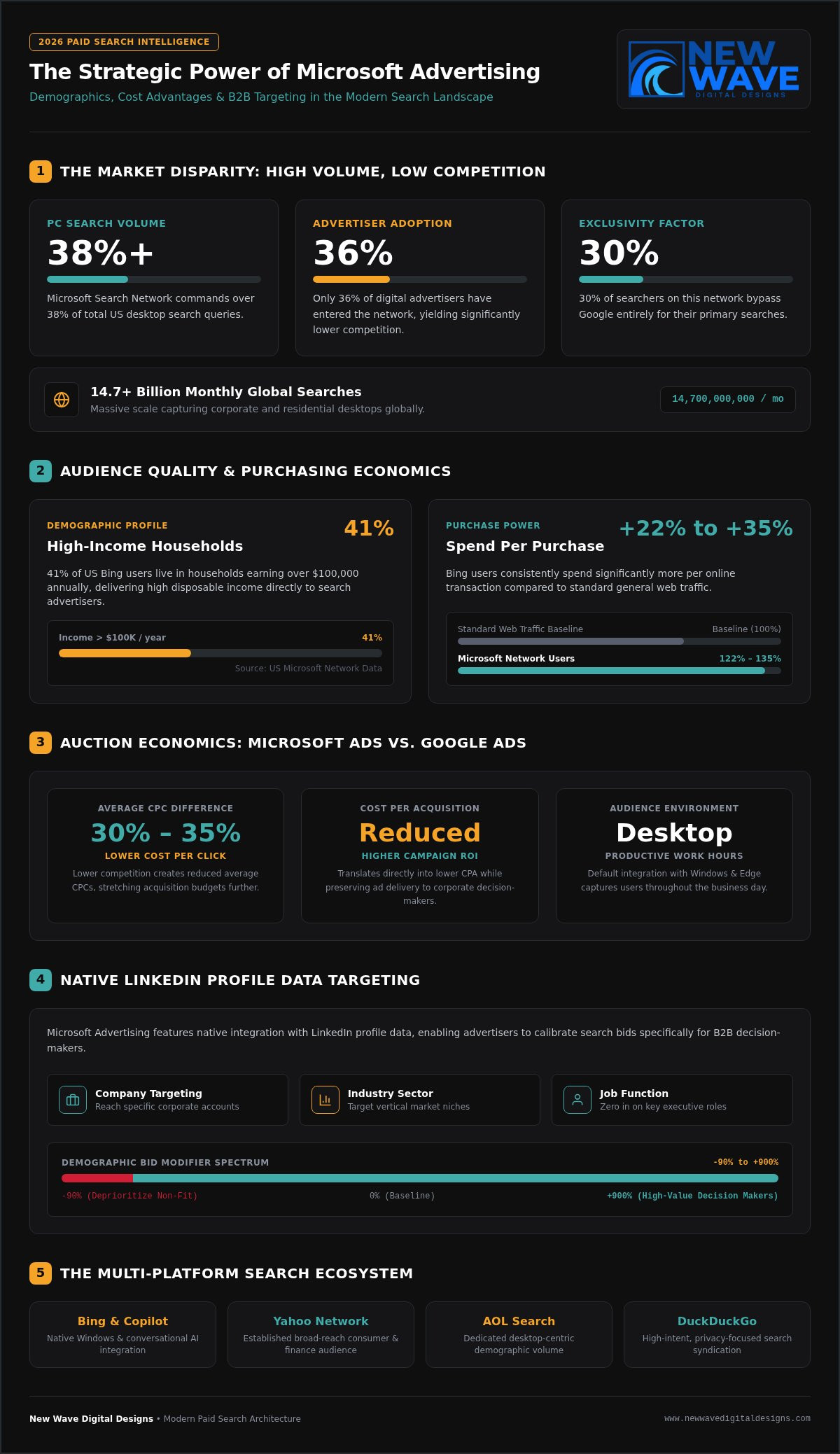
While the digital crowd clamors for visibility on Google, a quieter, more affluent revolution is taking place on the desktops of the world’s most influential decision-makers. In 2026, the Microsoft Search Network reaches over 38% of US PC search volume, yet only 36% of advertisers have claimed their place within this high-intent landscape. This disparity creates a strategic sanctuary where competition is lower and the audience is inherently more valuable. Professional Bing Ads management isn’t just a secondary tactic; it’s a sophisticated architecture designed to capture corporate leaders and high-income households during their most productive hours. By leveraging unique LinkedIn profile targeting and AI-driven Copilot placements, we transform search marketing into a precise craft that respects your budget and your vision.

You’ve likely felt the sting of rising costs per acquisition and the diminishing returns of a Google-only strategy. It’s frustrating to watch your margins thin while missing the corporate demographic that drives long-term growth. In this guide, you’ll discover how a refined Microsoft Advertising strategy captures these high-value audiences and maximizes ROI through meticulous digital craftsmanship. We’ll explore the mechanics of lower CPCs, the power of LinkedIn data integration, and the seamless process of scaling your reach beyond the traditional search giants.

Key Takeaways

  • Extend your reach beyond a single search engine. You’ll encompass a vast, high-intent network including Yahoo and AOL through the Microsoft Advertising ecosystem.
  • Capitalize on a wealthier, corporate-centric demographic. This strategy allows you to achieve a lower cost-per-acquisition compared to saturated search platforms.
  • Master the art of Bing Ads management by moving beyond simple imports. You’ll learn to architect a keyword strategy specifically tailored for the Microsoft ecosystem.
  • Harmonize sophisticated audience layering with AI-driven bidding. This ensures your message resonates with high-value decision-makers throughout 2026.
  • Discover the transformative synergy between visionary web design and high-performance advertising. This partnership elevates your digital presence into a form of craftsmanship.

Understanding the Strategic Landscape of Bing Ads Management

Microsoft Advertising is far more than a single search engine; it’s a gateway to an expansive, high-value digital territory. While many view it through the narrow lens of a secondary search bar, the Microsoft Advertising platform has matured into a sophisticated multi-platform ecosystem. It orchestrates visibility across Yahoo, AOL, and privacy-focused partners like DuckDuckGo. For the visionary brand, Bing Ads management is the meticulous orchestration of paid search to capture premium market segments that competitors often overlook. It’s an intentional choice to build where the foundation is solid and the competition is thin.

The Reach of the Microsoft Search Network

The Microsoft Search Network thrives within the workspaces of global decision-makers. Because Bing is the native default for Windows and the Edge browser, it captures a professional audience during their most productive hours. By 2026, the integration of Copilot and AI-powered search has fundamentally shifted user intent. Searchers no longer just browse. They engage in conversational queries that provide deeper contextual cues for advertisers. This network generates over 14.7 billion monthly searches globally. It offers a reservoir of hidden volume that remains untapped by those solely focused on the Google auction. These users aren’t just numbers; they represent a demographic where 41% of US users have a household income exceeding $100,000 per year.

Why Diversification is a Digital Necessity

Relying exclusively on Google creates a precarious dependency in a volatile marketplace. Diversification isn’t just a safety net; it’s a strategic necessity for reaching the 30% of searchers who bypass Google for their primary queries. This high-intent traffic often demonstrates higher purchase power and lower price sensitivity. In fact, Bing users spend an average of 22% to 35% more per purchase than standard web traffic. When you align this approach with a robust Organic SEO services New Jersey strategy, you create a dual-layered presence. You dominate the search landscape through both paid precision and organic authority. It’s about building a digital legacy that isn’t beholden to a single algorithm but rather flourishes across the entire search landscape. By expanding your horizons, you ensure your brand’s growth is both resilient and expansive.

The Architectural Advantages: Bing Ads vs. Google Ads

While the Google auction often feels like a relentless battle for visibility, professional Bing Ads management provides a more refined and cost-effective landscape. In 2026, the average CPC on Microsoft Advertising remains approximately 30% to 35% lower than its primary competitor. This translates directly into a reduced cost-per-acquisition, allowing your budget to stretch further while maintaining high-impact delivery. This efficiency isn’t just about spending less; it’s about reaching an audience with significantly higher disposable income. Statistics show that 41% of US Bing users reside in households with incomes exceeding $100,000. These searchers aren’t just browsing; they’re ready to invest in quality. The lower competition landscape ensures your brand claims a dominant share of voice without the exorbitant premiums found elsewhere. It’s a strategic sanctuary for those who value depth over volume.

LinkedIn Profile Targeting: The Secret Weapon

The true distinction in sophisticated Bing Ads management lies in its native integration with LinkedIn profile data. We don’t just guess who your audience is; we target them by company, industry, and job function. This surgical precision is indispensable for high-ticket B2B services where the decision-maker’s professional role is paramount. By applying bid modifiers ranging from -90% to +900%, we prioritize the corporate leaders who drive your business forward. It’s a level of demographic layering that transforms a simple search query into a highly qualified lead. This architectural approach ensures your message reaches the exact professional behind the screen, fostering trust through relevance and authority.

Superior CTR and Conversion Potential

Desktop users on the Microsoft network demonstrate a unique level of focus. Unlike the fragmented attention of mobile-first platforms, these searchers are often in a work-mode mindset, leading to a 4.1% average CTR compared to the 3.8% typically seen on Google. This engagement is bolstered by rich ad formats and image extensions that allow for true visual craftsmanship. By utilizing multi-image extensions and action links, we create a layered experience that guides the user from initial curiosity to final realization. When your ads are presented with clarity and depth, they resonate more deeply with an audience that values meticulousness. This alignment of intent and presentation is why many visionary brands choose to partner with a digital architect to refine their search presence. The results are clear: higher engagement, stronger conversion rates, and a more resilient brand identity.

Crafting a Visionary Campaign: The Methodology of Management

To build a digital presence that endures, one must move beyond the automated and into the intentional. Effective Bing Ads management is not a simple duplication of existing efforts; it’s a bespoke reconstruction. We treat every campaign as a unique blueprint, ensuring that every keyword and creative asset serves a higher strategic purpose. This methodology transforms search marketing from a technical task into a form of digital craftsmanship. It requires a deep understanding of the platform’s nuances, a commitment to meticulous detail, and a visionary approach to audience engagement.

The Bridge from Google: Import and Refinement

While the native import tools offer a convenient entry point, a visionary approach requires immediate and thorough refinement. A direct copy-paste often leads to inefficiencies because the Microsoft auction operates on different clearing prices and competition levels. In 2026, we calibrate bids downward to reflect the platform’s cost-efficiency while simultaneously elevating the ad copy. The tone must transition from the hurried, mobile-centric language often found on other networks to a more composed, professional dialogue. This resonance is essential for connecting with a desktop-bound audience that values clarity, depth, and professional confidence.

Strategic Keyword Architecture

Keyword selection serves as the foundation of this architectural process. We prioritize high-intent phrases that signal a user’s readiness for partnership rather than mere curiosity. Because the Microsoft network is a desktop powerhouse, search queries often reflect a deeper research phase and a more deliberate path to purchase. We focus on “Bottom of Funnel” (BOFU) terms that align perfectly with your broader Local search engine optimization goals. This synergy ensures that your brand appears not just as an option, but as the definitive solution within your community and beyond. By identifying these high-value clusters, we build a resilient structure for long-term growth.

Visual storytelling completes the campaign structure. By utilizing multi-image extensions and action links, we provide a sensory experience that linear text cannot achieve alone. This meticulous oversight is paired with transparent reporting, fostering a partnership built on clarity and consistent evolution. We don’t just manage budgets; we curate a brand experience that reflects the true spirit of your business. Through constant monitoring and strategic pivots, we ensure your investment remains protected and your growth remains steady.

Bing Ads Management: Architecting High-Intent Growth Beyond Google

Optimizing for Conversion: Precision and Performance

True optimization is a relentless pursuit of perfection. In the sophisticated world of Bing Ads management, we don’t just set budgets; we engineer outcomes through a blend of technical precision and creative insight. This process begins with a delicate balance between human intuition and algorithmic power. While AI provides the velocity, the digital architect provides the direction, and the data provides the proof. By layering search intent with granular demographic and geographic data, we ensure your message reaches the right individual at the exact moment of their need. This isn’t merely about visibility; it’s about creating a path to conversion that feels both inevitable and effortless.

Bidding with Architectural Intent

Bidding with architectural intent requires a nuanced understanding of your campaign’s long-term goals. For national campaigns in 2026, we often weigh the benefits of Enhanced CPC against Maximize Conversions. The former allows for meticulous manual control over specific auctions, while the latter leverages machine learning to find the most likely buyers within your budget. Protecting your investment is equally vital. We utilize exhaustive negative keyword lists, precise bid adjustments, and geographic fencing to filter out low-intent traffic. In an increasingly automated world, this manual oversight acts as the final safeguard for your ROI, ensuring every dollar spent contributes to your growth.

The Art of the A/B Test

The art of the A/B test is the heartbeat of a growing campaign. We craft headlines that speak to a professional, visionary audience, testing variations that resonate with the spirit of your brand. This evolution extends beyond the ad itself to the landing page experience. Whether you’re utilizing WordPress, Shopify, or SquareSpace, the synergy between your website design and the ad’s promise must be seamless. We use data-driven insights to refine every element, from the hero image to the call-to-action button. This continuous evolution ensures your digital masterpiece continues to perform at its peak as market trends shift.

Mapping the journey from the first click to the final realization requires sophisticated conversion tracking and a commitment to detail. We look beyond the surface metrics to understand how each touchpoint contributes to your long-term success. For e-commerce brands seeking to amplify their paid search results with sustainable organic growth, exploring proven e-commerce SEO strategies can transform your storefront into a high-ranking, revenue-generating digital masterpiece. If you’re ready to transform your paid search into a high-performance engine, discover how our visionary approach can elevate your business. Together, we can architect a future that transcends the ordinary and delivers measurable, high-intent growth.

Partnering for Growth: The New Wave Digital Designs Approach

At New Wave Digital Designs, we view search engine marketing through the lens of a master builder. We don’t sell clicks or treat your budget as a mere commodity. Instead, we approach Bing Ads management as a form of digital craftsmanship. This means every campaign is architected with a deep understanding of your brand’s true spirit. We provide a boutique experience that prioritizes your long-term evolution over quick, superficial wins. By treating your business as our own, we build a foundation of trust that allows for bold, visionary growth.

The success of a paid search campaign depends heavily on the quality of the destination. There is a powerful, undeniable synergy between high-performance ads and web design New Jersey. When a user transitions from a meticulously crafted ad to a landing page that reflects the same level of artistry, conversion becomes a natural outcome. We ensure that your digital presence is cohesive, evocative, and technically superior. This holistic alignment is what separates a standard service from a visionary partnership.

Beyond the Click: Holistic Growth

A visionary campaign requires a secure and optimized digital home to thrive. Our strategy integrates seamlessly with our website maintenance services to ensure your site remains as resilient as your marketing. We focus on technical security, page speed, and continuous optimization. This means your marketing efforts aren’t undermined by slow load times or security vulnerabilities. We believe that capturing the true spirit of your business requires a commitment to excellence across every digital touchpoint. It’s about creating a lasting legacy, not just a temporary spike in traffic.

Starting Your Visionary Journey

The first 90 days of a Microsoft Advertising partnership are a period of discovery, realization, and steady refinement. We begin by defining your most ambitious goals and identifying the high-intent segments that will drive your growth in 2026. This collaborative process ensures that our technical expertise is always aligned with your strategic vision. You can expect transparent communication, meticulous oversight, and a roadmap that looks far beyond the current quarter. We invite brands ready to elevate their presence to join us in this architectural endeavor. Together, we’ll realize the full potential of your brand through precision, performance, and partnership.

Realizing Your Digital Legacy Through Architectural Precision

The path to sustainable digital growth requires looking where others have stopped searching. By embracing the Microsoft Search Network, you access a sophisticated sanctuary of high-intent buyers and corporate decision-makers often ignored by the Google-only crowd. We’ve explored how lower clearing prices, surgical LinkedIn targeting, and meticulous A/B testing transform search into a high-performance engine. It’s about moving beyond the commodity of clicks to build a resilient, multi-layered presence that honors your brand’s unique identity.

Professional Bing Ads management is more than a technical service; it’s a commitment to partnership and long-term brand evolution. At New Wave Digital Designs, we combine our national reach with the meticulous attention to detail only a boutique studio can provide. Our expertise in high-intent B2B and E-commerce targeting ensures that every campaign resonates with the true spirit of your business. We’re here to ensure your digital home is as secure and optimized as your marketing efforts, creating a cohesive experience that builds deep trust with your audience.

Partner with New Wave Digital Designs for Visionary Bing Ads Management and discover the difference that digital craftsmanship can make for your business. Let’s begin the collaborative process of defining your goals and realizing your brand’s full potential. Your visionary journey starts today.

Frequently Asked Questions

Is Bing Ads management really worth it if I already use Google Ads?

Yes, diversifying your search presence is a strategic necessity for reaching the 30% of searchers who don’t use Google. By expanding your reach, you tap into a wealthier demographic that spends an average of 22% to 35% more per purchase. It acts as a sanctuary where lower competition leads to a 20% to 40% reduction in CPA. This resilience protects your brand against algorithm shifts and rising Google costs.

How much does Bing Ads management typically cost?

Professional management costs typically follow a monthly retainer or a percentage of ad spend model, though specific rates depend on your campaign’s complexity. Most agencies structure their fees based on the level of meticulous oversight and strategic guidance required to maintain high ROI. Rather than looking for the lowest price, visionary brands prioritize a partnership that views Bing Ads management as a craft, ensuring long-term brand evolution.

Can I import my Google Ads campaigns directly into Microsoft Advertising?

You can utilize the native import tool to transfer campaigns, ad groups, and responsive search ads with a few clicks. However, a simple copy-paste strategy is rarely enough for peak performance. Professional oversight involves manually calibrating bids and budgets downward to reflect Microsoft’s lower clearing auction prices. We refine your ad copy to match the professional tone of the Bing audience, ensuring your brand resonates with high-intent buyers.

What industries perform best with Bing Ads?

High-ticket B2B services, legal firms, and financial institutions often see the most significant returns on the Microsoft network. The platform’s desktop dominance makes it ideal for enterprise software and corporate services where decision-makers search during work hours. Additionally, e-commerce brands targeting a more mature, affluent demographic benefit from the network’s higher average order values. Any industry that values surgical precision and high-intent professional audiences will find this ecosystem rewarding.

How long does it take to see results from a Bing Ads campaign?

You’ll typically see initial impression and click data within the first 48 hours of launch. However, realizing the full potential of your investment requires a methodical 90-day period of discovery and refinement. During this time, we analyze performance snapshots, adjust bidding structures, and refine audience layering to maximize your ROI. This steady, deliberate process ensures your Bing Ads management strategy remains sustainable and your digital presence continues to evolve.

Does Bing Ads offer better B2B targeting than Google?

Bing Ads provides a unique advantage for B2B targeting through its native integration with LinkedIn profile data. You can layer search intent with verified professional dimensions such as job function, industry, and company name. This allows for bid adjustments from -90% up to +900% on specific corporate leadership roles. While Google relies on broader interest categories, Microsoft Advertising offers the surgical precision needed to reach the exact professional behind the screen.

What is the difference between Bing Ads and Microsoft Advertising?

Microsoft Advertising is the formal platform name, while Bing Ads is the colloquial term for the search engine itself. The platform manages your visibility across the entire Microsoft Search Network, which includes Yahoo, AOL, MSN, and partner sites like DuckDuckGo. Managing a campaign through this interface gives you access to a massive ecosystem that reaches over 724 million unique monthly users. It’s a comprehensive tool for architecting growth across diverse search surfaces.

How do AI and Copilot affect Bing Ads in 2026?

In 2026, AI Max for Search has transformed traditional search by embedding ads directly within Copilot conversational responses. These AI-powered placements deliver up to 73% higher CTRs because they respond to nuanced user intent in real-time. Conversational search ads aren’t just static text; they’re dynamic interactions that guide users through complex decision-making processes. This evolution allows visionary brands to engage with searchers in a more sophisticated, intuitive, and highly effective manner.