
More content isn’t always the first step toward better search visibility. An effective organic SEO strategy for small business starts with the improvements most likely to connect customer needs with business goals, then builds from there.
If you’re unsure whether to update your website, target different searches, or publish another article, you’re not alone. Limited time and resources make it important to focus on the work that can help customers find and use your site. Rankings alone won’t show whether SEO is attracting qualified enquiries or sales. A thoughtful plan can help you set priorities and measure progress without assuming you need constant publishing or expensive tools.
This guide explains how to identify what to tackle first, connect search activity to business outcomes, and decide what you can manage in-house or where expert support may help. We’ll cover customer intent, website foundations, useful content, and practical ways to track progress. The aim is steady, deliberate improvement supported by a digital presence that can evolve with your business.
Key Takeaways
- Shape an organic SEO strategy for small business around customer intent and business goals, not a list of keywords to repeat.
- Match customer questions to the pages best equipped to answer them clearly and completely.
- Compare foundational website work, page improvements, new content, and authority-building to choose a sensible next step.
- Use a first-quarter roadmap to turn an initial review of your website and search data into a manageable sequence of work.
- Weigh in-house effort, selective specialist help, and ongoing agency support against your time, technical confidence, and need for consistency.
What an organic SEO strategy for a small business should accomplish
An organic SEO strategy for a small business improves unpaid search visibility by making useful content easier to find, pages accessible to visitors and search engines, and the website’s foundations sound. The goal isn’t simply to appear more often. It’s to help the right people discover relevant information, products, or services and take a meaningful next step.
Search engine optimization (SEO) is a broad practice that includes improving a site’s content and technical accessibility. Organic SEO focuses on unpaid search results, while paid search uses advertising to gain placement for selected searches. Each can serve a different purpose. Advertising may support a time-sensitive promotion, while organic work builds a foundation for relevant discovery over time.
A focused strategy connects search activity to a business outcome. Depending on the business, that might mean more qualified inquiries, better product discovery, or audience growth among people likely to value what it offers. Start by identifying the pages and actions that support those outcomes, so SEO doesn’t become a disconnected checklist of technical tasks and articles.
Start with business goals and the customers you serve
Begin with the service, product, or business outcome you want search to support. Then use firsthand customer knowledge: the questions people ask, concerns they raise before deciding, and words they use to describe their needs. Separate broad awareness searches, such as learning how a solution works, from searches that suggest someone is comparing options or ready to act. This helps you match each need to an appropriate page.
For example, an informational page can explain a process, while a service or product page can help visitors assess whether a specific offering fits. These pages have different jobs. Give each a clear purpose rather than expecting every page to attract every type of searcher.
Set realistic expectations for organic search
Organic SEO is an ongoing investment, not a shortcut to immediate rankings or revenue. The pace and impact of improvements depend on factors such as competition, the website’s current condition, available resources, and consistent execution. No ethical SEO approach can promise specific rankings or business outcomes. Treat projections as planning assumptions, not guarantees.
Measure progress with a broader view than ranking position alone. Useful indicators can include:
- Whether key pages are accessible and appearing in search results.
- Changes in relevant organic visits and the searches bringing people to the site.
- Qualified inquiries, product discovery, or other business outcomes connected to organic visits.
These measures help show whether search visibility is reaching the intended audience and supporting the business. Rankings can offer context, but they’re most useful alongside relevance, visitor actions, and the experience people have after arriving.
Build the strategy around search intent, site structure, and useful content
A strong organic SEO strategy for small business gives each important customer need a clear destination on the website. Keyword research helps reveal how people phrase searches, but the goal isn’t to repeat a phrase as often as possible. It’s to understand the question behind it and create or improve a page that answers it accurately.
Each important search intent deserves a page designed to meet that need. Someone learning about website platforms needs different information from someone comparing website design services. Treating both searches as one topic can leave visitors without a clear answer.
Turn customer questions into a focused keyword and topic map
Gather customer language from sales conversations, support requests, and searches already happening on your site. Group similar questions by intent, then assign each group to the most relevant existing page or a planned one. Prioritize topics that fit your expertise and actual offerings. For example, a website design business could distinguish between a page explaining platform options and a service page describing its design work.
This map can also prevent pages from competing by covering the same ground. Before creating something new, check whether an existing page could serve the need more completely. Use the language customers recognize in titles and headings where it fits naturally, then write the rest for clarity. Search terms are useful signals, not a script to follow word for word.
Give every important page a clear role
Service pages explain what a business offers; product and category pages help visitors explore what’s available; educational pages answer questions and support early research. Give each page a descriptive title, useful headings, and a clear next step. Link related pages naturally so visitors can move from an explanation to a relevant service without having to search the site again.
Good structure serves people first. Clear navigation and links help visitors understand how information fits together and make related pages easier to discover. Digital.gov’s guidance connects SEO with content that enhances user experience and helps people find what they need. Content earns its place when it offers accurate, original insight and a distinct purpose, not simply because it targets a phrase.
For a broader view of how organic search work can fit into a website’s direction, explore this organic SEO services guide. If you’re considering how strategy and website design can work together, you can also learn about coordinated digital support.
Prioritize small-business SEO work without chasing quick fixes
Publishing more pages doesn’t automatically improve organic visibility. New content that repeats existing information, misses customer needs, or sits behind unclear navigation can add maintenance work without strengthening the site. A practical organic SEO strategy for small business prioritizes work by customer impact, business relevance, feasibility, and evidence, not by the number of tasks checked off.
Start with foundations that could prevent important pages from being found or used. Then review existing pages before commissioning new ones. Authority-building, such as earning relevant mentions and links, may support credibility, but it should be based on genuine value rather than shortcuts. Each opportunity has a different purpose and level of effort:
| Opportunity | Why it matters | Effort | A suitable next step |
|---|---|---|---|
| Technical foundations | Search engines and visitors need to access key pages and use them effectively. | Varies by site condition and platform. | Check crawlability, indexability, mobile usability, page experience, and descriptive page information. |
| Existing-page improvements | Useful pages may need clearer answers, current details, or closer alignment with search intent. | Often focused, though substantial rewrites may take more time. | Review important pages for outdated information, unclear explanations, or overlap with other pages. |
| New content | A new page can address a distinct customer need not served elsewhere. | Requires research, subject knowledge, writing, and upkeep. | Create a page only when you can define its audience, purpose, and unique answer. |
| Authority-building | Relevant references can help people discover and assess a business. | Ongoing relationship-building and useful contribution. | Look for appropriate opportunities to share expertise; avoid schemes focused on link volume. |
Compare foundational improvements with new content
Use evidence to choose what comes first. If a key page isn’t indexed, adding another article may not address the real obstacle. If visitors reach a service page but can’t understand what it offers, improving that page may be more useful than creating a broad awareness post. Add new content when it answers a relevant question clearly and provides something the current site lacks.
Measure meaningful progress instead of chasing vanity metrics
Google Search Console can help you review impressions, clicks, queries, and indexing signals. Google Analytics 4 can help assess relevant organic visits and on-site actions, provided measurement is configured appropriately. Neither tool tells the whole story: attribution can be incomplete, and a click or ranking isn’t a business outcome by itself.
Interpret these signals alongside qualified leads, sales, and business context. A rise in visits matters most when it reaches the right audience or supports a useful action. Choose a small set of measures tied to your goals, review them consistently, and use what you learn to set the next priority.
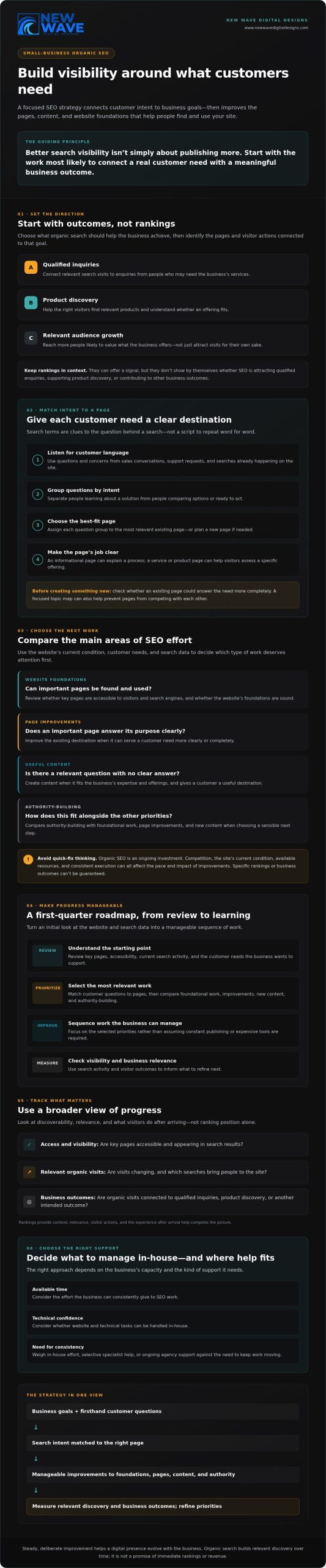
Turn an organic SEO strategy into a manageable first-quarter roadmap
A useful organic SEO strategy for small business turns priorities into an ordered plan, with clear ownership and a way to check whether each task is complete. The sequence below is a planning example, not a promise of rankings or results within a quarter. Adjust the pace to your capacity, website condition, and business goals.
Use a phased plan to create momentum
Phase one: establish a baseline. Document the business goals SEO should support, review available analytics and search data, and identify key pages. Check whether those pages can be accessed and indexed. Note technical concerns that could interfere with their visibility or use. This gives you a grounded starting point instead of relying on assumptions.
Phase two: address the essentials. Tackle the most consequential site issues first, then improve existing pages that matter to customers and the business. For example, clarify an important service page before creating several new articles. If navigation or page experience needs broader attention, the website design guide offers a related perspective on the role of the site itself.
Phase three: develop and review. Refine or publish selected content where there’s a distinct customer need, then examine early indicators and revisit priorities. Early observations can inform your next steps, but they aren’t proof that a particular task caused a change.
For every priority, record an owner, a realistic cadence, and a definition of completion. “Review key service pages this month and update unclear details” is easier to act on than “improve SEO.” A small set of finished, high-value tasks is more useful than an ambitious list that never leaves the planning document.
Create a repeatable review and learning cycle
Set a review rhythm your team can sustain. At each check-in, look at relevant search queries and page performance, business outcomes such as leads or sales, and technical issues that could affect important pages. Note what changed and when, including page updates or site changes. These records help put shifts in context rather than attributing every movement to the most recent edit.
Then ask what the evidence suggests: Are the right pages being discovered? Are visitors taking useful next steps? Have customer questions or business offerings changed? Reassess priorities as the answers evolve. An organic SEO and website review can help clarify how search priorities and site improvements may fit together when you need a broader perspective.
Decide when to manage SEO in-house or work with a strategic partner
The right support model depends on your team’s time, technical confidence, strategic complexity, and ability to follow through consistently. An organic SEO strategy for small business doesn’t require every task to be outsourced. You might manage customer research and content internally, bring in specialist help for a technical challenge, or work with an agency when you need ongoing strategy and coordinated website support.
When in-house SEO may be a practical fit
In-house work can make sense when someone has relevant expertise, protected time, and access to people who understand the business and can approve changes. Assign clear ownership for research, content review, website updates, and measurement. Some tasks may need technical assistance, but that doesn’t mean every decision or routine improvement requires an agency.
Be candid about capacity. A plan that relies on busy staff to publish, update pages, and review results without dedicated time may lose momentum. Selective specialist support can address a specific skill gap while your team retains responsibility for priorities and business context.
How to evaluate an SEO partner thoughtfully
Ask prospective partners how they’ll learn about your customers, set priorities, define deliverables, and report progress. A sound discussion should connect recommendations to business goals and explain assumptions, risks, measurement limits, and what falls outside the agreed scope. Look for clear communication, not promises of guaranteed rankings or revenue.
Consider whether your needs overlap. Website design, maintenance, hosting and security, and organic SEO can influence different parts of the same digital presence. When site changes and search strategy need to work together, coordinated support may simplify planning. New Wave Digital Designs provides organic SEO alongside website design for Shopify, WordPress, and Squarespace, as well as website maintenance and hosting and security.
- In-house: Does the team have the expertise and consistent time to carry out the work?
- Specialist support: Is there a defined technical or strategic gap to address?
- Agency partnership: Would ongoing guidance and coordination help maintain focus across SEO and website needs?
Use these questions to identify the support that fits your current priorities, rather than choosing a model based on assumptions. To discuss how organic SEO and website support could align with your business needs, explore New Wave Digital Designs.
Build search visibility through deliberate, steady improvements
A strong organic SEO strategy for small business isn’t a race to publish more or chase every ranking change. It’s a considered path from customer needs to useful pages, sound website foundations, and progress you can assess against business goals. Start with work that matters to customers, assign realistic ownership, and refine priorities as you learn.
Keep the focus on meaningful signals: whether the right pages are discoverable, whether visitors find what they need, and whether organic search supports valuable actions. A clear roadmap can help you sustain that work without expecting instant results or treating rankings as the whole story.
New Wave Digital Designs offers organic SEO strategies alongside custom website design, with website maintenance, hosting and security, and paid search also available. If coordinated website and search support could help shape your next steps, explore a thoughtful organic SEO partnership with New Wave Digital Designs.
Make the next improvement deliberate, useful, and aligned with where you want your business to go. Steady progress begins with a clear first step.
Frequently Asked Questions
What is an organic SEO strategy for a small business?
An organic SEO strategy for a small business is a plan to improve unpaid search visibility by helping the right audience find useful, relevant pages. It connects customer needs with website improvements, such as making key information easier to access and strengthening pages that answer real questions. The strategy should support business goals, such as qualified inquiries, product discovery, or audience growth, rather than focusing on rankings alone.
How do I start an SEO strategy for my small business?
Start by choosing a business goal, such as attracting qualified service inquiries or helping customers discover relevant products. Research the questions and language your customers use, then review your website’s key pages, search visibility, and technical accessibility to establish a baseline. Select a small set of actions based on customer impact and feasibility. Assign an owner and a way to measure completion before adding more work.
How long does SEO take to work for a small business?
There’s no fixed timeline for SEO results. Progress depends on factors such as competition, your website’s current condition, available resources, and how consistently improvements are implemented. Some changes may address access or clarity sooner, while broader visibility and business effects can take longer to assess. Set a baseline, review relevant indicators over time, and adjust your plan as evidence develops. Treat any timeline as an estimate, not a guarantee.
Can a small business do SEO without hiring an agency?
Yes. A business can handle tasks such as gathering customer questions, reviewing important pages, improving clear and accurate content, and monitoring search and website data. In-house work is most practical when someone has relevant knowledge, consistent time, and access to people who can approve site changes. Technical issues or complex strategy may call for specialist support. You can also combine internal ownership with outside help for specific needs.
How much should a small business spend on SEO?
There isn’t one appropriate SEO budget for every small business. The right investment depends on your goals, the work your site needs, your team’s capacity, and whether you’re seeking focused guidance or ongoing support. Before setting a budget, define the outcomes you want, the tasks you can handle internally, and the deliverables you expect from outside help. Compare proposals by scope, communication, and measurement, not by promises of guaranteed rankings.
What SEO metrics should a small business track?
Use Google Search Console to review impressions, clicks, search queries, and indexing signals for important pages. In Google Analytics 4, examine relevant organic visits and on-site actions, with measurement configured to reflect your goals. Compare those indicators with qualified leads, sales, or other business outcomes. Attribution has limits, so don’t assume a change in traffic caused a change in revenue. Interpret the data alongside business context and recorded site updates.
Is SEO better than Google Ads for a small business?
Is SEO better than Google Ads for a small business?
Neither is universally better. Organic SEO works toward unpaid visibility by improving relevant pages and the site over time, while Google Ads can provide paid placement for selected searches while campaigns are active. SEO may suit sustained discovery; ads may support a time-sensitive offer or a need for paid visibility. Consider your goals, timeframe, resources, and audience, then decide whether one approach or a coordinated mix fits your business. For businesses seeking specialized search marketing guidance to coordinate paid campaigns alongside organic efforts, agencies such as Digitalix offer dedicated SEM support.