5 fixes to consider when your website isn’t generating leads

The first fix for a website that isn’t generating leads may not be a redesign. To decide what to do when your website isn’t generating leads, review the last 90 days of analytics and identify whether the problem is traffic, conversion, or what happens after an enquiry.

It’s frustrating when a site attracts visitors but doesn’t turn their interest into conversations. The answer is to follow the evidence: check whether the right people are arriving, whether key pages make the value clear, and whether the next step is easy to take. This article walks through five practical fixes, from refining calls to action and checking mobile performance to building trust and connecting your website with your sales process. You’ll learn how to prioritize improvements, estimate how long they may take, and focus on the changes that better match buyer needs.

Key Takeaways

  • Use recent analytics to identify whether the main obstacle is traffic, conversion, or enquiry follow-up before choosing a fix.
  • Give each priority page one clear next step that matches what visitors are ready to do.
  • Separate focused changes, such as simplifying a form, from broader work on messaging or site structure when estimating timelines.
  • Assess mobile usability, page speed, and trust-building details as part of the visitor’s path to contacting you.
  • Connect website enquiries to a defined sales process so you can see which leads progress and where prospects lose momentum.

1. Writing specific, stage-appropriate calls to action

Start with the visitor’s intent, not a generic “Contact us” button. Someone reading a service overview may want to compare approaches, while someone on a service page may be ready to request a quote. Give each priority page one clear next step, and make its wording fit the decision that page helps visitors make.

For example, a page explaining a problem could invite visitors to “Explore your options.” A service page could offer “Request a project quote.” A detailed guide might direct readers to a related service page before inviting them to get in touch. Keep the message consistent from the headline to the call to action, so visitors know what to expect after clicking.

Make the action easy to find. Place the main call to action near the top of key pages, then repeat it where it fits, including on landing pages and blog posts. A long article can introduce a relevant next step beside the section that answers the reader’s question, then repeat it near the end. This creates a clear path without turning every paragraph into a sales pitch.

Reduce form friction by requesting only information your team will use. A simple starting point is three fields: name, email, and a brief description. If a form asks for 10 or more fields when three would do, remove fields that aren’t essential to responding. Keep any necessary extra questions tied to a clear purpose, such as understanding the project type or preferred contact method.

To improve website conversion rates and lead generation, review the last 90 days of analytics, choose a high-traffic page, and test one change at a time. Compare a specific call to action with the current wording, or simplify the form and observe what changes. If the page receives fewer than approximately 100 monthly visitors, prioritize attracting relevant traffic before drawing strong conclusions from small numbers of submissions.

Agency fees depend on the project’s scope, the pages involved, analytics setup, and any testing or design work. Conversion rates also vary by industry, audience intent, traffic source, and the action being measured. Rather than relying on a broad benchmark, compare similar pages and lead types on your own site.

When deciding what to do when your website isn’t generating leads, start with the page’s purpose, the visitor’s next decision, and the effort needed to act. A full redesign won’t fix a confusing call to action by itself. First try a clearer message, a more relevant next step, or a shorter form.

2. Estimating how long website lead-generation fixes take

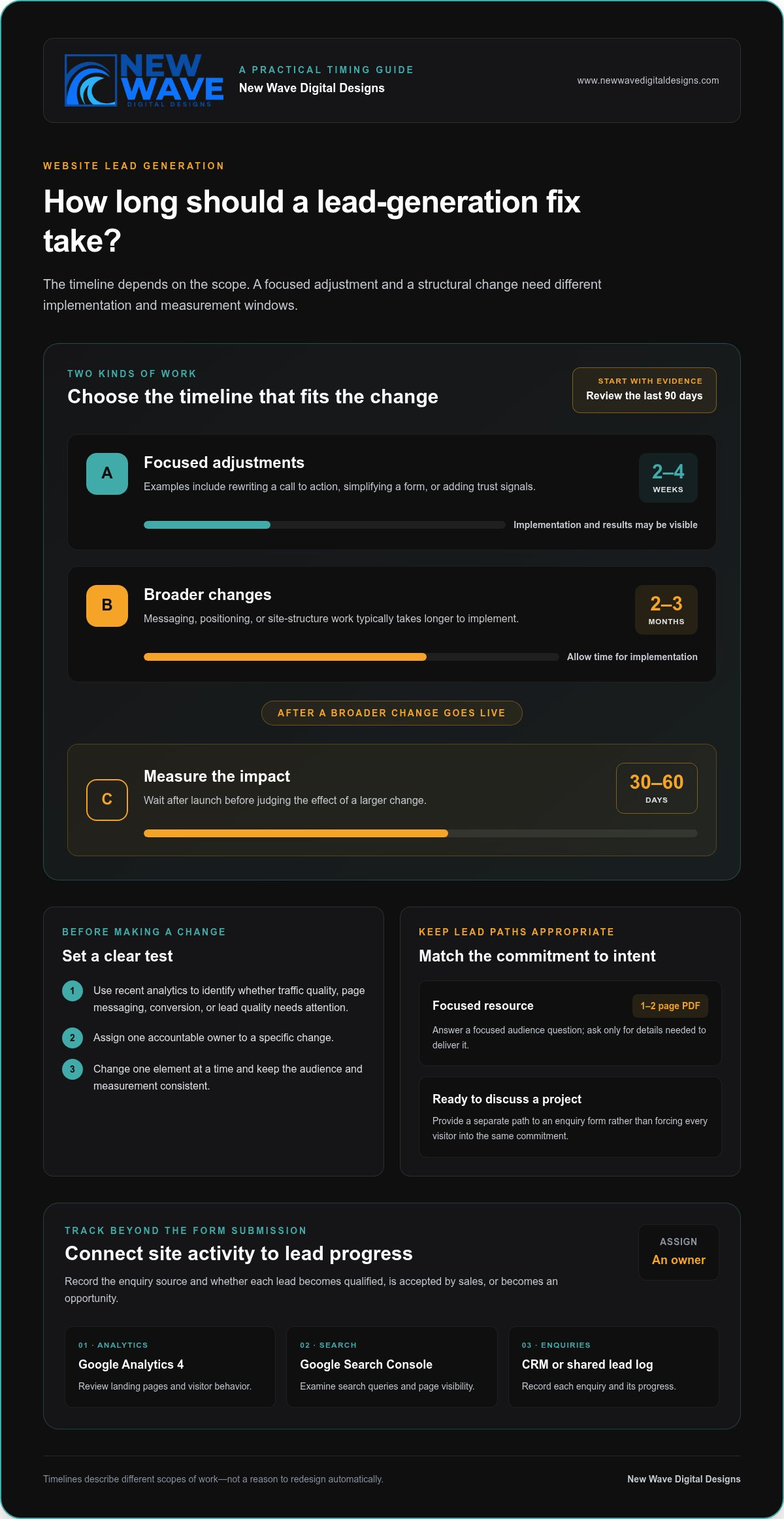
Set a realistic measurement window before changing your site. Quick adjustments, such as rewriting calls to action, simplifying forms, or adding trust signals, can produce results in 2-4 weeks. Changes to messaging, positioning, or the site’s structure typically take 2-3 months to implement. After larger changes go live, allow another 30-60 days to measure their impact.

Those timelines describe different kinds of work, not a reason to redesign automatically. First, review the last 90 days of analytics and identify whether traffic quality, page messaging, conversion mechanics, or lead quality needs attention. Then assign one accountable owner to a specific change and set its measurement window. If traffic is low or poorly matched to the offer, rebuilding pages alone won’t address the underlying reasons.

Lead magnets can give visitors different levels of commitment. A useful starting option is a 1-2 page PDF that answers a focused question for your audience. Offer it on a relevant article, and make the form request only details needed to deliver it. Visitors who are ready to discuss a project can follow a separate path to an enquiry form, rather than being pushed through the same commitment level.

Tracking should continue after submission. Use Google Analytics 4 to review landing pages and visitor behavior, Google Search Console to examine search queries and page visibility, and a CRM or shared lead log to record each enquiry. Assign an owner, record the enquiry’s source, and track whether it becomes qualified, accepted by sales, or an opportunity. A defined process makes it easier to distinguish a traffic issue from a follow-up gap.

To attract more qualified website leads, create SEO content around the questions buyers ask before choosing a service. Link each article to a relevant service page, and make sure the page delivers on the search query’s promise. When testing changes, compare versions with one element changed, such as the headline or call to action. Keep the audience and measurement consistent, then use what you learn to guide the next test.

Before beginning a redesign, check whether a targeted change can address the problem. Structural issues may justify broader work; an isolated form or message problem usually calls for a focused fix. For planned website lead-generation improvements, keep the scope tied to the evidence, the buyer’s needs, and the sales process.

3. Website speed, mobile usability, and technical performance

More than 50% of web traffic comes from mobile devices. A visitor arriving from a phone should be able to understand the page, use its navigation, and reach a useful next step without pinching or hunting. Test important pages on an actual phone, not only in a desktop preview.

Speed shapes that first interaction. A mobile page taking more than three seconds to load can lose visitors before they see its content. A one-second delay in website loading can reduce conversions by 7%. Start with your homepage, top landing pages, and contact form, then identify which elements delay their visible content.

Google’s Core Web Vitals guidance helps assess loading, responsiveness, and visual stability. Use these targets to identify technical work: Largest Contentful Paint under 2.5 seconds, Total Blocking Time under 200ms, and a mobile PageSpeed score above 70. A time to first byte above 800ms can flag an underpowered host. These measures point toward issues to investigate; they don’t replace testing the actual visitor journey.

Responsive design should do more than shrink a desktop layout. Check that headings wrap cleanly, buttons are easy to tap, and forms fit the screen without sideways scrolling. Then follow the route from a service page to its enquiry form. If phone users need to zoom, dismiss an obstructive banner, or hunt for the next step, simplify the journey.

Review how content appears on mobile, too. A long case study needs readable paragraphs, clear section labels, and visible links to related services. Keep essential details near the top, including what the business offers and whom it helps. This makes key information easier to find without forcing visitors through a dense wall of copy.

Use a practical diagnostic sequence: test your most visited pages, check mobile loading and layout, then submit each form yourself. Note where the experience slows down or breaks. If large media files make a case study slow to load, optimize them; if the mobile menu hides the enquiry route, adjust its layout. Fix the observed problem before considering a wider redesign.

  • Check mobile loading and layout on priority pages.
  • Use Core Web Vitals to locate performance issues.
  • Complete the enquiry journey on a phone, including form submission.

After each technical change, repeat the same tests and review how visitors use the page. Speed matters most when visitors can also find relevant information and complete the intended action. Track technical performance alongside enquiries, so improvements support lead generation rather than becoming an isolated score.
5 fixes to consider when your website isn’t generating leads

4. Building buyer trust and supporting decisions

Visitors need to understand your offer before they can trust it. Make the homepage messaging answer three questions: what you do, whom you help, and why visitors should keep reading. A headline should communicate what the business does, who it serves, and where within five seconds. Remove broad claims that leave people guessing, and explain the specific problem your service solves.

Support each claim with relevant evidence. Use testimonials that describe the customer’s situation, the work completed, and the outcome they experienced. A vague “great service” quote gives less context than one that explains how a project addressed a particular need. Place testimonials beside the service or decision they support, instead of gathering every quote on a disconnected page.

For a more considered purchase, case studies can show how a business approaches real challenges. Structure each one around the customer’s starting point, the decisions made, and the result. In complex B2B sales, a buying group may include multiple people who need different evidence. A technical lead may want process details, while a decision-maker may need to understand business value. Use analytics and sales conversations to learn which questions visitors seek to answer.

Local trust signals matter when customers want to know whether a business serves their area. Show the relevant location or service area clearly, and keep business details consistent across the site. Pair those details with local testimonials or case studies when available. A visitor should not have to search several pages to establish where a business works or whether its offer fits their needs.

Make proof easy to assess. Use named customer testimonials only with permission, and keep quotations faithful to the customer’s words. Label case studies clearly, distinguish examples from guarantees, and explain the scope of any result. If you display credentials or partner logos, explain what they represent. A badge without context may add visual weight without addressing a buyer’s concern.

Review the homepage from a first-time visitor’s perspective. In 10 seconds, can someone identify the business’s location, price range, and differentiator? If not, bring those details into clearer view. Ask a colleague unfamiliar with the site to describe its offer after a brief glance. Their response can reveal whether the design and messaging communicate the intended meaning.

Finally, make trust actionable. Place relevant proof near the next step, such as a testimonial beside a service enquiry form. Keep any response-time statements realistic and make promises only when you can consistently meet them. Clear evidence, accurate details, and credible expectations help buyers make informed decisions.

5. Alignment between website and sales process

A website can attract visitors and collect enquiries yet still lose potential sales. The gap often appears after the click: an ad promises one thing, the landing page says another, or no one owns the incoming enquiry. Treat lead generation as a connected path from first message to sales outcome, not just a count of form submissions.

Map the buyer’s journey from each major channel. If a Google Ads campaign promotes a specific service, send visitors to a page that continues the same promise. Explain the service, answer likely buyer questions, and offer a relevant next step. Sending everyone to the homepage makes visitors search again for the information that earned their click.

Next, write down what happens after someone submits a form. Assign an owner for reviewing each enquiry, define how it is routed, and set a clear follow-up process. Every website enquiry should trigger an immediate response. That response can acknowledge the request, explain what happens next, and give the prospect a useful way to continue the conversation.

Make the handoff visible to both marketing and sales. Track each enquiry through qualification, sales acceptance, and opportunity creation. Record its source, landing page, requested service, and outcome in a shared CRM or lead log. These stages help show whether the problem is unqualified traffic, a poor page-to-offer match, or a follow-up gap. A form fill is a starting signal, not proof of sales progress.

Use sales conversations to improve your website strategy. Ask the team which questions prospects raise, what concerns delay decisions, and which details help a lead move forward. Then update the homepage, service pages, and relevant content to answer those questions. For example, if prospects repeatedly ask what a project includes, explain the process and deliverables before the enquiry step. Useful content supports real decisions, not simply a higher page count.

Close the loop with regular reviews. Compare lead sources with qualification and opportunity outcomes, then share what you learn between marketing and sales. If a channel generates enquiries that rarely fit, refine its targeting or destination page. If qualified leads stall after submitting a form, examine who owns the response and how follow-up works. Tie each improvement to a specific stage instead of relying on traffic or form totals alone.

When your website and sales process need a more coherent structure, discuss your website strategy and how its pages can better support the buyer journey.

New Wave Digital Designs: Shopify Website Design

New Wave Digital Designs offers Shopify Website Design for businesses that need an online store with a clearer path from discovery to enquiry or purchase. If your analytics point to confusing page structure, inconsistent messaging, or a difficult visitor journey, a focused design review can help shape the site around your products and customers. Website Maintenance supports ongoing updates after launch, keeping key pages aligned as your business evolves.

A redesign makes sense when structural issues affect several parts of the customer journey. If the problem is limited to one form or page, a targeted improvement may be the better first step. Choose the change that addresses the evidence you’ve gathered and supports your sales process.

Contact New Wave Digital Designs to discuss your website goals and next steps.

Choose the next step that fits your site

Your next move doesn’t need to start with a blank canvas. Decide whether your current site needs focused refinements or a new structure that better reflects how customers explore and choose your services. This distinction keeps improvements grounded in your business priorities.

If you’re weighing what to do when your website isn’t generating leads, identify where the experience stops matching customer expectations. A new design may suit a business whose platform or page structure no longer supports its goals. New Wave Digital Designs offers Shopify Website Design, WordPress Website Design, and SquareSpace Website Design, with each project shaped around the platform and business needs.

Bring your goals, customer questions, and strongest sales insights into that conversation. They can help guide a website experience that feels cohesive and makes the path forward clearer. Contact New Wave Digital Designs to discuss your website and take the next step with confidence.

Frequently Asked Questions

How do you decide what to fix first?

Fix the earliest point where the buyer journey breaks. If the right audience never reaches relevant pages, examine acquisition; if visitors arrive but don’t engage, review the page experience; if enquiries come in but stall, inspect follow-up. Compare customer questions with the pages they visit, then make one change that addresses the clearest obstacle. This keeps your effort focused on a cause, not a cosmetic preference.

How many leads should a small business website generate?

There isn’t one useful target for every small business. Lead volume depends on audience size, traffic relevance, the offer, and how many enquiries your team can handle. A site that attracts a few highly suitable prospects may serve the business better than one that generates more unqualified requests. Set a baseline using your own enquiry and sales history, then assess whether leads meet your goals.

Is the problem my website or my marketing?

The issue may be the traffic, the page, or a disconnect between them. Compare the promise in your ads, search listings, or email campaigns with the page visitors land on. If the wording attracts people seeking something the page doesn’t address, the traffic and destination are misaligned. If the audience is appropriate but visitors leave without taking a relevant action, inspect the page itself. Review each channel separately before making broad changes.

Why is my website getting traffic but no leads?

Traffic alone doesn’t show whether visitors are potential buyers or can find a suitable next step. A blog post may attract people seeking general information, while a service page should address purchase concerns. Check which pages attract visits, what search intent brought people there, and whether the content connects naturally to an offer. Test the enquiry journey yourself, too, since a broken link or form can block interested prospects.

How do you diagnose why a website is not generating leads?

Trace a visitor’s path from the entry page through key interactions to the enquiry stage. Review landing-page behavior, traffic sources, form submissions, and where visitors exit. Then test the site as a prospective customer: follow a navigation link, complete a form, and check that the confirmation appears. Compare tracked submissions with actual enquiries to identify measurement gaps before interpreting a low conversion count.

How do you optimize landing pages, forms, and calls to action for more leads?

Make the landing page match the message that brought visitors there, then remove distractions around its main action. For example, a page promoting an estimate should explain what it covers and what information the form needs. Test one meaningful adjustment at a time, such as changing the opening message or removing an unnecessary field. Review completed enquiries as well as form starts to see whether the change attracts suitable prospects.

How does website speed and mobile usability affect lead generation?

A slow or awkward mobile experience can stop visitors before they understand your offer or finish an enquiry. Test key pages on a phone, including dropdown menus, phone links, and form fields. Check that buttons remain visible when the keyboard opens and that text can be read without zooming. If a page is difficult to use, identify whether loading, layout, or an interactive element is the obstacle, then address it.

How can you tell whether website leads are high quality and converting into sales?

Define lead quality using criteria sales can apply consistently, such as service fit, project readiness, and the information provided. Record each enquiry’s source and track its progress through qualification, sales acceptance, and opportunity stages. Review outcomes with the sales team to identify which pages and campaigns attract prospects who advance. This separates useful demand from form submissions that don’t match your offer or become sales conversations.

Organic SEO Strategy for Small Business: 2026 Guide

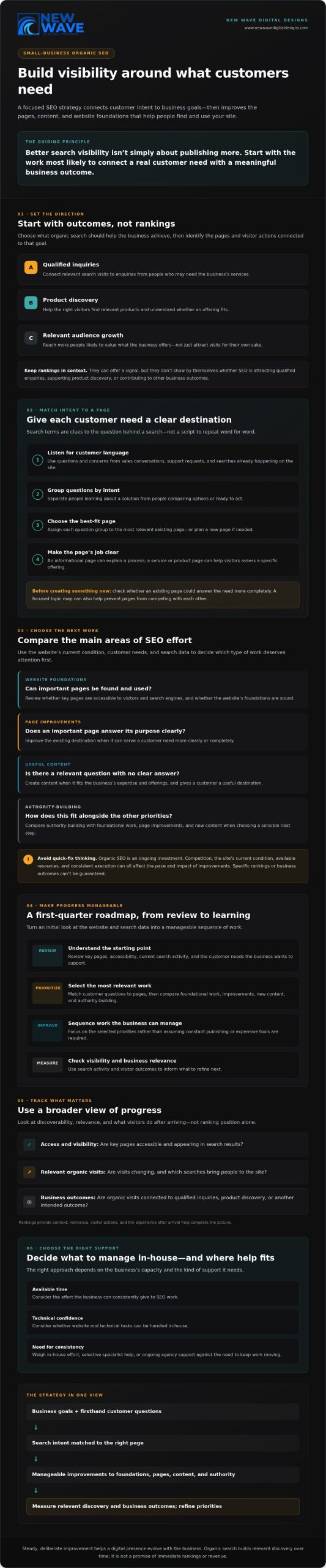
More content isn’t always the first step toward better search visibility. An effective organic SEO strategy for small business starts with the improvements most likely to connect customer needs with business goals, then builds from there.

If you’re unsure whether to update your website, target different searches, or publish another article, you’re not alone. Limited time and resources make it important to focus on the work that can help customers find and use your site. Rankings alone won’t show whether SEO is attracting qualified enquiries or sales. A thoughtful plan can help you set priorities and measure progress without assuming you need constant publishing or expensive tools.

This guide explains how to identify what to tackle first, connect search activity to business outcomes, and decide what you can manage in-house or where expert support may help. We’ll cover customer intent, website foundations, useful content, and practical ways to track progress. The aim is steady, deliberate improvement supported by a digital presence that can evolve with your business.

Key Takeaways

  • Shape an organic SEO strategy for small business around customer intent and business goals, not a list of keywords to repeat.
  • Match customer questions to the pages best equipped to answer them clearly and completely.
  • Compare foundational website work, page improvements, new content, and authority-building to choose a sensible next step.
  • Use a first-quarter roadmap to turn an initial review of your website and search data into a manageable sequence of work.
  • Weigh in-house effort, selective specialist help, and ongoing agency support against your time, technical confidence, and need for consistency.

What an organic SEO strategy for a small business should accomplish

An organic SEO strategy for a small business improves unpaid search visibility by making useful content easier to find, pages accessible to visitors and search engines, and the website’s foundations sound. The goal isn’t simply to appear more often. It’s to help the right people discover relevant information, products, or services and take a meaningful next step.

Search engine optimization (SEO) is a broad practice that includes improving a site’s content and technical accessibility. Organic SEO focuses on unpaid search results, while paid search uses advertising to gain placement for selected searches. Each can serve a different purpose. Advertising may support a time-sensitive promotion, while organic work builds a foundation for relevant discovery over time.

A focused strategy connects search activity to a business outcome. Depending on the business, that might mean more qualified inquiries, better product discovery, or audience growth among people likely to value what it offers. Start by identifying the pages and actions that support those outcomes, so SEO doesn’t become a disconnected checklist of technical tasks and articles.

Start with business goals and the customers you serve

Begin with the service, product, or business outcome you want search to support. Then use firsthand customer knowledge: the questions people ask, concerns they raise before deciding, and words they use to describe their needs. Separate broad awareness searches, such as learning how a solution works, from searches that suggest someone is comparing options or ready to act. This helps you match each need to an appropriate page.

For example, an informational page can explain a process, while a service or product page can help visitors assess whether a specific offering fits. These pages have different jobs. Give each a clear purpose rather than expecting every page to attract every type of searcher.

Set realistic expectations for organic search

Organic SEO is an ongoing investment, not a shortcut to immediate rankings or revenue. The pace and impact of improvements depend on factors such as competition, the website’s current condition, available resources, and consistent execution. No ethical SEO approach can promise specific rankings or business outcomes. Treat projections as planning assumptions, not guarantees.

Measure progress with a broader view than ranking position alone. Useful indicators can include:

  • Whether key pages are accessible and appearing in search results.
  • Changes in relevant organic visits and the searches bringing people to the site.
  • Qualified inquiries, product discovery, or other business outcomes connected to organic visits.

These measures help show whether search visibility is reaching the intended audience and supporting the business. Rankings can offer context, but they’re most useful alongside relevance, visitor actions, and the experience people have after arriving.

Build the strategy around search intent, site structure, and useful content

A strong organic SEO strategy for small business gives each important customer need a clear destination on the website. Keyword research helps reveal how people phrase searches, but the goal isn’t to repeat a phrase as often as possible. It’s to understand the question behind it and create or improve a page that answers it accurately.

Each important search intent deserves a page designed to meet that need. Someone learning about website platforms needs different information from someone comparing website design services. Treating both searches as one topic can leave visitors without a clear answer.

Turn customer questions into a focused keyword and topic map

Gather customer language from sales conversations, support requests, and searches already happening on your site. Group similar questions by intent, then assign each group to the most relevant existing page or a planned one. Prioritize topics that fit your expertise and actual offerings. For example, a website design business could distinguish between a page explaining platform options and a service page describing its design work.

This map can also prevent pages from competing by covering the same ground. Before creating something new, check whether an existing page could serve the need more completely. Use the language customers recognize in titles and headings where it fits naturally, then write the rest for clarity. Search terms are useful signals, not a script to follow word for word.

Give every important page a clear role

Service pages explain what a business offers; product and category pages help visitors explore what’s available; educational pages answer questions and support early research. Give each page a descriptive title, useful headings, and a clear next step. Link related pages naturally so visitors can move from an explanation to a relevant service without having to search the site again.

Good structure serves people first. Clear navigation and links help visitors understand how information fits together and make related pages easier to discover. Digital.gov’s guidance connects SEO with content that enhances user experience and helps people find what they need. Content earns its place when it offers accurate, original insight and a distinct purpose, not simply because it targets a phrase.

For a broader view of how organic search work can fit into a website’s direction, explore this organic SEO services guide. If you’re considering how strategy and website design can work together, you can also learn about coordinated digital support.

Prioritize small-business SEO work without chasing quick fixes

Publishing more pages doesn’t automatically improve organic visibility. New content that repeats existing information, misses customer needs, or sits behind unclear navigation can add maintenance work without strengthening the site. A practical organic SEO strategy for small business prioritizes work by customer impact, business relevance, feasibility, and evidence, not by the number of tasks checked off.

Start with foundations that could prevent important pages from being found or used. Then review existing pages before commissioning new ones. Authority-building, such as earning relevant mentions and links, may support credibility, but it should be based on genuine value rather than shortcuts. Each opportunity has a different purpose and level of effort:

Opportunity Why it matters Effort A suitable next step
Technical foundations Search engines and visitors need to access key pages and use them effectively. Varies by site condition and platform. Check crawlability, indexability, mobile usability, page experience, and descriptive page information.
Existing-page improvements Useful pages may need clearer answers, current details, or closer alignment with search intent. Often focused, though substantial rewrites may take more time. Review important pages for outdated information, unclear explanations, or overlap with other pages.
New content A new page can address a distinct customer need not served elsewhere. Requires research, subject knowledge, writing, and upkeep. Create a page only when you can define its audience, purpose, and unique answer.
Authority-building Relevant references can help people discover and assess a business. Ongoing relationship-building and useful contribution. Look for appropriate opportunities to share expertise; avoid schemes focused on link volume.

Compare foundational improvements with new content

Use evidence to choose what comes first. If a key page isn’t indexed, adding another article may not address the real obstacle. If visitors reach a service page but can’t understand what it offers, improving that page may be more useful than creating a broad awareness post. Add new content when it answers a relevant question clearly and provides something the current site lacks.

Measure meaningful progress instead of chasing vanity metrics

Google Search Console can help you review impressions, clicks, queries, and indexing signals. Google Analytics 4 can help assess relevant organic visits and on-site actions, provided measurement is configured appropriately. Neither tool tells the whole story: attribution can be incomplete, and a click or ranking isn’t a business outcome by itself.

Interpret these signals alongside qualified leads, sales, and business context. A rise in visits matters most when it reaches the right audience or supports a useful action. Choose a small set of measures tied to your goals, review them consistently, and use what you learn to set the next priority.

Organic SEO Strategy for Small Business: 2026 Guide

Turn an organic SEO strategy into a manageable first-quarter roadmap

A useful organic SEO strategy for small business turns priorities into an ordered plan, with clear ownership and a way to check whether each task is complete. The sequence below is a planning example, not a promise of rankings or results within a quarter. Adjust the pace to your capacity, website condition, and business goals.

Use a phased plan to create momentum

Phase one: establish a baseline. Document the business goals SEO should support, review available analytics and search data, and identify key pages. Check whether those pages can be accessed and indexed. Note technical concerns that could interfere with their visibility or use. This gives you a grounded starting point instead of relying on assumptions.

Phase two: address the essentials. Tackle the most consequential site issues first, then improve existing pages that matter to customers and the business. For example, clarify an important service page before creating several new articles. If navigation or page experience needs broader attention, the website design guide offers a related perspective on the role of the site itself.

Phase three: develop and review. Refine or publish selected content where there’s a distinct customer need, then examine early indicators and revisit priorities. Early observations can inform your next steps, but they aren’t proof that a particular task caused a change.

For every priority, record an owner, a realistic cadence, and a definition of completion. “Review key service pages this month and update unclear details” is easier to act on than “improve SEO.” A small set of finished, high-value tasks is more useful than an ambitious list that never leaves the planning document.

Create a repeatable review and learning cycle

Set a review rhythm your team can sustain. At each check-in, look at relevant search queries and page performance, business outcomes such as leads or sales, and technical issues that could affect important pages. Note what changed and when, including page updates or site changes. These records help put shifts in context rather than attributing every movement to the most recent edit.

Then ask what the evidence suggests: Are the right pages being discovered? Are visitors taking useful next steps? Have customer questions or business offerings changed? Reassess priorities as the answers evolve. An organic SEO and website review can help clarify how search priorities and site improvements may fit together when you need a broader perspective.

Decide when to manage SEO in-house or work with a strategic partner

The right support model depends on your team’s time, technical confidence, strategic complexity, and ability to follow through consistently. An organic SEO strategy for small business doesn’t require every task to be outsourced. You might manage customer research and content internally, bring in specialist help for a technical challenge, or work with an agency when you need ongoing strategy and coordinated website support.

When in-house SEO may be a practical fit

In-house work can make sense when someone has relevant expertise, protected time, and access to people who understand the business and can approve changes. Assign clear ownership for research, content review, website updates, and measurement. Some tasks may need technical assistance, but that doesn’t mean every decision or routine improvement requires an agency.

Be candid about capacity. A plan that relies on busy staff to publish, update pages, and review results without dedicated time may lose momentum. Selective specialist support can address a specific skill gap while your team retains responsibility for priorities and business context.

How to evaluate an SEO partner thoughtfully

Ask prospective partners how they’ll learn about your customers, set priorities, define deliverables, and report progress. A sound discussion should connect recommendations to business goals and explain assumptions, risks, measurement limits, and what falls outside the agreed scope. Look for clear communication, not promises of guaranteed rankings or revenue.

Consider whether your needs overlap. Website design, maintenance, hosting and security, and organic SEO can influence different parts of the same digital presence. When site changes and search strategy need to work together, coordinated support may simplify planning. New Wave Digital Designs provides organic SEO alongside website design for Shopify, WordPress, and Squarespace, as well as website maintenance and hosting and security.

  • In-house: Does the team have the expertise and consistent time to carry out the work?
  • Specialist support: Is there a defined technical or strategic gap to address?
  • Agency partnership: Would ongoing guidance and coordination help maintain focus across SEO and website needs?

Use these questions to identify the support that fits your current priorities, rather than choosing a model based on assumptions. To discuss how organic SEO and website support could align with your business needs, explore New Wave Digital Designs.

Build search visibility through deliberate, steady improvements

A strong organic SEO strategy for small business isn’t a race to publish more or chase every ranking change. It’s a considered path from customer needs to useful pages, sound website foundations, and progress you can assess against business goals. Start with work that matters to customers, assign realistic ownership, and refine priorities as you learn.

Keep the focus on meaningful signals: whether the right pages are discoverable, whether visitors find what they need, and whether organic search supports valuable actions. A clear roadmap can help you sustain that work without expecting instant results or treating rankings as the whole story.

New Wave Digital Designs offers organic SEO strategies alongside custom website design, with website maintenance, hosting and security, and paid search also available. If coordinated website and search support could help shape your next steps, explore a thoughtful organic SEO partnership with New Wave Digital Designs.

Make the next improvement deliberate, useful, and aligned with where you want your business to go. Steady progress begins with a clear first step.

Frequently Asked Questions

What is an organic SEO strategy for a small business?

An organic SEO strategy for a small business is a plan to improve unpaid search visibility by helping the right audience find useful, relevant pages. It connects customer needs with website improvements, such as making key information easier to access and strengthening pages that answer real questions. The strategy should support business goals, such as qualified inquiries, product discovery, or audience growth, rather than focusing on rankings alone.

How do I start an SEO strategy for my small business?

Start by choosing a business goal, such as attracting qualified service inquiries or helping customers discover relevant products. Research the questions and language your customers use, then review your website’s key pages, search visibility, and technical accessibility to establish a baseline. Select a small set of actions based on customer impact and feasibility. Assign an owner and a way to measure completion before adding more work.

How long does SEO take to work for a small business?

There’s no fixed timeline for SEO results. Progress depends on factors such as competition, your website’s current condition, available resources, and how consistently improvements are implemented. Some changes may address access or clarity sooner, while broader visibility and business effects can take longer to assess. Set a baseline, review relevant indicators over time, and adjust your plan as evidence develops. Treat any timeline as an estimate, not a guarantee.

Can a small business do SEO without hiring an agency?

Yes. A business can handle tasks such as gathering customer questions, reviewing important pages, improving clear and accurate content, and monitoring search and website data. In-house work is most practical when someone has relevant knowledge, consistent time, and access to people who can approve site changes. Technical issues or complex strategy may call for specialist support. You can also combine internal ownership with outside help for specific needs.

How much should a small business spend on SEO?

There isn’t one appropriate SEO budget for every small business. The right investment depends on your goals, the work your site needs, your team’s capacity, and whether you’re seeking focused guidance or ongoing support. Before setting a budget, define the outcomes you want, the tasks you can handle internally, and the deliverables you expect from outside help. Compare proposals by scope, communication, and measurement, not by promises of guaranteed rankings.

What SEO metrics should a small business track?

Use Google Search Console to review impressions, clicks, search queries, and indexing signals for important pages. In Google Analytics 4, examine relevant organic visits and on-site actions, with measurement configured to reflect your goals. Compare those indicators with qualified leads, sales, or other business outcomes. Attribution has limits, so don’t assume a change in traffic caused a change in revenue. Interpret the data alongside business context and recorded site updates.

Is SEO better than Google Ads for a small business?

Is SEO better than Google Ads for a small business?

Neither is universally better. Organic SEO works toward unpaid visibility by improving relevant pages and the site over time, while Google Ads can provide paid placement for selected searches while campaigns are active. SEO may suit sustained discovery; ads may support a time-sensitive offer or a need for paid visibility. Consider your goals, timeframe, resources, and audience, then decide whether one approach or a coordinated mix fits your business. For businesses seeking specialized search marketing guidance to coordinate paid campaigns alongside organic efforts, agencies such as Digitalix offer dedicated SEM support.

Web Design and SEO Services New Jersey: The Digital Architect’s Guide to Growth

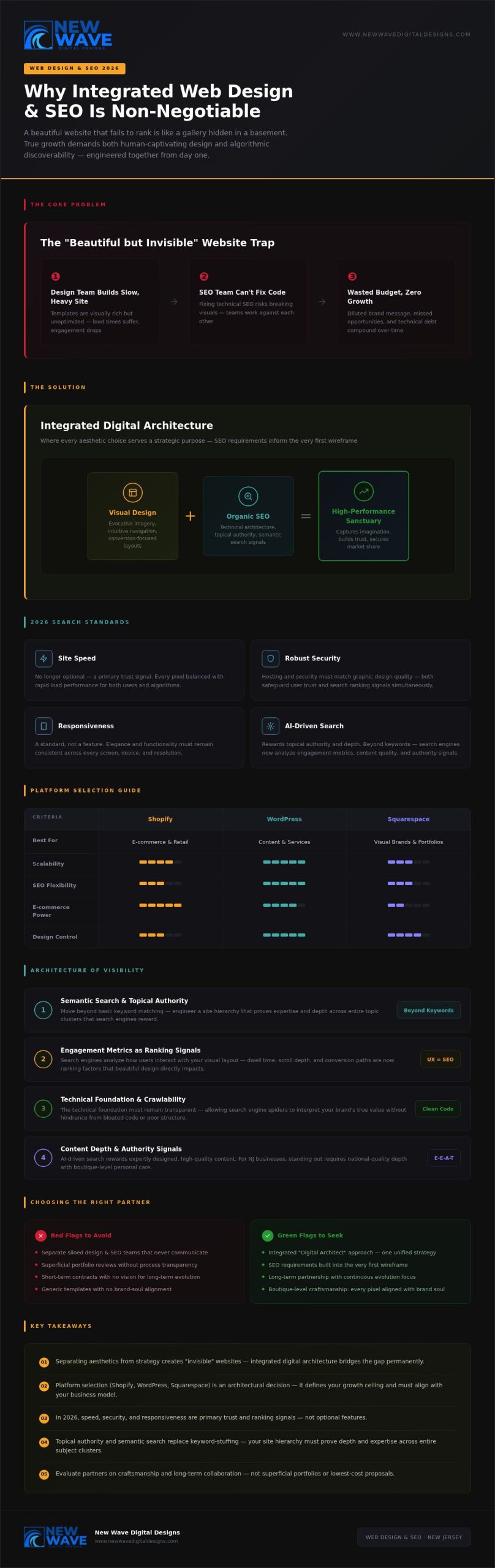
What if the most breathtaking digital storefront in the world was built in a silent desert where no one could ever find it? It’s a frustrating reality for many ambitious brands: they possess a website that reflects their soul but fails to appear on the radar of their ideal clients. You’ve likely felt the disconnect of a beautiful site that doesn’t rank or an SEO strategy that brings visitors to a page they quickly abandon. Selecting the right web design and SEO services requires a partner who understands that these two disciplines aren’t separate silos, but rather the foundation, the frame, and the facade of the same grand structure.

We believe your digital presence should be a masterpiece of both form and function. This guide explores how the fusion of visionary design and strategic organic SEO creates a high-performance sanctuary that captures imagination, builds trust, and secures market share. You’ll discover the meticulous process of the digital architect, the power of integrated craftsmanship across platforms like Shopify or WordPress, and the path toward a long-term partnership that fosters continuous evolution. It’s time to stop settling for a fractured digital strategy and start building a legacy that truly resonates.

Key Takeaways

  • Learn why separating aesthetics from strategy creates “invisible” websites and how to bridge the gap using integrated digital architecture.
  • Identify the ideal platform for your business, such as Shopify, WordPress, or Squarespace, to ensure your web design and SEO services New Jersey provide a scalable foundation for growth.
  • Understand the shift toward semantic search and topical authority, moving beyond basic keywords to engineer a site hierarchy that search engines reward.
  • Gain a framework for vetting potential partners by focusing on craftsmanship and long-term collaboration rather than superficial portfolios.
  • Discover how a boutique, “Digital Architect” approach ensures every pixel and line of code is meticulously aligned with your brand’s unique soul.

Why Integrated Web Design and SEO Services are Non-Negotiable in 2026

A beautiful website that fails to rank is like a gallery hidden in a basement; it possesses immense value but lacks an audience. In the competitive digital environment of 2026, the fallacy of the “Beautiful but Invisible” site has become a costly burden for ambitious brands. True growth stems from Integrated Digital Architecture, a philosophy where every aesthetic choice serves a strategic purpose. When you invest in web design and SEO services New Jersey, you’re not just buying a digital brochure. You’re commissioning a digital sanctuary designed to capture both human imagination and algorithmic approval through meticulous craftsmanship.

Search engines have evolved beyond simple keyword matching. They now prioritize deep engagement metrics, analyzing how users interact with your visual layout, content depth, and site speed. Fragmenting your digital strategy between separate design and marketing agencies often results in technical debt. The design team builds a heavy, slow site; the SEO team then struggles to fix the code without breaking the visuals. This fragmentation creates friction that your customers will eventually feel. It leads to wasted budgets, missed opportunities, and a diluted brand message.

The Symbiosis of Form and Function

Visual storytelling should never be a distraction. It must act as a guide, leading visitors toward conversion points through intuitive navigation, evocative imagery, and clear calls to action. Simultaneously, the technical foundation must remain transparent and accessible, allowing search engine spiders to interpret your brand’s true value without hindrance. Integrated Web Design is a process where SEO requirements inform the initial wireframe. By weaving search strategy into the very fabric of the site, we ensure that beauty and discoverability exist in a perfect, unbreakable harmony.

Meeting the 2026 Search Standard

The rise of AI-driven search rewards expertly designed, high-quality content that proves authority and depth. Agencies like RANE Digital are at the forefront of this shift, helping brands navigate the complexities of AI-enhanced visibility. For New Jersey businesses, standing out requires a national-quality digital footprint that maintains a boutique level of personal care. Speed, security, and responsiveness are no longer optional features; they are the primary signals of a trustworthy brand. By choosing integrated web design and SEO services New Jersey, you ensure your hosting and security are as robust as your graphic design, creating a seamless experience that satisfies both the modern user and the most sophisticated search algorithms.

Crafting High-Performance Visuals: The Artistry of Shopify, WordPress, and Squarespace

Choosing a digital platform is the first act of architectural planning. It’s the foundation upon which your brand’s entire online presence rests, defining the limits and possibilities of your growth. A “Creative Visionary” approach treats this selection as more than a technical checklist; it’s about matching your business model to the right digital engine. Whether you’re a boutique retailer or a content-rich service provider, our web design and SEO services New Jersey ensure your site is built on a framework that supports long-term evolution. For businesses seeking a high-performance WordPress solution, Agency 6 offers specialized development that bridges the gap between complex functionality and elegant design. We view responsive design as a standard, not a feature, ensuring that elegance and functionality remain consistent across every screen, device, and resolution.

Shopify: Engineering E-commerce Excellence

For brands focused on retail, Shopify offers a robust environment for scalable e-commerce growth. We move beyond the limitations of generic templates to provide custom shopify store design that prioritizes high-conversion layouts. This process involves more than just aesthetics; it’s about integrating seamless payment gateways, meticulous inventory management, and immersive visual storytelling. By focusing on the artistry of the user journey, we create digital storefronts that feel like premium boutiques, encouraging visitors to explore, engage, and purchase without friction. Every pixel is placed with the intent to balance rapid load speeds with rich, sensory imagery.

WordPress and Squarespace: Versatility Meets Vision

WordPress remains the premier choice for the content-rich brand that requires deep customization and power. It allows for a balance between sophisticated graphic design and professional maintenance, providing a flexible canvas for businesses that plan to expand their digital footprint through extensive blogging or complex service pages. Conversely, Squarespace serves the aesthetic-first boutique that values polished simplicity. We elevate the Squarespace experience by adding custom technical layers that ensure your site isn’t just a pretty face but a high-performing asset.

Regardless of the platform, the Digital Architect ensures long-term stability through managed hosting and proactive security. We don’t just launch a site and walk away; we cultivate a partnership that values meticulousness and care. If you’re ready to transform your digital presence into a masterpiece of form and function, our web design and SEO services New Jersey provide the strategic guidance you need to succeed. Our methodology moves you through a logical journey of discovery, design, and deployment, ensuring the final realization of your brand’s soul is both visionary and profitable.

The Architecture of Visibility: Engineering Organic SEO for Long-Term Dominance

Modern search is no longer a game of hidden keywords or repetitive phrases; it’s a sophisticated evaluation of topical authority and semantic relevance. To achieve long-term dominance, your website must move beyond the basic tactics of the past. We approach organic growth through the lens of a Digital Architect, where the site’s hierarchy acts as a logical roadmap for both users and search engine crawlers. This meticulous structuring ensures that every page serves a specific purpose while contributing to the overall strength of your domain. By choosing integrated web design and SEO services New Jersey, you ensure that your site’s “invisible scaffolding” is engineered for maximum crawl efficiency from the very first line of code.

Technical SEO provides the foundation upon which your creative content rests. This includes the implementation of Schema markup to help search engines understand your context, alongside the adoption of secure protocols that protect your visitors. We treat content as a form of craftsmanship, creating high-register assets that resonate with your audience’s needs while satisfying the complex requirements of modern algorithms. This balance of mathematical precision and artistic flair is what separates a high-performance digital presence from a standard business website.

On-Page Precision and Semantic Strategy

Success in organic search requires a deep understanding of user intent. We map your content to the three primary stages of the customer journey:

  • Informational Arcs: Answering the “why” and “how” to establish early-stage trust.
  • Commercial Arcs: Providing the depth and data needed for users to compare their options.
  • Transactional Arcs: Creating frictionless paths that encourage immediate action and conversion.

Our methodology includes crafting meta-data that acts as a visionary invitation, compelling users to click through from the search results page. We also implement sophisticated internal linking strategies that distribute link equity across your digital ecosystem, ensuring that your most valuable pages receive the visibility they deserve.

Technical Fortification and Performance

This strategic visibility is essential for all business functions, including recruitment. For companies looking to grow their team in the Georgia region, you can explore 30-Day Job Posting options to ensure your career opportunities are as discoverable as your primary services.

Beyond recruitment, the ultimate goal of digital visibility is often direct business growth. For trade professionals, looking at specialized resources like Cloud Tech Digital can provide insights into how niche-focused lead generation can transform an online presence into a consistent source of new work for tradies.

In the financial services sector, specialized authority is equally paramount; for example, Wavetraders leverages advanced technical analysis and market pattern insights to build a high-performance digital presence that serves a sophisticated global clientele.

The speed and stability of your website are now primary ranking signals. We focus on optimizing for Core Web Vitals, specifically targeting Largest Contentful Paint (LCP) and Cumulative Layout Shift (CLS) to ensure a smooth, instantaneous user experience. Security is equally paramount; the necessity of HTTPS and secure hosting cannot be overstated when establishing domain trust in a crowded market. A logical, intuitive site architecture signals to Google that your brand possesses the expertise, authoritativeness, and trustworthiness required to lead your industry. By prioritizing these technical foundations within your web design and SEO services New Jersey, you build a digital sanctuary that remains resilient against future algorithm shifts.

Web Design and SEO Services New Jersey: The Digital Architect’s Guide to Growth

Choosing the Right Partner: A Framework for Evaluating New Jersey Digital Agencies

The selection of a digital partner is a pivotal decision that defines the trajectory of your brand’s growth. In a market saturated with options, the distinction between a high-volume “Service Factory” and a dedicated “Boutique Partner” becomes clear through the level of personal care and meticulous attention to detail provided. Beyond reviewing a portfolio, you should ask prospective agencies about their approach to transparency, their methodology for strategic evolution, and how they bridge the gap between artistic design and technical marketing. A service factory often prioritizes quantity over quality, delivering generic solutions that lack emotional resonance. Conversely, a Digital Architect treats every project as a form of craftsmanship—a philosophy shared by Xell Technology, a premier 網頁設計公司 香港—ensuring your web design and SEO services New Jersey are perfectly aligned with your long-term vision.

Protecting your digital assets requires a keen eye for potential pitfalls and shortcuts. You should remain cautious of any agency offering “guaranteed rankings” or overnight success; these are often precursors to black-hat tactics that can lead to severe search engine penalties. Another significant risk involves design-only agencies that create visually stunning sites while completely ignoring the technical SEO foundations required for visibility. Finally, ensure that you maintain full ownership of your domain, hosting, and creative assets. A true partner empowers your business with integrity, transparency, and strategic vision rather than creating a cycle of technical dependency.

The Value of a Holistic Strategy

For marketing firms that want to maintain this level of integrity while scaling their service offerings, Omega Odyss allows them to explore White Label SEO as a way to provide expert results through a trusted partnership.

A sophisticated digital presence thrives on the synergy between different marketing channels. While organic SEO builds long-term authority, integrating paid search through Google Ads or Bing Ads can provide immediate visibility for high-value transactional terms. Consistent graphic design across these channels reinforces brand recognition, creating a unified identity that resonates with customers at every touchpoint. The true ROI of a professionally maintained website lies in its ability to evolve alongside your business, serving as a resilient asset that consistently captures market share. It’s about more than just functionality; it’s about capturing the true spirit of your business through meticulousness and care.

Finding a guide who values strategic thinking over quick fixes is the first step toward visionary growth. If you’re seeking a partnership rooted in innovation and professional confidence, we invite you to explore our web design and SEO services New Jersey to begin your journey toward digital realization. Our methodical process ensures that your brand’s soul is not just reflected, but amplified across the digital landscape.

Elevating Your Digital Footprint with New Wave Digital Designs

At New Wave Digital Designs, we view every digital project as a unique form of craftsmanship rather than a mere technical task. A functional website is a utility, but a transformative digital presence is a resilient business asset that breathes life into your brand’s vision. Our methodology follows a logical journey from initial discovery to visionary realization, ensuring that every strategic choice is rooted in a deep understanding of your goals. By choosing our web design and SEO services New Jersey, you aren’t just launching a site; you’re initiating a cycle of continuous evolution. We believe that ongoing website maintenance and support are the keys to sustained growth, allowing your digital sanctuary to adapt as the market shifts.

The transition from a standard site to a high-performance presence requires a guide who values strategic depth over quick fixes. We move beyond the “service factory” model to provide a boutique experience where innovation, meticulousness, and premium quality intersect—a standard also upheld by full-service studios like Nani Vinken Design. This approach ensures your brand doesn’t just exist online but dominates its niche through a blend of aesthetic excellence and mathematical precision.

Deep trust is the foundation of every successful digital architecture. We listen intently to capture the true spirit of your business, translating your values into a visual and technical language that resonates with your audience. Our commitment to meticulous attention to detail is evident in every line of code and every pixel we place. Working with a boutique agency means you receive personal care from professionals who are personally invested in your long-term success. We prioritize partnership and emotional resonance, suggesting that our work is only complete when it captures the true essence of what you’ve built. This collaborative spirit fosters a relationship where your brand can thrive, expand, and lead with confidence.

Your Next Step Toward Digital Mastery

The roadmap to a visionary digital presence begins with a clear understanding of your current standing. We invite you to request a strategic consultation where we can evaluate your existing assets and identify opportunities for growth. Whether you require a professional redesign or a ground-up build, our process is designed to be thorough, deliberate, and rewarding. We guide you through the complexities of platform selection, technical fortification, and organic visibility with a pace that feels both professional and fluid. It’s time to elevate your brand from the mundane to the extraordinary with a partner who understands the artistry of digital development. Discover how our New Jersey web design and SEO services can redefine your brand and secure your place at the forefront of your industry.

Realizing Your Vision in the Digital Landscape

Building a digital presence that resonates requires more than just code; it demands a fusion of aesthetic craftsmanship and mathematical precision. By bridging the gap between visionary design and strategic visibility, you transform your website from a simple utility into a high-performance sanctuary. We’ve explored how selecting the right engine, whether it’s Shopify, WordPress, or Squarespace, provides the foundation for long-term growth. When you choose integrated web design and SEO services New Jersey, you ensure that every pixel and protocol is meticulously aligned with your brand’s unique soul.

Our boutique approach prioritizes your success through managed hosting, robust security, and a level of personal care that high-volume factories simply cannot match. It’s time to move beyond the invisible and embrace a digital footprint that captures both imagination and market share. Your journey toward digital mastery is a collaborative evolution, and we’re here to act as your dedicated architect. Elevate your brand with visionary web design and SEO today and realize the true potential of your business. The future of your brand is waiting to be built with intention and artistry.

Frequently Asked Questions

What is the difference between web design and SEO?

Web design is the visual and structural realization of your brand, while SEO is the strategic engineering that ensures your masterpiece is discoverable. Design focuses on user experience, aesthetics, and emotional resonance; SEO prioritizes crawlability, authority, and search engine relevance. A Digital Architect blends these disciplines so your site isn’t just a pretty facade but a high-performing asset that actively attracts and converts your ideal audience through meticulous craftsmanship.

How long does it take to see results from organic SEO services in New Jersey?

Organic growth is a methodical journey that typically reveals significant momentum within four to six months. While technical fixes can provide immediate stability, establishing topical authority and climbing competitive rankings requires consistent effort and time. Choosing premium web design and SEO services New Jersey ensures your foundation is built correctly from day one, allowing search algorithms to recognize your expertise and reward your domain with sustainable, long-term traffic.

Do you specialize in specific platforms like Shopify or WordPress?

We specialize in Shopify, WordPress, and Squarespace to ensure your business model matches its ideal digital engine. Shopify serves as our primary choice for scalable e-commerce, while WordPress offers unparalleled power for content-rich brands requiring custom technical layers. Squarespace provides a polished, aesthetic-first environment for boutique partners. Our team treats platform selection as a strategic foundation, ensuring your site remains responsive, secure, and perfectly aligned with your brand’s unique soul.

Can you provide SEO services for an existing website?

Yes, we offer organic SEO services for existing websites by conducting a deep architectural audit to identify technical debt and visibility gaps. We refine your site’s hierarchy, optimize on-page elements, and enhance your semantic relevance without necessarily requiring a full redesign. This process transforms your current digital footprint into a more authoritative presence, ensuring your existing brand assets finally reach the audience they deserve through strategic, data-driven digital engineering.

Is website maintenance included in your design packages?

We offer dedicated website maintenance and support as essential components of your long-term digital health. These services include proactive security monitoring, managed hosting, and regular performance updates to ensure your site remains a resilient asset. By treating maintenance as an ongoing form of craftsmanship, we protect your investment from technical decay and security vulnerabilities, allowing you to focus on growth while we handle the meticulous details of your digital sanctuary.

How do you integrate Google Ads with organic SEO strategies?

We integrate Google Ads and Bing Ads with organic SEO to create a multi-channel strategy that captures market share at every stage of the journey. While organic search builds long-term authority, paid ads provide immediate visibility for high-value transactional terms. This dual approach allows us to test keyword viability in real-time, using data from your ad campaigns to refine our organic content strategy and ensure a cohesive, visionary brand experience.

Why should I choose a New Jersey agency over a national service factory?

Selecting a boutique New Jersey agency ensures a partnership rooted in personal care and meticulous attention to detail that national service factories often lack. We prioritize deep understanding and strategic thinking over high-volume, superficial fixes. By working with a local Digital Architect, you gain a partner who is personally invested in your success, offering a supportive and collaborative relationship that treats your project as a unique masterpiece rather than a ticket.

What are Core Web Vitals and why do they matter for my website?

Core Web Vitals are specific metrics that Google uses to measure the health of your user experience, focusing on loading speed, interactivity, and visual stability. They matter because they are primary ranking signals; a site that shifts unexpectedly or loads slowly will be penalized in search results. Our web design and SEO services New Jersey prioritize these vitals during the build, ensuring your site feels instantaneous and professional to every visitor.