
What if choosing between SEO and paid search is the wrong first decision? For a small business, search marketing services for small business work best when organic visibility, advertising, and the website experience are planned together. It’s understandable to weigh near-term campaign activity against longer-term growth when time and marketing resources are limited. But clicks and rankings alone don’t show whether a strategy is attracting the right prospects or supporting business goals.
This guide explains how organic SEO, Google Ads, and Bing Ads serve different needs, and how to prioritize them based on your goals, website readiness, and available resources. You’ll also learn what a search marketing engagement can include, from practical deliverables to reporting that connects search activity with meaningful outcomes. A campaign can bring someone to your site, but the website and measurement framework help determine what happens next. Together, these elements create a clearer path from visibility to informed decisions.
Key Takeaways
- Search marketing services for small business can combine organic SEO with Google Ads or Bing Ads, depending on your goals, timing, and website readiness.
- Use paid search to explore which queries and messages resonate while organic SEO develops visibility over time.
- Compare proposed work by how it connects to customer intent and business outcomes, and by the clarity of its deliverables and reporting.
- Prioritize in sequence: define outcomes, review your website, choose a channel focus, then measure what matters.
- A responsive, brand-aligned website helps carry the visitor experience forward after a search result or ad earns the click.
What search marketing services for small business actually include
Search marketing brings together the work that helps a business appear when people search: organic visibility earned through SEO and paid placements purchased through advertising platforms. The Search marketing overview describes this broader discipline, which includes both routes. For a small business, the distinction matters because each channel has a different mechanism, pace, and role in reaching potential customers.
SEO develops organic visibility over time; paid search can place an ad in eligible results for selected queries, subject to an auction and platform factors. Neither a ranking nor a click is a business outcome by itself. They are signals to interpret alongside what happens next, such as a qualified inquiry, purchase, or other action that supports the business.
Organic SEO and paid search: two routes to search visibility
Organic SEO improves a site’s relevance, accessibility, and ability to appear in unpaid search results. Work can include making pages easier for search engines to understand, aligning useful content with customers’ questions, and addressing technical barriers to discovery. Results develop through sustained improvements, not through buying an ad placement for a particular search.
Paid search uses platforms such as Google Ads and Bing Ads to show ads for selected queries. Advertisers set campaign parameters, but placement depends on auction dynamics and other platform factors, so no position is assured. Ads can provide visibility while a business explores demand or promotes a timely service. SEO develops a foundation for relevant searches over time.
What small-business search marketing services can cover
Well-defined search marketing services for small business turn strategy into practical work across search discovery, campaigns, and the website. Priorities depend on business goals and site condition, but the work may include:
- Organic SEO: keyword research to understand search intent, technical and on-page improvements, and search-focused content that answers useful customer questions.
- Paid search: campaign planning, ad management, and performance reviews to assess which queries and messages are bringing relevant visits and actions.
- Website support: design, maintenance, hosting, and security to help keep the destination after the click responsive, clear, and dependable.
These elements are connected. An ad may earn a visit, but a confusing page can interrupt the journey. Strong content can also be harder to find if technical issues affect important pages. A responsive, brand-aligned website on Shopify, WordPress, or Squarespace gives search visitors a more coherent next step. Ongoing maintenance and security help support that experience.
Before judging performance, define the action you want a visitor to take. Then read rankings, impressions, and clicks as indicators of visibility, not proof of growth on their own. Pair them with relevant actions and the website experience to assess search marketing as a connected system, rather than a collection of isolated tasks.
How SEO, Google Ads, and Bing Ads work together
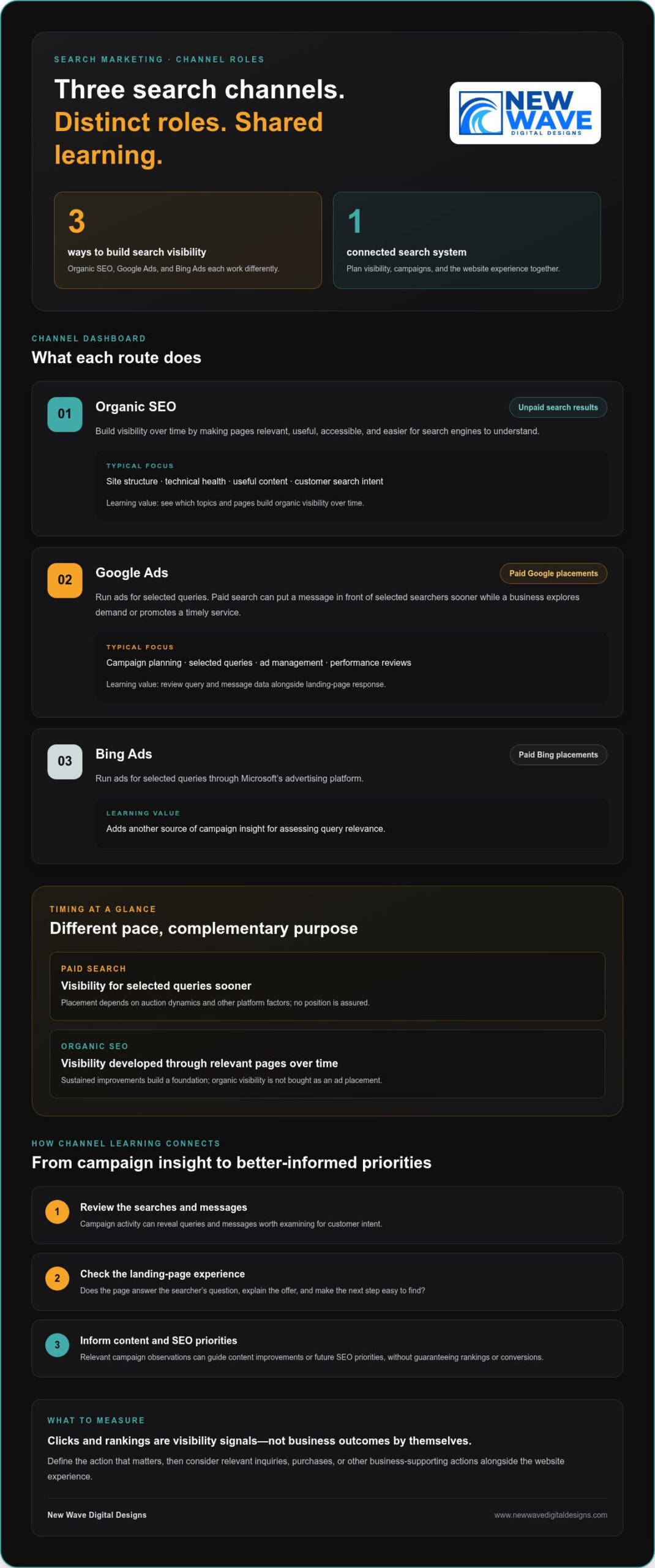
SEO and paid search can support the same business goal without doing the same job. Organic visibility develops as a site becomes more relevant and useful for important searches. Google Ads and Bing Ads can place ads for selected queries, subject to each platform’s auction and other factors. Together, they give a small business distinct ways to build visibility, observe customer intent, and refine its search presence.
Paid search can put a message in front of selected searchers sooner; organic SEO builds visibility through relevant pages over time. The channels can also inform each other: campaign activity can reveal queries and messages worth examining, while SEO develops useful pages around relevant topics.
| Channel | Placement | Approach | Learning value |
|---|---|---|---|
| Organic SEO | Unpaid search results | Improve site structure, page relevance, technical health, and useful content. | Shows which topics and pages build organic visibility over time. |
| Google Ads | Paid placements in Google search | Set up ads for selected queries and manage campaign settings. | Offers query and message data to review alongside landing-page response. |
| Bing Ads | Paid placements in Bing search | Run ads for selected queries through Microsoft’s advertising platform. | Adds another source of campaign insight for assessing query relevance. |
Share learning across channels thoughtfully. If a campaign attracts relevant searches for a particular service, review the landing page: does it answer the searcher’s question, explain the offer, and make the next step easy to find? That observation can inform content improvements or future SEO priorities, though it doesn’t guarantee a ranking or conversion. Effective SEM campaigns for small businesses also depend on aligning keyword choices with business objectives.
When organic SEO is the stronger priority
Organic SEO is a strong focus when a business wants to develop durable visibility around topics its customers search for. Start with a sound structure, clear and relevant pages, useful content, and technical health. These foundations help search engines interpret the site and give visitors a more coherent path through it. Organic SEO services can support a sustained visibility strategy.
When paid search can complement organic growth
Paid campaigns can complement SEO when a business wants to test selected queries or messaging while organic work develops. Review which searches bring relevant visitors, then compare the ad promise with the landing page’s content and response. Use those observations to guide testing and page refinement, not as automatic proof of what will succeed organically. Google Ads management for small business brings campaign planning and performance review into that process.
Search marketing services for small business are most useful when channel activity connects to a clear goal and a considered website experience. New Wave Digital Designs provides organic SEO and paid search support to help bring those priorities into the same conversation.
How to compare search marketing services for your small business
A useful proposal should make the connection between the work and your business goals easy to see. Start with the action you want a search visitor to take, such as requesting an estimate, booking an appointment, or completing a purchase. Then consider whether the proposed SEO or paid campaign targets the right customer intent and whether your website gives visitors a clear path to that action.
This makes comparison practical. A plan focused on paid visibility may suit a time-sensitive need, while organic SEO can support longer-term visibility around relevant topics. If key pages are hard to navigate or don’t explain your offer clearly, the website may need attention alongside search activity. A channel plan should account for that reality rather than treating clicks as the finish line.
Match services to goals, audience, and website readiness
Before comparing deliverables, describe the customer journey you want to support. What might a prospective customer search? What information would help them decide? What should they do next? Compare the proposed work against those questions. For example, a campaign aimed at people ready to request a service should lead to a page that clearly describes the service and makes the inquiry step visible.
Consider timing, too. If the business needs to promote a specific offer now, paid search may be part of the plan. If it’s building visibility for recurring customer questions, organic work may deserve greater emphasis. The right mix depends on goals, audience, and site readiness, not on the number of channels included.
Evaluate deliverables and reporting with useful questions
Look for clear descriptions of what will be done and how the work will be reviewed. Search marketing services for small business should translate technical activity into understandable tasks, priorities, and measures. Use questions like these to assess whether a proposal offers a coherent strategy:
- Research: How will keyword and query research connect to customer intent and business priorities?
- Execution: Which pages or technical areas will SEO work address, and what campaign planning or management is included for paid search?
- Measurement: Which indicators will be reported, and how will relevant website actions be tracked where measurable?
- Coordination: How might campaign observations shape future content, landing-page improvements, or channel priorities?
Reporting should distinguish leading indicators from outcomes. Impressions, rankings, clicks, and visits can show whether visibility is changing or people are reaching the site. They don’t, by themselves, show whether the business is attracting qualified inquiries or making sales. A useful report interprets those signals alongside relevant website actions, explains measurement limits, and identifies practical next steps.
It’s reasonable to want evidence of progress. A credible plan won’t promise specific rankings, traffic, leads, or revenue, because search results and customer decisions depend on factors beyond any one campaign. Instead, it should explain what will be measured, how findings will inform adjustments, and how progress relates to the outcomes the business cares about. That clarity gives the work a shared basis for decisions.
How to prioritize search marketing services on limited resources
A small business doesn’t need to pursue every search opportunity at once. Choose the first move that supports an important customer journey and fits the website’s readiness, competitive environment, and available resources. This sequence turns search marketing services for small business into a focused plan rather than a list of disconnected tasks.
- Define outcomes. Choose the customer action that matters most, such as a qualified inquiry, appointment request, or online purchase. Identify the products or services to prioritize.
- Review the site. Check whether relevant pages explain the offer, work well on mobile, and make the next step clear. Review site structure and conversion paths before expanding campaigns.
- Choose channel priorities. Match the opportunity to organic SEO, Google Ads, Bing Ads, or a focused combination. Account for customer intent, timing, competition, and available capacity.
- Measure and refine. Track indicators linked to the goal, review performance over a suitable period, and adjust priorities as search, campaign, or website data accumulates.
Build a practical first-phase search plan
Keep the first phase narrow enough to manage. Select a priority service or product, identify searches that suggest interest, then assess the page a visitor would reach. If the page needs clearer information or an easier mobile experience, address that gap before increasing campaign activity. If the page is ready but organic visibility is still developing, a focused paid campaign may complement ongoing SEO. Let the evidence guide the mix, rather than trying to be everywhere.
A simple scorecard can make the reasoning visible:
- Activity: Improve a priority service page. Purpose: Help searchers understand the offer. Indicator: Relevant engagement or inquiry actions. Review point: After the page change has had time to be observed.
- Activity: Run a focused paid campaign. Purpose: Reach selected searchers and assess query relevance. Indicator: Relevant clicks and qualified actions. Review point: During scheduled campaign reviews.
- Activity: Develop organic content. Purpose: Address useful customer questions. Indicator: Relevant impressions, clicks, and page engagement. Review point: As visibility and content performance develop.
Measure progress without mistaking activity for impact
Impressions can indicate exposure; clicks show that a searcher chose to visit; landing-page engagement offers clues about what happened after the visit. Qualified inquiries or sales are closer to business outcomes. Read these measures together, and make sure reporting distinguishes what is observable from what can’t be attributed confidently.
Interpret results in context. A campaign change, revised page, or shift in targeted queries can affect what the numbers mean. Compare periods that make sense for the activity, note what changed, and use the findings to decide what to maintain, refine, or pause. A sound plan explains how progress will be assessed without promising a fixed ranking or return.
New Wave Digital Designs’ search marketing support connects channel priorities with your website and measurement needs.
How New Wave Digital Designs brings search marketing together
Search visibility is strongest when the campaign, website, and business goal work in concert. New Wave Digital Designs provides organic SEO and Google Ads or Bing Ads management, helping shape channel priorities around what the business wants search visitors to do. Each service has a distinct role, but both can support a considered path from discovery to the next step.
A coordinated approach to organic and paid search
Organic SEO develops a site’s relevance and visibility across valuable search topics. Paid campaign management supports selected queries through advertising on Google or Bing. Planning them together brings keyword opportunities, campaign observations, and business priorities into the same discussion, rather than treating each channel as an isolated task.
For example, paid campaign activity may show that a particular search phrase is attracting relevant visitors, or that a landing page needs to explain an offer more clearly. Those observations can inform future content or campaign priorities. They are useful signals, not guarantees: search positions, lead volume, and campaign returns can’t be promised. Measurement helps clarify what is happening and where adjustments may be worthwhile.
This approach keeps the focus on meaningful progress. Search marketing services for small business should reflect the customer journey, the website’s current readiness, and the resources available to sustain the work. New Wave Digital Designs provides organic SEO alongside Google Ads and Bing Ads management, so channel decisions can be considered in relation to the same business objectives.
Connect search visibility to the website experience
A search result earns attention; the destination page carries the experience forward. The page should match the visitor’s query or the promise of an ad, explain the relevant product or service, and make the next action clear. For instance, someone searching for a specific service needs a focused page with useful details, not just a general homepage.
New Wave Digital Designs creates responsive, brand-aligned websites on Shopify, WordPress, and Squarespace. Responsive design helps a site adapt across screen sizes, while clear page structure supports a consistent experience from search result to landing page. If a website refresh would strengthen that post-click journey, explore professional web design.
The work can continue beyond launch. Website maintenance, hosting, and security complement ongoing digital marketing by supporting the website that organic visitors and paid campaigns lead to. That creates a more connected foundation: visibility, a prepared destination, and continued attention to the digital experience.
A search marketing approach can bring together your business goals, website, and channel priorities, with organic SEO, paid search, and website experience considered as parts of the same plan.
Make your next search move a deliberate one
Your next step doesn’t have to be a sweeping marketing overhaul. Choose one business priority, identify the search opportunity around it, and shape a focused plan that can be reviewed and refined as you learn. The most useful search marketing services for small business give each activity a purpose and connect it to a website experience built to welcome the right visitor.
New Wave Digital Designs brings organic SEO and Google Ads or Bing Ads management together with website design, maintenance, managed hosting, and security. This combination keeps search visibility and the digital experience in view as your business evolves. The goal is a thoughtful direction, not a promise of a particular ranking or return.
Ready to explore a search approach shaped around your goals? Discuss your search marketing goals with New Wave Digital Designs and define a clear first priority for your business.
Frequently Asked Questions
What are search marketing services for a small business?
Search marketing services for small business help a company become easier to find when potential customers search online. For example, a home repair company might improve service pages for unpaid results while advertising for a specific repair query. The work can also include making sure search visitors land on a useful page with clear details and a next step. The right scope depends on business priorities, audience, website, and resources.
Are SEO and search engine marketing the same thing?
Not always. SEO generally means improving a website’s unpaid search visibility, while search engine marketing may describe the broader combination of organic and paid search. Some providers use “SEM” to mean paid advertising alone. Since terminology varies, compare the actual work behind the label: for example, whether it includes page optimization, ad management, or both, and how progress is reported.
How long does SEO take to show results for a small business?
There’s no universal timetable for SEO results. The pace depends on factors such as the site’s starting condition, the competitiveness of its topics, and the work being completed. Rather than waiting for one target ranking, review milestones along the way: whether technical issues were addressed, priority pages became more relevant, and qualified actions are being recorded. These checkpoints help guide adjustments without treating any date or position as guaranteed.
Can a small business use Google Ads and SEO at the same time?
Yes. A business can advertise for selected searches with Google Ads while developing its unpaid search presence through SEO. For instance, an ad campaign for a particular service can help assess whether a query attracts relevant visitors, while SEO work builds useful information around related customer questions. Review each channel by its own purpose, and don’t assume ad activity automatically changes organic rankings or performance.
How much do search marketing services cost for a small business?
There isn’t one universal cost for search marketing services. Scope can vary with the channels involved, the condition of the website, campaign complexity, and the amount of ongoing work. When reviewing proposals, compare the research, optimization, campaign management, and reporting included, along with each party’s responsibilities. A clear description of scope makes it easier to understand what a quoted fee covers without relying on a headline figure alone.
What should a small business track in a search marketing campaign?
Track measures that help explain whether search activity is supporting a business goal. For an online shop, that might mean reviewing relevant landing-page visits alongside completed purchases; for a service business, it could mean qualified inquiry forms rather than every form submission. Impressions and clicks provide context, but they don’t establish lead quality. Define what counts as a valuable action, then review that measure consistently alongside campaign activity.
Do small businesses need a new website before investing in search marketing?
No, a new website isn’t automatically necessary. A focused update may be enough if the existing site has a sound structure but needs a clearer service page, more prominent contact details, or simpler mobile navigation. Broader design work may make sense if important information is difficult to find across the site. Identify the specific obstacle first, then decide whether targeted improvements or a larger redesign better supports visitors.