Improve Google Ads Conversion Rate With Relevant Keywords

A click is not a conversion; the action that follows is what counts. Google Ads conversion rate is the percentage of people who click an ad and complete a desired action, calculated by dividing conversions by total visitors and multiplying by 100%. To understand how to improve Google Ads conversion rate, first make sure you’re measuring the action that matters to your business.

If your ads attract clicks but few people buy, sign up, or request a quote, the gap may be between the search, the ad, and the landing page. Measuring those steps gives you a practical starting point, rather than leaving you to judge performance by clicks alone.

This guide explains how conversion tracking works, how to interpret the rate in context, and how to refine keywords, landing pages, and calls to action. You’ll see how each element can help bring the right visitors closer to taking the next step.

Key Takeaways

  • Measure conversion rate by connecting ad clicks to meaningful actions, such as purchases, sign-ups, or quote requests.
  • Use search-term insights to refine keyword targeting and exclude searches unlikely to lead to action.
  • Judge performance in context: search and display campaigns can behave differently, and results depend on the audience and offer.
  • Make each landing page deliver the same message and offer as the ad that brought visitors there.
  • Use a clear, action-focused call to action, then test variations to learn which best encourages the next step.

1. Adding relevant search terms as keywords

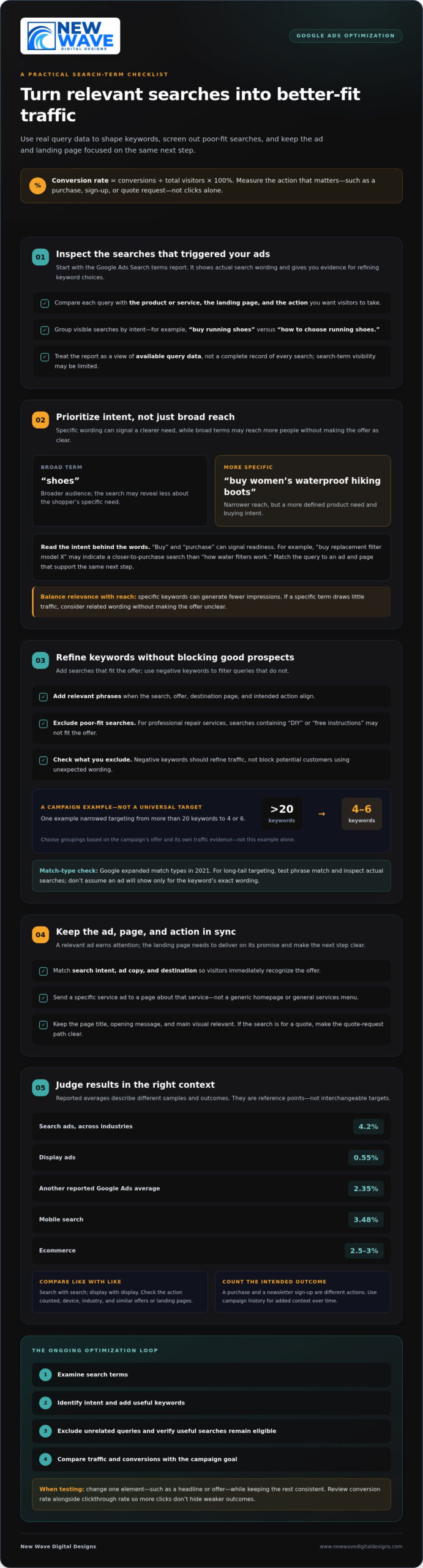
Start with the Search terms report in Google Ads. It shows the actual words people searched before your ads appeared, providing evidence to refine keyword choices. Compare each search with the product or service promoted, its landing page, and the action you want visitors to take. A search that aligns with all three is a stronger candidate than one that merely shares a broad topic.

Specific keywords can attract people with clearer intent, but they may generate fewer impressions than general terms. For example, “shoes” reaches a broad audience, while “buy women’s waterproof hiking boots” signals a more defined need. The longer phrase narrows who sees the ad, so weigh relevance against reach. If a specific term draws little traffic, consider related wording rather than broadening the keyword so much that the offer becomes unclear.

Search intent matters as much as the words themselves. Someone searching “buy replacement filter model X” may be closer to purchasing than someone searching “how water filters work.” Action words such as “buy” and “purchase” can signal readiness. Match those terms to an ad and page that support the same next step, such as ordering the exact product or requesting a quote.

Use negative keywords to screen out searches that don’t fit your offer. If a paid campaign promotes professional repair services, searches containing “DIY” or “free instructions” may be poor matches. After reviewing the report, add irrelevant terms as negatives, then check that useful searches aren’t being excluded too. Negative keywords should refine traffic, not block potential customers who use unexpected wording.

Reviewing search terms is an ongoing optimization step, not a one-time setup. Add relevant phrases as keywords, exclude unrelated queries, and revisit results as new searches appear. One campaign example reduced targeting from more than 20 keywords to 4 or 6; that illustrates a possible refinement, not a universal target. Choose keyword groupings according to the campaign’s offer and evidence from its own traffic.

Match types also shape reach. Google expanded match types in 2021, and the resulting changes may still influence which searches trigger ads. For long-tail targeting, test phrase match and inspect the search terms report to see whether the queries remain aligned. Don’t assume a chosen keyword will show your ad only for its exact wording. Review actual searches, then adjust keywords and negatives based on relevance and conversion activity.

Use a simple cycle: examine search terms, identify intent, add useful keywords, and exclude poor-fit queries. Then compare the traffic and conversions with the campaign’s goal. This measured approach helps optimize keyword coverage without mistaking more impressions for success.

2. Average conversion rates for search and display ads

Conversion benchmarks vary by campaign type and audience. Reported figures include a 4.2% average for search ads across industries and 0.55% for display ads. Another reported average for Google Ads is 2.35%, while mobile search is reported at 3.48%. Ecommerce conversion rates average 2.5-3%. These figures describe different samples and contexts, so they aren’t interchangeable targets.

Compare like with like: review search campaigns against search campaigns, and display campaigns against display campaigns. Check which action is counted, the device, and the industry before drawing conclusions. A purchase is not the same outcome as a newsletter sign-up. Your campaign history also provides context, especially when comparing similar offers and landing pages over time.

Use the Search terms report to assess which queries trigger ads and which lead to conversions. Search-term visibility may be limited, so treat the report as a view of available query data, not a complete record of every search. Group visible terms by intent, such as “buy running shoes” and “how to choose running shoes,” then compare conversion activity for each group.

To improve ad copy, responsive search ads, and offers, provide headline and description variations that reflect search intent and the landing-page offer. Google’s machine learning optimizes eligible combinations over time. Keep the message and offer consistent, then review which combinations support conversions.

Smart Bidding strategies such as Target CPA use conversion-focused bidding to pursue the campaign’s target cost per action. Choose a meaningful conversion action, review its recorded performance, and assess whether the target reflects the value of that action.

To find higher-converting traffic, compare search terms with audience segments and location targeting in your campaign. For example, review whether quote requests come from particular service areas or audience groups, then adjust targeting based on conversion results.

Run a Google Ads experiment by changing one element, such as a headline or offer, while keeping the rest of the test consistent. Compare variations, rotate ads, and review conversion rates alongside clickthrough rates so increased clicks don’t obscure weaker outcomes.

3. Landing page and ad message alignment

A relevant ad earns attention, but the landing page must deliver on its promise. If someone searches for a particular product, clicks an ad about it, and lands on a generic homepage, the next step becomes harder to follow. Align search intent, ad copy, and destination so visitors recognize the offer immediately. This connection creates a clearer experience and a more focused path to purchase.

Start by matching the page to the ad group’s central theme. For an ad promoting a specific service, use a landing page that explains that service rather than sending every visitor to a general services menu. Keep the page title, opening message, and main visual relevant to the search. A visitor looking for a quote should see a clear way to request one, not a page focused on an unrelated offer.

Offer consistency is equally important. If an ad promises a 20% discount, the landing page should show that same discount and explain how it applies. If the ad highlights a particular product feature, the page should make that feature easy to find. Differences between the ad and page can create doubt, especially when visitors need to search for the terms that first prompted their click.

Reduce friction by making the next step visible and the page easy to navigate. Put essential product or service details near the top, organize supporting information under clear headings, and make the main action easy to find. For example, a page promoting a consultation can explain what the visitor will receive, then show the request form without sending them through several menus. Check load speed too, since a slow page can interrupt the visit before the offer appears.

  • Match the message: Use the same product, service, and offer in the ad and page.
  • Make details accessible: Place relevant information where visitors can find it quickly.
  • Remove obstacles: Keep navigation clear and the intended action easy to reach.

Review the landing page from the visitor’s perspective after each campaign change. Search a promoted term, read the ad, and follow its destination. Ask whether the page answers the search, delivers on the ad’s promise, and makes the next action clear. If a campaign introduces a new offer, update the corresponding page before directing traffic there. This sequence helps maintain relevance throughout the journey, from search to decision.

When visits don’t lead to action, compare the ad’s promise with the page’s content before changing targeting. A relevant message and a well-structured destination give interested visitors a coherent experience, helping them evaluate the offer and decide whether to proceed.
Improve Google Ads Conversion Rate With Relevant Keywords

4. Specific and emotionally compelling calls to action

A clear call to action tells visitors what to do next. “Get a quote,” “Book a demo,” and “Shop the collection” describe distinct actions; “Learn more” may leave the next step less obvious. Choose wording that matches the offer and the visitor’s intent, so the action feels like a natural continuation rather than a demand.

Give people enough information to decide before asking them to act. For a demo, explain what it covers and who it suits, then use “Book your product demo.” For a newsletter, say what subscribers will receive, then invite them to “Get practical marketing tips.” Specific context makes the action meaningful and helps visitors understand what happens after the click.

Emotional resonance comes from relevance, not pressure. Someone browsing a gift page may respond to “Find a thoughtful gift,” while someone comparing software may prefer “See how the platform works.” Let the offer, audience targeting, and search intent guide the tone. Avoid urgency claims or promises the business can’t support.

  • For a purchase: “Choose your color” or “Add to cart.”
  • For an inquiry: “Request a project quote” or “Tell us what you need.”
  • For consideration: “Compare plan features” or “View the product details.”

Place the primary action where visitors can find it when they’re ready to decide. On a product page, put a purchase button near the item’s essential details. On a service page, a request form can follow a concise explanation of the service. Keep secondary actions visually distinct so “View examples” doesn’t compete with “Request a quote.”

Test alternative calls to action with an A/B comparison. For example, compare “Request a quote” with “Plan your project” while keeping the audience, landing page, and offer consistent. Review completed actions, not just clicks: a button can attract attention without producing the conversion the campaign seeks. Record the wording and result, then use the better fit as the starting point for your next test.

Make the action easy to complete after the click. If “Book a demo” opens a form, ask only for the information needed to arrange it, and label each field clearly. If “Shop now” leads to a product, make the item and its purchase options easy to identify. Matching the CTA to the destination creates a clear path from browsing to response.

Review CTA language whenever the offer or campaign targeting changes. An invitation to “Download the guide” won’t fit a page that now promotes a consultation. Keep the call to action, ad promise, and page destination aligned, then test changes against the same conversion goal.

5. Google Ads conversion rate definition and formula

Conversion rate describes how often ad traffic completes a chosen action. That action could be an online purchase, demo booking, phone call, quote request, newsletter sign-up, or gated-asset download. Choose an action that reflects meaningful progress, rather than counting every visit as success.

Use this formula: conversion rate = conversions ÷ total visitors × 100%. For example, divide recorded quote requests by the visitors who arrived from ads, then multiply by 100%. The result expresses how often that traffic completed the selected action. Keep the numerator and denominator tied to the same campaign and reporting period.

Conversion tracking connects ad interactions with actions on your website, such as purchases or sign-ups. Before judging a campaign, confirm that tracking records the intended action and that the report uses the right conversion goal. If purchases and newsletter sign-ups both count, the combined rate describes two different outcomes, not purchase performance alone. Separate goals when you need to understand each result.

A rate can exceed 100% when Google Ads counts multiple conversions for each ad interaction. That does not automatically indicate an error; it may reflect repeat actions, depending on the selected conversion settings. For a purchase-focused campaign, examine purchase counts separately. For a lead campaign, distinguish completed quote requests from other tracked actions.

In the United States, Google Ads policies and privacy requirements for data collection, consent, and use can affect which conversions tracking records. Configure measurement to respect user permissions and platform policies, then interpret reported conversions within those limits.

Allow enough time for conversions to appear in reporting before interpreting a campaign change. A visitor might click today and submit a quote request later, so a recent period can undercount actions still in progress. Check whether the data includes the full path from ad click to conversion, and compare equivalent periods with consistent goals and settings.

The data needed to draw a conclusion depends on how often the chosen action occurs and how consistently tracking captures it. A campaign with infrequent purchases needs more observation than one generating regular sign-ups before a pattern becomes persuasive. Avoid reacting to a single conversion or short-lived shift; look for a stable direction across comparable traffic and campaign conditions.

To improve your conversion rate, use the formula as a diagnostic tool: identify the action, verify its tracking, and examine the traffic that leads to it. Review your Google Ads measurement approach to make campaign decisions from clearer conversion data.

New Wave Digital Designs: Shopify Website Design

New Wave Digital Designs can help when your campaign sends visitors to an online store that needs a clearer, more relevant experience. Its Shopify Website Design service can shape product pages around the offer in your ads, creating a focused path from product details to purchase. WordPress Website Design and SquareSpace Website Design are also available for sites on those platforms. Website Maintenance can support your existing site as its content and needs evolve.

Consider this next step when your ads attract relevant traffic, but visitors struggle to understand the offer or take action on the destination page. A cohesive design can better align the message, page structure, and next step. Contact New Wave Digital Designs to discuss your website needs.

Make Your Next Improvement Deliberate

Better campaign performance grows from observation and thoughtful adjustment. Choose one point in the visitor journey that could be clearer, make a focused change, and assess how people respond. This disciplined process turns “how to improve Google Ads conversion rate” into practical work, not a search for a single clever setting.

Consider whether your website gives each campaign a destination that reflects its purpose. New Wave Digital Designs offers Shopify Website Design, WordPress Website Design, and SquareSpace Website Design, shaping sites around their platform and business goals. Considered design can give your advertising a cohesive destination for interested visitors.

When you’re ready to explore how your website can better support your campaigns, contact New Wave Digital Designs. Take the next step with clarity, and keep building an experience that earns each visitor’s attention.

Frequently Asked Questions

What is conversion rate?

Conversion rate is the proportion of ad-driven visitors who complete a defined business goal. For example, a visitor who clicks an ad and submits a lead form can count as a conversion. The rate distinguishes traffic that advances a business objective from traffic that merely arrives. Its meaning depends on the action selected, so clarify whether you’re measuring purchases, qualified leads, or another outcome.

What Qualifies as a Conversion Activity?

A conversion activity is a meaningful action you choose to measure, such as an online purchase, subscription upgrade, demo booking, phone call, free-account sign-up, quote request, newsletter subscription, or gated-asset download. Select actions tied to a business goal. For example, a retailer may prioritize completed purchases, while a consultant may track qualified quote requests. Don’t treat low-intent interactions, such as viewing a page, as equivalent to completed sales.

Why the low CVR?

A low conversion rate can point to a mismatch between the search and the completed action. Check whether the ad attracts the intended audience, the page answers their needs, and the form or checkout works as expected. A form asking for unnecessary details, for example, may discourage submissions. Compare mobile and desktop performance, and confirm that tracking records successful completions rather than button clicks alone.

What is a good Google Ads conversion rate by industry and campaign type?

There isn’t one benchmark that fits every industry and campaign. Reported averages include 4.2% for search ads across industries, 0.55% for display ads, and 2.5-3% for ecommerce conversion rates. Compare only similar campaign types and conversion goals. A search campaign measuring purchases shouldn’t be judged directly against display ads measuring newsletter sign-ups. Use benchmarks as context, then assess progress against your own campaign’s past performance.

How do you calculate Google Ads conversion rate, and which conversions should count?

Divide conversions by the relevant total visitors, then multiply by 100%. Choose actions that represent real progress toward your goal, such as completed orders or qualified inquiries. If you count several actions together, the resulting rate may obscure which one drives value. For clearer reporting, keep purchases, form submissions, and other goals distinct, and ensure the visitor total matches the campaign and reporting period you’re evaluating.

How do you set up and troubleshoot Google Ads conversion tracking and GA4 imports?

Define the desired action first, then configure tracking to record its successful completion. For a GA4 import, link the relevant accounts and select the event that represents the goal, such as a completed purchase. Test the full journey from ad landing page to confirmation, and compare recorded events across platforms. If counts differ, review event triggers, attribution settings, duplicate tags, and whether both systems measure the same action.

How can you improve Google Ads conversion rates with better keyword targeting and negative keywords?

Build keyword groups around distinct offers and search intent rather than placing unrelated terms in one group. Review search terms for patterns that indicate research, employment, or a different product need, then exclude unsuitable queries with negative keywords. For example, a paid repair service might exclude searches clearly seeking free do-it-yourself instructions. Keep useful variations eligible, and check query quality again after changes affect campaign traffic.

How do landing page speed, relevance, and design affect Google Ads conversion rates?

A slow or confusing page can interrupt a visitor before they complete an action. Check load performance on mobile and desktop, then test the page as a new visitor. Keep the headline, product details, and offer relevant to the ad, and make the next step easy to find. Clear navigation, readable content, and a working checkout or form help remove friction between arrival and conversion.

How to Create Effective Landing Pages for Google Ads

What if your landing page is the missing link between a promising Google Ads click and a qualified lead? When visitors arrive and can’t find the offer they expected, even a polished page can leave them unsure what to do next. Learning how to create effective landing pages for Google Ads starts with treating the page as a continuation of the ad, not a separate design exercise.

If paid clicks aren’t producing enough leads or sales, it can be difficult to know which change to make first. Start by checking whether the page matches the ad, explains the offer clearly, and makes the next step easy to take. This guide walks through how to align campaign intent with page content, create a smooth experience on desktop and mobile, and measure what happens after each click. Use these steps to bring your ad, page design, and visitor needs into closer alignment.

Key Takeaways

  • Learn how to create effective landing pages for Google Ads by carrying the ad’s promise through to a relevant page and clear next step.
  • Shape the page around one offer, one audience, and one primary action, with supporting details that build confidence without competing for attention.
  • Compare a dedicated landing page with an existing website page to choose a destination suited to your campaign and visitor journey.
  • Follow a practical process from campaign research and page planning to review and launch, keeping each page tied to a specific campaign theme.
  • Measure meaningful actions and lead or purchase quality, then use documented, focused changes to guide ongoing refinement.

What makes a Google Ads landing page effective?

A Google Ads landing page is a focused destination that continues the ad’s promise and helps visitors take a relevant action. They should recognize the offer, understand why it matters, and see what to do next without searching through unrelated content. For a basic overview, see What is a Landing Page?

A landing page doesn’t have to be a separate website or a unique URL for every campaign. A homepage introduces the broader business and gives visitors several paths to explore. A landing page puts one campaign’s message and visitor need first. A relevant service page on your existing site can also work when it provides the information the visitor needs and makes the next step clear.

Message match builds confidence: when the page reflects the ad’s offer and audience, visitors can understand what happens after the click and what to do next. That alignment is central to how to create effective landing pages for Google Ads. Focus the page, but don’t hide useful information or make it difficult to navigate.

How does a landing page connect to a Google Ad?

The journey begins with a search query, continues through the ad, and ends at a page where the visitor can take an intended action, such as submitting an enquiry or making a purchase. Each step should feel connected. If an ad promotes Google Ads management, for example, the page should identify that service, explain what the visitor can learn or do, and present a relevant next step.

Google Ads reports landing page experience as one component in its Quality Score diagnostics, alongside ad relevance and expected click-through rate. Use it as a reason to investigate the visitor experience, not as a conversion guarantee or a score to optimize in isolation. If the ad and page seem misaligned, review the wording of the offer, the intended audience, and the expectations the page sets.

When is a dedicated landing page useful?

A dedicated page is useful when a campaign promotes a distinct offer or targets a specific search intent that needs a tailored explanation. An ad about Google Ads management, for instance, may lead to a page focused on that service, while a broad search for a business name may be better served by the homepage. Choose a destination based on visitor intent, the complexity of the offer, and the quality of the relevant content already on your site.

Before creating a page, ask what the visitor needs to understand before acting. A straightforward offer may need only a concise explanation and a clear action. A more considered decision may require extra context, supporting details, and answers to likely questions. In both cases, the page should make the path from interest to action feel natural.

Evaluate the page with three questions: does it reflect the search and ad, give the visitor enough context to decide, and make the intended action easy to find? A homepage can work if it answers those questions for the campaign. A dedicated landing page can be a better fit when the wider site would force visitors to navigate through unrelated choices. The goal is a purposeful journey, not simply a shorter page.

Build the page around one offer, one audience, and one clear action

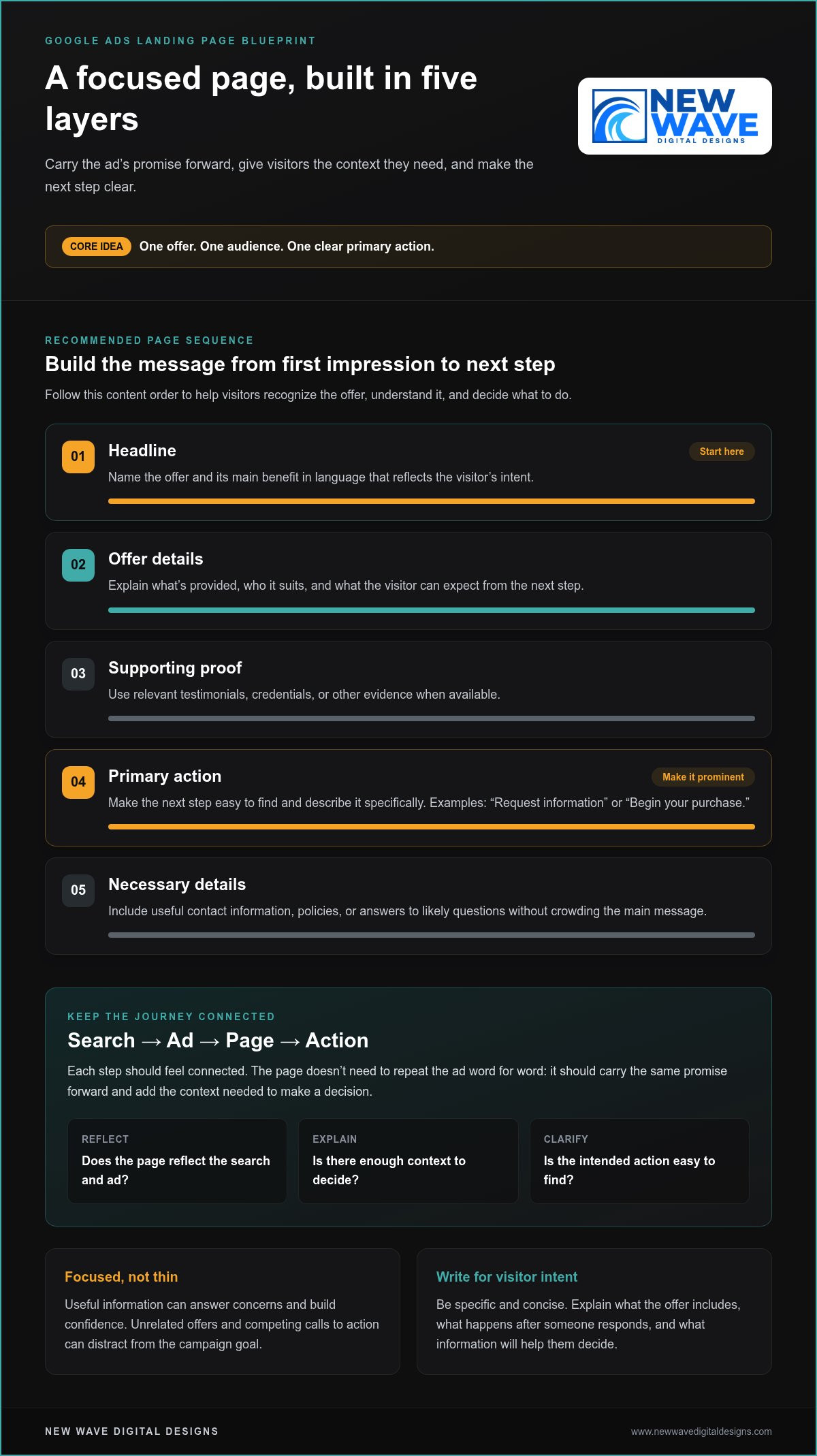
Once visitors arrive, the page structure should make their decision straightforward. Lead with a headline that names the offer and its value. Explain who it’s for and what to do next, then add concise supporting details and a prominent call to action. This order helps visitors move from recognizing the offer to understanding it and deciding whether to act.

Keep the page focused, not thin. Useful information can answer concerns and build confidence, while unrelated offers and competing calls to action can distract from the campaign goal. Use a simple content plan:

  • Headline: State the offer and its main benefit in language that reflects the visitor’s intent.
  • Offer details: Explain what’s provided, who it suits, and what the visitor can expect from the next step.
  • Supporting proof: Include relevant testimonials, credentials, or other evidence when available.
  • Primary action: Make the next step easy to find and describe it specifically.
  • Necessary details: Add useful contact information, policies, or answers to likely questions without crowding the main message.

Message match means maintaining continuity between a person’s search, the ad they choose, and the page they reach. The page doesn’t need to repeat the ad word for word. It should carry the same promise forward and add the context the visitor needs to make a decision. This is a practical foundation for how to create effective landing pages for Google Ads.

What should the headline and page copy communicate?

Write the headline for the visitor’s likely intent, not just the business’s internal description of its service. If the ad promotes Google Ads management, make that subject clear at the top of the page. Use the following copy to explain who the service is for and what the visitor can do next. Specific, concise language helps people quickly decide whether they’re in the right place.

Answer the questions that matter at this stage: What does the offer include? What happens after someone responds? What information will help them decide? Prioritize those answers over broad claims or mechanical repetition of the ad.

How should forms, calls to action, and trust elements work together?

Use a CTA that names the action, such as “Request information” or “Begin your purchase,” instead of a vague label. Make the primary action visually prominent and limit secondary links that could pull attention away. For forms, ask only for details needed for the next meaningful step. Every additional question should have a clear purpose.

Place trust details where they can help with a decision. A testimonial may support the offer, while a relevant policy or contact detail can address a concern near a form. Keep these elements clear and accurate. Thoughtful Google Ads and website design can help bring campaign intent and page structure into closer alignment.

Dedicated landing page or existing website page: which should you choose?

The best destination is the page that answers the searcher’s need with the least friction. A dedicated landing page gives a campaign more control over its message and layout. An existing product or service page may already provide the right detail and a clear path to action. Neither option is automatically better. Choose based on how closely the page fits the campaign and how much work it needs.

Consideration Dedicated landing page Existing website page
Message match Can be tailored closely to a specific ad, audience, or offer. Works well if its content already reflects the ad’s promise and search intent.
Setup effort Requires planning, writing, design, tracking, and ongoing upkeep. May be ready to use, though content or layout changes could be needed.
Page flexibility Offers more control over campaign-specific content and journey. Must fit within the existing site structure and page purpose.
Measurement Can make campaign actions easier to isolate, provided tracking is configured appropriately. Can be measured too, but shared content or multiple actions may require careful interpretation.

When does a dedicated campaign page make sense?

Consider a dedicated destination when the campaign has a distinct offer, targets a clearly defined audience, or needs a focused conversion journey. A time-sensitive promotion, for example, may need terms and a call to action that aren’t prominent on a general service page. A campaign for one service can also benefit from copy that directly addresses the visitor’s questions instead of asking them to navigate a broad menu.

That control comes with responsibility. Each additional page needs accurate content, thoughtful design, functioning measurement, and updates as the offer changes. An outdated campaign page can undermine the relevance it was created to provide.

When can an existing page be the better destination?

Use an existing page if it already answers the search query, supports the ad’s promise, and makes the intended action clear. Someone searching for a particular product may be better served by its detailed product page than by a new page that repeats the same information. A general homepage is less suitable if visitors have to sift through unrelated services to find that product.

Review the page from the visitor’s perspective. Does the main heading reflect the ad’s offer? Are competing calls to action or unrelated sections drawing attention away? Could a modest edit to the headline, opening copy, or placement of the primary action make the page more relevant? If so, refine what’s already there before building another destination.

Use this decision rule: choose a dedicated page when the campaign needs an experience the current site doesn’t provide; choose an existing page when it already fits the visitor’s intent and supports the next step. This balance is part of how to create effective landing pages for Google Ads without adding pages that have no clear purpose.

How to Create Effective Landing Pages for Google Ads

How to create and launch a Google Ads landing page step by step

A dependable launch starts before design work. Establish what the campaign promises, who it’s meant to reach, and what action the page should support. Then build and review the destination as a complete journey, from the first screen to the confirmation visitors see after submitting a form or completing a purchase.

Test the complete visitor journey before directing paid traffic. A page can look polished and still fail if its form, links, or measurement don’t work as intended.

  1. Research the campaign. Review its search themes, ad language, audience, offer, and intended action. Connect each landing page to a specific campaign theme rather than combining unrelated search intents on one destination.
  2. Write a page brief. Record the visitor’s likely need, the offer, supporting evidence, and the primary conversion action. Map the ad’s central promise to the page headline, key content, and call to action.
  3. Plan the visitor journey. Decide what a person needs to know before acting, such as what the offer involves or what happens after an enquiry. Arrange the content in a logical order and make the next step easy to find.
  4. Build the page. Create or refine the destination using the brief. Check that the layout adapts to mobile and desktop, text is readable, controls are easy to use, and links and forms work correctly.
  5. Review the experience. Check accessibility, loading issues, clear privacy information, accurate content, and distractions that could interrupt the intended journey. Confirm that the final destination URL matches the campaign plan.
  6. Verify measurement and launch. Test that the intended action, such as a form submission or purchase, is recorded accurately. Review the relevant Google Ads, Google Analytics 4, or Google Tag Manager configuration against current product documentation before relying on the data. Then direct campaign traffic to the tested page.

What belongs in the landing page brief?

Make the brief specific enough that a designer or writer can understand the campaign before building begins. Include the audience, search intent, offer, available supporting evidence, primary conversion action, and questions visitors may need answered. Note the ad’s central promise and how it should carry through to the headline, supporting content, and CTA. This gives you a clear reference for reviewing the finished page and helps keep copy and design aligned with campaign intent.

What should you check before sending Google Ads traffic?

Test common mobile and desktop screen sizes, including the full form process and what visitors see after submission or purchase. Check that buttons and links lead to the right places, text remains legible, the page loads reliably, and privacy disclosures are easy to find wherever personal information is collected. Confirm the final destination URL and verify that tracking records the action you want to measure, not just a button click that may not represent a completed conversion.

Building a strong destination takes coordinated campaign thinking, design, and measurement. New Wave Digital Designs provides website design and paid search services to help align those elements.

Measure, refine, and connect landing page design with Google Ads

A landing page’s results involve more than the number of conversions. A page may generate many enquiries but attract people who aren’t a good fit. Pair performance data with lead or purchase quality, then identify where the visitor journey works smoothly and where it creates friction. That fuller view helps distinguish useful improvements from changes that only make a dashboard look better.

Which landing page metrics can guide improvements?

Conversion rate is the share of measured visitors who complete a defined action. It’s useful for tracking a page over time, but interpret it alongside traffic sources and conversion quality. A form submission matters more when it represents a relevant prospect than when it’s an unqualified enquiry. For purchases, consider order quality as well as completed transactions.

Review multiple signals together. If visitors arrive but few begin a form, the offer, page content, or action may not be clear enough. If they start but don’t complete it, check for unnecessary questions or usability barriers. Engagement measures can show where visitors spend time or leave, but no single metric explains why. Combine the data with a careful page review and, where possible, feedback on lead or customer quality.

Use Google Ads and Google Analytics 4 reports only after checking that tracking records the intended actions accurately. Confirm that a conversion represents a completed enquiry or purchase, rather than an incidental click, and that reporting is configured consistently. Review current Google product documentation before drawing conclusions from the data.

How can design and campaign management work together?

Campaign intent sets the direction: which audience the ad reaches, what the offer promises, and what action the page should support. Website structure and visual design make that journey easier to understand, while measurement shows where it may need refinement. These elements inform one another. If visitors engage with the ad but don’t complete the intended action, review both traffic relevance and the page experience before deciding what to change.

Make each test deliberate. Write down the issue you’re investigating, the change you’ll make, and the result you expect. When practical, change one important element at a time, such as the headline or form layout. Then compare the outcome with your original hypothesis, including lead or purchase quality. If several elements change together, it’s harder to tell which adjustment mattered. Keep a record of what changed and what the evidence suggests, even when a test has no clear result.

Website design, graphic design, and Google Ads management can work together to align brand expression, campaign intent, page structure, and measurement. New Wave Digital Designs offers these services alongside organic SEO, helping businesses develop a coherent digital presence. This cycle of observing, refining, and learning is central to how to create effective landing pages for Google Ads without relying on guesswork.

Give your next campaign a clearer path forward

The next step doesn’t have to be a complete rebuild. Choose one campaign, review the experience from a visitor’s perspective, and identify the most useful improvement to explore. A thoughtful, measured approach to how to create effective landing pages for Google Ads can turn each insight into a stronger foundation for future decisions.

New Wave Digital Designs provides website design for Shopify, WordPress, and Squarespace, along with Google Ads and Bing Ads management, graphic design, hosting, and website maintenance. These services can support a coherent experience from campaign to page and ongoing site care, shaped around your business needs.

Work with New Wave Digital Designs on a landing page aligned with your campaign goals.

Frequently Asked Questions

Can I use my homepage as a Google Ads landing page?

Yes, your homepage can work if it directly addresses the ad’s subject and makes the intended action easy to find. It may suit branded searches from people looking for your business, but be less useful for an ad promoting one specific service if visitors have to search through a broad menu. Review the page on mobile, too. If the offer and next step aren’t immediately clear, a more focused destination may serve the campaign better.

How many landing pages should a Google Ads campaign have?

There’s no fixed number. Build or select pages around meaningful differences in search intent, audience, or offer, rather than creating a separate page for every keyword. Several search terms seeking the same service may fit one page, while a product promotion and a service enquiry may need distinct experiences. Keep the number of pages manageable so you can maintain accurate content, functioning tracking, and relevant information as campaigns change.

What is a good conversion rate for a Google Ads landing page?

There isn’t one conversion rate that’s good for every campaign. The right interpretation depends on the action being measured, the audience, the offer, and whether conversions lead to qualified enquiries or purchases. Compare similar traffic and actions over time, and examine quality alongside volume. A higher rate isn’t necessarily better if it comes from less relevant enquiries. Treat benchmarks as context, not as a target that overrides business value.

How long should I wait before changing a landing page?

Wait until you have enough relevant data to make a considered comparison, rather than reacting to a short-term fluctuation. The time needed depends on traffic volume, conversion frequency, and how consistent the campaign has been. Before making changes, check that tracking works and review whether visitors match the intended audience. If you find a clear technical problem, such as a broken form, fix it promptly instead of waiting for more data.

Do Google Ads landing pages need a privacy policy?

If a page collects personal information, explain clearly how that data will be used and make the relevant privacy notice easy to find near the form. This helps visitors understand what they’re sharing before they submit it. The exact disclosures that apply can depend on your business and the data collected, so avoid generic copy that doesn’t reflect your practices. Keep the notice current when your data collection or use changes.

Can I test two landing page versions with Google Ads?

Yes, you can compare page versions, but structure the test so the result is useful. Decide what you’re testing, such as a headline or form layout, and keep the audience, offer, and conversion definition consistent where practical. Confirm that both versions load correctly and that tracking records the same intended action. Review current Google Ads experiment options and setup guidance before launching, since available controls can change.

Search Marketing Services for Small Business: SEO and Paid Search in 2026

What if choosing between SEO and paid search is the wrong first decision? For a small business, search marketing services for small business work best when organic visibility, advertising, and the website experience are planned together. It’s understandable to weigh near-term campaign activity against longer-term growth when time and marketing resources are limited. But clicks and rankings alone don’t show whether a strategy is attracting the right prospects or supporting business goals.

This guide explains how organic SEO, Google Ads, and Bing Ads serve different needs, and how to prioritize them based on your goals, website readiness, and available resources. You’ll also learn what a search marketing engagement can include, from practical deliverables to reporting that connects search activity with meaningful outcomes. A campaign can bring someone to your site, but the website and measurement framework help determine what happens next. Together, these elements create a clearer path from visibility to informed decisions.

Key Takeaways

  • Search marketing services for small business can combine organic SEO with Google Ads or Bing Ads, depending on your goals, timing, and website readiness.
  • Use paid search to explore which queries and messages resonate while organic SEO develops visibility over time.
  • Compare proposed work by how it connects to customer intent and business outcomes, and by the clarity of its deliverables and reporting.
  • Prioritize in sequence: define outcomes, review your website, choose a channel focus, then measure what matters.
  • A responsive, brand-aligned website helps carry the visitor experience forward after a search result or ad earns the click.

What search marketing services for small business actually include

Search marketing brings together the work that helps a business appear when people search: organic visibility earned through SEO and paid placements purchased through advertising platforms. The Search marketing overview describes this broader discipline, which includes both routes. For a small business, the distinction matters because each channel has a different mechanism, pace, and role in reaching potential customers.

SEO develops organic visibility over time; paid search can place an ad in eligible results for selected queries, subject to an auction and platform factors. Neither a ranking nor a click is a business outcome by itself. They are signals to interpret alongside what happens next, such as a qualified inquiry, purchase, or other action that supports the business.

Organic SEO and paid search: two routes to search visibility

Organic SEO improves a site’s relevance, accessibility, and ability to appear in unpaid search results. Work can include making pages easier for search engines to understand, aligning useful content with customers’ questions, and addressing technical barriers to discovery. Results develop through sustained improvements, not through buying an ad placement for a particular search.

Paid search uses platforms such as Google Ads and Bing Ads to show ads for selected queries. Advertisers set campaign parameters, but placement depends on auction dynamics and other platform factors, so no position is assured. Ads can provide visibility while a business explores demand or promotes a timely service. SEO develops a foundation for relevant searches over time.

What small-business search marketing services can cover

Well-defined search marketing services for small business turn strategy into practical work across search discovery, campaigns, and the website. Priorities depend on business goals and site condition, but the work may include:

  • Organic SEO: keyword research to understand search intent, technical and on-page improvements, and search-focused content that answers useful customer questions.
  • Paid search: campaign planning, ad management, and performance reviews to assess which queries and messages are bringing relevant visits and actions.
  • Website support: design, maintenance, hosting, and security to help keep the destination after the click responsive, clear, and dependable.

These elements are connected. An ad may earn a visit, but a confusing page can interrupt the journey. Strong content can also be harder to find if technical issues affect important pages. A responsive, brand-aligned website on Shopify, WordPress, or Squarespace gives search visitors a more coherent next step. Ongoing maintenance and security help support that experience.

Before judging performance, define the action you want a visitor to take. Then read rankings, impressions, and clicks as indicators of visibility, not proof of growth on their own. Pair them with relevant actions and the website experience to assess search marketing as a connected system, rather than a collection of isolated tasks.

How SEO, Google Ads, and Bing Ads work together

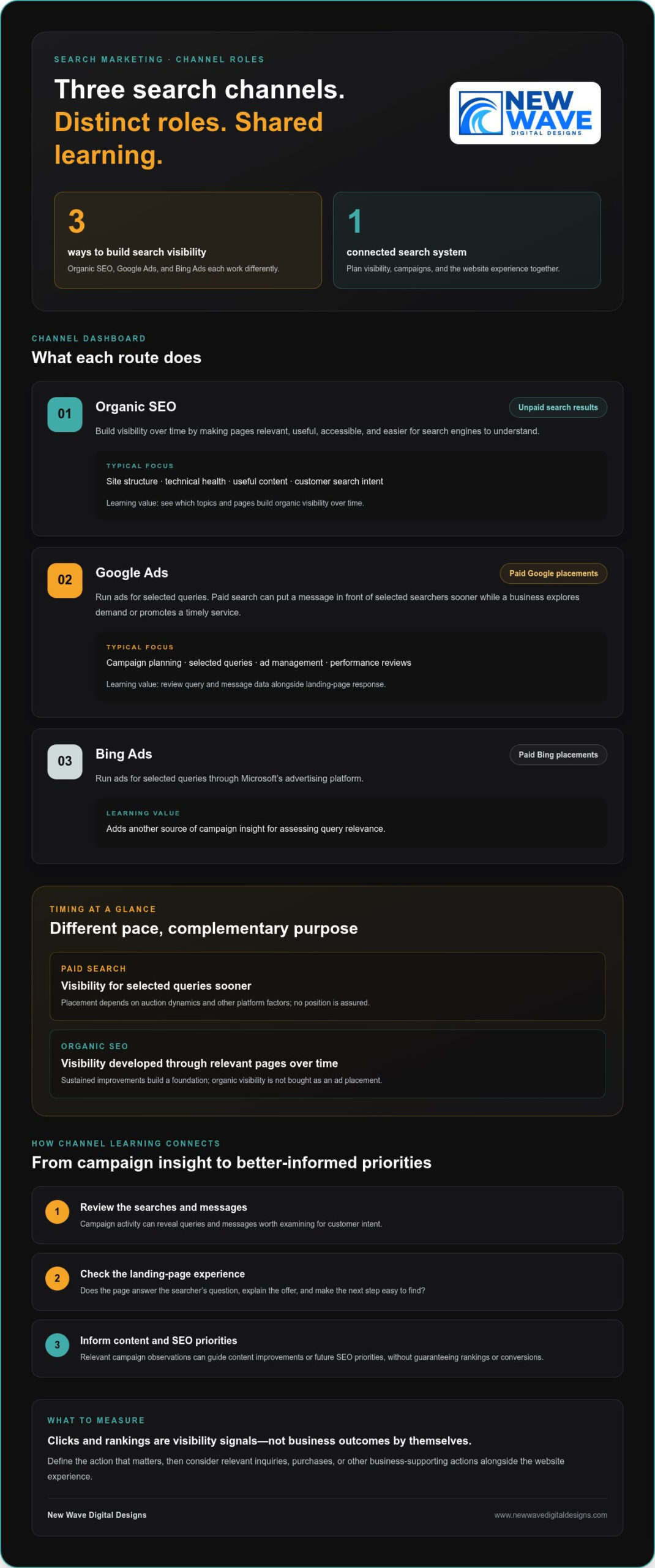
SEO and paid search can support the same business goal without doing the same job. Organic visibility develops as a site becomes more relevant and useful for important searches. Google Ads and Bing Ads can place ads for selected queries, subject to each platform’s auction and other factors. Together, they give a small business distinct ways to build visibility, observe customer intent, and refine its search presence.

Paid search can put a message in front of selected searchers sooner; organic SEO builds visibility through relevant pages over time. The channels can also inform each other: campaign activity can reveal queries and messages worth examining, while SEO develops useful pages around relevant topics.

Channel Placement Approach Learning value
Organic SEO Unpaid search results Improve site structure, page relevance, technical health, and useful content. Shows which topics and pages build organic visibility over time.
Google Ads Paid placements in Google search Set up ads for selected queries and manage campaign settings. Offers query and message data to review alongside landing-page response.
Bing Ads Paid placements in Bing search Run ads for selected queries through Microsoft’s advertising platform. Adds another source of campaign insight for assessing query relevance.

Share learning across channels thoughtfully. If a campaign attracts relevant searches for a particular service, review the landing page: does it answer the searcher’s question, explain the offer, and make the next step easy to find? That observation can inform content improvements or future SEO priorities, though it doesn’t guarantee a ranking or conversion. Effective SEM campaigns for small businesses also depend on aligning keyword choices with business objectives.

When organic SEO is the stronger priority

Organic SEO is a strong focus when a business wants to develop durable visibility around topics its customers search for. Start with a sound structure, clear and relevant pages, useful content, and technical health. These foundations help search engines interpret the site and give visitors a more coherent path through it. Organic SEO services can support a sustained visibility strategy.

When paid search can complement organic growth

Paid campaigns can complement SEO when a business wants to test selected queries or messaging while organic work develops. Review which searches bring relevant visitors, then compare the ad promise with the landing page’s content and response. Use those observations to guide testing and page refinement, not as automatic proof of what will succeed organically. Google Ads management for small business brings campaign planning and performance review into that process.

Search marketing services for small business are most useful when channel activity connects to a clear goal and a considered website experience. New Wave Digital Designs provides organic SEO and paid search support to help bring those priorities into the same conversation.

How to compare search marketing services for your small business

A useful proposal should make the connection between the work and your business goals easy to see. Start with the action you want a search visitor to take, such as requesting an estimate, booking an appointment, or completing a purchase. Then consider whether the proposed SEO or paid campaign targets the right customer intent and whether your website gives visitors a clear path to that action.

This makes comparison practical. A plan focused on paid visibility may suit a time-sensitive need, while organic SEO can support longer-term visibility around relevant topics. If key pages are hard to navigate or don’t explain your offer clearly, the website may need attention alongside search activity. A channel plan should account for that reality rather than treating clicks as the finish line.

Match services to goals, audience, and website readiness

Before comparing deliverables, describe the customer journey you want to support. What might a prospective customer search? What information would help them decide? What should they do next? Compare the proposed work against those questions. For example, a campaign aimed at people ready to request a service should lead to a page that clearly describes the service and makes the inquiry step visible.

Consider timing, too. If the business needs to promote a specific offer now, paid search may be part of the plan. If it’s building visibility for recurring customer questions, organic work may deserve greater emphasis. The right mix depends on goals, audience, and site readiness, not on the number of channels included.

Evaluate deliverables and reporting with useful questions

Look for clear descriptions of what will be done and how the work will be reviewed. Search marketing services for small business should translate technical activity into understandable tasks, priorities, and measures. Use questions like these to assess whether a proposal offers a coherent strategy:

  • Research: How will keyword and query research connect to customer intent and business priorities?
  • Execution: Which pages or technical areas will SEO work address, and what campaign planning or management is included for paid search?
  • Measurement: Which indicators will be reported, and how will relevant website actions be tracked where measurable?
  • Coordination: How might campaign observations shape future content, landing-page improvements, or channel priorities?

Reporting should distinguish leading indicators from outcomes. Impressions, rankings, clicks, and visits can show whether visibility is changing or people are reaching the site. They don’t, by themselves, show whether the business is attracting qualified inquiries or making sales. A useful report interprets those signals alongside relevant website actions, explains measurement limits, and identifies practical next steps.

It’s reasonable to want evidence of progress. A credible plan won’t promise specific rankings, traffic, leads, or revenue, because search results and customer decisions depend on factors beyond any one campaign. Instead, it should explain what will be measured, how findings will inform adjustments, and how progress relates to the outcomes the business cares about. That clarity gives the work a shared basis for decisions.

Search Marketing Services for Small Business: SEO and Paid Search in 2026

How to prioritize search marketing services on limited resources

A small business doesn’t need to pursue every search opportunity at once. Choose the first move that supports an important customer journey and fits the website’s readiness, competitive environment, and available resources. This sequence turns search marketing services for small business into a focused plan rather than a list of disconnected tasks.

  1. Define outcomes. Choose the customer action that matters most, such as a qualified inquiry, appointment request, or online purchase. Identify the products or services to prioritize.
  2. Review the site. Check whether relevant pages explain the offer, work well on mobile, and make the next step clear. Review site structure and conversion paths before expanding campaigns.
  3. Choose channel priorities. Match the opportunity to organic SEO, Google Ads, Bing Ads, or a focused combination. Account for customer intent, timing, competition, and available capacity.
  4. Measure and refine. Track indicators linked to the goal, review performance over a suitable period, and adjust priorities as search, campaign, or website data accumulates.

Build a practical first-phase search plan

Keep the first phase narrow enough to manage. Select a priority service or product, identify searches that suggest interest, then assess the page a visitor would reach. If the page needs clearer information or an easier mobile experience, address that gap before increasing campaign activity. If the page is ready but organic visibility is still developing, a focused paid campaign may complement ongoing SEO. Let the evidence guide the mix, rather than trying to be everywhere.

A simple scorecard can make the reasoning visible:

  • Activity: Improve a priority service page. Purpose: Help searchers understand the offer. Indicator: Relevant engagement or inquiry actions. Review point: After the page change has had time to be observed.
  • Activity: Run a focused paid campaign. Purpose: Reach selected searchers and assess query relevance. Indicator: Relevant clicks and qualified actions. Review point: During scheduled campaign reviews.
  • Activity: Develop organic content. Purpose: Address useful customer questions. Indicator: Relevant impressions, clicks, and page engagement. Review point: As visibility and content performance develop.

Measure progress without mistaking activity for impact

Impressions can indicate exposure; clicks show that a searcher chose to visit; landing-page engagement offers clues about what happened after the visit. Qualified inquiries or sales are closer to business outcomes. Read these measures together, and make sure reporting distinguishes what is observable from what can’t be attributed confidently.

Interpret results in context. A campaign change, revised page, or shift in targeted queries can affect what the numbers mean. Compare periods that make sense for the activity, note what changed, and use the findings to decide what to maintain, refine, or pause. A sound plan explains how progress will be assessed without promising a fixed ranking or return.

New Wave Digital Designs’ search marketing support connects channel priorities with your website and measurement needs.

How New Wave Digital Designs brings search marketing together

Search visibility is strongest when the campaign, website, and business goal work in concert. New Wave Digital Designs provides organic SEO and Google Ads or Bing Ads management, helping shape channel priorities around what the business wants search visitors to do. Each service has a distinct role, but both can support a considered path from discovery to the next step.

A coordinated approach to organic and paid search

Organic SEO develops a site’s relevance and visibility across valuable search topics. Paid campaign management supports selected queries through advertising on Google or Bing. Planning them together brings keyword opportunities, campaign observations, and business priorities into the same discussion, rather than treating each channel as an isolated task.

For example, paid campaign activity may show that a particular search phrase is attracting relevant visitors, or that a landing page needs to explain an offer more clearly. Those observations can inform future content or campaign priorities. They are useful signals, not guarantees: search positions, lead volume, and campaign returns can’t be promised. Measurement helps clarify what is happening and where adjustments may be worthwhile.

This approach keeps the focus on meaningful progress. Search marketing services for small business should reflect the customer journey, the website’s current readiness, and the resources available to sustain the work. New Wave Digital Designs provides organic SEO alongside Google Ads and Bing Ads management, so channel decisions can be considered in relation to the same business objectives.

Connect search visibility to the website experience

A search result earns attention; the destination page carries the experience forward. The page should match the visitor’s query or the promise of an ad, explain the relevant product or service, and make the next action clear. For instance, someone searching for a specific service needs a focused page with useful details, not just a general homepage.

New Wave Digital Designs creates responsive, brand-aligned websites on Shopify, WordPress, and Squarespace. Responsive design helps a site adapt across screen sizes, while clear page structure supports a consistent experience from search result to landing page. If a website refresh would strengthen that post-click journey, explore professional web design.

The work can continue beyond launch. Website maintenance, hosting, and security complement ongoing digital marketing by supporting the website that organic visitors and paid campaigns lead to. That creates a more connected foundation: visibility, a prepared destination, and continued attention to the digital experience.

A search marketing approach can bring together your business goals, website, and channel priorities, with organic SEO, paid search, and website experience considered as parts of the same plan.

Make your next search move a deliberate one

Your next step doesn’t have to be a sweeping marketing overhaul. Choose one business priority, identify the search opportunity around it, and shape a focused plan that can be reviewed and refined as you learn. The most useful search marketing services for small business give each activity a purpose and connect it to a website experience built to welcome the right visitor.

New Wave Digital Designs brings organic SEO and Google Ads or Bing Ads management together with website design, maintenance, managed hosting, and security. This combination keeps search visibility and the digital experience in view as your business evolves. The goal is a thoughtful direction, not a promise of a particular ranking or return.

Ready to explore a search approach shaped around your goals? Discuss your search marketing goals with New Wave Digital Designs and define a clear first priority for your business.

Frequently Asked Questions

What are search marketing services for a small business?

Search marketing services for small business help a company become easier to find when potential customers search online. For example, a home repair company might improve service pages for unpaid results while advertising for a specific repair query. The work can also include making sure search visitors land on a useful page with clear details and a next step. The right scope depends on business priorities, audience, website, and resources.

Are SEO and search engine marketing the same thing?

Not always. SEO generally means improving a website’s unpaid search visibility, while search engine marketing may describe the broader combination of organic and paid search. Some providers use “SEM” to mean paid advertising alone. Since terminology varies, compare the actual work behind the label: for example, whether it includes page optimization, ad management, or both, and how progress is reported.

How long does SEO take to show results for a small business?

There’s no universal timetable for SEO results. The pace depends on factors such as the site’s starting condition, the competitiveness of its topics, and the work being completed. Rather than waiting for one target ranking, review milestones along the way: whether technical issues were addressed, priority pages became more relevant, and qualified actions are being recorded. These checkpoints help guide adjustments without treating any date or position as guaranteed.

Can a small business use Google Ads and SEO at the same time?

Yes. A business can advertise for selected searches with Google Ads while developing its unpaid search presence through SEO. For instance, an ad campaign for a particular service can help assess whether a query attracts relevant visitors, while SEO work builds useful information around related customer questions. Review each channel by its own purpose, and don’t assume ad activity automatically changes organic rankings or performance.

How much do search marketing services cost for a small business?

There isn’t one universal cost for search marketing services. Scope can vary with the channels involved, the condition of the website, campaign complexity, and the amount of ongoing work. When reviewing proposals, compare the research, optimization, campaign management, and reporting included, along with each party’s responsibilities. A clear description of scope makes it easier to understand what a quoted fee covers without relying on a headline figure alone.

What should a small business track in a search marketing campaign?

Track measures that help explain whether search activity is supporting a business goal. For an online shop, that might mean reviewing relevant landing-page visits alongside completed purchases; for a service business, it could mean qualified inquiry forms rather than every form submission. Impressions and clicks provide context, but they don’t establish lead quality. Define what counts as a valuable action, then review that measure consistently alongside campaign activity.

Do small businesses need a new website before investing in search marketing?

No, a new website isn’t automatically necessary. A focused update may be enough if the existing site has a sound structure but needs a clearer service page, more prominent contact details, or simpler mobile navigation. Broader design work may make sense if important information is difficult to find across the site. Identify the specific obstacle first, then decide whether targeted improvements or a larger redesign better supports visitors.

Google Ads Management: 2026 Small Business Growth

What if your advertising budget wasn’t a monthly sacrifice to an indifferent algorithm, but a precision-engineered foundation for your company’s legacy? You’ve likely felt the sting of rising CPCs and the quiet anxiety of “Smart” campaigns that prioritize volume over the high-quality leads your business actually needs. It’s exhausting to watch your margins thin while navigating an interface that feels designed to obscure rather than reveal. Effective google ads management for small business requires more than just technical settings; it demands a blend of strategic vision, technical security, and creative craftsmanship.

We believe your digital advertising should be a high-precision growth engine, built on meticulous campaign architecture and intentional oversight. This article reveals how to transform your spend into a transparent, revenue-linked asset that grows alongside your ambitions. You’ll learn how to master the new 2026 verification requirements, why the synergy between ad copy and web design is your greatest lever for success, and how a dedicated partnership can finally provide the consistent lead flow you deserve.

Key Takeaways

  • Learn how to identify and seal “budget leakage” by shifting from generic, high-volume setups to a precision-based strategy that honors your brand’s unique search intent.
  • Discover why the synergy between meticulous web design and campaign structure is the essential architect’s tool for achieving a superior Quality Score and reduced costs.
  • Evaluate the true opportunity cost of automated solutions versus a strategic partnership for google ads management for small business that prioritizes long-term brand resonance.
  • Master a structured “test and learn” framework to determine your ideal initial spend while navigating the spectrum of bid strategies to maximize revenue rather than just clicks.
  • Future-proof your digital presence by understanding the 2026 shift toward stricter advertiser verification and the critical importance of a certified Consent Management Platform.

Beyond the Click: Why Small Business Google Ads Require Meticulous Strategy

Google Ads is often misunderstood as a simple transaction where you trade dollars for clicks. In reality, it’s a sophisticated orchestration of search intent and brand response. As we move through 2026, the landscape has shifted. We now operate in an era of AI-assisted tools that require strict human governance to remain profitable. Without a digital architect to guide the process, most companies fall victim to “Budget Leakage.” This phenomenon occurs when generic campaign structures drain your resources by bidding on irrelevant terms that never convert. It’s a quiet erosion of your margins.

Many business owners feel a deep sense of frustration after attempting a DIY approach. The interface is a technical labyrinth designed to encourage spending, often at the expense of precision. Professional Google Ads management for small business isn’t just about clicking buttons. It’s about building a foundation that ensures every cent of your investment is working toward a specific, high-precision growth goal. You don’t just need more traffic. You need a strategy that respects your budget and honors your brand’s unique spirit.

The Concept of Digital Craftsmanship in SEM

True search engine marketing is a form of craftsmanship. Every keyword you select should be a reflection of your visionary goals, not just a popular term in a database. We shift the focus from raw traffic to “qualified intent.” This requires a deep sense of empathy. You must understand the searcher’s journey, their pain points, and the specific moment they are ready to engage. When intent and message align perfectly, the result is a seamless connection. This precision is what separates a generic ad from a strategic asset.

Why ‘Smart’ Campaigns Aren’t Always Wise

Google often pushes “Smart” campaigns as a panacea for time-strapped owners. While automation has its place, surrendering total control to automated bidding often comes with a hidden cost. These generic setups prioritize volume over value. This leads to placements on irrelevant websites or apps that thin your margins. Effective google ads management for small business requires professional oversight to refine AI-generated suggestions. You need a partner who can distinguish between a helpful algorithmic signal and a wasteful expenditure. By maintaining a human-governed structure, you ensure your brand maintains its competitive edge in an increasingly automated world. Precision beats automation every time.

The Architecture of High-Conversion Campaigns: Precision Over Volume

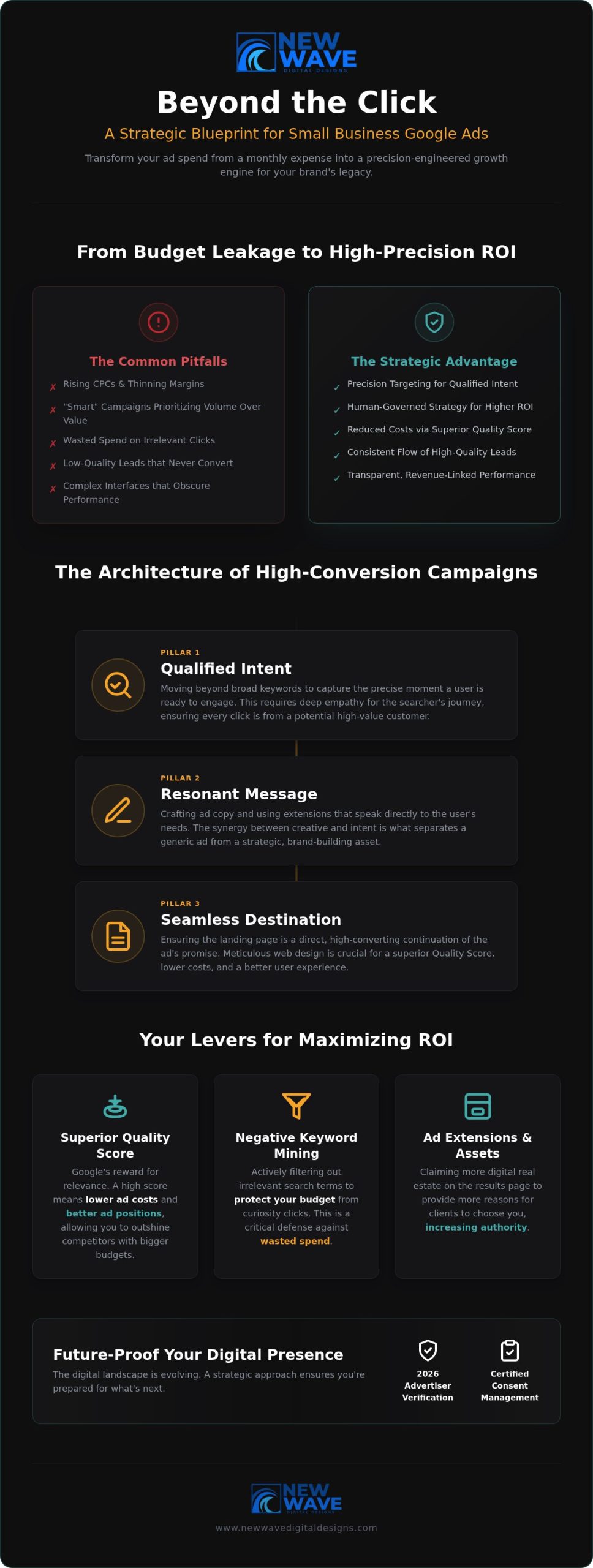
A high-performing campaign is not built on luck; it is a structure supported by three essential pillars: Intent, Message, and Destination. When these elements align, your advertising transforms from a speculative expense into a deliberate investment. Strategic google ads management for small business focuses on this harmony. We look past the raw volume of clicks to find the quality of the connection. By treating your campaign as a digital blueprint, we ensure that every interaction is meaningful and every dollar spent is defended.

The Quality Score framework is your most potent secret weapon. Google rewards relevance, not just the highest bidder. When your ads resonate deeply with searchers and lead to a high-converting landing page, your costs decrease while your visibility rises. This allows a boutique brand to outshine larger competitors with deeper pockets. This level of meticulous google ads management for small business transforms technical settings into a formidable barrier against wasted spend. We supplement this with negative keyword mining to filter out the noise of irrelevant searches, protecting your budget from curiosity clicks that never convert.

Claiming your digital real estate requires the sophisticated use of ad extensions and assets. These components expand your presence on the search results page, offering potential clients more reasons to choose you. Whether it’s highlighting a specific service or showcasing a testimonial, these assets provide the depth and authority needed to capture attention in a crowded marketplace.

Keyword Selection as a Strategic Foundation

Before selecting a single term, conducting thorough market research and competitive analysis is vital to understand the landscape you’re entering. We distinguish between high-volume “vanity” terms that drain budgets and high-intent “buying” terms that drive growth. Utilizing long-tail keywords allows you to bypass expensive, broad-market competition by targeting specific, nuanced needs. Keyword Intent is the bridge between a problem and your specific solution.

The Synergy of Ad Copy and Landing Page Design

A visionary website design is the heartbeat of ad profitability. If your ad promises luxury but your website delivers a fragmented experience, the disconnect will drive visitors away. Maintaining “Message Match” is non-negotiable. The visual language and the written promise must be identical from the first click to the final conversion. Professional Web Design serves as the bedrock for your paid search success, ensuring that your digital storefront is as compelling as the ad that brought the visitor there. Partnering with a team that understands this digital architecture ensures your vision is never lost in the data.

Evaluating Management Models: DIY, Automated, or Strategic Partnership

Choosing how to govern your advertising is a pivotal decision that defines the trajectory of your digital presence. Many owners initially view the DIY route as a sensible cost-saving measure, yet the hidden expenses of lost opportunity and technical errors often outweigh any perceived savings. When you spend hours navigating a complex interface, you’re diverting energy away from the visionary leadership your company requires. Professional google ads management for small business is not a recurring bill; it’s an investment in a scalable asset that grows in value through strategic oversight.

The choice between a high-volume factory and a boutique partner is equally critical. Factory models prioritize throughput, treating your brand as a mere entry in a database. In contrast, a boutique partnership offers a sophisticated blend of professional confidence and artistic inspiration. This approach ensures that every campaign is treated with a high degree of personal care, reflecting the true spirit of your business rather than a generic template. You deserve a guide who is personally invested in your long-term success and understands that google ads management for small business is a form of digital craftsmanship.

The Myth of ‘Set and Forget’ Advertising

The digital landscape of 2026 is characterized by rapid shifts in searcher behavior and platform requirements. Relying on a ‘set and forget’ mentality leads to account decay, where once-profitable campaigns lose their edge due to rising competition or outdated creative. Regular, methodical evolution is essential. This consistent maintenance ensures your ads remain relevant in a shifting market, protecting your margins from the entropy of an unmanaged profile. Without deliberate refinement, even the most meticulously built campaigns will eventually succumb to the noise of the marketplace.

Defining the Value of a Digital Architect

A Digital Architect does far more than just buy clicks. They serve as a partner who builds growth, using search data to inform your overall business trajectory. This strategic consulting bridges the gap between technical execution and visionary goals. Beyond the campaign dashboard, a professional partner integrates technical security and managed hosting into the strategy. This protects your ad traffic from the threats of downtime and malicious activity. Such a comprehensive approach provides the peace of mind that comes from knowing your digital foundation is secure, allowing you to focus on the evolution of your brand.

Google Ads Management: 2026 Small Business Growth

Maximizing ROI: Small Business Ad Spend Guide

A budget is the fuel for your digital engine, but without a precise map, even the most robust resources are wasted. Determining an initial “test and learn” budget requires a blend of ambition and pragmatism. We typically analyze historical data and industry benchmarks to establish a baseline that allows for meaningful discovery without overextending your resources. Research indicates that many businesses find success starting with an ad spend between $1,000 and $10,000 per month, depending on their specific market goals. This initial phase is essential for identifying high-intent pathways, establishing brand resonance, and securing scalable growth.

We navigate the bid strategy spectrum with a steady hand. For new campaigns, Manual CPC provides the granular control needed to test specific hypotheses and protect your initial investment. As the campaign gathers data, we transition toward more sophisticated, AI-driven strategies like Maximize Conversions. This methodical shift ensures that your google ads management for small business remains efficient, allowing the algorithm to work in harmony with our strategic oversight. Success is ultimately measured by the metrics that actually matter: ROAS (Return on Ad Spend) and CAC (Customer Acquisition Cost). These data points provide the transparency needed to link every dollar of spend directly to your company’s revenue.

True visibility often extends beyond the dominant search platforms. Integrating Bing Ads into your broader strategy captures high-intent searchers who may be overlooked by competitors, often at a lower cost-per-click. This multi-channel approach ensures your brand’s presence is comprehensive, resilient, and authoritative.

Budgeting for Precision, Not Just Presence

Dominating a niche category is far more profitable than being invisible in a broad one. By narrowing our focus, we ensure your brand captures the most qualified intent within your specific market. We further refine this through “Dayparting,” a strategy that schedules your ads to appear only when your customers are most likely to engage and convert. Budget is a tool, not a barrier, when applied with strategic surgicality.

The Role of Remarketing in the Conversion Journey

The journey from discovery to realization is rarely linear. Statistically, about 97% of visitors don’t convert on their first interaction with your brand. Remarketing allows you to nurture these potential clients through strategic, non-intrusive display ads that reinforce your brand’s unique spirit. To maintain the integrity of this ecosystem, we leverage Website Maintenance Services to ensure all tracking pixels and conversion tags remain functional. This technical diligence ensures that no lead is lost to a broken script or a tracking error. Secure your growth today by choosing a digital architect who treats your budget with the respect it deserves.

Elevating Your Presence: The New Wave Approach to Search Engine Marketing

At New Wave Digital Designs, we don’t view digital advertising as a mere technical utility. Instead, we approach google ads management for small business as a form of digital architecture. Our philosophy marries technical expertise with artistic inspiration, ensuring that every campaign we build isn’t just functional, but a true reflection of your brand’s spirit. We move beyond the cold data of clicks and impressions to focus on the emotional resonance that drives a customer to choose you over a competitor. This collaborative journey begins with a deep discovery of your visionary goals and transitions into a steady, methodical process of realization and continuous evolution.

A precision-engineered campaign requires a seamless foundation. We specialize in integrating your ad strategy with bespoke Shopify and WordPress ecosystems. This synergy ensures that your landing pages aren’t just destinations, but high-converting experiences that honor the promise made in your ad copy. As a boutique partner, we reject the high-volume factory model. We treat every project with a high degree of personal care and meticulous attention to detail, positioning ourselves as a strategic extension of your own team rather than a distant vendor.

A Partnership Built on Transparency and Trust

We believe that trust is earned through clarity. Our custom reporting avoids the dense jargon that often obscures performance. Instead, we speak the language of your specific business goals, providing transparent insights that link your ad spend directly to revenue and growth. We don’t just set up a campaign and walk away. Our team engages in continuous optimization cycles that mirror your business’s growth, adjusting bids, refining creative, and mining for new opportunities as the market shifts. You’ll find peace of mind knowing your digital presence is governed by dedicated experts who are personally invested in your long-term success.

Forging Your Path to Digital Dominance

The first steps in a New Wave engagement are built on deep understanding. We listen intently to your needs before applying our technical and creative expertise to build your custom blueprint. We ensure that your paid search strategy doesn’t exist in a vacuum. It is carefully aligned with your organic SEO efforts and your core brand identity to create a unified, authoritative presence across the web. This holistic approach ensures that every touchpoint reinforces your brand’s value and moves you closer to your goals. It’s time to move past superficial fixes and embrace a strategy built for longevity. Invite a Digital Architect to transform your Google Ads strategy today.

Realizing Your Vision Through Strategic Precision

Digital advertising is not a static task but an evolving form of craftsmanship. Transforming your online presence from a fragmented expense into a high-precision growth engine requires a deep understanding of your brand’s unique spirit. By aligning search intent with meticulously designed website ecosystems, you create a seamless journey that resonates with your audience and defends your margins. Expert google ads management for small business provides the strategic oversight needed to turn these abstract concepts into tangible revenue.

As Google Ads and Bing Ads certified experts, we specialize in the intricate Shopify and WordPress environments that form your digital foundation. Our boutique partnership model ensures your campaigns receive the personal care and technical diligence required to flourish in a shifting market. We’re committed to your long-term evolution, treating every project as a unique architectural masterpiece. It’s time to elevate your presence and claim your digital real estate with confidence. Forge Your Digital Growth Strategy with New Wave Digital Designs and begin your journey toward lasting success.

Frequently Asked Questions

Is Google Ads worth it for a small business with a limited budget?

Yes, Google Ads is exceptionally valuable when applied with precision rather than raw volume. A limited budget isn’t a barrier if you dominate a niche category through surgical keyword selection and dayparting strategies. By focusing on high-intent terms that mirror your brand’s unique spirit, you ensure every dollar works toward a specific growth goal. This architectural approach prevents budget leakage and transforms a small investment into a high-precision growth engine.

How much does Google Ads management typically cost for a small business?

Management costs for small businesses typically follow a flat monthly fee or a percentage of your total ad spend. While industry averages vary based on the complexity of your campaign architecture, the value lies in the strategic oversight provided. Professional google ads management for small business focuses on maximizing your return on investment rather than just buying clicks. You should view this as an investment in a scalable asset that protects your budget from technical errors and irrelevant traffic.

What is the difference between Google Ads and organic SEO?

Google Ads provides immediate visibility through paid placements, while organic SEO builds long-term authority and trust over time. Paid search allows you to capture qualified intent the moment a campaign launches, making it ideal for rapid growth. Organic SEO involves optimizing your website’s technical foundation and content to earn higher rankings naturally. A visionary digital strategy utilizes both to create a resilient, multi-channel presence that captures searchers at every stage of their journey.

How long does it take to see results from a new Google Ads campaign?

You will see traffic flowing to your website almost immediately after your campaign is approved and launched. However, achieving peak profitability requires a methodical “test and learn” phase that usually spans the first few months. During this time, a digital architect refines your bid strategies, mines for negative keywords, and optimizes ad copy to improve your Quality Score. Consistent, high-quality lead flow is the result of this deliberate and ongoing evolution.

Can I manage Google Ads myself or do I need a professional agency?

You can manage campaigns yourself, but the technical complexity of the 2026 interface often leads to significant “budget leakage” for the uninitiated. Professional google ads management for small business offers the meticulous attention to detail required to navigate new verification requirements and AI-governed structures. Entrusting your growth to a dedicated partner allows you to focus on your core business while ensuring your digital advertising remains a precision-engineered asset rather than a source of frustration.

What is a good conversion rate for small business Google Ads in 2026?

A “good” conversion rate is highly dependent on your industry, but in 2026, success is defined by the quality of the lead rather than just the percentage. With stricter advertiser verification and consent management policies in place, the focus has shifted toward high-intent interactions. We prioritize building brand resonance through meticulous message match between your ads and landing pages. This architectural synergy typically results in conversion rates that outperform generic, automated campaign setups.

How do I know if my Google Ads manager is doing a good job?

A high-performing manager provides transparent reporting that links your ad spend directly to revenue and business goals. You should see a consistent flow of high-quality leads and a steady improvement in your Return on Ad Spend (ROAS). Beyond the data, a true partner acts as a digital architect who listens to your needs and offers strategic consulting. If your manager focuses on vanity metrics like impressions rather than your actual growth, it may be time for a more sophisticated approach.

Does Google Ads help my website’s organic search ranking?

Google Ads does not have a direct impact on your website’s organic search rankings, as the two systems operate on separate algorithms. However, the data gathered from your paid campaigns can inform your organic SEO strategy by revealing which keywords drive the most conversions. Increased brand visibility through ads can also lead to more direct searches for your business. This synergy strengthens your overall digital presence, making your brand appear more authoritative and reliable to potential clients.

SEO vs PPC: 2026 Growth Guide for New Jersey Businesses

In the high-stakes environment of the local market, the most expensive marketing strategy isn’t the one with the highest invoice; it’s the one built on a fragile foundation. You’ve likely watched your digital spend escalate as the average cost per click in Google Ads has climbed to $5.42 this year. It’s a common anxiety to feel trapped between the immediate gratification of paid ads and the slow, steady climb of organic search, fearing that a single wrong turn could derail your growth. We understand the pressure to perform, the need for precision, and the desire for a legacy that lasts beyond the next billing cycle.

This guide offers a masterclass in balancing SEO vs PPC for New Jersey businesses, transforming these technical channels into a cohesive architectural triumph. You’ll gain a clear roadmap for budget allocation, learn to harmonize paid precision with organic longevity, and discover how to build a digital infrastructure that thrives under 2026’s new data privacy standards. We’ll examine the strategic interplay of visibility, authority, and conversion to ensure your enterprise doesn’t just participate in the market, but leads it with confidence and craftsmanship.

Key Takeaways

  • Move beyond the binary choice of organic versus paid to understand how a strategic allocation of resources creates a more resilient digital presence.
  • Explore how the craftsmanship of Organic SEO fosters deep trust and emotional resonance with your audience through a foundation of technical security.
  • Harness the immediate visibility and testing agility of Google Ads to navigate competitive markets with precision and speed.
  • Apply a clear comparative framework for SEO vs PPC for New Jersey businesses to align your marketing spend with your specific growth timeline and business model.
  • Adopt a unified search strategy where paid data and organic insights work in harmony to build a high-converting digital infrastructure.

The Digital Dilemma: Understanding SEO vs PPC for New Jersey Businesses

A digital presence is rarely built in a vacuum; it requires a deliberate blueprint that honors both the immediate need for visibility and the enduring value of authority. For many leaders, the choice between organic and paid channels feels like a fork in the road, yet the most successful enterprises recognize that these paths are parallel components of a singular infrastructure. Deciding on SEO vs PPC for New Jersey businesses isn’t about choosing a winner, but about orchestrating a strategic allocation of resources that aligns with your specific goals, timeline, and market position.

Your current business stage dictates the rhythm of this investment. If you’re launching a new brand, you need the instant illumination of paid search to validate your messaging. If you’re scaling, you require a balanced harmony that captures high-intent traffic while lowering your long-term acquisition costs. For those dominating their niche, the focus shifts toward protecting market share through a fortified organic moat and sophisticated, brand-aligned design that maximizes the ROI of every visitor. This architectural approach ensures that your website isn’t just a placeholder, but a high-performance engine for conversion.

The Craftsmanship of Organic SEO

Organic SEO functions as a digital estate, an asset that appreciates as you invest in its technical integrity and narrative depth. It requires a patient hand and a commitment to Understanding Search Engine Optimization as a foundational discipline rather than a collection of shortcuts. This process begins with a secure, well-maintained technical foundation; without WordPress maintenance or secure hosting, even the most poetic content will fail to resonate with search algorithms. Organic SEO is the art of building long-term authority through strategic content and technical excellence. By prioritizing meticulous craftsmanship, you build deep trust, establish industry leadership, and create a resilient presence that remains long after an ad budget is exhausted.

The Precision of PPC Advertising

PPC advertising offers a surgical level of precision, allowing you to harness Google Ads and Bing Ads for immediate market entry. This channel provides the agility to test new products, pivot your messaging, and capture demand in real-time. The success of these campaigns relies on more than just high bids; it demands data-driven targeting and evocative graphic design that captures the true spirit of your brand at first glance. Paid search provides instant feedback for your brand’s messaging, offering a clear window into what resonates with your audience. When executed with a visionary eye, PPC becomes a powerful tool for rapid growth, providing the visibility you need to scale while your organic authority matures.

The Long-Term Artistry of Organic SEO

Organic visibility isn’t just a metric; it’s a bridge of trust. When your brand appears naturally at the pinnacle of search results, it signals authority, reliability, and permanence. This is the core distinction when weighing SEO vs PPC for New Jersey businesses; one buys attention, while the other earns it. Over time, this earned authority creates an emotional resonance that paid ads often struggle to replicate. It transforms your digital presence into a destination rather than a transient stop, fostering a relationship with your audience that deepens with every interaction.

Technical Integrity as an SEO Foundation

A visionary website requires a foundation of absolute stability. Site speed and security are no longer optional extras; they are the bedrock of your search engine rankings. Search algorithms favor sites that demonstrate meticulous care. Utilizing professional website maintenance services is essential to prevent the subtle ranking drops that occur when technical debt accumulates. Whether your enterprise operates on Shopify, WordPress, or Squarespace, a responsive and secure environment is the first step toward enduring visibility. It’s about protecting your investment through hosting and security that never wavers.

Strategic Content Evolution

True search success transcends the mechanical repetition of keywords. It requires a strategic evolution of content that captures the true spirit of your business through visionary storytelling. When you pair high-register prose with evocative graphic design, you extend dwell time and deepen engagement. This synergy between organic search and a consistent brand identity ensures that every visitor experiences the artistry of your work. It’s a methodical process: you define the vision, you craft the narrative, and you realize the growth.

The most compelling aspect of this approach is its compounding nature. Unlike paid channels where traffic stops the moment you pause the spend, organic visibility builds momentum. Each piece of content and every technical optimization adds a new layer to your digital estate. For those navigating the choice of SEO vs PPC for New Jersey businesses, this compounding effect often becomes the deciding factor for long-term sustainability. If you’re ready to evolve your digital presence, exploring a partnership with a visionary digital architect can turn these concepts into a tangible reality.

PPC advertising serves as a brilliant, immediate catalyst in a dense and competitive landscape. While organic authority matures, paid search offers the agility to command attention exactly when and where it is needed most. This speed is vital when navigating the choice of SEO vs PPC for New Jersey businesses, as it allows an enterprise to bypass the wait and engage with high-intent audiences instantly. By utilizing Google Ads and Bing Ads, you gain the power to test new concepts, validate fresh markets, and refine your messaging in real-time. It is a methodical approach to market entry that prioritizes visibility, precision, and rapid realization.

The true power of paid search lies in its capacity for meticulous audience segmentation. You aren’t just reaching more people; you’re reaching the right people with surgical accuracy. This targeted reach is amplified by high-impact graphic design, which transforms standard ad placements into evocative visual experiences. In 2026, where digital saturation is at an all-time high, the craftsmanship of your visuals is what separates a fleeting glance from a meaningful conversion. Every ad becomes a testament to your brand’s quality, depth, and visual excellence.

Maximizing ROI Through Strategic Ad Management

Achieving a transformative return on investment requires more than a simple bid; it demands a sophisticated understanding of audience behavior and meticulous budget management. Professional oversight ensures that every dollar spent is an investment in growth rather than a sacrifice to inefficiency. A central component of this success is the landing page, which serves as the Digital Architect’s secret weapon for conversion. Whether your site is built on Shopify, WordPress, or Squarespace, the transition from ad to page must be seamless, evocative, and brand-aligned. Integrating your paid search with a broader digital strategy ensures that your short-term wins reinforce your long-term vision.

The Art of the Ad Creative

The most effective ads don’t just inform; they inspire. By weaving evocative action and sensory metaphors into your copy, you capture the true spirit of your business and build an emotional resonance that purely technical ads lack. When your ad visuals and brand identity design remain consistent across every touchpoint, you foster immediate recognition and deep trust. Paid search also acts as a sophisticated feedback loop, providing immediate data on how your brand’s evolution is perceived by the market. It’s a journey of continuous refinement, where every click informs the next stage of your creative growth.

SEO vs PPC: 2026 Growth Guide for New Jersey Businesses

SEO vs PPC for New Jersey Businesses: A Comparative Framework

Choosing between SEO vs PPC for New Jersey businesses is not merely a tactical decision, but an act of architectural intent. One provides the immediate illumination of a spotlight, while the other builds the enduring strength of the structure itself. To navigate this choice, you must evaluate how your enterprise values time, control, and the perception of authority. While both channels aim for the same result, their paths diverge in how they interact with your audience and your balance sheet. Understanding these nuances allows you to orchestrate a marketing spend that is both efficient and visionary.

The timeline to results represents the most stark contrast. PPC delivers visibility in days, making it the ultimate tool for new product launches or seasonal surges where speed is paramount. Conversely, organic SEO requires months of meticulous cultivation. It’s a journey of technical refinement and content depth that builds momentum over time. While PPC offers surgical precision in targeting specific demographics, SEO provides an expansive, broad reach that captures users at every stage of their discovery. This breadth often leads to higher credibility, as sophisticated users frequently view organic rankings as a badge of industry merit rather than a paid placement.

Evaluating Cost and Return on Investment

The cost structure of these channels reflects their different roles in your digital infrastructure. PPC requires a recurring ad spend; it’s a liquid investment that generates revenue today but demands a constant feed to remain active. Organic SEO functions more like a digital asset. The upfront investment in technical health and authoritative content creates a foundation that appreciates in value. While PPC offers the speed of a digital sprint, SEO provides the endurance of a marathon. When the budget stops, PPC traffic vanishes instantly, whereas a fortified organic presence continues to yield results long after the initial work is complete.

Choosing Based on Business Objectives

Your specific objectives should dictate the weight you give to each channel. You might prioritize Shopify website design New Jersey when your goal is to build a high-converting e-commerce powerhouse that dominates organic search through craftsmanship and storytelling. If your aim is rapid scaling or testing a new market segment, leveraging the immediate impact of Google Ads or Bing Ads is the more agile choice. The intensity of market competition in your specific niche also plays a role. In highly saturated environments, a unified search strategy is often the only way to maintain a resilient presence. To begin building your high-performance digital infrastructure, connect with the experts at New Wave Digital Designs today.

The New Wave Approach: Crafting a Unified Search Strategy

The most sophisticated growth models don’t treat organic and paid search as competing interests. Instead, they embrace a ‘Digital Architect’ philosophy where every channel reinforces the other to create a resilient, high-converting presence. Navigating the choice of SEO vs PPC for New Jersey businesses requires moving beyond silos and toward a unified search strategy. This integrated approach ensures that your marketing spend isn’t just a cost, but a calculated investment in a larger, visionary infrastructure that values both immediate impact and enduring authority.

In this unified model, data flows freely between channels to sharpen your competitive edge. Your PPC campaigns act as a high-speed laboratory, identifying which specific keywords and messaging drive immediate conversions. This intelligence then informs your long-term organic strategy, allowing you to prioritize the content that is already proven to resonate. Conversely, the authority built through meticulous SEO work lowers your ad costs by improving your landing page quality scores and increasing user trust. It’s a methodical cycle of discovery, realization, and growth where every search query becomes an opportunity for brand evolution.

Using PPC to bridge the gap while your organic authority builds is a hallmark of strategic maturity. It allows you to maintain a dominant presence in the search results even as you undergo the slow, steady process of climbing the organic rankings. This dual visibility ensures that you capture demand at every stage of the customer journey, from the initial discovery to the final decision. By harmonizing these forces, you create a digital ecosystem that is both agile and indestructible.

Building Your Digital Craftsmanship Foundation

A unified search strategy is only as strong as the platform it rests upon. Professional web design is the absolute prerequisite for search success; without a high-performance site, your ad spend is wasted on a leaky bucket. Whether you require a custom Shopify store design or a robust WordPress presence, the artistry of the build determines the ROI of the marketing. Ongoing maintenance and secure hosting further protect these investments, ensuring that technical debt never erodes your hard-won visibility. Partnering with a boutique agency provides the meticulous attention to detail and personal care that high-volume service factories simply cannot replicate.

Next Steps for Strategic Evolution

Your journey toward digital dominance begins with a clear assessment of your current presence. You must identify the gaps where your brand’s spirit isn’t being fully captured or where technical friction is stalling your progress. From there, we create a roadmap that balances immediate wins with your long-term vision, using PPC to illuminate the path while your organic authority matures. It’s a steady, composed process that moves your enterprise from a participant in the market to a visionary leader. By treating your digital presence as a form of craftsmanship, you ensure that every click and every search result contributes to a legacy of continuous evolution.

Realizing Your Vision Through Strategic Search Harmony

The path to market leadership is rarely found in isolated tactics. It emerges from a deliberate orchestration of paid precision and organic longevity, built upon a foundation of technical excellence. We’ve explored how a unified approach to SEO vs PPC for New Jersey businesses transforms these technical channels into a singular engine for growth. By prioritizing technical integrity and visionary storytelling, you build a digital estate that captivates your audience and withstands market shifts.

Success in 2026 demands a partner who views your website as a form of craftsmanship. As a boutique agency, we bring meticulous attention to detail and deep expertise in Shopify, WordPress, and Squarespace to every project. We harmonize design, security, and search marketing to ensure your enterprise doesn’t just rank, but resonates. It’s time to move beyond fragmented tactics and embrace a deliberate roadmap for evolution.

Partner with New Wave Digital Designs to craft your visionary growth strategy. Your brand’s true spirit deserves a presence that is as enduring as it is impactful.

Frequently Asked Questions

Is SEO or PPC better for a new business in New Jersey?

A balanced approach is often the most visionary choice for a new enterprise. PPC allows you to illuminate your brand immediately in a crowded marketplace, capturing demand while your organic authority matures. However, starting SEO early ensures you aren’t perpetually reliant on ad spend. Deciding on SEO vs PPC for New Jersey businesses early in your journey allows you to build a resilient infrastructure that supports both immediate liquidity and long-term appreciation.

Can I run PPC ads while my SEO is still developing?

You absolutely should run PPC ads as a bridge to your organic success. This strategy provides immediate traffic and vital data while your SEO foundation is being meticulously crafted. By using Google Ads or Bing Ads early on, you can test messaging and identify high-converting keywords that will eventually inform your organic content strategy. It’s a methodical way to maintain market presence without waiting months for search engines to recognize your authority.

How long does it take for SEO to start outperforming PPC?

Organic SEO typically begins to demonstrate its compounding value within six to twelve months of consistent effort. While PPC provides an instant spotlight, the cost-per-acquisition for organic traffic often drops significantly as your site gains authority. Once your foundation is established, the traffic from search engines can outperform paid channels in terms of long-term ROI. It is the difference between a digital sprint and the enduring strength of a marathon.

Does having a high-quality web design affect my PPC costs?

Meticulous web design is a critical factor in reducing your advertising expenses. Search platforms evaluate your landing page experience to determine your Quality Score, which directly influences your cost per click. A brand-aligned, high-performance site on Shopify or WordPress ensures that visitors stay engaged, signaling to ad networks that your content is valuable. Investing in craftsmanship at the design stage effectively lowers the toll you pay for every lead generated through paid search.

Why should I invest in website maintenance alongside my SEO strategy?

Website maintenance is the invisible guardian of your search engine rankings. Search algorithms prioritize sites that are secure, fast, and technically sound; a single security vulnerability or broken plugin can cause your authority to crumble. By investing in managed hosting and technical support, you protect the growth you’ve worked so hard to achieve. It ensures your digital infrastructure remains a high-performance asset that reflects the meticulousness and professional confidence of your brand.

What is the most common mistake New Jersey businesses make with SEO vs PPC?

The most frequent error is treating these two channels as isolated silos rather than a unified search strategy. Many leaders invest heavily in PPC but neglect the technical foundation of their site, leading to high bounce rates and wasted budget. Conversely, some expect organic SEO to deliver instant results and abandon the effort too early. Successful enterprises recognize that SEO vs PPC for New Jersey businesses works best when integrated into a single, visionary architectural plan.

How do I know if my current digital marketing strategy is working?

True success is measured by the realization of your business objectives rather than mere vanity metrics. You should see a steady evolution in your conversion rates, a healthy return on ad spend, and a gradual increase in non-paid organic traffic. If your digital presence feels stagnant or disconnected from your brand’s spirit, it may indicate a need for a more strategic allocation of resources. A high-performance strategy should feel like a logical journey toward growth.