Signs You Need a New E-commerce Website to Improve Sales

A beautiful storefront can still lose sales if shoppers can’t navigate it easily. The clearest signs you need a new e-commerce website include persistently weak conversions, a frustrating mobile experience, slow-loading pages, and products that are hard to find. When several problems appear together, the cause may run deeper than outdated images or buttons.

It’s frustrating to invest in attracting visitors only to see them leave before buying. Start by identifying where the shopping journey breaks down and whether targeted updates could fix it or the site needs a broader redesign. This guide covers warning signs, from declining performance and mobile friction to slow pages and confusing product discovery, to help you decide what your store needs.

Key Takeaways

  • Compare conversion trends and checkout drop-offs over time to distinguish a persistent usability problem from a temporary dip.
  • Test the complete shopping journey on a phone, from product browsing through checkout, and note where effort or confusion builds.
  • Use Core Web Vitals to pinpoint whether loading, responsiveness, or visual stability is undermining the experience.
  • Ask people unfamiliar with your store to find specific products and observe where navigation or search leaves them stuck.
  • Match the remedy to the problem: a focused refresh may be enough when the site’s underlying structure still supports your business.

1. Bounce rates, conversion rates, and abandoned carts

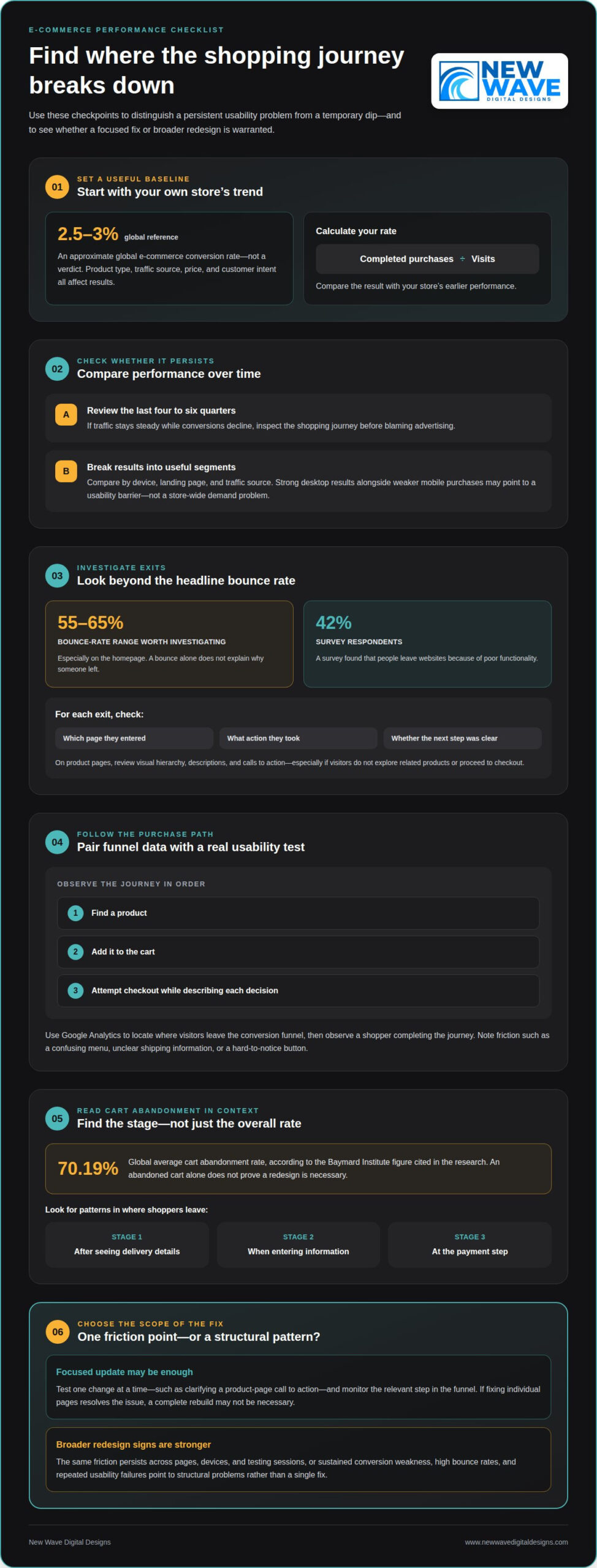
A good e-commerce conversion rate is approximately 2.5-3% globally. Treat that as a broad reference, not a verdict: product type, traffic source, price, and customer intent all affect results. Calculate your store’s rate by dividing completed purchases by visits, then compare it with your own earlier performance.

When traffic stays steady but conversions decline, inspect the shopping journey before blaming advertising. Compare conversion trends across the last four to six quarters to see whether the change persists. Then break down the data by device, landing page, and traffic source. Strong desktop results alongside weaker mobile purchases, for example, may point to a usability barrier rather than a store-wide demand problem.

Bounce rate adds another clue. Ecommerce bounce rates above 55-65% are worth investigating, especially on the homepage. A bounce alone doesn’t explain why someone left, so examine the page they entered, the action they took, and whether the next step was clear. If visitors arrive on a product page but don’t explore related products or proceed to checkout, review its visual hierarchy, descriptions, and calls to action.

Use Google Analytics to identify where visitors leave the conversion funnel, then pair that data with usability testing. Ask a shopper to find a product, add it to the cart, and attempt checkout while describing each decision. A confusing menu, unclear shipping information, or a button that’s hard to notice can turn interest into hesitation. A survey found that 42% of people leave websites because of poor functionality, making observed friction worth addressing.

Cart abandonment needs similar investigation. The global average cart abandonment rate is 70.19%, according to the Baymard Institute figure cited in the research, so an abandoned cart isn’t automatically proof that a redesign is necessary. Look for patterns: do shoppers leave after seeing delivery details, when entering information, or at the payment step? A consistent drop at one stage gives you a more useful target than the overall rate.

Test one change at a time, such as clarifying a product-page call to action, then monitor the relevant step in the purchase funnel. If the same friction persists across pages, devices, and testing sessions, the signs you need a new e-commerce website become stronger. A redesign is more compelling when sustained conversion weakness, high bounce rates, and repeated usability failures suggest structural problems rather than a single fix.

2. Mobile-friendly design

An outdated e-commerce website often shows its age through cramped mobile layouts, tiny controls, crowded menus, or product details that disappear off-screen. If customers have to pinch, zoom, or scroll repeatedly to take action, the design is creating avoidable friction. Google uses mobile-first indexing, so the mobile version also matters when pages are assessed for search.

Check the entire shopping journey on a phone, not just the homepage. Open a category, select a product, review its details, add it to the cart, and proceed to checkout. Look for cut-off buttons, overlapping text, difficult-to-use filters, and forms that reset unexpectedly. A layout that looks polished on desktop can still make these steps difficult on a smaller screen.

Compare mobile and desktop analytics to spot differences in product views, cart additions, and completed orders. If mobile visitors arrive but often leave before taking key actions, test the affected pages at different screen sizes and identify the exact point of friction.

Business growth can also outpace an existing design. A store that adds product categories, for example, may find its original homepage and menu no longer guide customers clearly. New audiences, a wider product range, or a changed brand identity can make the old structure feel restrictive. For creative brand owners and designers scaling their digital presence, platforms like IAMFASHION highlight how critical it is that an online store matches brand evolution. Compare current customer needs with the pages and features your website supports. A persistent mismatch may require more than visual updates.

Compare your visual presentation with customer expectations in your market, rather than copying another store’s style. Faded product photography, inconsistent typography, or an unclear value proposition can make a site feel neglected. Cluttered navigation adds to the problem: if customers have to scan competing menu labels to find a category, the site structure needs attention. A modern design should make the next action easy to spot.

Security and payment warning signs include browser security alerts, checkout errors, failed payment attempts, or payment steps that don’t work smoothly on mobile. These issues can interrupt a purchase and undermine customer confidence. Review the full checkout flow, from product selection to confirmation, and note error messages, broken buttons, or confusing transitions.

A redesign can bring risks such as broken links, missing product information, and disrupted customer journeys. Reduce them by documenting current pages, recording important URLs, and testing key paths before launch. For example, confirm that returning customers can still find a product category and complete checkout on a phone.

Before deciding, list the mobile problems, the pages they affect, and the customer action each one blocks. If fixing individual pages resolves the issues, a complete rebuild may not be necessary. If outdated design, changing business needs, and mobile usability problems affect the store more broadly, they’re stronger signs you need a new e-commerce website, leading many growing brands to consult specialists like Mosster Services Limited to craft a streamlined digital presence.

3. Page speed and Core Web Vitals

A slow e-commerce website keeps shoppers waiting before they can examine products or act. Many users expect pages to load within two seconds, and pages taking more than two to three seconds can lose potential customers before they see the offer. If most of your pages take longer than three seconds, investigate promptly whether the underlying site needs an update.

Speed affects more than first impressions. Slower loading can be associated with weaker conversion performance. That doesn’t mean every slow page requires a complete website redesign; first identify which pages are slow and what’s delaying them. Large product images, unnecessary scripts, and complex page layouts can all contribute to longer waits.

Core Web Vitals help assess the experience beyond a single load-time number. Good targets include Largest Contentful Paint, or LCP, under 2.5 seconds; Interaction to Next Paint, or INP, under 200 milliseconds; and Cumulative Layout Shift, or CLS, under 0.1. These measures focus on how quickly key content appears, how promptly pages respond, and whether elements shift unexpectedly.

Test the same URLs consistently: homepage, category pages, product pages, cart, and checkout. Check them on both mobile and desktop, since a page that feels quick on one device may lag on another. Record the slowest page and its Core Web Vitals results, then retest after each update. This comparison helps distinguish a troublesome template from a broader performance problem.

Pay attention to what visitors experience as a page loads. A product image that appears late, an unresponsive menu, or a checkout button that shifts as content loads can interrupt the shopping journey. If category pages repeatedly load slowly while simpler pages perform well, examine shared images and scripts on that template before replacing the whole site.

A redesign makes more sense when slow performance affects most pages, persists after targeted improvements, and reflects limitations in the site’s structure. If the issue is limited to a few images or one template, focused changes may be enough. Use measured load times and Core Web Vitals, alongside the customer actions affected, to decide whether a targeted update or a broader rebuild is more practical.
Signs You Need a New E-commerce Website to Improve Sales

4. Mobile usability and device-level performance

A page can fit a phone screen and still be difficult to use. Responsive web design needs to adapt more than page width: menus, product images, filters, and purchase controls must remain clear and usable. A category page, for example, may resize correctly while a large promotional banner hides its filter button. Check that essential actions stay visible as the layout changes.

Test the store on a mid-range phone, not just a recent flagship device. Open the homepage, browse a category, and inspect a product page at a customer’s natural pace. Check whether text is readable without zooming, buttons respond to taps, and menus close after a selection. Testing on a device can reveal friction a desktop preview misses.

Review touch interactions separately. Try selecting a product option, opening an image, and closing a pop-up with one hand. If controls are too close together, customers may tap the wrong option or lose their place. On product pages, keep key details and the add-to-cart action easy to find as shoppers scroll through images and descriptions.

Compare key pages across screen sizes and orientations. A homepage may look balanced in portrait mode but feel crowded when a customer turns a phone sideways. Check that navigation doesn’t cover product content, text doesn’t collide with images, and important actions remain clear. Record each issue by page and device to see whether it’s isolated or part of a wider design problem.

A responsive website can deliver a mobile experience without requiring a separate mobile application. That keeps the store consistent across devices rather than sending customers to another destination. Check whether your current web design presents the same product details, categories, and purchase steps on each device. Missing or inconsistent information can create doubt even when every page loads.

Distinguish a mobile usability issue from a broader platform limitation. If a homepage banner blocks navigation, revising that component may solve the problem. If product pages, filters, and checkout all require awkward workarounds on a mid-range phone, the underlying structure may be holding the store back. Document the customer action affected and test the revised experience on the same device. Repeated barriers across the site are stronger evidence that a redesign should address mobile usability from the ground up.

Customers should be able to find relevant products without decoding your menu. Test product discovery by asking five people outside your team to find three products. Watch where they pause, select the wrong category, or abandon the task. Their first attempts can reveal labels that make sense internally but don’t match the words shoppers use.

Review the journey from the homepage to a product page. Group related categories under clear names, use consistent menu labels, and make search easy to find. If customers have to open several unrelated dropdowns to find a product type, for example, simplify the hierarchy. Treat site search as part of navigation, too: test whether a familiar product name returns the right result.

Readability can hinder product discovery even when the right pages exist. Long menus, dense category descriptions, low-contrast text, and inconsistent labels slow shoppers down. Ask testers to complete a task, then note how long it takes and where they hesitate. The three-click rule suggests people should find what they need in three clicks, but that idea has been challenged. Judge the experience by successful task completion, not a rigid click count.

Google rankings shouldn’t be the only reason to change navigation. A clear structure helps visitors understand how products relate, while descriptive category names make pages easier to interpret. Check whether key categories are reachable from the homepage and whether each product page links back to a useful category. If shoppers and search engines encounter unclear paths, reorganizing the site may support both discovery and visibility.

Separate a navigation problem from a platform limitation before choosing a solution. If clearer labels, reordered categories, or improved search settings resolve the issue, a focused redesign may be enough. Consider migration if the current platform prevents essential changes, such as building a workable category structure or supporting product discovery. Compare your business’s current requirements with what its system can handle.

Test the experience before committing to a solution: give people a specific product-finding task, observe their route, and record where they get confused. Repeat after adjusting labels or page hierarchy. If people still struggle because the site structure can’t accommodate the catalog, a broader rebuild or platform migration may make sense. If improved navigation solves the task, keep the structure and refine the experience instead.

If product discovery remains difficult across key categories, get help planning a clearer e-commerce website around how customers browse and shop.

New Wave Digital Designs: Shopify Website Design

New Wave Digital Designs creates Shopify websites for businesses that need clearer structure, stronger product presentation, or a more usable shopping journey. A purpose-built redesign can align your storefront with your goals as your business evolves. The team also designs websites on WordPress and Squarespace and provides Website Maintenance for ongoing site needs.

Bring your priorities into the conversation: where customers struggle, which pages need attention, and what your store should support next. These details give the design work a practical foundation, shaped around your business rather than visual changes alone.

To discuss your e-commerce website needs, contact New Wave Digital Designs or visit www.newwavedigitaldesigns.com.

Turn your findings into a clear next step

Recognizing the signs you need a new e-commerce website is only the beginning. Next, decide what a better customer journey should make possible, then use that goal to guide design choices. Start with the business outcome you want your storefront to support, such as helping shoppers understand your offer or explore your catalog. A clear goal gives your redesign direction beyond simply looking newer.

Before making changes, write down the customer tasks your website must support and the obstacles you want to remove. This gives you a practical basis for planning and evaluating options, while keeping the experience aligned with your business as it evolves. New Wave Digital Designs can turn those priorities into a considered website design.

Contact New Wave Digital Designs to discuss a thoughtful next step for your e-commerce website. With a clear purpose guiding the work, your storefront can better reflect your business and welcome customers into a more intuitive experience.

Frequently Asked Questions

How do I know if my ecommerce website needs a redesign?

Consider a redesign when recurring problems affect several parts of the shopping journey, not just one page. Look for patterns such as staff relying on workarounds to update products, customers struggling to compare options, or new business goals the current layout can’t accommodate. Document each issue, its impact, and the pages involved. This helps distinguish a design problem from a content or process issue that can be changed separately.

How do slow page speeds affect e-commerce conversion rates?

Slow pages can interrupt a purchase before shoppers reach the details they need to decide. Delays on a product page may prevent images or options from appearing promptly, while sluggish cart updates can leave customers unsure whether an action worked. Review performance throughout the purchase path, including filtering and cart interactions. This shows whether delays cluster around one feature or affect the store more broadly.

How can I tell if my e-commerce site is not mobile-friendly?

Try completing a purchase on your phone in its default browser, with the screen set to its normal text size. Check whether product information stays readable, forms are comfortable to use, and the checkout summary remains clear as you enter details. Test browser back navigation, too: if it unexpectedly clears selected products or entered information, the mobile journey needs attention. Repeat the test on another phone or browser to uncover device-specific inconsistencies.

How do high bounce rates and cart abandonment indicate website problems?

High exit rates can signal friction, but their location and context matter. Compare pages with similar traffic sources, then check whether visitors leave before viewing product details, after selecting options, or during checkout. A campaign landing page may attract the wrong audience, while repeated exits at one checkout field may point to a confusing step. Consider session patterns and customer feedback together before deciding what to change.

When should a business redesign or rebuild its e-commerce website?

Redesign when the existing foundation can still support the store but its presentation or customer journey needs restructuring. Rebuild when essential requirements depend on capabilities the current setup can’t provide, such as a different product organization or connections to business systems. Before deciding, identify what must remain stable, including product records and essential customer journeys. Those requirements help define a practical project plan.

How can I audit an e-commerce website before deciding to rebuild it?

Start by inventorying important pages, products, integrations, and customer tasks. Review analytics for changes in performance by page and traffic source, then test common tasks as a shopper. Ask staff which updates require repeated workarounds and record each issue’s business impact. Group findings into content, design, usability, and technical needs to see whether targeted improvements or a broader rebuild is the better fit.

E-commerce SEO Strategies: A Visionary Framework for Digital Growth in 2026

True digital visibility is never a mechanical checklist; it is the architectural craftsmanship of authority, structural clarity, and genuine discovery. If you feel trapped on the exhausting treadmill of rising ad spend while organic traffic remains stubbornly flat despite endless product uploads, you aren’t alone. The rapid rise of AI-driven search overviews has created widespread uncertainty, leaving ambitious store owners wondering how to break through the noise. To secure sustainable revenue in 2026, brands must embrace visionary e-commerce SEO strategies that transform their storefronts into cohesive environments engineered for algorithmic trust and human delight.

Your online store deserves a presence that reflects the true caliber of your craft while consistently capturing high-intent buyers. In this guide, you will master the architectural and creative strategies required to transform your online store into a high-ranking, revenue-generating digital masterpiece. We will lay out the definitive roadmap to elevate search visibility, align product data with modern engines, and cultivate frictionless shopping experiences that turn casual browsers into devoted patrons.

Key Takeaways

  • Discover how to architect structured topical silos and intuitive taxonomies that streamline crawl paths while enhancing the customer journey.
  • Implement visionary e-commerce SEO strategies that transcend simple keywords to align dynamic product catalogs with authentic commercial intent.
  • Master the technical foundations required for modern discovery, including refined Core Web Vitals benchmarks and advanced merchant schema tailored for generative AI engines.
  • Elevate standard product detail pages into compelling digital showcases by harmonizing high-performance visual media with evocative, trust-building copy.
  • Uncover how integrating robust organic search with multi-channel marketing creates a resilient digital ecosystem designed for sustainable revenue growth.

The Evolution of E-commerce SEO: Beyond Simple Keywords

E-commerce visibility has outgrown simple keyword repetition and superficial meta tags. Some mistakenly treat organic search as a passive, zero-cost channel, but sustainable digital equity demands deliberate craftsmanship and continuous technical care. Applying foundational search engine optimization principles to modern storefronts requires an architectural alignment between vast catalog data and authentic buyer intent. Traditional tactics falter when applied to dynamic catalogs with thousands of active SKUs. Without structural discipline, search crawlers lose their way in crawl bloat, faceted URL duplication, and fluctuating inventory states. Modern e-commerce SEO strategies shift the focus from chasing raw search volume to answering distinct shopper queries, establishing a resilient foundation for long-term commercial growth.

The 2026 Search Landscape: AI and Intent

Generative search engines and AI Overviews have fundamentally altered how consumers evaluate and purchase goods. Shoppers no longer browse through pages of blue links; they prompt search engines with detailed, multi-layered buying requirements. High-intent long-tail phrases now carry significantly more commercial value than broad head terms because they capture shoppers at the moment of peak purchase intent. Optimizing a storefront for generative discovery means structuring product data, authentic customer sentiment, and contextual specifications so machine-learning models can instantly parse, verify, and cite your store as the premier destination. Merchandisers looking to stay ahead can explore Revenue Generating AI Tools to unlock new opportunities for catalog intelligence and sustainable revenue growth.

E-commerce SEO vs. Lead Generation SEO

Lead generation websites typically rely on static informational pages and predictable conversion pathways. Online stores, by contrast, navigate complex technical ecosystems involving faceted filters, variant matrices, and real-time inventory adjustments. Unmanaged canonical tags on size or color variants can dilute link equity, while outdated pricing or out-of-stock items erode merchant trust signals in search engines. E-commerce SEO is the architectural bridge between a product catalog and a qualified buyer. By deploying sophisticated e-commerce SEO strategies, digital architects ensure that dynamic database updates enhance, rather than undermine, the digital storefront’s authority and revenue potential.

Architecting High-Intent Structures: Category and Product Mapping

A digital architect treats site hierarchy like the blueprint of a grand gallery. Every corridor must lead effortlessly toward value, creating a harmonious balance between search crawler logic and human intuition. Implementing topical silos organizes products into tightly grouped thematic clusters, signaling deep subject authority to search engines while preserving navigational serenity for shoppers. By grounding your catalog architecture in Google’s ecommerce SEO best practices, you ensure crawler efficiency without sacrificing aesthetic clarity. Deliberate internal links then distribute hard-earned equity down from high-traffic category hubs directly to your high-margin creations.

Mastering Category Page Authority

Category hubs represent your primary digital storefronts. They anchor competitive commercial queries while introducing visitors to the true depth of your collection. Successful e-commerce SEO strategies unite structured indexation with artful visual presentation. Instead of cluttering collection layouts with walls of dense text, weave concise, intent-driven narratives around curated product grids. Managing faceted filters with selective indexation prevents duplicate crawl traps, channels ranking signals cleanly, and creates an inviting threshold where broad searches smoothly transition into focused purchases.

Product Page Precision

If category pages spark curiosity, product detail pages seal conviction. Capturing specific SKUs and granular transactional terms requires meticulous data craftsmanship, including clear specifications, material profiles, and authentic customer reviews. User-generated content infuses pages with fresh semantic relevance, elevating buyer confidence and algorithmic relevance simultaneously. Elevating this experience through visionary custom shopify store design ensures that technical schema and compelling aesthetics work in concert. When structural precision aligns with intentional visual flow, product pages transform into high-converting showcases. For brands ready to refine their digital presence, collaborating with a dedicated organic SEO and design team turns disparate catalog listings into an enduring engine for growth.

Technical Craftsmanship: Optimizing for AI Search and Core Web Vitals

Behind every captivating digital storefront lies an invisible framework of engineering precision. Search algorithms perceive technical performance as a direct reflection of merchant credibility. Aligning your platform with the official Core Web Vitals guidelines requires mastering three critical benchmarks evaluated at the 75th percentile of real-user visits: Largest Contentful Paint (LCP) under 2.5 seconds, Interaction to Next Paint (INP) under 200 milliseconds, and Cumulative Layout Shift (CLS) under 0.1. Preserving these thresholds prevents interaction lag during faceted filtering, variant selection, and cart actions. Crawl efficiency also demands proactive care. Rather than allowing seasonal or discontinued products to produce dead ends, thoughtful canonicalization and redirection protect link equity. Entrusting these technical complexities to professional website maintenance services safeguards site health against silent performance regressions.

Structured Data for the Modern Merchant

Basic meta tags can no longer satisfy generative search systems. Modern e-commerce SEO strategies require granular Schema.org definitions that connect your storefront directly to Google’s Shopping Graph. In practice, structured data is the digital language your store uses to speak directly to AI search engines. Implementing rich merchant markup requires exact properties:

  • Offer and Return Data: Integrate shippingDetails and hasMerchantReturnPolicy to qualify for expanded merchant listings and transactional snippet badges.
  • Product Variant Hierarchies: Utilize ProductGroup markup with hasVariant and variesBy attributes, allowing complex SKU matrixes to index accurately without canonical confusion.
  • Global Identifiers: Supply validated GTIN, MPN, and brand attributes alongside genuine review ratings to establish undeniable product provenance.

Mobile-First Artistry

Responsive design is merely the baseline; modern mobile commerce demands tactile elegance and instantaneous response. With over two-thirds of digital shoppers browsing on handheld screens, friction in navigation directly depresses conversion rates. Speed, responsive layouts, and rock-solid hosting form an inseparable triumvirate. Partnering with visionary specialists for comprehensive organic SEO services provides the structural foundation required for sustainable national discovery. By fusing architectural security with responsive front-end execution, your platform delivers an effortless shopping journey that algorithms reward and customers cherish.

E-commerce SEO Strategies: A Visionary Framework for Digital Growth in 2026

The Content Masterpiece: A Blueprint for E-commerce Authority

Dry technical specifications rarely stir desire. Modern algorithms and discerning buyers alike look for evidence of depth, taste, and brand distinction. Merely pasting manufacturer descriptions creates a sterile browsing environment that search crawlers penalize as duplicate thin text. Forward-thinking e-commerce SEO strategies approach written and visual content as an immersive brand experience. By coupling meticulous dimensional details with resonant editorial narratives, you bridge the distance between functional utility and emotional resonance. Thoughtful graphic design, bespoke layouts, and engaging educational guides serve as clear indicators of quality, capturing top-of-funnel curiosity and guiding visitors smoothly into the transactional heart of your catalog.

The Product Description Template

Compelling product descriptions follow a deliberate three-tier architecture that satisfies both inquisitive shoppers and semantic search engines:

  • The Immediate Hook: Open by directly acknowledging the shopper’s core frustration or unmet aesthetic desire, immediately confirming they have found the right item.
  • The Feature-Benefit Bridge: Translate dry dimensions, raw materials, or performance specs into tangible daily enhancements that illustrate life with the product.
  • The Trust Anchor: Conclude with verified patron feedback, transparent care instructions, and explicit shipping thresholds to eliminate purchase hesitation.

Visual Storytelling and SEO

Visual presentation communicates trust long before a visitor reads a single sentence. Search engines now index images and video through visual comprehension algorithms, making media optimization essential for high-intent product discovery. Clean file names, context-rich alternative text, and responsive picture delivery ensure fast rendering without compromising visual fidelity. Short-form product videos showcase craftsmanship while extending dwell time and lowering bounce metrics. Elevating your store through bespoke Custom Squarespace website design transforms conventional templates into stunning digital showcases where visual identity actively reinforces algorithmic authority. If you want to refine your digital presence, partner with our creative specialists to build an authoritative, high-converting e-commerce experience.

Scaling Your Vision: Integrating SEO into a Holistic Strategy

Isolating search optimization within a technical silo limits its true potential. Lasting commercial growth occurs when organic discovery serves as the core anchor of an expansive, multi-channel ecosystem. Tracking keyword positions alone provides an incomplete narrative; authentic success reveals itself in qualified pipeline growth, repeat purchase rates, and escalating customer lifetime value. Visionary e-commerce SEO strategies do not merely capture sporadic clicks. They construct an enduring brand footprint that lowers blended customer acquisition costs and builds compound visibility across the entire web.

The Synergy of Paid and Organic Search

Paid advertising and organic optimization perform best as collaborative allies rather than competing disciplines. Granular conversion metrics gathered from Google Ads and targeted Bing Ads management illuminate the precise queries driving real revenue. You can immediately channel these transactional insights back into your organic content architecture, securing dual visibility for your highest-converting terms. Dominating both paid listings and organic placements builds immediate trust, deters competitors from siphoning branded traffic, and establishes undeniable category leadership across modern search landscapes.

Your Digital Evolution Partner

Sustained digital growth requires more than rigid technical routines; it demands a dedicated creative partnership. High-volume service factories often view storefronts as uniform collections of database rows, missing the unique character that defines your business. True brand evolution thrives through meticulous craftsmanship, proactive maintenance, and strategic web design tailored to your specific market position:

  • Customized Architectural Strategy: Aligning site structure, structured schema, and visual storytelling to your distinct commercial goals.
  • Agile Performance Maintenance: Safeguarding speed thresholds and server reliability as inventory expands and search algorithms advance.
  • Holistic Multi-Channel Alignment: Harmonizing paid search campaigns, graphic design, and organic optimization into a cohesive revenue engine.

Your online store is not just another website; it is an appreciating digital asset that deserves deliberate craftsmanship. By aligning comprehensive e-commerce SEO strategies with an experienced digital architect, you build a resilient, high-performing commerce experience designed to lead your industry for years to come.

Architecting the Future of Your Digital Storefront

Transforming an e-commerce platform into an authoritative industry benchmark requires treating digital discovery as an art form. By structuring clear category hierarchies, implementing exact merchant schema for generative AI engines, and harmonizing technical speed with evocative visual storytelling, your brand transcends ordinary transactional commerce. Sustainable growth demands visionary e-commerce SEO strategies that adapt gracefully as search algorithms and consumer behaviors evolve in 2026.

At New Wave Digital Designs, we reject cookie-cutter formulas in favor of dedicated craftsmanship. As a boutique studio specializing in custom storefront design across Shopify, WordPress, and Squarespace, we unite technical organic SEO with targeted SEM to elevate your catalog into an enduring revenue engine. Your brand holds immense creative and commercial potential. Take the definitive step toward digital distinction and Partner with New Wave Digital Designs for Visionary E-commerce Growth today.

Frequently Asked Questions

What are the most effective e-commerce SEO strategies for 2026?

The most effective e-commerce SEO strategies center on multi-layered Schema.org integration, optimizing for Core Web Vitals thresholds like INP under 200 milliseconds, and structuring topical category silos. Rather than stuffing keywords, visionary storefronts align machine-readable merchant feeds with high-intent conversational queries. By pairing meticulous technical maintenance with rich user-generated reviews and visual assets, stores build authentic algorithmic authority across both generative search overviews and traditional listings.

How long does it typically take to see results from an e-commerce SEO campaign?

Is Shopify better than WordPress for e-commerce SEO?

How do I optimize my product pages for AI search results?

Optimize for AI discovery by providing exhaustive, verifiable product attributes that large language models can parse with absolute confidence. Ensure your pages feature detailed Schema.org markup, including global identifiers like GTINs, precise variant arrays, shipping details, and genuine customer sentiment. Generative search engines prioritize verified facts over sales hyperbole. Writing clear, problem-solving product copy paired with authentic visual demonstrations positions your inventory directly within AI-generated shopping answers.

What is the role of structured data in e-commerce SEO?

Structured data acts as the formal bridge between your store’s database and search engine algorithms. Implementing JSON-LD schemas such as ProductGroup, Offer, and MerchantReturnPolicy translates raw catalog attributes into clear signals for Google’s Shopping Graph. This markup powers rich snippet visual enhancements, real-time pricing displays, and delivery badges in search results. Without robust schema, your products risk remaining invisible to automated discovery systems and AI query processors.

How can I improve my store’s ranking for high-competition keywords?

Elevating performance for ultra-competitive head terms requires building comprehensive topical silos around your primary category pages. Instead of targeting broad terms in isolation, support them with tightly focused long-tail product pages, buyer guides, and deliberate internal linking. Combining refined e-commerce SEO strategies with targeted pay-per-click testing provides search validation while funneling qualified engagement signals that demonstrate authority and user satisfaction to algorithmic ranking models over time.

Do I need a blog for my e-commerce site to rank well?

While not mandatory for ranking individual SKUs, an editorial blog significantly strengthens your store’s topical authority and top-of-funnel reach. Educational buying guides, care tutorials, and comparative articles attract shoppers during the early consideration phase of their buying journey. These resources earn natural backlinks and allow you to link internally to high-margin collection hubs, establishing an interconnected content ecosystem that supports higher rankings across your entire store.

How does site speed affect my e-commerce search engine rankings?

Site speed directly impacts rankings through Google’s Core Web Vitals, which evaluate performance metrics like Largest Contentful Paint and Interaction to Next Paint. Search engines prioritize storefronts that provide instantaneous, stable interactions. When slow scripts or oversized images create lag during filtering or checkout, bounce rates climb and search engines downgrade organic placements. Fast storefronts protect dwell time, reassure shoppers, and directly lift organic conversion rates.

Hire Shopify Expert vs DIY: Architecting Your E-commerce Legacy in 2026

A digital storefront in 2026 is no longer a mere collection of product listings. It is a living, breathing monument to your brand’s ambition. You likely recognize that Shopify offers a robust foundation for growth, yet the increasing complexity of AI shopping agents, checkout extensibility, and headless architecture can make the platform feel like an impenetrable labyrinth. It’s natural to fear the technical dead ends that stall your momentum or the weight of an app ecosystem that demands constant attention.

The choice to hire Shopify expert vs DIY represents the most critical strategic decision you’ll make for your brand’s digital future. We promise to provide the clarity you need to move from technical anxiety to creative authority. By the end of this exploration, you’ll understand the hidden costs of a makeshift build, the transformative power of professional artistry, and how to architect a scalable foundation that converts your vision into a lasting revenue stream. We’ll dissect the technical requirements of the modern web, evaluate the true ROI of expert partnership, and reveal how to protect your store’s performance in an evolving marketplace.

Key Takeaways

  • Understand the nuances of the hire Shopify expert vs DIY debate, balancing immediate cost savings against the long-term architectural integrity of your brand.
  • Learn how bespoke design transcends mere functionality to create an emotional resonance that turns casual visitors into loyal brand advocates.
  • Identify the critical technical thresholds where a self-built store may falter under the weight of increased traffic and complex commerce requirements.
  • Discover the specific indicators, from stagnating conversion rates to security vulnerabilities, that signal it’s time to transition to professional craftsmanship.
  • Explore the strategic benefits of a boutique partnership that prioritizes managed hosting and security to safeguard your digital legacy as you scale.

The Allure and Reality of the DIY Shopify Path

The dream of digital entrepreneurship often begins with a blank canvas and a Shopify login. For many, the DIY path represents an empowering entry point, characterized by the use of native themes and intuitive drag-and-drop interfaces. This approach is fueled by a desire for absolute control and a need to preserve initial capital. To balance these needs, many entrepreneurs explore Starter Website Package options that provide professional quality at an accessible price point. It feels accessible. It feels manageable. It feels like the logical first step in building a brand from the ground up.

However, a profound accessibility paradox exists within this model. While Shopify makes it incredibly simple to open a shop, mastering the platform to a professional standard is an entirely different endeavor. The initial excitement of going live often gives way to the Time Tax. This is the hidden cost where hours, days, and weeks are consumed by troubleshooting minor technical glitches or wrestling with layout shifts. Every minute spent fixing a broken button is a minute stolen from product development, customer relationship building, and strategic scaling. When weighing the choice to hire Shopify expert vs DIY, you must consider if your time is best spent as a technician or a visionary.

The Template Trap: When Convenience Limits Vision

Templates offer a seductive speed-to-market, yet they often function as a creative cage. In a 2026 marketplace saturated with over 3 million active stores, a generic design is a recipe for invisibility. Relying on out-of-the-box themes frequently leads to App Bloat, where users stack third-party plugins to compensate for missing native features. This clutter slows down performance, complicates the user journey, and risks the security of your digital assets. True brand identity requires a bespoke touch that a standard template simply cannot provide. It is the difference between living in a pre-fabricated house and commissioning a custom estate, a level of distinction that Senses Group helps global brands achieve through integrated branding and ecommerce strategy. Brands serious about standing out should explore Shopify theme customization as a strategic path to a distinctive, high-converting storefront that transcends the limitations of generic templates.

The Technical Learning Curve

Beneath the user-friendly surface lies a complex architecture of code and logic. Gaining a deep understanding e-commerce requires more than just listing products; it involves mastering Liquid, Shopify’s proprietary templating language, and managing intricate SEO metadata. Without an expert eye, critical tasks like image optimization and the configuration of complex shipping or tax rules become minefields. These technical layers are not mere hurdles. They are the structural pillars of a secure, high-converting storefront. Meticulousness in these details separates a functional website from a scalable digital legacy that commands respect and trust.

The Value of Professional Craftsmanship: Why Hire a Shopify Expert?

Choosing to hire Shopify expert vs DIY moves your business from a state of mere existence to one of strategic dominance. While a DIY approach focuses on basic assembly, professional craftsmanship treats your storefront as a piece of digital engineering. This commitment to excellence is shared by multi-award winning agencies like C Me Online, who specialize in professional web design and e-commerce development. An expert doesn’t just install a theme; they architect a system. This involves developing an e-commerce strategy that aligns your technical infrastructure with your long-term commercial goals. It’s about precision. It’s about vision. It’s about the relentless pursuit of excellence.

Bespoke design serves as the heartbeat of this process. It creates a visual identity that resonates emotionally with your audience, fostering a sense of trust that generic templates cannot replicate. Beyond aesthetics, performance engineering ensures your site excels in core web vitals and mobile responsiveness. We design conversion-centric user experiences that guide customers naturally from discovery to checkout, removing friction and maximizing the value of every visitor. This level of meticulousness transforms a simple website into a high-performance engine for growth.

If your project involves building a custom MVP or modernizing a legacy application to support your store’s growth, you can learn more about Founders Workshop to see how their software development expertise can help you architect a robust digital foundation.

Standard features and third-party apps often come with technical debt. Custom-coded solutions offer a cleaner, more efficient way to achieve specific business logic without the baggage of “app bloat” discussed earlier. By ensuring a seamless custom shopify store design, you create a backend that is as elegant as the frontend. This administrative efficiency allows your team to manage operations with fluidity and grace. If you’re ready to elevate your presence, our team at New Wave Digital Designs can help you refine your digital footprint.

A Partnership Built on Trust and Vision

An expert acts as a strategic guide rather than a simple service provider. This partnership is built on a shared commitment to your brand’s evolution. Professional insights help you anticipate market shifts and prevent costly mistakes before they manifest. Instead of reacting to technical hurdles, you follow a deliberate roadmap for growth. For brands seeking a partner that offers a high level of strategic oversight, you can learn more about jWeb Media and their full-service digital solutions. This collaborative spirit ensures that your digital assets are not just maintained, but are constantly evolving to capture new opportunities in a competitive marketplace. The decision to hire Shopify expert vs DIY ultimately hinges on whether you want a vendor or a visionary partner invested in your legacy.

Determining whether to hire Shopify expert vs DIY requires a cold, analytical look at your brand’s trajectory. It is a choice between immediate capital preservation and long-term foundational integrity. While the DIY path may seem cost-effective at the outset, it often ignores the hidden expenses of lost conversions and technical debt. If you are architecting a legacy, you must evaluate if your current build can gracefully withstand a 500% surge in traffic during a seasonal peak. A self-built store often buckles under such pressure, leading to lost revenue and a tarnished reputation. Conversely, professional Shopify store development ensures your infrastructure is elastic, secure, and optimized for performance from the very first line of code.

Security and digital integrity have become the non-negotiable standards of 2026. DIY builds are frequently vulnerable to misconfigured permissions or outdated third-party scripts that can compromise customer data. An expert-managed storefront provides a fortress of protection, integrating advanced security protocols that safeguard your digital assets. This meticulousness extends to SEO dominance. While a DIY setup might cover basic meta tags, an architected solution builds SEO into the site’s structural DNA, ensuring your brand remains visible in an increasingly crowded marketplace.

Assessing Your Technical Threshold

A professional digital presence is a direct reflection of your product’s quality. “Good enough” is no longer a viable strategy for brands that aspire to lead. To determine if you possess the skills to manage a professional build, consider this brief self-assessment. Can you optimize Core Web Vitals to meet the latest search engine requirements? Do you have the expertise to implement complex schema markup for AI-driven search? Are you comfortable managing API integrations without breaking your checkout flow? A professional eye for Shopify website design identifies subtle friction points that a DIY builder would overlook, ensuring your reputation remains untarnished by technical mediocrity.

The Opportunity Cost of Your Time

Your role as a CEO is to innovate, lead, and expand. When you spend dozens of hours wrestling with CSS or shipping configurations, you aren’t just saving money; you’re losing momentum. Every hour dedicated to web development is an hour stolen from product innovation and market expansion. Delegating these technical burdens to a visionary partner accelerates your time-to-market and allows you to focus on the high-level strategy that drives growth. The decision to hire Shopify expert vs DIY ultimately hinges on the value you place on your own time and the speed at which you wish to see your vision realized.

Hire Shopify Expert vs DIY: Architecting Your E-commerce Legacy in 2026

Signs It’s Time to Transition from DIY to Professional Help

For those who prefer to remain hands-on but want to reduce the time spent on trial and error, working with a digital confidence coach NZ can provide the necessary technology training to streamline your learning curve. This allows you to maintain control over your digital storefront while still freeing up valuable time to focus on your brand’s expansion.

Recognizing the tipping point in the hire Shopify expert vs DIY journey is vital for preserving your brand’s momentum. Often, the signs aren’t catastrophic failures but subtle erosions of potential. You might observe stagnating conversion rates despite healthy traffic volumes, a clear indicator that your user journey contains invisible friction points. Perhaps technical glitches have begun to haunt your checkout experience, particularly as Shopify moves toward mandatory checkout extensibility. When your current design no longer mirrors the premium evolution of your business, you risk alienating the very customers you’ve worked so hard to attract. As you look toward advanced integrations like ERP systems, CRM platforms, or custom fulfillment logic, the limitations of a DIY foundation become a ceiling you can no longer ignore. For those who want to ensure their technical foundation is optimized for search visibility, FNP Digital offers comprehensive solutions to support your brand’s digital transition.

The High Cost of Technical Debt

In the rush to launch, many entrepreneurs rely on a patchwork of apps and “quick fixes” that eventually conflict with one another. These choices create a fragile ecosystem where a single platform update can cause a systemic collapse. Technical debt is the cumulative cost of choosing easy solutions over correct ones. To move forward with confidence, a professional audit is necessary to identify these hidden bottlenecks and restore the structural integrity of your storefront. Transitioning to a partner like New Wave Digital Designs allows you to clear this debt and build upon a clean, optimized foundation that prioritizes long-term stability over short-term convenience.

Scaling Beyond the Basics

Your digital presence must grow in parallel with your global ambitions. Scaling for international commerce requires more than just a simple currency toggle; it demands a sophisticated approach to localized experiences and robust multi-currency support. If you are currently operating on a template-driven platform and have reached its limits, following a comprehensive Squarespace to Shopify migration checklist can help you make the architectural leap without sacrificing your search rankings or brand equity. Implementing advanced E-commerce SEO strategies ensures your brand achieves national reach and remains visible as search algorithms become more complex. This evolution also necessitates professional graphic design to elevate your brand identity, ensuring every visual touchpoint exudes the artistry and quality your customers expect. When you reach this threshold, the decision to hire Shopify expert vs DIY becomes less about initial expenditure and more about your commitment to professional excellence. True growth requires a digital architecture that can support the weight of your success without bending under the pressure of expansion. A comprehensive approach to Shopify theme customization becomes essential at this stage, enabling your storefront to deliver localized, immersive experiences that resonate with a global audience.

New Wave Digital Designs: Your Visionary Shopify Partner

At New Wave Digital Designs, we view digital services through the lens of meticulous craftsmanship. The choice to hire Shopify expert vs DIY is ultimately a decision about the caliber of your brand’s foundation. We don’t just build sites; we architect experiences that capture the true spirit of your business. Our approach is characterized by a sophisticated blend of professional confidence and artistic inspiration. We believe every project deserves a level of personal care that high-volume factories simply cannot provide. By choosing a partnership over a transaction, you ensure that your digital storefront is built to endure. To see how professional infrastructure supports this level of growth, you can explore Web Development and Managed IT Services tailored for small businesses.

A visionary brand requires a secure harbor. We provide managed hosting and security services that act as a safeguard for your digital assets. This isn’t just about technical uptime. It’s about protecting the integrity of your brand’s legacy in an era of increasing digital volatility. By handling the complex science of server management and security protocols, we allow you to focus on the art of your business. This peace of mind is the cornerstone of a scalable digital strategy, allowing for fearless innovation.

Our process begins with listening. We believe that to build a successful Shopify website design, we must first understand the heartbeat of your brand. This deep understanding allows us to bridge the gap between a philosophical vision and a practical, high-converting result. We are personally invested in your long-term success, building trust through transparency and meticulous attention to detail. As your digital architects, we manage both the aesthetic “art” and the technical “science” of your site, ensuring a harmonious balance that resonates with your target audience. This commitment to a unified brand identity is why we recommend resources like The CEO Creative for businesses that need high-quality custom branding products to complement their digital storefront. You aren’t just another project in a queue; you are a partner in a shared creative journey.

Growth is not a static event but a process of continuous evolution. Beyond the initial launch, we offer comprehensive website maintenance and support to ensure your storefront remains at the cutting edge of performance. We integrate organic SEO and sophisticated SEM strategies, including Google Ads and Bing Ads, to drive consistent, high-quality traffic to your store. This tripartite approach—design, maintenance, and marketing—creates a comprehensive growth engine that propels your brand forward. For those aiming for measurable scaling, resources like petermontoya.com illustrate how performance marketing can secure market dominance. We invite you to transform your digital presence through a collaborative partnership that values strategy over quick fixes. Together, we can architect a digital legacy that stands the test of time and market shifts.

The journey from a functional storefront to a formidable digital legacy requires a transition from mere assembly to intentional architecture. We’ve explored how the decision to hire Shopify expert vs DIY is not simply a matter of initial budget, but a strategic choice regarding your long-term brand trajectory. A DIY build serves as a functional entry point, yet a professionally engineered store provides the resilient foundation required for global expansion and technical integrity. You don’t just need a website; you deserve a digital monument that reflects your craftsmanship and ambition.

Our commitment to your success extends far beyond the initial launch. We provide professional website maintenance and support, managed hosting and security solutions, and strategic organic SEO and SEM management to ensure your evolution is steady and secure. This holistic approach transforms your vision into a high-performance reality that commands trust. It’s time to stop wrestling with technical debt and start leading your industry with confidence. Partner with a visionary Shopify expert to architect your digital future. Your brand’s evolution is a masterpiece in progress, and we are ready to help you realize its full potential.

Frequently Asked Questions

Is Shopify easy enough for a beginner to build a professional store?

Shopify is designed for accessibility, allowing beginners to launch a basic storefront quickly using native templates. However, when weighing the choice to hire Shopify expert vs DIY, consider that creating a professional grade experience requires deep technical knowledge. A beginner often lacks the expertise to optimize for core web vitals or implement complex business logic. While you can build a functional shop, architecting a scalable digital legacy usually necessitates professional intervention to avoid mediocrity.

How much time does it typically take to DIY a Shopify store vs hiring an expert?

A DIY build often consumes 40 to 100 hours of a business owner’s time as they navigate the technical learning curve. This “Time Tax” diverts your focus from core growth strategies and product innovation. In contrast, hiring an expert typically involves a project timeline of four to eight weeks. While the duration may seem similar, the expert path results in a fully optimized, high performance store, whereas the DIY path often ends in a work-in-progress state.

Can I start with a DIY store and hire a Shopify expert to fix it later?

You can start solo and transition later, though this often requires a professional audit to address accumulated technical debt. Many entrepreneurs find that the cost to hire Shopify expert vs DIY increases when an architect must first dismantle conflicting apps and “quick fixes.” Starting with a professional foundation is more efficient, but we frequently help brands refine and elevate their existing DIY stores into sophisticated, high converting digital assets that command trust.

What are the main risks of building a Shopify store without professional help?

The primary risks include security vulnerabilities, poor site performance, and a diluted brand identity. Without professional guidance, many stores suffer from “App Bloat,” where excessive third party plugins slow down load times and create checkout friction. Additionally, DIY builds often miss critical SEO structural elements and legal compliance standards; for example, you can discover 216digital to see how legislation like Colorado’s web compliance law impacts e-commerce. These technical oversights can lead to lost revenue and a tarnished reputation that is difficult to repair over time.

Will hiring a Shopify expert improve my search engine rankings?

Hiring an expert significantly enhances your visibility through meticulous structural SEO and targeted marketing. Professional architects build search optimization into the site’s DNA, rather than just filling out basic meta tags. To better understand the technical metrics behind this visibility, you can learn more about PurpleCow Digital and their guide to domain authority and page rank. At New Wave Digital Designs, we complement organic strategies with strategic SEM management, including Google Ads and Bing Ads. This comprehensive approach ensures your brand isn’t just functional, but actively attracting and converting the right audience across the national landscape.

A developer typically focuses on the technical execution of specific tasks, while a Shopify expert acts as a visionary digital architect. Experts offer a holistic perspective that integrates design artistry with strategic engineering. While a developer might write code to solve a single problem, an expert ensures that every feature aligns with your brand’s long term commercial goals. This partnership focuses on craftsmanship and long term success rather than just fulfilling a technical checklist.

How do I know if my DIY store is actually hurting my sales?

You can identify sales friction through metrics like high cart abandonment rates and stagnating conversions despite steady traffic. If your site feels unpolished or lacks a cohesive visual identity, it likely fails to build the trust necessary for high value transactions. Technical glitches during the checkout process are a definitive sign that your DIY store is hindering your growth. A professional audit can reveal these invisible bottlenecks that are quietly draining your potential revenue.

What ongoing maintenance does a Shopify store require after launch?

Post launch success requires consistent website maintenance and support to safeguard your digital assets. This includes proactive security monitoring, managed hosting updates, and regular performance audits to prevent downtime. Beyond the technical basics, your store needs ongoing SEO refinements and content updates to stay relevant in an evolving market. For those who also manage WordPress assets alongside their commerce platform, you can check out Digital Junction to find specialized care plans that keep your broader web presence in peak condition. We treat maintenance as a form of continuous evolution, ensuring your storefront remains a secure, high performing monument to your brand’s ambition.

Custom Shopify Store Design: Crafting Visionary E-commerce Experiences

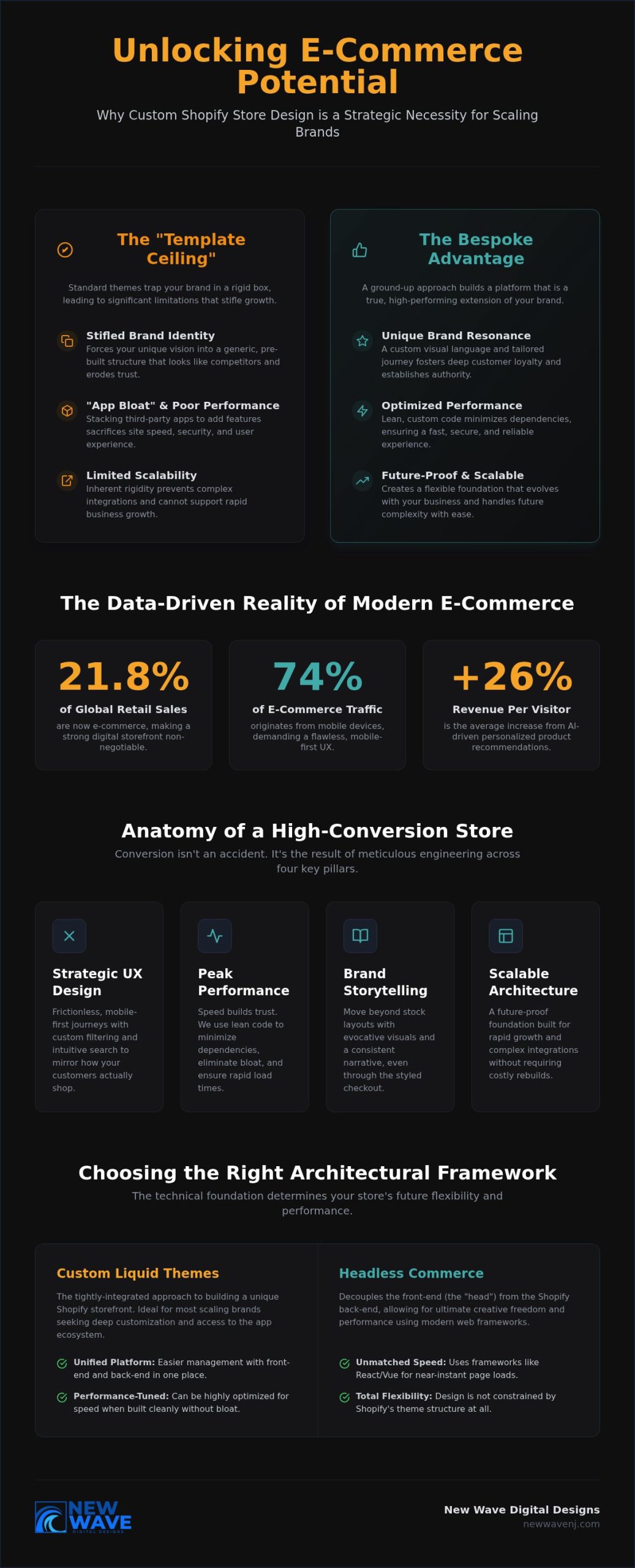
What if your digital storefront wasn’t just a place to process transactions, but a living, breathing extension of your brand’s soul? In an era where e-commerce sales account for over 21.8% of global retail, the bridge between a casual visitor and a loyal advocate is built on the first few seconds of interaction. You’ve likely felt the frustration of a generic template that fails to capture your unique value, or perhaps you’re battling the technical limitations and slow speeds of a bloated site. Investing in a custom shopify store design is more than a visual upgrade; it’s a strategic commitment to brand resonance, technical excellence, and sustainable growth.

We believe your business deserves a digital home that reflects its true spirit through meticulous craftsmanship and visionary thinking. This guide reveals how bespoke Shopify architecture transforms your digital storefront into a high-converting brand legacy that evolves with your ambitions. We’ll explore the anatomy of conversion, the power of immersive product visualization, and the methodical process of building a platform that offers seamless user experiences, artistic integrity, and uncompromising performance.

Key Takeaways

  • Learn why moving beyond standard templates is essential for scaling brands and how bespoke architecture prevents the “template ceiling” from stifling your growth.
  • Discover the meticulous UX strategies and brand-aligned storytelling elements that transform a digital storefront into a high-converting, intuitive customer journey.
  • Understand the technical nuances between custom Liquid themes and headless commerce to choose the right custom shopify store design framework for your brand’s specific performance needs.
  • Explore a collaborative design roadmap that prioritizes deep discovery and strategic wireframing to ensure your platform is built on a foundation of your core business values.
  • Gain insight into how a partnership-based development model creates a scalable, future-proof platform capable of evolving alongside your business’s long-term vision.

Beyond the Template: Why Custom Shopify Store Design is a Strategic Necessity

A digital storefront is more than a simple catalog; it’s a profound expression of a brand’s identity and a critical engine for growth. Many businesses begin their journey using standardized themes, which offer a predictable framework on the Shopify platform. However, as a brand matures, these pre-built structures often transform into a “Template Ceiling.” This invisible barrier limits your ability to innovate, stifles your narrative, and forces your unique vision into a rigid, predetermined box. Real custom shopify store design isn’t a superficial skin applied to a generic frame. It’s a ground-up architectural process that prioritizes your specific business objectives over convenience.

Psychological resonance plays a vital role in modern commerce. Consumers don’t just buy products; they invest in stories and trust. When a website looks identical to a dozen competitors, that trust begins to erode. A unique visual language fosters deep loyalty by signaling meticulousness and professional authority. Custom Shopify design exists at the delicate intersection of brand artistry and technical performance. Before committing to any platform, it’s worth understanding how your foundational choice shapes everything that follows — our in-depth look at wordpress vs shopify for ecommerce can help clarify which architecture best serves your brand’s long-term vision.

The Limitations of Out-of-the-Box Themes

Standard themes carry an inherent structural rigidity that makes implementing unique brand interactions nearly impossible. You’re often left fighting the code to make small adjustments, leading to a fragmented user experience. This frustration frequently drives merchants toward “App Bloat.” By stacking third-party apps to compensate for missing features, you inadvertently sacrifice site speed and security for basic functionality. In a saturated market, this technical debt makes your store look and feel like every other generic merchant, stripping away your competitive edge before a customer even scrolls.

The Strategic Advantage of Bespoke Architecture

Building a custom shopify store design allows us to tailor the customer journey to the specific nuances of your user personas. Instead of following a generic path, we craft fluid, intuitive transitions that mirror your customers’ actual buying behaviors. This level of UX/UI craftsmanship allows for precise optimization of the conversion funnel through data-driven decisions rather than guesswork. A bespoke approach also future-proofs your business. It creates a scalable platform capable of handling rapid growth and complex integrations without the need for a total rebuild every few years. We design for where your business is today, and more importantly, where it’s destined to be tomorrow. For brands based in the region, our dedicated Shopify website design New Jersey services bring this bespoke architectural philosophy to life with local market insight and boutique-level attention.

The Anatomy of Conversion: Key Elements of Professional Shopify Development

Conversion isn’t a happy accident. It’s the result of meticulous engineering and artistic intent. A professional custom shopify store design treats every interaction as a strategic opportunity to build trust and guide the visitor toward a purchase. We move beyond stock imagery and generic layouts, opting instead for evocative assets that speak to the soul of your brand. This level of craftsmanship establishes the usability in e-commerce that modern, discerning consumers expect from a premium digital storefront.

User Experience (UX) as a Revenue Driver

Mobile commerce is no longer a secondary consideration. With 74% of e-commerce traffic originating from mobile devices, your site must feel effortless on every screen. We focus on reducing friction by implementing custom product filtering and sophisticated search discovery tailored to your specific inventory. Integrating AI-driven product recommendations can also significantly boost your bottom line; in fact, personalized suggestions have been shown to increase revenue per visitor by an average of 26%. Even the checkout journey is a canvas for consistency. While we leverage Shopify’s world-class security, we style the interface to ensure the transition from cart to completion feels like a natural extension of your brand’s narrative.

Technical Performance and Speed Optimization

Speed is the foundation upon which trust is built. While many stores suffer from “App Bloat,” our approach utilizes lean, custom Liquid code to minimize unnecessary JavaScript dependencies. This architectural precision ensures your site remains lightning-fast, even with high-resolution imagery. Industry studies indicate that even a 1-second delay in page load time can result in a significant and measurable decline in conversion rates, making performance engineering a financial necessity. We balance visual excellence with technical speed through intelligent image optimization and lazy loading, ensuring your custom shopify store design performs as beautifully as it looks.

Strategic visibility starts at the source. We integrate organic SEO principles directly into the site’s architecture from day one. This proactive approach includes:

  • Architecting clean, logical URL structures and site hierarchy.
  • Implementing advanced schema markup for rich search results.
  • Optimizing metadata and heading tags for national search relevance.

Our goal is to build a platform that doesn’t just exist, but thrives. If you’re ready to transform your storefront into a high-performing brand legacy, New Wave Digital Designs is your partner in digital craftsmanship.

Evaluating Architectural Frameworks: Custom Themes vs. Headless Shopify

Selecting the right architectural foundation is a pivotal decision that defines how your brand breathes in the digital space. As a digital architect, I view this choice as more than a technical requirement; it’s a strategic alignment of your brand’s soul with its functional needs. For brands seeking a custom shopify store design, two primary paths emerge: the sophisticated craftsmanship of Custom Liquid Themes and the limitless, decoupled potential of Headless Commerce. Each path offers a unique set of tools to bridge the gap between artistic vision and technical performance. Understanding the broader platform landscape — including how wordpress vs shopify for ecommerce compares in terms of creative freedom and operational stability — can further inform this critical architectural decision.

When to Choose a Custom Liquid Theme

Custom Liquid themes represent the gold standard for high-growth boutique brands that value a balance between uniqueness and operational efficiency. By building ground-up within Shopify’s native language, we create a storefront that is entirely your own without the layers of complexity found in headless builds. This approach is ideal if your internal marketing teams need to maintain full control through the intuitive Shopify admin. It ensures that every daily update or seasonal campaign remains simple to execute. Furthermore, staying within the native ecosystem guarantees seamless compatibility with the vast array of Shopify apps, allowing you to scale your store’s functionality with total confidence and zero friction.

The Visionary Potential of Headless Shopify

For brands that view their digital presence as a piece of performance art, Headless Shopify offers the ultimate creative freedom. By decoupling the frontend presentation layer from the backend commerce logic, we gain total authority over every pixel and micro-interaction. Utilizing modern frameworks like Hydrogen and Oxygen, we can deliver ultra-fast, omnichannel experiences that remain consistent across web, mobile, and even IoT devices. This is a forward-thinking trend for 2026, where “agentic commerce” and immersive product visualization require a platform that can evolve at the speed of your imagination. It’s an investment in a custom shopify store design that removes all creative boundaries, allowing for a truly bespoke user journey.

The decision between these frameworks often depends on your specific scale and long-term objectives. While a custom Liquid build provides an exceptional return on investment for most, enterprise-level brands often leverage the advanced infrastructure of Shopify Plus to support more complex, headless architectures. We believe in a partnership model where we listen to your needs before recommending the path that best supports your evolution. Whether you choose the elegant efficiency of a native theme or the raw power of a headless storefront, the goal is to build a high-converting brand legacy that stands the test of time. Working with the best Shopify developers in New Jersey ensures you have the strategic foresight and technical expertise to make the right architectural choice for your brand’s future.

Custom Shopify Store Design: Crafting Visionary E-commerce Experiences

The Design Roadmap: A Collaborative Journey from Discovery to Launch

Crafting a visionary digital presence requires a methodical, deliberate approach that treats your business as a unique landscape rather than a generic plot of land. We view custom shopify store design as a transformative journey, moving through specific stages of professional realization. This process isn’t a hasty assembly; it’s a layered architecture designed for longevity and resonance. We begin by listening intently to your story, then we build meticulously to ensure every technical detail supports your artistic vision.

  • Phase 1: Deep Discovery. We capture the spirit and objectives of your business to ensure the foundation is true.
  • Phase 2: Strategic Wireframing. Mapping the digital architecture allows us to visualize the user flow before a single line of code is written.
  • Phase 3: Visual Realization. We apply sophisticated design and evocative assets to the strategic framework.
  • Phase 4: Technical Development. Our team handles meticulous coding and complex third-party integrations with surgical precision.
  • Phase 5: Quality Assurance and Launch. We conduct rigorous stress tests to ensure security and performance at scale.

The Importance of a Strategic Discovery Phase

A successful project starts long before the design phase. We analyze competitor landscapes to identify unique market opportunities that others might overlook. This phase defines your visual brand identity, focusing on how typography, color theory, and emotional resonance influence consumer behavior. By setting measurable KPIs, such as Average Order Value (AOV) and conversion rates, we ground our creative decisions in practical results. This strategic alignment ensures that your new custom shopify store design doesn’t just look beautiful but functions as a high-performing asset for your brand.

Ongoing Maintenance and Evolution

The launch of your store is the beginning of a continuous digital evolution. A custom build requires professional care to maintain its competitive edge. We provide managed hosting and security monitoring to protect your investment from emerging threats. Regular updates and technical support ensure that your platform evolves alongside the latest Shopify API versions, such as the quarterly releases we’ve seen throughout 2026. To keep your brand at the forefront, we integrate continuous SEO and SEM management, driving targeted traffic to your storefront. If you’re ready to start your journey, begin your custom Shopify project with us today.

Elevating Your Vision with New Wave Digital Designs

At New Wave Digital Designs, we don’t just build websites; we architect digital legacies. Choosing a custom shopify store design is the first step in a long-term partnership built on deep trust, strategic thinking, and shared ambition. We position ourselves as Digital Architects who listen intently to the heartbeat of your business before applying a single pixel. Our philosophy is rooted in the belief that digital development is a form of craftsmanship, where every line of code serves the higher purpose of capturing your brand’s true spirit. We bridge the gap between conceptual art and practical results by offering a comprehensive suite of services that move your business forward.

Our methodology integrates the artistic soul of Graphic Design with the technical rigor of Organic SEO and Google Ads management. This tripartite approach ensures your site is visually stunning, technically sound, and strategically visible. We also provide ongoing website maintenance and hosting and security, ensuring your digital architecture remains resilient against the tests of time and traffic. This commitment to continuous evolution is what separates a mere service provider from a dedicated boutique partner. Much like the design-led philosophy at summerstreetstudio.com.au, we’re invested in your growth, your narrative, and your long-term success.

The journey from a generic template to a custom masterpiece is transformative. It’s the difference between blending in and standing out; between settling for technical limitations and embracing ultimate creative freedom. Your vision deserves a digital home that reflects its depth, quality, and visual excellence. Moving beyond the standard “Template Ceiling” allows you to foster deep consumer trust and loyalty through a unique visual language. For businesses across the state seeking a broader perspective on professional digital craftsmanship, our comprehensive web design New Jersey guide explores how visionary architecture across platforms can elevate your entire digital presence. We invite you to move beyond the superficial and invest in a storefront that truly resonates with your audience. Start your visionary journey today and build a brand legacy that lasts.

Schedule Your Custom Shopify Discovery Session

Architecting Your Future: The Path to Digital Distinction

Transitioning from a standard theme to a bespoke platform is the definitive way to secure your brand’s legacy. We’ve explored how a meticulous custom shopify store design integrates high-performance engineering with evocative visual storytelling to move beyond the limitations of generic templates. By choosing a framework that aligns with your specific scale, whether through Liquid themes or headless commerce, you create a seamless journey that resonates with your audience and drives measurable results.

Our “Digital Architect” approach ensures your storefront is built on a foundation of integrated SEO, performance optimization, and ongoing security management. We view every project as a form of collaborative craftsmanship, aiming to capture the true spirit of your business while providing the technical support needed for continuous evolution. It’s time to elevate your vision and transform your digital presence into a high-converting masterpiece that evolves with your ambitions.

Begin Your Brand Transformation with a Custom Shopify Design

We look forward to realizing your visionary goals together and building a storefront that stands as a testament to your brand’s excellence.

Frequently Asked Questions

How long does a custom Shopify store design project typically take?

A typical project lifecycle spans 8 to 12 weeks, depending on the architectural complexity and depth of the brand narrative. We begin with a methodical discovery phase and move through strategic wireframing before entering technical development. This steady rhythm ensures that every detail is polished and every integration is secure. We prioritize meticulous craftsmanship over frantic speed, ensuring your digital storefront is built to endure as a high-performing brand legacy.

Will a custom design make it harder for my team to manage the store?

A custom design often makes store management more intuitive by aligning the backend interface with your specific operational workflows. We build within the native Shopify environment to ensure your marketing team retains full control over content, products, and seasonal updates. By removing the clutter of unnecessary third-party apps, we create a streamlined administrative experience. Our goal is to empower your team with a platform that is both technologically sophisticated and effortlessly functional.

What is the difference between a custom Shopify theme and a modified template?

A custom shopify store design is a ground-up architectural build tailored specifically to your brand’s soul, while a modified template is a pre-existing frame with surface-level tweaks. Templates often carry hidden technical debt and structural rigidity that stifle long-term growth. In contrast, a bespoke build offers total creative freedom and performance optimization. We treat every project as a unique digital ecosystem, ensuring your storefront is free from the “Template Ceiling” that hinders high-growth brands.

How does custom Shopify design impact my search engine rankings (SEO)?

Custom architecture provides a superior foundation for organic visibility by allowing for clean code, logical site hierarchy, and advanced schema markup. Unlike bloated templates that suffer from slow load times and poor indexability, a bespoke build is engineered for speed and search engine resonance. We integrate SEO principles into the very bones of the site from day one. This proactive strategy ensures your brand is positioned for national reach and sustainable traffic growth in a competitive marketplace.

Do I need Shopify Plus for a custom store design?

You don’t necessarily need Shopify Plus to benefit from a custom shopify store design, as bespoke Liquid themes perform beautifully on Basic and Advanced plans. While Shopify Plus offers enterprise-grade features and enhanced API access, our digital architects can craft stunning, high-converting experiences for brands at various stages of growth. We listen to your specific business objectives before recommending the most strategic plan. Our focus remains on delivering quality and depth, regardless of the underlying subscription tier.

Can you integrate custom third-party software or ERPs into my Shopify store?

We specialize in integrating sophisticated third-party software, ERPs, and fulfillment systems to create a unified digital ecosystem. By utilizing Shopify’s robust API, we ensure that your inventory, customer data, and financial reporting flow seamlessly between platforms. This methodical integration reduces manual friction and enhances operational efficiency. We treat these technical tasks as essential components of your digital craftsmanship, ensuring your backend is as powerful and refined as your frontend presentation.

What kind of ongoing support do you offer after the custom store launches?

Our partnership extends far beyond the initial launch through comprehensive website maintenance, hosting, and security monitoring. We provide regular technical updates to ensure your store remains compatible with the latest Shopify API versions and industry standards. This ongoing care includes performance audits and continuous SEO management to drive targeted growth. We view ourselves as your long-term digital guide, committed to the meticulous attention to detail required for your platform’s continuous evolution and success.

How do you ensure the custom design remains fast and mobile-responsive?

We ensure peak performance by utilizing clean code architecture and minimizing JavaScript dependencies that often bloat generic themes. Every visual asset is optimized for lightning-fast loads, while our mobile-first methodology guarantees a fluid experience on every screen. With 74% of e-commerce traffic coming from mobile devices, we prioritize responsive design as a technical necessity. This performance engineering balances visual excellence with technical speed, ensuring your visitors enjoy a seamless, high-converting journey regardless of their device. Businesses throughout the region can explore how our Shopify website design New Jersey expertise delivers these performance standards within a locally attuned, boutique development framework.

Navigating Success: The Role of Website Support for E-commerce Websites

In the dynamic landscape of e-commerce, where consumer expectations are soaring, ensuring a seamless shopping experience. It is pivotal for the success of online businesses. The backbone of this success lies in robust website support for e-commerce websites. As we delve into the intricacies of online retail, it becomes evident that a well-supported website is not just an asset but a necessity.

Understanding the Essence of Website Support

Website support for e-commerce websites encompasses a range of services geared towards maintaining the functionality, security, web hosting and overall health of your online platform. From troubleshooting technical glitches to ensuring the website’s compatibility with various devices and browsers, a dedicated support system is a safety net for your business. It goes beyond problem-solving; it’s about preemptively identifying and addressing issues to provide a seamless shopping experience.

The Dynamics of E-commerce Website Support

Technical Troubleshooting:

Efficient website support involves a proactive approach to promptly identifying and resolving technical issues. Whether it’s a payment gateway glitch or a loading speed concern, a support team that understands the intricacies of e-commerce can be a game-changer.

Security Measures:

In the age of cyber threats, the security of customer data is non-negotiable. A robust website support system implements and maintains the latest security measures, protecting your e-commerce platform from potential breaches and ensuring the trust of your customers. Take a look at the 10 Common Web Security Vulnerabilities by clicking the link.

Mobile Responsiveness:

With an increasing number of users shopping on mobile devices, website support for e-commerce must prioritize mobile responsiveness. A seamless transition from desktop to mobile ensures customers can enjoy a consistent and enjoyable shopping experience, regardless of their device.

User Experience Optimization:

Website support plays a crucial role in enhancing the overall user experience. A support team focused on user experience can contribute significantly to customer satisfaction and retention, from streamlining the checkout process to optimizing product pages.

The Impact on Customer Satisfaction

A well-supported e-commerce website directly correlates with heightened customer satisfaction. In the competitive realm of online shopping, customers expect a hassle-free and enjoyable experience. Website support for e-commerce websites meets these expectations and surpasses them, creating a positive brand image.

Imagine a scenario where a potential customer encounters a technical issue while purchasing. Prompt and effective website support swiftly resolves the problem, turning a potentially frustrating experience into a positive one. This level of customer-centric support retains existing customers and contributes to positive word-of-mouth, fostering brand loyalty.

Future-Proofing Your E-commerce Venture

Investing in website support for your e-commerce website is akin to future-proofing your venture. As technology advances and consumer behaviors evolve, your website needs to adapt. A dedicated support team ensures that your online platform stays ahead of the curve, seamlessly implementing updates and integrating new features.

Moreover, as your business grows, so do the challenges it faces. Scalability becomes a concern, and an adept website support team can navigate these challenges effortlessly. Whether it’s handling increased website traffic during promotions or integrating new payment methods, having a reliable support system is instrumental in your e-commerce venture’s continued success.

Conclusion

In the ever-evolving landscape of e-commerce, the significance of website support cannot be overstated. It is not merely a reactive measure to fix issues. It is a proactive strategy to ensure a seamless shopping experience for your customers. A well-supported e-commerce website not only meets the current expectations of online shoppers. But it also anticipates and addresses future challenges, thereby securing the longevity and success of your online venture.

As you embark on this e-commerce journey, remember that your website is the face of your business in the digital realm. Investing in robust website support for your e-commerce website is an investment in customer satisfaction, brand loyalty, and the sustained growth of your online venture.

For more amazing content visit New Wave Digital Designs.