Website Designer: How to Find the Right Fit for Your Business

What if your website looked polished but still left visitors unsure what to do next? Choosing a website designer is about more than colours and layouts. The right design connects your brand promise to a useful digital experience, giving each page a clear purpose and helping visitors take the next step.

It’s understandable to feel uncertain about which platform or design approach will suit your business. A site built to sell products has different needs from one designed to introduce services, and visual appeal alone won’t make either effective. Start with what visitors need to find and do, then consider how the site’s structure, features, and visual style can support those needs.

In this guide, you’ll learn what a designer contributes, how discovery and platform selection shape a project, and what to prepare before work begins. You’ll also see how Shopify, WordPress, and Squarespace can serve different website needs. New Wave Digital Designs creates responsive, brand-aligned websites for these platforms, bringing business goals, design, and functionality into one considered experience.

Key Takeaways

  • A website designer shapes a site’s structure and visual experience around its audience, brand, and business purpose.
  • A clear sequence from discovery through launch preparation helps turn business goals into practical design decisions.
  • Shopify, WordPress, and Squarespace suit different website purposes, so match the platform to the functionality your business needs.
  • Gathering goals, audience insights, brand assets, content, and feature priorities gives your project a stronger foundation.
  • Plan for ongoing website care alongside the initial design to support your site as your business evolves.

What Does a Website Designer Do for a Business?

A business website has two jobs: represent the organisation clearly and help its audience find what they need. Meeting both goals takes more than attractive colours or striking imagery. A website designer shapes the visual experience and site structure around the website’s purpose, bringing brand identity, usability, and business objectives together.

A website designer plans how a site looks, feels, and guides visitors, aligning its visual design and page structure with the brand, audience, and goals. Design and development are related but distinct. Design establishes the layout, visual direction, and user pathways; development builds those plans into a functioning website. Depending on the project, different specialists may handle these disciplines, or they may be coordinated as part of one process. Both matter: a considered design needs sound implementation, while technical functionality needs an intuitive experience around it. For a broader overview of the field, see What is web design?

How website design connects brand identity and user experience

Visual choices create a first impression before visitors read every word. Typography, colour, imagery, spacing, and graphic details can express whether a business feels warm, refined, energetic, or practical. When these elements reflect the brand’s character, the website feels like a cohesive introduction rather than a collection of unrelated pages.

Usability gives that identity a clear path to follow. Descriptive navigation labels, well-organised content, and visible headings help visitors locate services, understand what the business offers, and find a relevant next step. A clear page hierarchy gives important information prominence without crowding out useful details.

Responsive design adapts the presentation to different screen sizes, so layouts, text, and navigation remain usable on phones, tablets, and desktop screens. The goal isn’t simply to shrink a desktop page. It’s to preserve clarity and ease of use as the available space changes.

What a professionally designed website can support

A website’s structure should make intended actions easy to understand. Depending on the business, that might mean exploring services, viewing product information, submitting an enquiry, or completing a purchase. Page layouts can guide visitors towards these actions by placing relevant information and prompts at useful points in their journey.

Consistency matters, too. Shared visual patterns across pages help visitors recognise the brand and understand how to move through the site. A service page, for example, can use the same heading styles and navigation as the home page while presenting information tailored to that service. This creates a coherent experience without making every page identical.

Design is a foundation, not a promise of business results. A polished, easy-to-use website can support business goals, but it can’t guarantee traffic or sales on its own. Performance also depends on factors such as the offer, content, audience reach, and ongoing marketing. New Wave Digital Designs creates responsive, brand-aligned websites that bring visual craft and practical purpose into one considered experience.

How a Website Designer Turns Business Goals into a Website

A successful website project moves from understanding the business to preparing a practical, considered launch. The website designer brings structure to that journey, while you contribute knowledge of your business, customers, and priorities. The process works best as a partnership: creative direction takes shape through informed decisions and useful feedback, not guesswork.

Discovery clarifies the goals and audience; planning turns those insights into a site structure, and design and development bring that structure to life. Each stage informs the next, helping the finished website reflect the agreed direction.

Discovery and planning establish the design direction

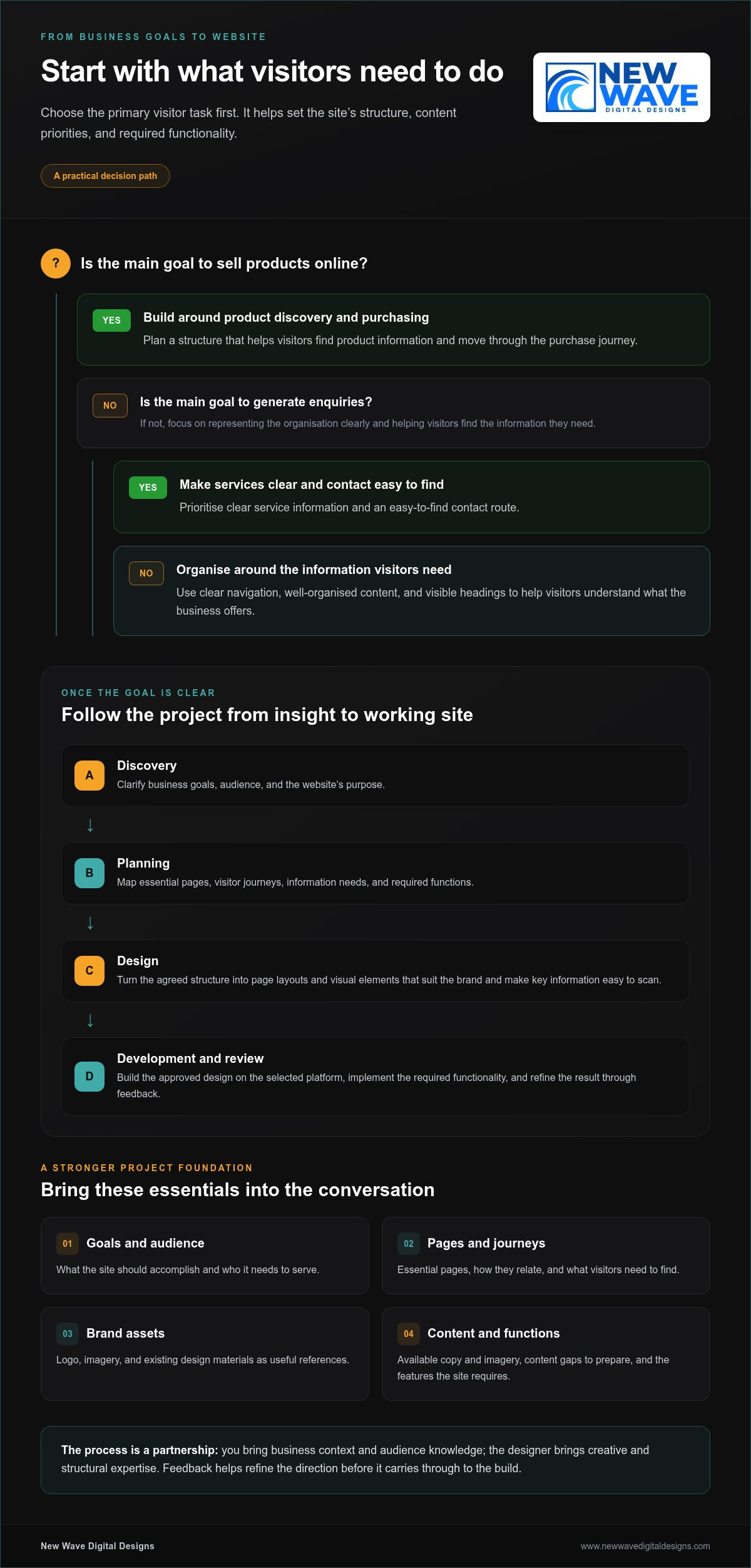
Early conversations clarify what the website needs to accomplish and who it needs to serve. A business focused on enquiries may need clear service information and an easy-to-find contact route, while an online shop needs a structure that supports product discovery and purchasing. These goals help set priorities before visual decisions begin.

Next, the project takes shape through a plan for essential pages and visitor journeys. The designer considers what information visitors need, how pages relate to one another, and which functions the site requires. Brand assets, such as a logo, imagery, and existing design materials, provide useful reference points. Content matters just as much: available copy and imagery can influence page layouts, while gaps show what needs to be prepared.

At this stage, collaboration is an exchange. You bring business context and audience knowledge; the designer brings creative and structural expertise. Resources such as Smashing Magazine for web designers also explore design, user experience, and development considerations that inform thoughtful digital work.

Design, development, and review bring the concept to life

Once the direction and structure are agreed, design translates the plan into page layouts and visual elements. The goal is to create a coherent system that suits the brand and makes key information easy to scan. Feedback at this point helps refine the visual direction before it carries through to the build.

Development applies the approved design to the selected platform and implements the required functionality. This is where layouts become working pages, navigation connects the site’s sections, and features are configured for their intended purpose. The build should reflect the original plan rather than introduce unnecessary complexity.

Review brings the details into focus. Assess whether the pages communicate clearly, whether the content is in place, and whether the experience matches the agreed direction. Specific feedback, such as pointing out a missing detail or a confusing step, gives the designer a clear basis for refinement.

  1. Discovery: Clarify business objectives, audience, and project priorities.
  2. Planning: Map pages, visitor journeys, content, and required functionality.
  3. Design: Develop layouts and visual direction around the agreed plan.
  4. Development: Build the website on the chosen platform and apply its functions.
  5. Review: Refine the site using feedback on its content and experience.
  6. Launch preparation: Organise final checks and prepare the approved site for launch.

For a project grounded in your business goals, explore website design with New Wave Digital Designs, where platform, brand, and purpose come together in a responsive site.

Which Website Platform Fits Your Business and Website Goals?

The right platform is the one that supports what your website needs to do, not simply the one receiving the most attention. An online store, a content-rich website, and a brand-focused business site can have different requirements. Consider what content you’ll publish, which features visitors need, and how you expect the site to develop. These priorities give a website designer a practical foundation for recommending a platform and shaping its design.

When Shopify, WordPress, or Squarespace may suit the project

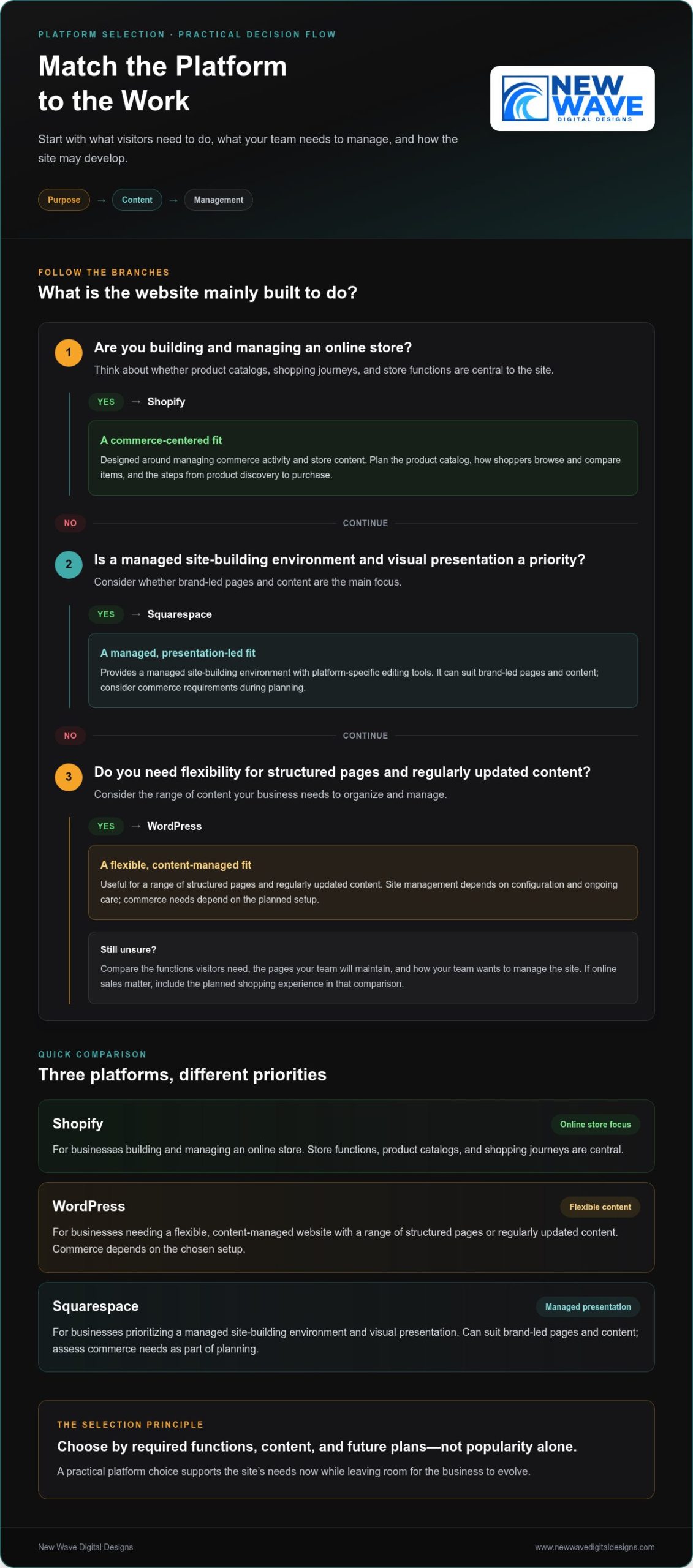
Each platform can support different kinds of projects, but the best fit depends on your needs. Shopify is a relevant option for businesses planning to sell products online. WordPress and Squarespace can also suit business websites, with the choice shaped by the site’s content, functionality, and presentation goals.

Platform Strength and typical fit Planning consideration
Shopify Designed for businesses building an online store. Plan how products, store content, and customer actions should be organised.
WordPress An option for business websites with content and functionality needs to define. Clarify the kinds of pages, content, and features the site must support.
Squarespace An option for businesses prioritising brand presentation and a cohesive website. Consider how the site’s content and required features fit the design direction.

For an online shop, decisions about product presentation and the path to purchase should inform the site’s structure from the outset. Explore this custom Shopify store design guide for more context on designing around ecommerce needs. For a brand-led site, this custom Squarespace website design guide offers a closer look at shaping a distinctive presentation.

How design requirements shape the platform decision

Start with the work your website must perform. Product sales call for planning around a shopping experience; frequent publishing calls for a clear content structure; a site centred on introducing a brand needs a deliberate visual and informational hierarchy. These needs can overlap, so list essential functions rather than choosing based on a single feature or trend.

Think beyond launch, too. The pages and capabilities you need now, along with directions you may want to take the site later, can influence platform fit. A clear set of priorities helps avoid choosing a design that looks appealing but makes important tasks awkward or leaves future plans out of view. Platform selection shouldn’t rest on blanket claims about which option is best for every business or inherently superior for SEO.

New Wave Digital Designs creates responsive, brand-aligned websites using Shopify, WordPress, and Squarespace. The platform decision can be considered alongside the site’s purpose, required functionality, and visual direction, aligning the technical foundation with the creative approach.
Website Designer: How to Find the Right Fit for Your Business

What Should You Prepare Before Working With a Website Designer?

A clear starting point helps turn your business knowledge into a focused website plan. You don’t need every word perfected or every creative decision made before beginning. Sharing what the site needs to achieve, who it should serve, and what materials you already have gives your website designer a stronger basis for structural and visual choices.

Clarify your goals, audience, and essential website functions

Begin with the website’s main purpose. Is it meant to introduce your services, support online sales, or make it easier for visitors to enquire? Note the key actions you want visitors to take, then identify the audiences the site must serve and what each group needs to understand or do.

Separate launch essentials from possible later additions. This keeps the initial design centred on the most important visitor needs while giving future ideas a place in the plan.

Gather content and visual references for a stronger collaboration

Collect materials that can give the project a clear foundation: existing brand assets, photography, business details, and website copy you’re ready to share. If some content is still being developed, identify what’s missing so page layouts can account for it instead of treating placeholders as final decisions.

Examples of websites or other digital experiences can also help communicate qualities you admire, such as calm navigation, expressive typography, or an editorial feel. Treat these as conversation starters, not designs to reproduce. Explain what appeals to you, and the designer can translate that direction into a distinctive fit for your brand.

Before the project begins, gather:

  • Goals: The site’s primary purpose and the outcomes it should support.
  • Audience: The people the website needs to serve and what they need to find.
  • Brand assets: Logos, colours, photography, and other existing visual materials.
  • Content: Available copy, business information, and a note of what still needs to be created.
  • Functions: Essential features for launch, plus enhancements that can wait.
  • References: Examples that illustrate the mood or experience you want to convey, with notes on why they work for you.

These priorities help shape decisions without requiring you to arrive with a finished blueprint. For smoother collaboration, consolidate feedback from everyone involved before sharing it. A single, considered set of comments makes it easier to distinguish essential changes from personal preferences and keeps creative discussion centred on the agreed goals.

Ready to turn your priorities and materials into a considered website plan? Start planning your website design with New Wave Digital Designs.

Build Your Website With a Designer Who Connects Craft and Purpose

A website becomes a more useful business asset when its visual craft is guided by a clear purpose. The decisions explored in this guide form a practical framework: define what the site needs to achieve, select a platform that suits its functions, prepare content and brand materials, and plan how the site will be cared for after launch.

That framework keeps creative choices connected to real needs. Instead of beginning with a design trend, a website designer can shape the structure and visual direction around your audience, brand, and priorities. The result is a more coherent foundation for the experience you want visitors to have.

Design and platform expertise for distinct business needs

New Wave Digital Designs creates responsive, brand-aligned websites for small and medium-sized businesses. Its design work spans Shopify, WordPress, and Squarespace, allowing the platform and visual approach to reflect each project’s purpose and required functionality.

A business preparing to sell products online may have different structural needs from one focused on sharing service information or presenting its brand. Those differences shape decisions about content, navigation, and how visitors move through the site. Tailoring design to the project brings business identity and practical use together rather than treating appearance as a separate layer.

Clear priorities make that collaboration more grounded. Knowing what visitors should find and do helps guide creative choices, while prepared content and brand assets give the design a meaningful starting point. It’s a partnership between your knowledge of the business and the designer’s experience shaping a cohesive digital presence.

Plan beyond launch with thoughtful website support

A website also needs consideration after it goes live. Maintenance, managed hosting, and security are relevant parts of ongoing site care, supporting the website as it continues to serve the business. Planning for these needs early makes post-launch responsibilities part of the wider website conversation, rather than an afterthought. For a closer look at ongoing care, explore the website maintenance services guide.

Visibility can be supported through distinct forms of marketing. Organic SEO focuses on building a site’s presence in unpaid search results, while paid search management uses campaigns on platforms such as Google Ads and Bing Ads. These services can complement a well-considered website, but they serve different roles and don’t guarantee traffic or sales.

Your next step can be simple: bring your goals, audience, and early ideas into a conversation, then work together to shape the right direction. Whether you’re planning a new site or rethinking an existing one, start a website design conversation with New Wave Digital Designs and turn your priorities into a considered project plan.

Give Your Next Website Idea a Clear Direction

Your next website project doesn’t need to begin with a perfect brief. It can start with a clear ambition: what you want your business to communicate, how you hope visitors will engage, and what you want the site to make possible. From there, a website designer can help turn those intentions into a considered digital experience.

New Wave Digital Designs brings creative direction and practical planning together, with website design for Shopify, WordPress, and Squarespace, plus responsive experiences tailored to business needs. As your needs evolve, related maintenance, hosting, security, and digital marketing services can support the site beyond its initial design. Each element has a distinct role, shaped around your priorities rather than assumed results.

Bring your early ideas, questions, or established plans to the conversation. Let’s shape a website around your vision and business goals. Your next step can be the beginning of a more purposeful online presence.

Frequently Asked Questions

What does a website designer do?

A website designer shapes a site’s visual identity, page structure, and visitor experience around business goals. For example, a service business may need pages that make its offerings easy to compare, while a shop may prioritise product browsing. Design is distinct from development, which builds the site’s technical functionality, though project roles can connect. The scope depends on the site’s needs, platform, and agreed project.

Is a website designer the same as a web developer?

No. A designer usually focuses on visual direction, layout, and usability, while a developer implements functionality and builds the website. The responsibilities can overlap, or specialists can coordinate across the project. Both perspectives matter: a visually strong concept needs thoughtful technical execution, and working features need a clear, usable interface. The project scope determines how these roles are divided and brought together.

How much does it cost to hire a website designer?

The cost depends on the project’s scope, platform, content needs, functionality, and design requirements. A site with a small set of pages and straightforward needs differs from one requiring extensive content or specialised features. Before discussing scope, identify the outcomes that matter most and which functions are essential. This gives the project a clearer basis, so the proposed work can reflect your priorities rather than assumptions.

How long does it take to design and build a website?

There isn’t one timeline that fits every website project. The duration depends on the scope, required functionality, content readiness, and how much review the work needs. You can help keep decisions focused by defining priorities early and gathering feedback from all decision-makers before sharing it. If copy, images, or approvals are still in progress, include those dependencies in the project plan.

Can a website designer improve an existing website without rebuilding it?

Sometimes a project can focus on targeted refinements, such as improving page layouts, visual consistency, or a confusing visitor journey. Other sites may need broader redevelopment to support their goals or required features. The right approach depends on the current platform, the site’s condition, and what you want to change. Reviewing those factors helps determine whether focused updates or more substantial development makes sense.

What should I provide to a website designer before a project begins?

Share your business objectives, audience insights, brand materials, existing content, required features, and examples of digital experiences you like. Add a brief note about what appeals to you in each reference, such as its tone or navigation, rather than expecting a design to be copied. These inputs help set priorities and creative direction. As planning develops, the project team can identify any additional content or decisions needed.

Do I need website maintenance after my new site launches?

A website may need ongoing technical care after launch, depending on its platform and operational needs. Maintenance, hosting, and security are separate considerations from the initial design: they relate to caring for the live site over time. New Wave Digital Designs provides website maintenance, managed hosting, and security services. The right support depends on the website and how the business plans to manage it after launch.

Professional Web Development: From Brand Vision to Business Growth

People searching for “professional web development” may be comparing more than visual styles. Strong web development connects your brand, platform, and customer journey to the goals your website needs to support. The key is turning your vision into a site that works for your customers and for the business behind it, an approach championed by New Wave Digital Designs.

It’s understandable to feel unsure where to begin. Your brand and priorities may be clear, yet translating them into a site structure, choosing between Shopify, WordPress, and Squarespace, and planning for future growth can feel less certain. This article explains the main decisions involved in professional web development, from shaping a responsive, brand-aligned experience to selecting a platform that fits your needs. You’ll also learn how thoughtful design, technical foundations, and ongoing care can support a cohesive customer journey shaped around your business goals.

Key Takeaways

  • Professional web development connects brand strategy, useful content, and reliable functionality to create a website that serves visitors and business goals.
  • Compare Shopify, WordPress, and Squarespace by your commerce needs, content plans, and preferred approach to site management.
  • Evaluate web development beyond visual polish by considering the process, platform fit, mobile experience, security, and ongoing support.
  • A clear process from discovery through testing and launch helps shape the site structure and resolve key decisions before implementation.
  • Plan for maintenance and hosting after launch so your website can be reviewed, updated, and supported as your business evolves.

What Professional Web Development Builds Beyond a Good-Looking Website

A polished visual identity can invite visitors in. Professional web development gives that experience structure by bringing strategy, design, implementation, testing, and continued technical care together. A well-built website translates a brand into a usable, consistent digital experience shaped around real business needs.

Design and development are closely connected, but serve distinct roles. Design shapes the site’s visual language and how information is presented. Development turns that direction into working pages, navigation, and functionality. The broader discipline of Web development includes both the work visitors see and the technical systems that make a website function.

What is included in professional web development?

The work often begins with discovery: understanding the business, its audience, and what visitors need to do. Information architecture then organizes pages and content into a clear hierarchy. Visual design establishes the brand’s look, and responsive implementation adapts layouts and functions to different screen sizes. Quality assurance checks that key pages, links, and features work as intended.

Each decision should reflect the customer journey. Someone looking for service details may need clear descriptions and an easy next step. A shopper may need useful product categories, informative product pages, and a straightforward route to purchase. Project scope depends on the business, platform, content, and required functionality, so the plan should fit the actual needs rather than follow a one-size-fits-all template.

How does a professionally developed website support business goals?

Clear structure helps visitors find relevant information without needless searching. Focused content can answer common questions and point to an appropriate next step, whether the goal is to inform customers, encourage inquiries, or support online sales. These are ways a website can serve business goals, not promises of a particular outcome.

Mobile usability, accessible content, and dependable performance belong in planning from the outset, not as finishing touches. Responsive layouts help keep information and functions usable across screen sizes. Readable text, descriptive links, and clear controls make pages easier to follow, while testing can reveal issues before launch. These foundations support a coherent customer experience and give a business a site it can continue to maintain and evolve.

Shopify, WordPress, or Squarespace: Match the Platform to the Work

A platform should fit the website’s purpose, not dictate it. The right choice depends on what visitors need to do, what content the business needs to manage, and how the site may develop over time. Compare platforms by practical requirements rather than popularity alone.

Platform Typical use Content and commerce needs Management considerations
Shopify Businesses building and managing an online store Product catalogs, shopping journeys, and store functions are central Designed around managing commerce activity and store content
WordPress Businesses that need a flexible, content-managed website Useful for a range of structured pages and regularly updated content; commerce needs depend on the planned setup Offers flexibility, with site management shaped by its configuration and ongoing care
Squarespace Businesses prioritizing managed site-building and visual presentation Can suit brand-led pages and content, with commerce needs considered during planning Provides a managed site-building environment with platform-specific editing tools

Selection principle: Start with required functions, content, and future plans. This helps keep the site practical now while leaving room for the business to evolve.

When does Shopify fit an e-commerce website?

Shopify is built for businesses creating and managing an online store. Start planning with the product catalog, how shoppers will browse and compare items, and the steps from product discovery to purchase. Organize categories so products are easy to find, provide the details shoppers need to understand each item, and make the next step clear. Businesses considering a broader cross-border ecommerce strategy can use the International Trade Administration’s guidance as a reference while defining their plans. For store-specific design considerations, explore the Shopify website design guide.

How do WordPress and Squarespace serve different website needs?

WordPress may suit a business that values flexibility in organizing and managing a range of content. Squarespace may be a fit when a managed site-building environment and visual presentation are priorities. Neither platform is right for every organization. Compare the pages you’ll maintain, the functions visitors need, and how your team wants to manage the site. If online sales are important, include the planned shopping experience in that comparison rather than treating the platform choice as a purely visual decision.

These decisions are most useful when tied to the customer experience and the work the website must perform. New Wave Digital Designs creates custom websites for Shopify, WordPress, and Squarespace, with platform and design choices shaped around business needs. Explore custom website design to learn more.

From Discovery to Launch: What a Professional Development Process Looks Like

A website project can feel complex when brand decisions, content, platform choices, and technical details arrive all at once. A structured process breaks the work into manageable stages. Each stage clarifies what the site needs to do and gives the next decisions a clear starting point.

Discovery defines the goals, planning shapes the structure, design establishes the experience, development brings it to life, testing checks the details, and launch moves the site into active use. This sequence creates clarity while allowing scope to reflect each project’s needs.

What happens during discovery, planning, and design?

The first stage connects business priorities with audience needs. What should visitors understand, find, or do? Reviewing existing content and required functionality helps set the project scope, identify missing information, and separate essential features from optional ones.

  1. Discovery and scope: Define business priorities, intended audiences, content needs, and the functions the website must support.
  2. Structure and design: Organize pages around visitor needs, then develop a visual direction that reflects the brand and supports the intended experience.

Consider page structure before implementation. Agreeing on how information fits together and where key actions belong can prevent avoidable revisions later. Feedback at this stage helps refine the emerging site while changes are still focused on structure and design. It also gives each design decision a purpose: pages should feel connected to the brand and make sense within the visitor’s journey.

How are development, testing, and launch handled?

Once the structure and visual direction are ready, development turns them into a responsive, functioning website. Content is added, page layouts are built, and planned features are implemented. Working from an agreed scope keeps the build aligned with the project’s goals, while regular collaboration helps resolve questions before they accumulate.

  1. Development: Build responsive pages, integrate content, and implement the agreed functionality.
  2. Quality assurance: Review the site on relevant screen sizes and check links, forms, page behavior, and presentation across important user journeys.
  3. Launch: Put the reviewed website into active use, then continue stewardship through appropriate maintenance, hosting, and security attention.

Testing should follow real visitor tasks, not just a visual review. Submit a contact form, follow the main navigation, and check that important content remains readable across screen sizes. For an online store, review the product-browsing and purchase path. Launch marks a transition, not the end of caring for the website. Continued reviews and maintenance help keep its technical foundation aligned with changing business needs.

Professional Web Development: From Brand Vision to Business Growth

How to Evaluate Web Development Quality Before You Commit

A strong portfolio can catch your eye, but polished visuals are only one part of a well-built website. Look for evidence that the work supports a real business purpose: visitors can find what they need, pages work across devices, and the site’s structure fits its intended use.

Use this checklist to assess the approach as well as the finished appearance:

  • Process and scope: Does discovery connect your priorities, audience, brand, and required functionality to a clear project plan?
  • Platform fit: Are platform decisions explained in practical terms, based on your content needs and the tasks the website must support?
  • Responsive experience: Review examples on a smaller screen. Are navigation, text, forms, and key actions easy to use?
  • Security and performance: Are security, hosting, and performance testing included in the site plan, with findings evaluated rather than replaced by a blanket promise?
  • Ongoing support: Is there a clear path for maintenance and functional reviews after launch?

Portfolio examples are most useful when you examine how they work. Move through the pages and note whether the purpose is clear and the next steps are easy to find. Look for projects with needs similar to yours, then consider whether their layouts, content structure, and functions are relevant to your goals. Visual polish matters, but usability and fit reveal more about the thinking behind a site.

Which technical and user-experience signals matter?

Test the basics as a visitor. Navigate between important pages, try the forms, and check whether essential content is readable and easy to locate. Performance should be measured as part of quality review, not reduced to an unsupported guarantee. Security, hosting, and maintenance also belong in the website plan because a launch-ready site still needs appropriate care as it evolves.

How can you judge whether the process fits your business?

A productive partnership begins with listening. The project plan should reflect your brand and priorities, and platform and functionality choices should be explained in language you can act on. Defined feedback points help you shape the work as it develops; clear responsibilities reduce uncertainty about decisions and content. A thoughtful process also sets out how the site will be supported after launch.

New Wave Digital Designs combines custom website design and development with responsive, brand-aligned experiences and ongoing website support. Explore New Wave Digital Designs to see how a collaborative approach can shape a website around your business. You can also explore web development services.

Build for the Long Term: Launch, Maintenance, and What Comes Next

A website launch is a milestone, not the end of the work. Platforms evolve, content changes, and features that once worked well may need review as the business grows. Planning for care after launch helps keep the site aligned with its purpose and gives the business a clear way to address technical needs over time.

What website maintenance and hosting contribute after launch

Design and development create the site; maintenance and hosting support its continued operation. Site care can include platform and software updates, technical checks, security attention, and reviews of important functions such as forms or shopping paths. Hosting provides the environment where the website operates, while maintenance keeps its components under review. The right plan depends on the platform, site functionality, and business priorities.

These responsibilities are distinct from the initial design and development scope. A site may be complete at launch yet still need recurring attention as its content, technical requirements, and business needs change. New Wave Digital Designs provides website maintenance, managed hosting, and security services. Explore the website maintenance services guide for a closer look at ongoing care.

How can marketing support the website over time?

A well-structured website can provide a foundation for related marketing efforts. Organic SEO can help align site content and structure with search visibility goals, while Google Ads and Bing Ads can support paid search campaigns. These services complement one another, but do not guarantee outcomes. Their role and direction should reflect the business’s objectives, audience, and website content.

Website launch and ongoing support are connected parts of a larger plan. Custom website design and development, maintenance, managed hosting, security, and marketing services can work together to support a cohesive digital presence as needs evolve.

How to take the next step toward a developed website

Before starting a project, consider who the website needs to reach, what visitors should be able to do, which features are essential, what content is ready, and whether Shopify, WordPress, or Squarespace fits the plan. You don’t need every detail settled. A collaborative discussion can help clarify priorities and shape a practical direction around your brand and business needs.

Start a website project conversation to explore the needs and direction of your website.

Shape a Website That Can Grow With Your Business

A website built around your brand and business needs is more than a visual showcase. It brings strategy, useful content, and dependable functionality together to guide visitors through a clear experience. Choosing Shopify, WordPress, or Squarespace based on your content and required features helps create a practical foundation, while a considered process turns an initial vision into a responsive site.

Strong development also looks beyond launch. Website maintenance, managed hosting, and security support ongoing site care, while organic SEO and paid search can complement the website as part of a broader digital approach. Lasting value comes from connecting these decisions to real priorities rather than treating design alone as the measure of success.

New Wave Digital Designs creates custom websites for Shopify, WordPress, and Squarespace, with responsive, brand-aligned design for small and midsize businesses. Ongoing maintenance, hosting, and security services support the site as needs evolve. A cohesive digital presence starts with a website shaped around clear business priorities.

Frequently Asked Questions

What does professional web development include?

Professional web development typically includes planning, design, implementation, testing, and technical care after launch. The process may cover defining goals, organizing pages and content, creating a brand-aligned visual direction, building responsive layouts, and checking that links, forms, and other functions work. The precise scope depends on the business, platform, content, and features the website needs. Development brings these parts together into a useful, cohesive experience.

How do I choose between Shopify, WordPress, and Squarespace?

Choose based on the website’s main purpose, the content you’ll manage, and the functions visitors need. Shopify is designed for businesses building and managing an online store. WordPress can suit businesses that need a flexible, content-managed website, while Squarespace may appeal to those prioritizing managed site-building and visual presentation. Consider future plans, too. The best fit is the platform that supports your practical needs, rather than one selected simply for popularity.

Can a professional website be built around my existing brand?

Yes. A website can be designed around your existing brand identity, including its visual language, messaging, and customer experience. Sharing brand assets and explaining what customers should understand or do helps guide page structure and design choices. If some elements need refinement, the site can still be shaped to feel consistent and recognizable. The goal is to translate the brand into a responsive digital experience that reflects the business across its pages.

How long does professional web development take?

Project duration depends on the website’s scope, platform, content readiness, required functionality, and feedback process. A site with a focused set of pages and straightforward needs differs from one requiring extensive content or more involved features. Clear decisions about goals, structure, and responsibilities can help the work proceed with fewer uncertainties. A project plan should account for actual requirements rather than rely on a one-size-fits-all timeline.

What should I look for in a professional web development partner?

Look for a collaborative process that connects discovery to your brand, audience, and business priorities. A strong partner explains platform and functionality decisions in clear language, defines project scope and responsibilities, and makes room for feedback as the site develops. Review portfolio examples for usability and relevance, not just visual polish. Also consider responsive behavior, security, hosting, maintenance, and how support can continue after launch.

Does a website need maintenance after it launches?

Yes. Websites may need platform updates, technical checks, security attention, and reviews of important functions after launch. Maintenance needs vary according to the platform, site features, and business priorities. Hosting is also an ongoing consideration because it provides the environment where the website operates. Planning for these responsibilities helps distinguish the initial design and development project from the recurring care that supports the site as it evolves.

Can web development support SEO and digital advertising?

Yes. A clear site structure, useful content, and functional pages provide a foundation that can support organic SEO and paid search efforts. SEO can inform how website content and pages are organized, while Google Ads and Bing Ads can direct campaigns toward relevant landing pages. These services can work together as part of a broader digital approach, but website development or marketing alone can’t guarantee rankings, traffic, or business results.

Start a conversation with New Wave Digital Designs about your website project.

Hiring a Web Designer for a Small Business: A 2026 Guide

The most impressive portfolio may not lead to the right website for your business. When hiring a web designer for small business growth, look beyond visual style to the decisions behind the work: what your site needs to accomplish, how customers will use it, and who will maintain it after launch.

It’s understandable to feel unsure when project requirements are still taking shape or proposals are full of unfamiliar design and technical terms. A website is a meaningful investment, so start by identifying the customer actions it should support, the content those customers need, and the tools you’ll use to manage the site. That gives you a practical basis for comparing proposals.

This guide will help you define a project scope tied to your goals, compare freelancers, agencies, and DIY website tools, and assess which approach fits your needs. You’ll also learn what to look for in a collaborative design partner, how to think about platforms such as Shopify, WordPress, and Squarespace, and why maintenance and marketing belong in the plan from the start. The aim is to make a considered choice and build a website that can support your business beyond launch.

Key Takeaways

  • Start with the outcomes your website should support, then shape the project scope around your customers and business priorities.
  • When hiring a web designer for small business, consider relevant experience, clear communication, platform fit, and ongoing needs, not just visual style.
  • Compare DIY tools, freelancers, and agencies by the time, customization, coordination, and continuing support each requires.
  • Choose a platform to suit your site’s structure and business requirements, then plan for content, testing, maintenance, and growth beyond launch.
  • A thoughtful design partnership can align your brand and website strategy while creating a more maintainable digital foundation.

Hiring a Web Designer for a Small Business Starts With the Right Goals

Finding the right designer can feel like one more demanding task on a small-business owner’s already full schedule. Limited time and resources make it important to know what you’re investing in. Hiring a web designer for small business works best as a partnership: you bring knowledge of your customers and operations, while the designer brings creative and technical skills to shape a useful digital experience.

Begin with the outcome, not a list of visual effects. Do you need to generate qualified leads, sell products online, build credibility, or help customers find essential information? A website can serve several purposes, but choosing its primary job helps guide the pages, content, and features. For example, a service business may need clear service descriptions and a straightforward inquiry path, while an online store needs an easy way to browse products and complete purchases. Since web design brings together visual presentation, structure, and usability, exploring what web design entails can clarify the range of decisions involved.

Visual polish can earn attention; a website shaped around customer needs and business goals gives that attention a useful next step.

Identify the business outcome before discussing design

Connect every proposed page or feature to a real customer need. A services page should explain what customers are considering and how to take the next step. An online checkout should make product details, cart review, and purchasing clear. Sort requirements into launch essentials and later enhancements so extra features don’t crowd out the tasks customers need to complete first.

  • Lead generation: Track qualified inquiries, not just form submissions. Review whether inquiries match the services you offer.
  • Online sales: Measure completed purchases and check whether visitors can move from product information to checkout without confusion.
  • Customer information: Look for useful engagement, such as visits to key information pages and whether visitors can find answers without contacting you.

These measures make it easier to assess the site after launch and keep design choices tied to a practical purpose. Pick measures that reflect what the website is meant to do, rather than relying on visits alone.

Recognize when a small business is ready to hire

An outdated experience, cumbersome content updates, or a customer journey that leaves visitors unsure what to do can signal that the current site needs attention. A redesign may suit a business whose brand, services, or priorities have changed. A new site may make more sense when the existing one can’t support core needs, such as explaining services clearly or selling products. Neither situation automatically calls for a fully custom build.

You don’t need every detail settled before defining an initial scope. Identify the main audience, the website’s primary job, the essential launch requirements, and the areas causing friction. Bring examples of sites or features you like, but describe what works about them, such as clear navigation or concise product information, rather than requesting a visual copy. That gives the project a clear starting point while leaving room to refine details collaboratively.

How to Evaluate a Web Designer for Your Small Business

A portfolio can catch your eye, but hiring a web designer for small business success calls for a broader assessment. Look for evidence that the designer can understand your audience, explain their decisions, and shape a site around the outcomes you’ve defined. A polished presentation is only one part of a strong proposal. Ask how the proposed work addresses your project, not just whether you like the examples.

Use this checklist to compare how each potential design partner approaches the work:

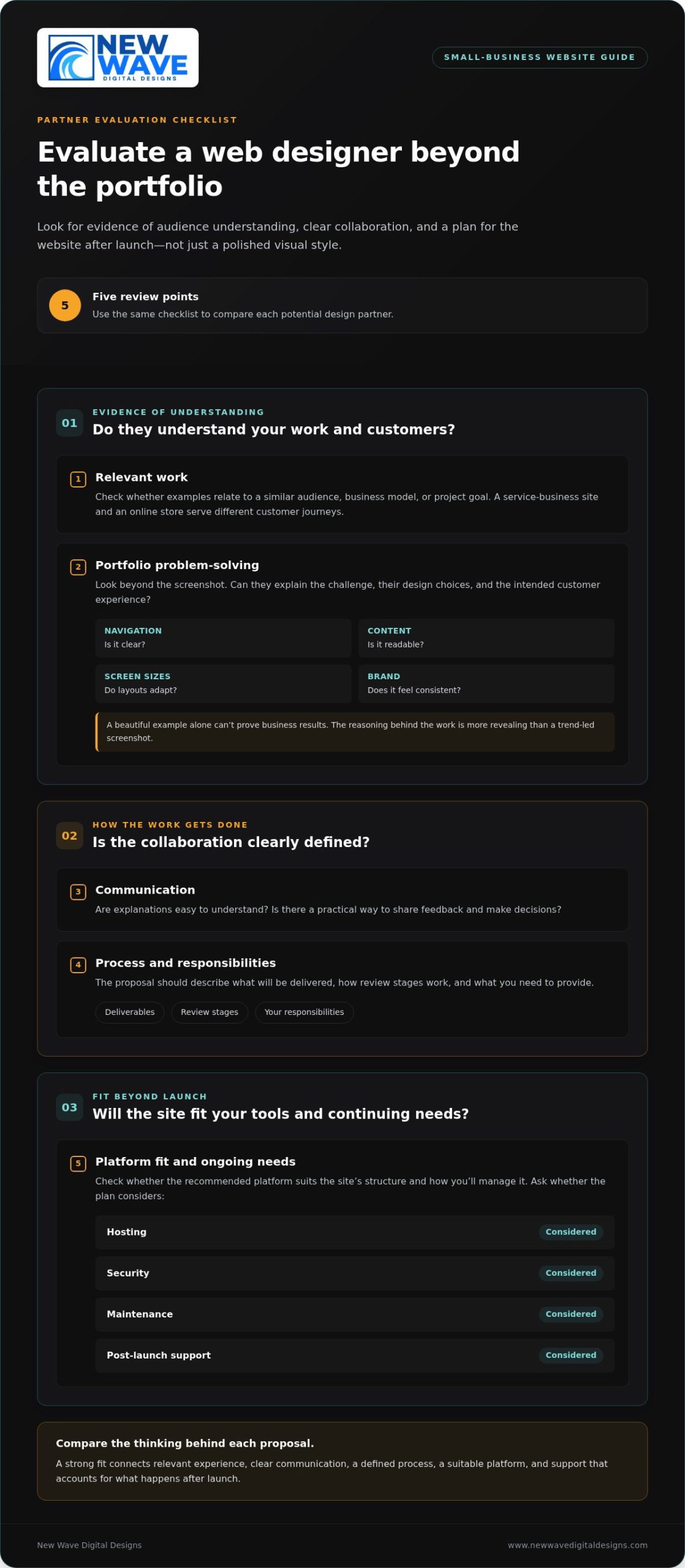
  • Relevant work: Do examples speak to a similar audience, business model, or project goal? An online store and a service business site have different customer journeys.
  • Communication: Are explanations clear, and is there a practical way to share feedback and make decisions?
  • Process: Does the proposal describe deliverables, review stages, and responsibilities? Look for a clear account of what you need to provide.
  • Platform fit: Is the recommended platform suited to the site’s structure and the way you’ll manage it?
  • Ongoing needs: Are hosting, security, maintenance, and post-launch support considered?

These points help reveal whether a proposal is built on thoughtful reasoning or simply attractive visuals. The U.S. Small Business Administration’s guidance on marketing and sales strategy can also help you place the website within your broader business efforts.

Read portfolios for problem-solving, not visual trends

Compare portfolio examples by audience, business model, and project goals. A service business site and an online store have different customer journeys, even if both look refined. Notice whether navigation is clear, content is readable, layouts adapt to different screen sizes, and the brand feels consistent. A beautiful example alone can’t prove business results. Look for an explanation of the challenge, the design choices, and the intended customer experience. That reasoning is more revealing than a trend-led screenshot.

Understand scope, communication, and project responsibilities

Read the proposed scope closely. It should identify the pages and features included, who supplies or prepares content, how feedback and revisions work, and what launch support covers. Check whether the proposal names responsibilities for items such as copy, images, and final content approval. Clear responsibilities reduce confusion and help keep decisions aligned as the project takes shape. Make sure you understand how communication will happen and how feedback will be gathered.

Think beyond launch, too. Add hosting, security, website maintenance, and ongoing support to your planning checklist so these needs aren’t an afterthought. New Wave Digital Designs brings brand-aligned website design together with ongoing digital services. Explore its website design services as you consider what a collaborative project could include.

Freelancer, Agency, or DIY: Which Web Design Route Fits?

There’s no single right way to build a small-business website. The best fit depends on how much time you can contribute, how complex the project is, and who will handle the site after launch. Compare the trade-offs in owner time, customization, coordination, and support before choosing a route.

DIY website builder

Owner time: Higher, since you plan, build, and manage updates. Customization: Often suited to straightforward needs, within the builder’s options. Coordination and support: You handle setup and ongoing tasks, using the platform’s available resources. May fit: A simple launch when you’re comfortable learning the tool and maintaining the site yourself.

Independent freelancer

Owner time: You provide direction and feedback, while a designer handles the agreed work. Customization: Can be tailored to the project scope. Coordination and support: Technical and ongoing responsibilities depend on the agreement and the freelancer’s role. May fit: A defined project, such as a focused redesign or a store with clear requirements.

Agency partnership

Owner time: You contribute business knowledge and make decisions, while project work is coordinated through the partnership. Customization: Can address connected design and business needs. Coordination and support: Multiple services may be aligned through one working relationship, depending on the project scope. May fit: A more involved store or a broader growth plan that connects the site with ongoing marketing or maintenance.

These are general patterns, not promises about every provider. A freelancer may handle a complex project, and a DIY site can grow alongside a business. The important question in hiring a web designer for small business is whether the responsibilities match your desired level of involvement and the work your website needs to do.

When DIY website builders may be a practical starting point

A builder can be a sensible route for a straightforward site with a small set of pages, especially if you’re comfortable making updates yourself. You retain direct control, but that means investing your own time in setup, content, and maintenance. Before choosing, list the pages and functions you need, then compare them with the builder’s available design and management options. Don’t assume DIY is automatically limiting or suitable for every project.

When a freelancer or agency partnership may help

Specialist support can help coordinate design, development, and business requirements when the project has more moving parts. An agency relationship may be useful if the website connects with services such as organic SEO, advertising, graphic design, or ongoing maintenance. If you are exploring experienced creative partners, learn more about Studio Murschetz to see how a professional design studio aligns brand identity with digital execution. Clarify roles, deliverables, and post-launch responsibilities so the working model fits the project.

Hiring a Web Designer for a Small Business: A 2026 Guide

Plan the Web Design Project, Platform, and Ongoing Support

A clear project plan turns business priorities into a website customers can use and the owner can maintain. Map the work in sequence: define the brief, choose a suitable platform, prepare content, develop the design, test key tasks, and launch. Keep these stages connected so platform or visual decisions don’t outrun the site’s purpose.

Choose a platform around the business model

Shopify is designed for businesses building an online store and managing product sales. WordPress and Squarespace are additional options to assess against the site’s structure, content needs, and the owner’s preferred workflow. No platform is right for every small business. Consider what customers need to do, what the business needs to manage, and how the site may develop. For example, write down whether visitors primarily need to browse and buy products, read information, or contact you, then use those tasks to guide the platform discussion.

Prepare content and design for real use

Gather the core ingredients before design takes shape: services or products, intended audience, brand assets, page content, and the actions visitors should take. For each page, decide what a visitor needs to understand and what the next step should be. Then build for more than appearance. Responsive layouts should work across screen sizes, navigation should make important information easy to find, and content should be readable and accessible. Search-friendly foundations include clear page structure and descriptive content that helps people and search engines understand what each page offers.

Before launch, test the experience on different devices and check essential journeys, such as finding a service, submitting an inquiry, or completing a purchase. Review links, page content, and forms as part of those tasks. A deliberate review catches confusing navigation, missing information, and layout issues while there’s still time to address them.

Prepare for life after launch

A website needs care beyond its debut. Plan for hosting, security, software and content updates, and ongoing support so the site remains functional as the business changes. A website maintenance services guide can help frame the questions to consider. Organic visibility also develops over time, making an organic SEO strategy guide a useful reference when planning how site content supports discovery.

During hiring a web designer for small business, include these long-term responsibilities in the project conversation. New Wave Digital Designs creates responsive, brand-aligned websites and provides website maintenance, managed hosting and security, and organic SEO. Explore website design and ongoing support to consider how these pieces can work together.

Work With New Wave Digital Designs to Build a Small-Business Website

A strong website brings business goals, brand expression, and customer needs into one coherent experience. New Wave Digital Designs partners with small and medium-sized businesses to create responsive, brand-aligned websites, with design for Shopify, WordPress, and Squarespace. The right platform depends on the project: an online store, a content-rich site, and a straightforward business website can call for different structures and workflows.

That strategic fit matters when hiring a web designer for small business growth. The aim isn’t simply to create attractive pages. It’s to shape a useful customer journey and a digital foundation the business can continue to care for as its needs evolve.

Bring design, platform, and brand into one coherent experience

Responsive design helps make the experience usable across screen sizes, while clear structure guides visitors toward the information or action they need. Shopify website design can support businesses building an online store, with the platform selected to match the project’s requirements. A consistent visual identity matters beyond the website, too. Graphic design can help align digital and print materials, creating a recognizable presence wherever customers encounter the brand.

For businesses considering an online store, exploring a Shopify website design guide can help clarify the questions to bring into a platform and design discussion.

Build a website that can evolve beyond launch

Launch is a beginning, not the end of a website’s life. Ongoing maintenance, managed hosting, and security support the site’s continued functionality and care. Organic SEO and paid search can complement that foundation in different ways: SEO supports visibility through useful, search-friendly content, while Google Ads and Bing Ads provide paid search options. Graphic design can reinforce brand consistency across these efforts. The right mix depends on the business’s goals and priorities.

New Wave Digital Designs brings website design together with ongoing support and digital marketing services, so the plan can account for both the experience customers see and the work that supports it over time. Explore New Wave Digital Designs’ website design and digital marketing services to consider a thoughtful next step for your business.

Set Your Website Up for What Comes Next

A lasting website starts with a clear purpose, a practical scope, and a platform suited to the way your business works. As you consider hiring a web designer for small business growth, look beyond the launch: choose a partner and plan that account for customer needs, ongoing care, and future priorities.

New Wave Digital Designs creates custom websites for Shopify, WordPress, and Squarespace, with each platform considered in light of the project. The work can continue beyond design through website maintenance, managed hosting and security, organic SEO, and Google Ads or Bing Ads management. Together, these services can support a considered digital presence as your business evolves.

Every business has its own story and goals. Take the next step by exploring website design for your small business and start shaping a website that reflects your brand and serves your customers. A thoughtful plan today can give your next stage of growth a stronger foundation.

Frequently Asked Questions

Can a small business afford to hire a web designer?

Affordability depends on the project’s scope, complexity, platform, content readiness, and ongoing requirements. Start by identifying essential pages and functions, such as service information, an inquiry form, or product checkout, then separate launch needs from later enhancements. Consider project fees separately from continuing services like maintenance or hosting. A focused scope makes planning clearer without requiring a predetermined budget or assuming a particular return.

What should I look for when hiring a web designer for a small business?

Look for relevant portfolio work, clear communication, a defined process, experience with a suitable platform, mobile usability, a precise scope, and post-launch support. A useful standard for hiring a web designer for small business projects is whether the designer understands the goal behind the visual choices. Assess how the proposed work addresses your audience and needs. Don’t choose solely on appearance or broad promises that aren’t tied to specific deliverables.

Should a small business hire a freelance web designer or an agency?

Either can be a good fit, depending on the project. A freelancer may offer a flexible, direct working relationship for a clearly defined scope. An agency can coordinate multiple disciplines when a project connects design, development, marketing, or ongoing services. Consider complexity, how involved you want to be, and who will handle responsibilities after launch. Choose the model whose working relationship and capabilities align with the actual work.

How long does it take to design a small-business website?

Timelines vary with the site’s size, custom functionality, content readiness, feedback process, and platform requirements. Rather than assume a standard duration, plan milestones for discovery, content preparation, design, development, testing, and launch. Having materials ready and making decisions promptly can help keep work moving, while changes to scope or delayed feedback may affect the schedule. Agree on project stages and expectations as part of planning.

Which website platform is best for a small business?

The best fit depends on whether you need e-commerce, flexible content management, straightforward owner updates, or particular features. Shopify is suited to businesses building an online store; WordPress and Squarespace are also options to assess against your site structure and workflow. These platforms have different strengths, so start with how customers will use the site and how you’ll manage it, then consider future business needs.

Do small businesses need website maintenance after launch?

Yes. A launched site still needs attention to hosting, security, updates, functionality, and content. The specific maintenance tasks depend on the platform and how the site is set up, but planning for them helps prevent launch from being treated as the finish line. Decide who will manage ongoing care and include it in your website plan. New Wave Digital Designs provides website maintenance, managed hosting, and security services to support sites over time.

Can a web designer help with SEO and online advertising?

Web design can establish useful foundations for search visibility, but organic SEO and paid search require distinct ongoing strategies. New Wave Digital Designs provides organic SEO and manages Google Ads and Bing Ads. These efforts work best when aligned with business goals, relevant landing pages, and clear next steps for visitors. Neither design nor marketing guarantees rankings, traffic volumes, or advertising results, so plan around meaningful objectives and continued evaluation.

How to Choose a Web Design Company: A Practical 2026 Guide

When you search for top web design companies, a polished portfolio can be an appealing starting point, but it won’t tell you whether a company understands your goals, recommends a suitable platform, or supports your site after launch. The right partner should be able to explain how its approach fits your business, not just show attractive designs.

Proposals can be difficult to compare. One may emphasize visual design, another technical features, and a third ongoing services, while leaving scope, responsibilities, or ownership unclear. The best fit depends on how well the full project meets your needs, not on a single feature or presentation.

This guide offers a practical framework for evaluating web design partners by strategy, platform fit, process, and ongoing support. You’ll learn how to assess Shopify, WordPress, and Squarespace against your requirements, clarify what a project includes, and understand who handles launch responsibilities and maintenance. With those details in view, you can choose a partner like New Wave Digital Designs with greater confidence and build a site designed to serve your business over time.

Key Takeaways

  • Compare agencies by how their strategy supports your business goals, not by portfolio visuals alone.
  • Use your site’s purpose, content needs, and preferred level of control to assess Shopify, WordPress, and Squarespace.
  • When comparing web design companies, look for clear scope, responsibilities, ownership, and launch planning.
  • Confirm who will provide content and images, manage domain access, and coordinate third-party services before committing.
  • Consider whether maintenance, hosting, security, SEO, or paid search fits your needs after launch. Don’t assume every service is essential.

What Should a Web Design Company Do for Your Business?

A website should do more than look polished. It should help people understand what you offer, find the information they need, and take a useful next step. A web design company can help plan the site’s structure, visual design, and user journey, then build a website around your business priorities.

Web design is the visual and interactive expression of a website; the website itself is a business tool that guides visitors toward information, inquiry, or purchase. The work can involve user experience, interface design, and development, as outlined in this overview of what web design encompasses. The exact balance depends on your goals and the agreement you make with your provider.

Which business goals can a website support?

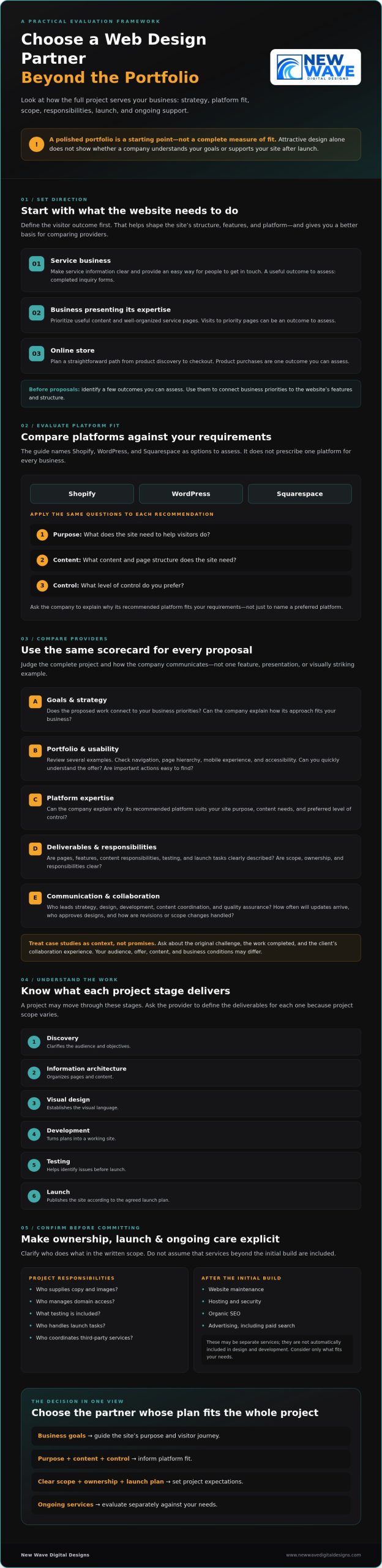
Start with the outcome you want visitors to reach. A service business seeking qualified inquiries needs clear service information and an easy way to get in touch. A company focused on presenting its expertise may prioritize useful content and well-organized service pages. An online store needs a straightforward path from product discovery to checkout.

Before requesting proposals, identify a few outcomes you can assess, such as completed inquiry forms, product purchases, or visits to priority pages. These goals help determine the site’s features, structure, and platform. They also give you a more useful basis for comparing web design companies than appearance alone.

What is included in website design and development?

A project may move through discovery, information architecture, visual design, development, testing, and launch. Discovery clarifies the audience and objectives. Information architecture organizes pages and content. Design establishes the visual language, and development turns those plans into a working site. Testing helps identify issues before launch. Ask the provider to define each stage and its deliverables, since project scope varies.

Be clear about what falls outside the initial build. Website maintenance, hosting, security, organic SEO, and advertising may be available as separate services, but they aren’t automatically included in design and development. A launch plan, for example, might cover publishing the site while leaving future updates or search marketing to a separate agreement.

Review the written scope for who supplies copy and images, who manages domain access, what testing is included, and who handles launch tasks. Clarifying those responsibilities early helps align the design, build, and ongoing care with your business needs.

How to Compare Web Design Companies Beyond Their Portfolios

A portfolio is a useful first impression, not a complete measure of fit. Compare how each company approaches a project, communicates decisions, and designs a site for its audience. Strong work should look considered, but it should also make information easy to find and important actions easy to take.

How can you assess a company’s portfolio?

Review several examples, not just the most visually striking one. Ask who each site serves, what the business needed, and how the structure supports that purpose. Check the navigation, page hierarchy, mobile experience, and accessibility features. Can you quickly understand the offer? Are calls to action easy to find? A compelling visual style shows creative range, but it doesn’t guarantee results for your business.

Consider whether the examples reflect your business model, content, and required functionality. An online store, for instance, has different needs from a service website designed to encourage inquiries. If you can, explore live sites on a phone as well as a desktop. Notice whether menus, forms, and key information remain easy to use.

What should you ask before choosing an agency?

Ask who leads strategy, design, development, content coordination, and quality assurance. Clarify how discovery works, how often you’ll receive updates, who approves designs, and how revisions or scope changes are handled. Before committing, ask what testing and launch support are included and which responsibilities remain yours.

References or case studies can add useful context. Ask what the original challenge was, what work the company completed, and how the client found the collaboration. Treat outcomes as examples, not promises: your audience, offer, content, and business conditions may differ.

Use a simple scorecard to compare providers on the same terms:

  • Goals: Does the proposal connect the work to your business priorities?
  • Platform expertise: Can the company explain why its recommended platform fits your requirements?
  • Deliverables: Are pages, features, content responsibilities, testing, and launch tasks clearly described?
  • Communication: Are updates, feedback, approvals, and change requests explained?
  • Post-launch support: Is ongoing maintenance or other support available, and what does it include?

Compare the answers, not just the score. A thoughtful partner should explain trade-offs and help you understand what’s included before work begins. If you’re exploring custom website design, review website design services as one point of comparison.

Shopify, WordPress, or Squarespace: Which Platform Fits Your Website?

The right platform is the one that supports your site’s purpose and the way you plan to manage it. Start with your requirements: Are you selling products, publishing a range of content, or building an online presence for your services? Then consider who will update the site, what functions it needs, and how much control you want over its design and administration. Popularity alone isn’t a sound reason to choose.

Platform | May suit | Questions to consider

Shopify | Businesses centered on selling products online | How will the platform support your catalogue, store workflows, and required integrations?

WordPress | Sites with evolving content or specific customization needs | Who will manage updates, and how much flexibility does the site require?

Squarespace | Businesses seeking a managed site to present services, work, or content | Does its editing and design approach suit the way your team will maintain the site?

When might Shopify suit an online store?

If selling products online is central to your business, Shopify is a platform worth evaluating. Map the customer’s path from browsing to purchase, then list what your catalogue and store workflows require. Note any integrations the business depends on. Discuss those requirements with prospective providers rather than assuming a platform or proposed setup will support every need. For a closer look, explore this Shopify website design guide.

When might WordPress or Squarespace be a better fit?

WordPress and Squarespace are both options to consider for content-focused or service-based websites. Compare how each fits your content structure, customization needs, and preferred editing experience. Ask who will make routine updates and whether your team wants to manage the site directly or rely on support. The right choice should remain practical after launch, not simply look appealing in a design preview. If Squarespace is on your shortlist, this guide to custom Squarespace website design offers another perspective.

Before choosing, ask each provider to explain its platform recommendation in relation to your requirements, future content changes, and ongoing maintenance. A clear rationale lets you compare proposals on fit and practical trade-offs, not preference alone.

How to Choose a Web Design Company: A Practical 2026 Guide

What Should a Web Design Proposal Include Before You Commit?

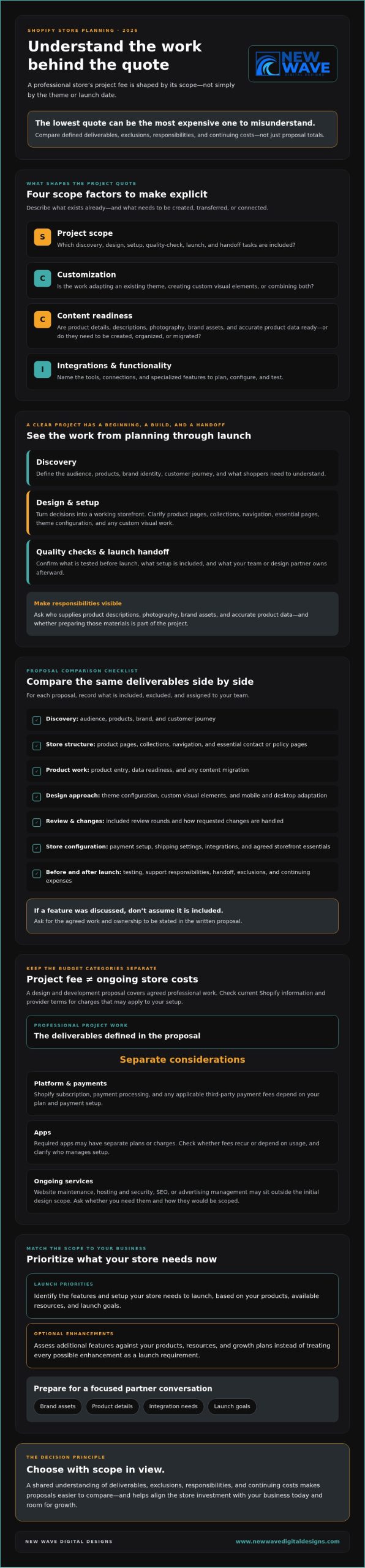
A proposal should turn your goals into a clear plan, not leave key decisions hidden behind a headline price. Scope and requirements shape each project, so compare proposals based on the same brief. This makes it easier to see what each provider will deliver, what you’ll need to supply, and what support continues after launch.

How do you clarify scope, timeline, and responsibilities?

Look for a written description of the work, review points, and each party’s responsibilities. Before signing, use this checklist:

  1. Scope and deliverables: Identify the pages, design work, functionality, and other specific outputs included.
  2. Content and assets: Confirm who writes or supplies copy, selects images, and prepares other materials.
  3. Schedule and approvals: Request a project schedule tied to the agreed scope, with milestones, review periods, and approval responsibilities.
  4. Changes and exclusions: Ask what isn’t included and how additional requests are evaluated, approved, and documented.
  5. Testing and launch: Clarify what will be tested, who gives final approval, and who is responsible for launch tasks.

Timelines should reflect the actual project plan, not an assumed standard. Ask how delays in feedback, content delivery, or approvals affect the schedule. Clear answers help you compare proposals on substance rather than presentation.

Who owns the website and its accounts after launch?

Confirm how access and ownership will work for the finished website, domain, content, and relevant third-party accounts. Ask which accounts will be created or used in your business’s name, who can access them, and how credentials will be transferred or managed. If training or handover documentation is included, have the proposal describe what you’ll receive.

Give ongoing arrangements the same attention as the build. Check whether hosting, security, updates, maintenance, and support are included or handled separately. Ask what each arrangement covers and who to contact for routine changes. Don’t assume that paying for a site automatically includes its continued care.

Before choosing among web design companies, review each proposal against the same requirements: scope, responsibilities, schedule, ownership, and post-launch arrangements. If an item is vague, request clarification in writing before you commit. To discuss website design and support options, explore New Wave Digital Designs.

Choose a Web Design Partner for Launch and Long-Term Growth

A sound choice brings four elements into alignment: your business goals, a suitable platform, a clearly defined proposal, and a realistic plan for support after launch. Keep that framework in view as you compare partners. A thoughtful design should serve the business now while leaving room to manage and refine the site as needs evolve.

Post-launch services aren’t automatic requirements for every project. Consider what your team can manage, what needs specialist attention, and what responsibilities the proposal assigns to you. New Wave Digital Designs offers website design for Shopify, WordPress, and Squarespace, along with maintenance, hosting and security, organic SEO, Google Ads, and Bing Ads. These are options to discuss based on your requirements, not a checklist every business must buy.

What support might a website need after launch?

Think of maintenance, hosting, and security as distinct needs. Maintenance concerns ongoing care for the website; hosting is where the site is made available online; security involves protecting the site and its access. Ask what each service covers, who handles it, how you request help, and whether it’s included in the proposal or arranged separately.

If you’re planning for ongoing care, read this website maintenance services guide. Before agreeing to support, clarify its scope and communication expectations. Don’t assume a service includes round-the-clock emergency coverage or a specific response time unless the provider confirms that in writing.

How can design connect with search and advertising?

Organic SEO may be relevant if you want your site’s content to support discovery through search. Paid search, such as Google Ads or Bing Ads, is separate from website design. If you’re considering advertising, define its objective and how you’ll assess whether it serves that goal. A coordinated plan can connect the site experience with search activity, but these services should reflect your priorities rather than being added by default.

Before launch, make sure you know who will maintain the site, manage hosting and security, and oversee any search or advertising work you choose. That clarity creates a stronger handoff and helps you plan for the next stage without committing to services you don’t need.

With your scope and priorities in hand, you can explore web design and digital marketing services and discuss which options fit your project.

Choose a Partner for What Comes Next

The strongest web design partnership begins with clear business goals, a platform that fits your needs, and a proposal that spells out scope and responsibilities. Look beyond visual polish: consider how the site will guide visitors, who will manage it, and what support is available after launch. Those details can help you choose a website that works as a business asset, not simply a finished design.

New Wave Digital Designs provides custom website design for Shopify, WordPress, and Squarespace, with website maintenance, managed hosting, and security available for ongoing needs. Organic SEO and Google Ads or Bing Ads management may also be relevant when they align with your goals, but they aren’t automatic requirements for every project.

Ready to explore an approach suited to your business? Explore New Wave Digital Designs’ website services and consider which capabilities fit your project. With a thoughtful brief and clear expectations, you can move forward with confidence and build a digital presence ready to evolve alongside your business.

Frequently Asked Questions

What does a web design company do?

A web design company can plan and build a website’s structure, appearance, and user experience. Depending on the provider and agreed scope, its work may also include development, testing, and launch support. Ongoing maintenance, hosting, security, and marketing may be separate services rather than part of the initial build. Before hiring a provider, clarify the deliverables in writing and match the project scope to your business goals.

How do I choose a web design company?

Start by defining your website’s goals, audience, required features, and support needs. Then compare relevant portfolio work, platform experience, written deliverables, communication practices, and post-launch arrangements. If you’re searching for “web design companies in somerset county nj,” use the same questions to assess each provider rather than relying on visual style alone. Choose a partner whose recommendations fit your requirements and whose proposal makes responsibilities clear.

How much does it cost to hire a web design company?

Project scope and requirements shape the proposal, so there isn’t one amount that applies to every website. An online store, a redesign, and an informational site can involve different platforms, functionality, content needs, and services. Give each provider the same project brief, then compare written proposals by deliverables and exclusions. Ask which ongoing services are separate, and don’t judge a proposal by its headline figure alone.

Which platform is best for a small business website?

No single platform is best for every small business. Shopify may suit a business focused on online product sales, while WordPress or Squarespace may better match other content, customization, or administration needs. Consider the site’s purpose, required functions, and who will update it. Ask a prospective web design company to explain its recommendation in relation to your goals, content, and available resources.

What should a web design proposal include?

A proposal should clearly describe the project scope, deliverables, responsibilities, milestones, and approval process. It should also explain what’s excluded, how additional requests are handled, and whether content, testing, launch, training, or post-launch support is included. Confirm arrangements for website and account access and ownership. If an important detail is unclear, ask the provider to clarify it in writing before you commit.

Do web design companies provide website maintenance?

Some web design companies offer maintenance, while others focus on the initial design and build. The arrangement varies, so ask what ongoing care covers, how requests are handled, and which responsibilities remain yours. New Wave Digital Designs offers website maintenance, managed hosting, and security services. Confirm the specific scope and support arrangements for your website rather than assuming they’re automatically included in a design project.

Should SEO be included in a web design project?

SEO may inform a website’s structure and content, but ongoing search work isn’t automatically included in a design project. Ask which SEO-related tasks are part of the build and which require a separate service. If organic search or paid advertising supports your goals, define the objectives and responsibilities clearly. New Wave Digital Designs offers organic SEO and Google Ads and Bing Ads management as services to consider based on your needs.

Cost of a Professional Shopify Store in 2026: What Shapes Your Quote?

The lowest Shopify quote can be the most expensive one to misunderstand. The cost of a professional Shopify store 2026 depends on more than a template or launch date. When proposals cover different design work, setup tasks, and launch support, comparing totals alone can hide important gaps.

It’s reasonable to want a clear picture of what your investment includes and what may sit outside the project fee. Shopify subscription charges, payment-processing fees, apps, and ongoing maintenance or marketing are separate considerations. Ask what applies to your store rather than assuming these costs are bundled together.

This guide explains the work that can shape a professional Shopify proposal, from brand-led design and store setup to the tasks to confirm before launch. You’ll also find a checklist for comparing deliverables and questions to ask about continuing costs. With a shared understanding of scope, you can choose a design partner and store investment that fit your business today and leave room for growth.

Key Takeaways

  • The cost of a professional Shopify store 2026 is shaped by project scope, customization, content readiness, and integrations, not simply by the theme selected.
  • Before comparing providers, clarify which discovery, design, setup, quality-check, and launch handoff tasks each proposal includes.
  • Use a written checklist to compare product setup, integrations, revisions, testing, and support responsibilities side by side.
  • Prioritize the features your store needs to launch, then assess optional enhancements against your products, resources, and growth plans.
  • Prepare brand assets, product details, integration needs, and launch goals to make conversations with potential design partners more focused.

What Shapes the Cost of a Professional Shopify Store in 2026?

A Shopify proposal reflects the work required to bring your store to life: project scope, customization, content readiness, and integrations. A store built around an adapted theme and prepared content calls for a different level of effort than one requiring a distinct brand-led experience, extensive product setup, or migration from another platform. The cost of a professional Shopify store 2026 is best understood through its defined deliverables, not a template label or headline quote.

Keep the project fee separate from the ongoing costs of operating the store. A design and development proposal covers agreed professional work. Shopify subscription and transaction-related charges, app fees, and optional continuing services belong in a separate part of your budget. Shopify’s Shopify ecosystem includes tools and third-party services, so check current Shopify information and provider terms for charges that may apply to your setup.

Which store requirements can change a project quote?

Theme adaptation uses an existing design foundation. A more customized storefront may require additional design and development to reflect your brand and customer needs. The quote may also depend on how many products need setup, whether descriptions and images are ready, and whether content or product information must be migrated. Requested integrations and specialized functionality can add planning, configuration, and testing work.

To make proposals easier to compare, describe the products, content, and store features you already have. Then identify what needs to be created, transferred, or connected.

Which expenses are separate from design and development?

Agency project fees are distinct from recurring platform and payment-related charges. Your Shopify subscription, payment processing, and any applicable third-party payment fees depend on your plan and payment setup. Apps may also have separate plans or charges, so review current terms before including a feature in your budget.

  • Platform and payments: Confirm current subscription and transaction-related charges with Shopify and your payment provider.
  • Apps: Check whether required apps have recurring or usage-based fees, and clarify who manages their setup.
  • Ongoing services: Website maintenance, hosting and security, SEO, and advertising management may be separate from the initial design scope. Ask whether you need them and how they would be scoped.

Before choosing a partner, request a written proposal that names included work, exclusions, and continuing expenses. That clarity helps you align the store’s design with your business goals and plan for costs after launch.

What Should a Professional Shopify Store Project Include?

A clear project has a beginning, a build, and a considered handoff. Discovery defines the audience, products, brand identity, and customer journey. Design and setup turn those decisions into a working storefront, while quality checks help catch issues before launch. The proposal should describe each stage and state what your team and the design partner are responsible for.

Scope should also make the content work tangible. Ask which product pages, collections, navigation menus, and essential pages, such as contact or policy information, are included. Confirm who provides product descriptions, photography, brand assets, and accurate product data. If those materials need to be created or organized, clarify whether that work is part of the project or remains with your team.

How do planning and design become a usable storefront?

Discovery should connect your brand to practical shopping decisions: what customers need to understand, how they’ll find products, and what steps lead them toward checkout. Ask how the design will adapt across mobile and desktop screens, and how navigation and collections will help shoppers move through the catalog.

Get the design approach in writing. Does the scope involve configuring a theme, creating custom visual elements, or both? How many review rounds are included, and how are requested changes handled? For general context on platform plans, review Shopify’s 2026 pricing plans and keep plan details distinct from the design partner’s deliverables. You can also explore the related topic Shopify website design when considering what you want from a design project.

What should be clarified before launch?

Configuration can involve important decisions, so ask explicitly whether the project includes product entry, payment setup, shipping settings, and other agreed storefront essentials. Don’t assume a feature is covered just because it came up in a conversation. The proposal should name each task, its owner, and any information you need to supply.

Testing and handoff deserve the same precision. Confirm who checks checkout, forms, mobile layouts, and key storefront interactions, and how issues are documented. Then ask what training or handoff materials you’ll receive, whether launch support is included, and what post-launch assistance would be scoped separately.

  • Discovery: Goals, audience, products, brand, and customer journey.
  • Design and setup: Theme or custom work, storefront structure, content responsibilities, and revisions.
  • Quality checks and handoff: Testing roles, launch tasks, training, and ongoing support boundaries.

A well-defined scope gives both sides a shared blueprint. Before a Shopify website design discussion, gather your brand assets, product information, and launch priorities. Explore Shopify website design and note which project responsibilities you want to discuss.

How to Compare Shopify Store Design Proposals Fairly

A headline quote tells you little unless you know what work sits behind it. To compare the cost of a professional Shopify store 2026 fairly, place each written proposal beside the same checklist. One provider may include product entry and testing, while another may leave those tasks to you. That difference matters as much as the quoted fee.

Ask each provider to document assumptions, exclusions, dependencies, and how changes are handled. If your team must supply product descriptions or brand assets, establish when they’re due and what happens if they aren’t ready. A clear scope turns proposals into comparable plans rather than competing headline figures.

Compare Questions to ask Clarify in writing
Scope Which design, development, configuration, and launch tasks are included? Deliverables, exclusions, and owner for each task
Customization Is the work theme configuration, custom visual design, or a mix? What is being tailored to your brand and customer needs
Product setup Who adds products, images, descriptions, and collection details? Product information required and setup responsibilities
Integrations Which apps or third-party services are being connected? Setup limits and any separate provider or app charges
Revisions How many review rounds are planned? How extra feedback or new requests affect scope
Testing Who checks checkout, forms, mobile layouts, and key interactions? Testing responsibilities and issue-resolution process
Support What launch or post-launch help is included? Duration, boundaries, and separately scoped assistance

Which questions reveal what a Shopify proposal really covers?

Ask providers to walk through design, development, store configuration, quality assurance, and launch, naming the deliverable for each stage. Confirm the planned review rounds and how a request outside the agreed scope is assessed and approved. Also ask which Shopify, app, payment, and third-party expenses remain your responsibility. For broader business context, Forbes offers guidance on developing a strong e-commerce strategy, which can help you connect project decisions to commercial priorities.

How can you assess fit beyond the quoted scope?

Cost of a Professional Shopify Store in 2026: What Shapes Your Quote?

How to Match Shopify Store Scope to Your Business Priorities

A strong project scope reflects what your store needs to do at launch, not every feature you might want eventually. Start with your products, customer journey, and available resources. A focused scope can give essential tasks the attention they need while keeping future enhancements visible without making them launch dependencies.

Product complexity can guide that decision. A small catalog with consistent options may need a different setup approach from products with many variants, detailed specifications, or distinct collection structures. Content readiness matters too. If product data, descriptions, and brand assets are prepared, the project can focus more directly on building the storefront. If they’re still being developed, clarify who will prepare them and how that affects responsibilities.

Which requirements belong in the first launch?

Prioritize the essentials that let customers understand your offer and complete a purchase: accurate product information, intuitive navigation, consistent brand presentation, and a functional checkout journey. Then identify integrations that support real operational needs, such as a tool your business already relies on. Don’t add apps or features without a clear purpose and an owner responsible for managing them.

Separate the plan into two lists: launch requirements and later enhancements. A new content feature, expanded automation, or additional customization may be valuable, but it doesn’t necessarily need to delay a usable first release. This distinction helps partners scope the work around your priorities and makes the cost of a professional Shopify store 2026 easier to assess against what the business needs now.

How should you plan for ongoing store care?

Decide who will update storefront content, manage technical changes, and oversee security after launch. These responsibilities may sit with your team or be discussed as separate ongoing services. Keep them distinct from one-time design and development work, and clarify what support you may need as the store evolves.

If you’re considering outside help, review the scope of Website Maintenance Services and confirm what the offering covers rather than assuming it’s included in a store project. Small businesses needing flexible assistance can also look to providers like SaaSy Systems & Designs for website design, automation, and ongoing tech support. Marketing needs such as SEO or advertising management should also be discussed separately from the initial build.

Before requesting a proposal, note your launch-critical features, product and content readiness, required integrations, and available internal resources. New Wave Digital Designs offers custom Shopify website design, and a conversation about your requirements can help clarify the scope to consider. Discuss your Shopify store requirements.

Choosing a Professional Shopify Store Partner and Next Steps

The right partner helps translate business goals into a clear store plan, with responsibilities and continuing needs defined before work begins. A proposal should make it easy to see what the design partner will deliver, what your team must provide, and which services or platform expenses sit outside the project. That clarity matters more than choosing a quote based on its headline alone.

Before requesting proposals, assemble a concise project brief. Include what you sell, what customers need to do in your store, and what resources your team can bring to the work. The more clearly you describe the desired customer experience and launch priorities, the easier it is to discuss a suitable scope instead of defaulting to features you may not need.

What information helps a provider prepare a useful proposal?

Gather a product and content inventory, brand materials such as logos and visual guidelines, and details of any existing store or website. List the integrations your operations rely on, practical constraints, and the customer journey you want the store to support. Also identify who will approve design decisions and who can provide product data, copy, and other materials. These details help surface dependencies early.

What should happen before you approve the project?

Review the proposal together before committing. Confirm the deliverables, exclusions, milestones, client responsibilities, and process for handling changes. Make sure both sides understand what must be ready at each stage and how decisions or feedback will be shared. If a point is vague, ask for it to be clarified in writing.

Then separate project work from ongoing costs. Shopify subscription and transaction-related charges, as well as fees for third-party apps or payment services, should be checked against current provider information. If you may need website maintenance, hosting and security, SEO, or advertising management, discuss those as distinct services rather than assuming they’re included in the initial Shopify design scope.

New Wave Digital Designs provides custom Shopify website design, with related services available to discuss according to your needs. A tailored conversation can connect your goals, brand assets, products, and integration requirements to a clearly defined project scope. If you’re weighing the cost of a professional Shopify store 2026, bring your priorities and questions to the discussion.

Discuss your Shopify store project with New Wave Digital Designs.

Shape a Shopify Investment Around Your Next Chapter

The cost of a professional Shopify store 2026 is shaped by the work your business actually needs, from storefront design and product setup to integrations and launch responsibilities. Compare proposals by written deliverables, exclusions, and who owns each task, not by the headline quote alone. Keep ongoing platform, app, maintenance, and marketing expenses distinct from the initial project scope.

A clear brief makes the next conversation more useful. Gather your product details, brand assets, integration needs, and launch goals, then outline what’s essential now and what can evolve later. The right scope should reflect your business priorities and leave room for thoughtful growth.

New Wave Digital Designs offers custom website design for Shopify, WordPress, and Squarespace. Related services, including maintenance, hosting and security, SEO, paid search, and graphic design, can be discussed separately according to your needs. Discuss your Shopify store project with New Wave Digital Designs and take the next step with a clearer vision for your store.

Frequently Asked Questions

How much does a professional Shopify store cost in 2026?

The cost of a professional Shopify store 2026 depends on the agreed project scope, customization, content readiness, product setup, integrations, and launch support. Shopify subscription charges, payment-related fees, and third-party app expenses may be separate from design services. Since requirements and platform terms vary, request a written proposal that details deliverables and exclusions, then verify current Shopify and app charges directly before setting your budget.

What affects the cost of hiring a Shopify designer?

The amount of work required is a central factor. Custom design, product and content setup, integrations, migration, revisions, testing, and launch assistance can all shape a project. Prepared brand assets and accurate product information may also affect the work involved. Ask each provider to list deliverables, assumptions, exclusions, and your team’s responsibilities. Comparing those details side by side gives you a clearer basis for evaluating proposals than comparing headline quotes alone.

Does a professional Shopify store quote include Shopify fees?

Not necessarily. A design proposal may cover professional design and development, while Shopify subscription charges, payment-related fees, and third-party app expenses are paid separately. Ask the provider to identify what its proposal covers and which costs you’ll pay to Shopify or other vendors. Then verify current plan, payment, and app terms with the relevant providers, since charges and options can change. Don’t assume a platform expense is included unless the proposal explicitly says so.

Are custom Shopify stores more expensive than theme-based stores?

Not automatically. The labels alone don’t explain the work involved. A theme-based project might configure an existing design, while a more customized project could include visual changes and development tailored to your brand and customer needs. Ask providers to describe the requested features, customization, revision process, and support included in each proposal. Comparing these deliverables helps you judge whether the proposed scope suits your needs without relying on broad terms like “custom” or “theme-based.”

What should be included in a professional Shopify store proposal?

A useful proposal defines the project from planning through handoff. Look for details about design, store configuration, product and content responsibilities, requested integrations, testing, launch tasks, and handoff materials. It should also state exclusions, dependencies, planned revision rounds, and how additional requests are handled. Ask whether continuing maintenance or marketing is included or would be scoped separately. Written clarity helps you compare providers and understand what your team needs to prepare.

Are there ongoing costs after a Shopify store launches?

There may be recurring Shopify subscription charges, payment-related fees, third-party app expenses, and separately arranged services such as maintenance or marketing. Which apply depends on your store setup and the providers you choose. Keep these expenses distinct from one-time design and development work when planning your budget. Check current terms directly with Shopify, payment providers, and app vendors, and ask any design partner to clarify which ongoing services, if any, are included in its proposal.

Is hiring a professional Shopify designer worth it for a small business?

It depends on your goals, available time, internal skills, and the store experience you want to create. A professional designer can help shape a storefront around your brand and business requirements, while you remain responsible for tasks assigned to your team. Before deciding, compare the written deliverables and responsibilities with the work you can confidently manage yourself. Consider whether the proposed scope addresses your priorities and clarify any continuing support separately.

Professional Website Redesign: A Strategic Blueprint for Digital Evolution in 2026

Your website isn’t just a digital address; it’s the architectural foundation of your brand’s legacy and the primary engine of your commercial growth. You’ve likely felt the sting of high bounce rates or the quiet anxiety that your current site no longer mirrors the sophisticated spirit of your business. It’s natural to hesitate, fearing that a major transition might compromise your SEO rankings or disrupt your technical stability. A professional website redesign is not merely a cosmetic facelift. Instead, it’s a deliberate, strategic evolution that aligns your visual identity with high-performance functionality.

In this guide, you’ll discover how to transform your digital presence into a high-speed, secure, and intuitive masterpiece that drives lead generation. We’ll examine the meticulous process of building on Shopify, WordPress, or Squarespace while maintaining the technical integrity your brand demands. From the latest WordPress 7.1 standards to the nuances of WCAG 2.1 compliance, we’ll outline a blueprint for a site that’s built for longevity. You’re about to see how visionary design, technical precision, and strategic partnership can turn your website into your most powerful asset.

Key Takeaways

  • Understand how a professional website redesign serves as a strategic architectural overhaul that aligns your technical performance with your brand’s visionary goals.
  • Learn to evaluate your current site through both quantitative metrics and qualitative brand resonance to identify critical gaps in your digital presence.
  • Explore the distinct advantages of Shopify and WordPress to select the platform that best supports your specific requirements for scalability or content flexibility.
  • Gain a clear blueprint for a secure migration that preserves your SEO authority and ensures a flawless experience during the launch phase.
  • Discover why a long-term partnership model and continuous data analysis are essential for your site’s ongoing evolution after the initial launch.

The Strategic Imperative: Redesign vs. Refresh

Choosing between a subtle update and a total transformation is the first critical decision in your digital journey. A professional website redesign represents a comprehensive structural and strategic overhaul of your brand’s identity, technical framework, and commercial functionality. It’s an architectural commitment to excellence that goes far beneath the surface. Conversely, a “refresh” is a tactical update of visual assets, such as typography or color palettes, that leaves the underlying architecture untouched. While a refresh might provide a temporary lift, it rarely addresses the systemic issues that hinder long-term growth.

You’ll recognize the need for a deeper shift when conversions begin to plateau, platform limitations stifle your growth, or your brand pivots toward a new, more sophisticated audience. We view this process through the lens of Digital Craftsmanship, where innovation, meticulousness, and a premium level of service converge. This philosophy ensures that technical performance and artistic vision aren’t competing interests but rather two halves of a single, high-performance whole. By adhering to core web design principles, we build digital environments that resonate emotionally, perform flawlessly, and scale effortlessly.

When a Cosmetic Refresh Isn’t Enough

A new coat of paint won’t fix a crumbling foundation. When your growth is hampered by technical debt, legacy code becomes a barrier to innovation that no visual update can resolve. You may encounter deep-seated User Experience (UX) failures where friction points in the customer journey lead to abandoned carts and lost trust. Often, the issue lies in platform constraints. Moving from rigid, entry-level builders to scalable ecosystems like Shopify or WordPress allows your business to breathe, expand, and integrate complex features that were previously impossible. These structural changes require a visionary guide rather than a simple graphic update.

The ROI of Strategic Brand Evolution

Investing in a professional website redesign aligns your digital presence with a premium market positioning that attracts higher-value clients. A cohesive brand identity does more than look good; it cultivates deep trust, establishes authority, and increases customer lifetime value by creating a seamless, memorable experience. This strategic evolution ensures your site isn’t just a digital brochure but a dynamic engine for growth. Ultimately, a redesign serves as the vital bridge between your current digital performance and your most ambitious future vision.

The Architectural Audit: Decoding Your Current Digital Performance

A professional website redesign begins with a meticulous diagnostic phase. We treat this as an architectural audit; it’s a deep dive into the complex layers of your existing digital presence to understand what truly moves your audience. This process is bifurcated into quantitative and qualitative analysis. We scrutinize the cold numbers to find the narrative hidden within your data. Simultaneously, we evaluate the “soul” of your site, ensuring your brand voice resonates with authority and creates a lasting emotional impact. This qualitative review ensures your site isn’t just functional but also deeply aspirational. Our audit typically focuses on three core pillars:

  • Quantitative Metrics: We analyze bounce rates that signal immediate disinterest, session durations that reveal engagement depth, and conversion funnels that expose exactly where your revenue leaks.
  • Qualitative Resonance: We assess how your visual identity and brand voice align with your premium market positioning.
  • Technical Integrity: Our team probes for security vulnerabilities, assesses hosting stability, and measures page speeds with surgical precision.

By benchmarking against your competitors, we identify the silent gaps in your market that your redesign can exploit. We look for the missed opportunities in their user journeys, turning their technical or creative weaknesses into your strategic advantages. This methodical approach reinforces the brand’s image as a reliable and thorough partner, moving beyond superficial fixes to address the root causes of underperformance.

Data-Driven Discovery

To truly improve user experience, we must move beyond assumptions and into the realm of recorded behavior. We utilize heatmaps and user recordings to observe actual visitor interactions in real-time, identifying the exact moments of friction that a static report might miss. This data-driven discovery includes a rigorous SEO performance audit to protect your hard-earned rankings while identifying new growth keywords. With more than 60% of web traffic now originating from mobile devices, we ensure your responsiveness is fluid and flawless across every possible screen size.

Defining the Visionary Blueprint

Every transformative project requires a “North Star” to guide the creative process. We define clear, visionary goals: perhaps a 30% increase in lead quality or a significant reduction in checkout abandonment. We map the entire user journey, from the first spark of discovery to the final moment of conversion, ensuring every step feels intuitive and deliberate. You can see how we approach visionary digital craftsmanship through this lens of strategic architecture. If your current metrics feel like a mystery, our team is ready to provide the expert website support needed to illuminate your path forward and set the stage for your digital evolution.

Platform-Specific Evolution: Tailoring the Redesign

Choosing a platform is about selecting the digital soil where your brand will grow and flourish. A professional website redesign must be built on a foundation that supports your specific commercial goals, technical requirements, and visionary ambitions for the next five years. Whether you require the transactional power of Shopify, the infinite flexibility of WordPress, or the curated elegance of Squarespace, each ecosystem demands a unique architectural approach. This choice is the first step in creating a high-performance engine for brand growth and technical excellence.

Shopify Redesign: The E-commerce Powerhouse

For brands driven by conversion, Shopify offers a robust environment for e-commerce scalability and fluid transactional experiences. We prioritize custom theme development over restrictive, off-the-shelf templates to ensure your brand identity remains distinct, evocative, and premium. A high-performance redesign in this space involves meticulous technical SEO, specifically managing complex redirect maps and canonical tags to preserve your existing search authority. By integrating bespoke functionality and high-conversion checkout flows, we transform your digital shop into a seamless, high-performance engine for growth.

WordPress and Squarespace: Crafting Fluid Experiences

WordPress remains the gold standard for content-rich brands that demand complex technical integrations and total creative ownership. It’s in this ecosystem that the distinction of a professional web designer vs Wix becomes most apparent; true customization requires a level of craftsmanship that DIY builders simply cannot replicate. We focus on hardening technical security, optimizing site speed, and leveraging the platform’s flexibility to build a site that evolves alongside your business needs.

Squarespace serves as a sanctuary for boutique businesses that value aesthetic minimalism and intuitive management. Our approach balances this curated beauty with robust SEO and marketing features, proving that a site can be both visually stunning and strategically sound. We ensure that site speed and technical security are prioritized across these diverse CMS ecosystems, providing you with a secure, easy-to-manage platform. This methodical selection process ensures your professional website redesign isn’t just a change in appearance, but a strategic leap in digital capability and technical excellence.

Professional Website Redesign: A Strategic Blueprint for Digital Evolution in 2026

The Anatomy of a Successful Redesign: A Case Study Framework

Every professional website redesign tells a story of metamorphosis, moving from a state of digital stagnation to one of visionary authority. The “Before” state often reveals a brand trapped within the confines of a generic template, where a lack of emotional resonance creates a glass ceiling for commercial growth. These legacy sites suffer from fragmented messaging and subtle friction points that quietly erode visitor trust. By identifying these specific missed opportunities, we execute a strategic pivot. This involves making core creative and technical decisions that align the site’s architecture with the true spirit of the business, setting the stage for a dramatic transformation in market perception.

The “After” state is characterized by measurable success and elevated brand prestige. We see the tangible impact through increased lead quality, improved revenue streams, and a cohesive digital identity that commands attention. This evolution ensures your brand remains competitive across every touchpoint. For those seeking multi-device excellence, our approach to responsive web design creates a seamless experience that feels intentional and fluid on every screen size.

Visual and Brand Transformation

Moving from a standard, off-the-shelf layout to a custom visual identity is where digital craftsmanship truly shines. Our professional graphic design services elevate the digital experience from a mere technical task to a form of evocative storytelling. We focus on consistency across all touchpoints, ensuring that your web presence, digital marketing, and brand assets speak with a unified voice. This polished and authoritative presence builds deep trust, as every visual element is meticulously crafted to reflect a premium level of service. It’s about creating a sensory experience that resonates with your audience long after they leave the page.

Technical and SEO Performance Wins

A successful project also secures the technical longevity of your brand through rigorous optimization. We focus on achieving “Green” Core Web Vitals, ensuring that your redesigned architecture is fast, stable, and secure. A strategic professional website redesign can double organic search visibility within six months by establishing a more logical and crawlable site structure. It’s a documented reality that every millisecond of improved page speed directly correlates to a significant lift in conversion rates. By prioritizing these performance wins, we turn your website into a high-performance engine for long-term growth. If your current site no longer mirrors your professional excellence, Partner with New Wave Digital Designs to realize your brand’s full potential.

Realizing the Vision: Implementation and Continuous Growth

The culmination of a professional website redesign is not a static endpoint but the commencement of a dynamic new era for your brand. We implement a rigorous Launch Protocol that treats deployment as a high-stakes performance, ensuring every technical element is synchronized for a seamless transition. This methodical approach involves detailed migration maps, exhaustive pre-testing, and zero-downtime deployments to protect your commercial momentum. After the initial launch, the focus shifts to post-launch optimization, where we utilize real-world data to fine-tune the user experience and maximize conversion efficiency. By treating your website as a living asset, we ensure it remains a high-performance engine for brand growth and technical excellence.

The Launch and Migration Strategy

A successful deployment relies on a meticulously executed 301 redirect map, a critical step that preserves your existing SEO authority and prevents the frustration of broken links. We conduct comprehensive cross-browser and cross-device testing to ensure your visionary new site performs flawlessly for every visitor, regardless of their technology. This level of technical precision is a hallmark of our approach to Shopify website design, where e-commerce stability meets artistic excellence. Our migration strategy is designed to be invisible to the user, providing a fluid transition that maintains your professional standing and search engine rankings.

Long-term Maintenance and Partnership

The security imperative dictates that managed hosting and maintenance are the lifeblood of your new digital home. We provide managed hosting solutions that ensure 99.9% uptime, robust technical security, and the peace of mind that comes from a dedicated digital partnership. To maintain peak performance, we conduct quarterly audits that address emerging technical debt, platform updates, and evolving user behaviors. These checkpoints allow us to refine your digital architecture and ensure your site stays at the forefront of your industry. By integrating ongoing SEO and SEM management, we drive consistent, high-quality traffic to your platform, ensuring your investment continues to yield significant returns. This commitment to continuous evolution transforms your website from a simple tool into a passionate, forward-thinking partner in your long-term success.

Shaping Your Digital Legacy

A professional website redesign is the vital bridge between your current digital standing and a future defined by visionary growth. This journey transforms your site from a static address into a high-performance engine, built on a foundation of technical excellence and artistic craftsmanship. By selecting a platform that supports your specific ambitions and conducting a rigorous architectural audit, you align your brand’s true spirit with the functional demands of a modern marketplace. Your evolution doesn’t end at deployment; it requires a steady commitment to meticulous maintenance and strategic foresight.

We’re dedicated to your long-term success through custom Shopify, WordPress, and Squarespace expertise. Our approach includes managed hosting and technical security to ensure your digital home remains a secure, high-speed asset that never falters. As your strategic partner, we focus on continuous growth and the meticulous details that elevate your brand above the noise. Elevate your digital presence with a visionary website redesign from New Wave Digital Designs. Your brand’s most powerful chapter is ready to be written.

Frequently Asked Questions

How often should a business undergo a professional website redesign?

Industry standards suggest a comprehensive update every three to five years to maintain technical relevance and security. However, the true indicator is when your current site no longer reflects your brand’s visionary goals or when performance metrics begin to plateau. A professional website redesign ensures your digital architecture evolves alongside shifting consumer behaviors and web standards, preventing your business from appearing stagnant in a fast-moving national marketplace.

Will a website redesign hurt my current SEO rankings?

A professional website redesign should preserve and eventually enhance your organic rankings if executed with a meticulous migration strategy. We utilize comprehensive 301 redirect maps and technical audits to ensure search engines recognize your new structure without losing historical authority. While minor fluctuations can occur during the initial re-indexing phase, the long-term gains in site speed and mobile responsiveness typically result in a significant boost to search visibility.

What is the average timeline for a custom website redesign project?

Most comprehensive redesign projects span between 10 and 16 weeks, depending on the complexity of your technical requirements and the depth of the initial architectural audit. This methodical timeline allows for a thorough discovery phase, bespoke creative development, and rigorous pre-launch testing. Every project is treated with a high degree of personal care, moving through each stage at a pace that ensures professional precision and fluid execution without frantic urgency.

Is it better to redesign on my current platform or migrate to a new one?

The decision depends entirely on whether your current ecosystem supports your five-year growth plan. If you are experiencing rigid platform constraints or high technical debt, migrating to a more scalable solution like Shopify or WordPress may be essential for long-term success. We evaluate your specific needs for e-commerce functionality, content management, and security to determine which digital soil will best allow your brand to flourish and evolve.

How do I measure the success and ROI of a website redesign?

Success is measured through a combination of quantitative performance data and qualitative brand resonance. We analyze key performance indicators such as lead quality, conversion rates, and reduced bounce rates to determine your tangible return on investment. Additionally, the improved user experience and visual excellence of your new site should result in increased customer trust and a higher lifetime value, turning your digital presence into a high-performance engine for growth.

What are the common pitfalls to avoid during a professional redesign?

The most significant pitfalls include failing to conduct a proper architectural audit and ignoring the technical migration of existing SEO authority. Many businesses also fall into the trap of prioritizing aesthetics over functionality, resulting in a site that looks stunning but fails to convert. Avoiding these errors requires a strategic partnership with a guide who values strategic thinking and meticulous attention to detail over quick, superficial fixes that lead to technical debt.

How much input should I have in the creative design process?

Your involvement is critical to capturing the true spirit of your business, and we view our relationship as a collaborative partnership. While we apply our technical and creative expertise as digital architects, your insights into your brand’s core values and audience are the primary inspiration for the visual identity. We listen intently to your needs before translating them into a visionary digital experience that resonates emotionally with your national audience.

Do I need to update my brand logo and identity along with the website?

An update isn’t mandatory, but a redesign is the ideal moment to ensure your visual identity matches your new, more sophisticated digital presence. Our professional graphic design services can refine your logo and brand assets to create a cohesive experience across all touchpoints. This alignment ensures that your technical performance and artistic vision work in harmony, presenting a polished and authoritative image that commands respect within your industry.

Professional Web Design in Branchburg, NJ: Elevating Your Digital Craftsmanship

What if your digital presence was no longer a static placeholder, but a sophisticated piece of architectural craftsmanship that actively drives your business forward? Many entrepreneurs feel the quiet frustration of generic templates that mirror their competitors, leaving their brand’s true spirit obscured behind a veil of digital mediocrity. You’ve likely felt the sting of outdated security or the disconnect between your marketing goals and your site’s actual performance. It’s a common struggle to find a partner who understands that a website must be both a work of art and a precision-engineered tool.

When seeking expert Shopify website design, you deserve a boutique approach that prioritizes meticulous detail, strategic thinking, and long-term technical evolution. At New Wave Digital Designs, we promise to show you how a brand-aligned, responsive website can elevate your professional standing, improve conversion rates through strategic UI/UX, and provide the secure foundation your growth requires. This guide explores the shift from simple templates to visionary digital architecture, ensuring your business is prepared for the technical demands of 2026 and remains resilient in an ever-changing marketplace.

Key Takeaways

  • Learn why a professional website is more than just a digital placeholder; it’s a sophisticated landmark that establishes immediate brand authority and visionary credibility.
  • Discover a meticulous design methodology that translates your brand’s unique DNA into a high-performance digital structure through an intentional discovery process.
  • Understand the strategic differences between Shopify, WordPress, and Squarespace to ensure your Shopify website design Branchburg NJ project aligns with your long-term scalability.
  • Uncover how to weave organic SEO and strategic search engine marketing into your site’s architecture to transform it into a proactive growth engine.
  • Explore the value of a boutique partnership that provides ongoing technical maintenance and secure hosting to protect the integrity of your digital craftsmanship.

The Digital Landmark: Defining Professional Web Design Excellence

A digital landmark is more than a simple URL. It’s the physical manifestation of your brand’s soul in a virtual space. Professional web design exists at the precise intersection of three core pillars: brand identity, user experience, and technical performance. When these elements harmonize, your website ceases to be a mere digital placeholder and becomes a visionary growth engine. It’s about creating a presence that doesn’t just exist but commands attention through intentionality and craft.

Credibility in the modern era is built on the foundation of your digital architecture. A sophisticated, architecturally sound website signals to your audience that you value quality, precision, and longevity. While our roots and focus on Shopify website design Branchburg NJ ground us in meticulous service, our craftsmanship transcends geographic boundaries. We design for a national stage, ensuring your brand resonates with authority whether your clients are across the street or across the country. True design excellence is universal.

The Distinction Between Craftsmanship and Templates

Templates are often seductive in their simplicity. They offer a quick path to a functional site, but they rarely capture the true spirit of a unique business. This is the fundamental difference between craftsmanship and mass production. A template feels generic because it is. It lacks the emotional resonance required to build deep trust with a discerning audience. DIY layouts often result in a “sameness” that can actually dilute your brand’s value. If you’re weighing the options between a custom build and a DIY platform, you should consider the long-term impact on your brand’s perception. You can read more about why professional expertise matters in our comparison of Professional Web Designer vs Wix. True digital artistry requires a bespoke approach that aligns every pixel with your strategic goals.

The Tripartite Value of Professional Design

Achieving excellence in Shopify website design Branchburg NJ requires a balanced, tripartite approach. For a comprehensive overview of web design, one must look at how visual, technical, and strategic elements interact to create a cohesive whole. We view every project through this triple lens to ensure nothing is left to chance.

  • Visual Excellence: This is the artistic inspiration that captures your brand’s DNA. We use sensory metaphors and polished aesthetics to create an immediate emotional connection with every visitor.
  • Technical Integrity: A beautiful site is useless if it’s slow or insecure. We prioritize meticulous coding and architectural stability, ensuring speed, security, and responsive performance on every device.
  • Strategic Alignment: Every design choice must serve a purpose. We build with conversion and long-term evolution in mind, transforming your site into a proactive marketing tool rather than a static brochure.

This methodical approach ensures that your site isn’t just a temporary fix. It’s a durable asset designed to evolve alongside your business. By focusing on these three pillars, we create digital landmarks that stand the test of time and competition.

The Architecture of Excellence: Our Meticulous Design Methodology

Excellence in the digital space is rarely the result of chance. It’s the byproduct of a rhythmic balance between artistic inspiration, technical precision, and strategic foresight. As digital architects, we don’t just build websites; we craft environments where your brand can thrive. This process requires a shift away from the high-volume factory model toward a boutique approach where every pixel is placed with intentionality. When we approach Shopify website design Branchburg NJ, we treat the project as a form of craftsmanship that bridges the gap between bold conceptual ideas and practical, transformative results.

Our commitment to meticulousness means that no detail is too small to escape our attention. Whether it’s the weight of a font, the speed of a page load, or the security of a checkout process, everything is handled with care. We believe that true quality is found in the harmony of these parts, creating a whole that is visually stunning, strategically sound, and technically robust.

Discovery and Visionary Strategy

Our journey begins with a deep dive into your brand’s DNA. We listen intently to your business goals, your history, and your aspirations before a single line of code is written. This discovery phase is essential for capturing the true soul of your professional identity. By understanding your unique value proposition, we can develop a roadmap that moves methodically from broad concepts to a final realization. This strategic alignment ensures that your site isn’t just an aesthetic upgrade, but a precise reflection of your business’s core values. Much like choosing the right platform for your internal operations, selecting a design strategy requires a thorough evaluation of long-term scalability and functional requirements.

Meticulous Development and Quality Assurance

Once the vision is clear, we transition into the technical realization of your digital landmark. Our architectural approach to coding focuses on creating clean, efficient, and scalable foundations that support growth without compromising performance. We believe that technical integrity is the silent partner of visual excellence. Our process includes rigorous testing for cross-browser compatibility and meticulous mobile optimization to ensure a seamless experience for every visitor. Responsive design is the fluid adaptation of a website’s layout and content to provide an optimal viewing experience across every possible screen size, and our approach to responsive web design NJ ensures your brand never loses its luster on any device. This dedication to detail ensures that your investment remains secure and performant as technology continues to evolve. If you’re ready to move beyond generic templates, you might consider how a partnership focused on digital craftsmanship can redefine your online presence and elevate your brand’s authority.

The Strategic Framework: Evaluating Shopify, WordPress, and Squarespace

Selecting the foundation for your digital presence is a strategic imperative that requires a deep understanding of your business’s future trajectory. At New Wave Digital Designs, we act as your sophisticated partner, guiding you through the distinct ecosystems of Shopify, WordPress, and Squarespace to ensure your choice aligns with your long-term vision. This decision is a core component of our Web Design New Jersey philosophy, where we treat every platform selection as an architectural commitment. We don’t believe in one-size-fits-all fixes; we believe in strategic alignment that empowers your brand’s unique DNA.

Shopify: The Visionary Choice for E-commerce

For those whose primary goal is high-performance e-commerce, Shopify website design Branchburg NJ represents the visionary choice. It offers unparalleled security, effortless management, and nearly infinite scalability for growing brands. However, many merchants fall into the trap of using generic templates that lack brand resonance. We specialize in Custom Shopify Store Design to ensure your presence feels unique and authoritative rather than mass-produced. Our approach ensures that your Shopify website design Branchburg NJ project results in a high-converting engine that reflects your brand’s craftsmanship.

WordPress: Artistic Flexibility and Content Authority

WordPress remains the ultimate canvas for artistic flexibility and content authority. It’s the ideal choice for businesses requiring bespoke functionality or complex, content-rich structures. While the platform offers immense power, it demands professional maintenance and secure hosting to maintain technical integrity. We approach WordPress as a form of digital development that prioritizes both creative freedom and rigorous security protocols. By building custom environments, we ensure your site is a true reflection of your professional identity while maintaining the speed and reliability your audience expects. When your existing WordPress environment no longer mirrors the sophisticated spirit of your business, a professional website redesign can serve as the deliberate, strategic evolution needed to realign your visual identity with high-performance functionality.

Squarespace: Polished Aesthetics for Boutique Brands

Squarespace is often the perfect match for boutique brands, portfolios, and service-based businesses that rely on visual storytelling. Its polished aesthetics provide a sophisticated starting point, but professional customization is what truly elevates a site beyond basic templates. We help you find the delicate balance between the stability of a closed system and the creative expression your brand deserves. It’s about making the platform work for you, rather than working around its limitations. Regardless of the ecosystem you choose, ensuring you have the essential pages for a small business website is a critical step in building credibility and guiding your visitors toward a meaningful conversion. This methodical approach ensures your digital presence is both beautiful and functional.

Professional Web Design in Branchburg, NJ: Elevating Your Digital Craftsmanship

Engineering Growth: Integrating SEO and Digital Marketing into Your Design

A visionary website is more than a static monument; it’s a living engine for growth. While we’ve established the importance of architectural integrity and platform selection, true digital craftsmanship requires a proactive marketing strategy. We don’t view design and search visibility as separate tasks. Instead, we engineer growth by weaving organic SEO and digital marketing into the very fabric of your site’s architecture. This holistic approach ensures that your Shopify website design Branchburg NJ project doesn’t just attract visitors but inspires meaningful engagement and visionary conversion.

Our methodology shifts the focus from raw traffic to the quality of the user journey. By integrating graphic design with technical precision, we create high-impact visual assets that elevate your digital campaigns. Every element, from the hero image to the footer, is designed to move your brand forward. It’s about capturing the true spirit of your business and translating it into a measurable competitive advantage.

Designing for Organic Visibility

Technical SEO serves as the structural steel of your website. We prioritize site speed, schema markup, and clean URL structures as the core foundations of our design process. By organizing information through a logical content hierarchy, we ensure that your site satisfies both human curiosity and search algorithms. This meticulous attention to detail allows search engines to crawl and index your content with ease. Organic SEO provides long-term ranking stability by building a foundation of technical excellence and authoritative content that endures as trends shift. This enduring visibility is what transforms a simple site into a persistent digital landmark.

The Synergy of Design and Paid Search

There’s a powerful, often overlooked relationship between high-end design and Search Engine Marketing. A professionally designed landing page does more than just impress; it lowers your Google Ads cost-per-click by significantly improving your quality score and user experience. When your Bing Ads maintain visual consistency with your website’s brand identity, you build immediate trust and reduce friction in the user journey. We focus on creating clear, persuasive call-to-actions that guide visitors toward a commitment. This synergy ensures that every dollar spent on paid search is supported by a destination that is ready to convert. If you’re ready to transform your site into a high-performance growth engine, we invite you to partner with our digital marketing specialists to realize your brand’s full potential.

Partnering with New Wave Digital Designs: Your Vision, Realized

Selecting a partner for your digital presence is a decision that extends far beyond a launch date. It’s a commitment to a shared vision where technical precision meets artistic inspiration. At New Wave Digital Designs, we reject the high-volume factory model in favor of a boutique partnership that prioritizes meticulous care and personal investment. We act as your digital architects, ensuring that every element of your site captures the true spirit of your business while maintaining the highest standards of performance. Whether your project involves a sophisticated Shopify website design Branchburg NJ or a bespoke WordPress build, we provide the expertise needed to transform your brand into a visionary digital landmark.

The true value of our partnership lies in the deep trust we build through consistent, high-register service. We don’t just deliver a product; we foster a long-term relationship centered on your continuous evolution. By combining technical mastery with a passion for digital craftsmanship, we help you bridge the gap between where your business is today and where it can go tomorrow. This professional evolution is the ultimate catalyst for growth, providing you with a platform that resonates with authority on a national stage.

Managed Hosting and Technical Security

Hosting is the silent foundation of your digital architecture’s stability. Without a secure and reliable base, even the most beautiful design remains vulnerable to the shifting tides of the internet. We provide managed hosting and security services that act as a protective shield for your investment. This isn’t just about uptime; it’s about security hardening and proactive maintenance that prevents issues before they arise. Our team handles the meticulous technical tasks that keep your site performant, providing you with the peace of mind to focus on your core business goals. Protecting your digital presence from emerging vulnerabilities is a core part of our commitment to your long-term success.

Starting Your Digital Evolution

Your journey toward a more sophisticated online presence begins with a single, collaborative conversation. We treat every project with the meticulous attention of a digital architect, listening intently to your goals before applying our creative and technical expertise. This process is designed to bring your unique vision to life in a way that feels both authentic and transformative. When we embark on a Shopify website design Branchburg NJ project, we focus on creating a durable asset that scales with your ambition. For businesses ready to move beyond generic digital placeholders, the next step is to embrace a more intentional approach to growth. We invite you to explore how our boutique model can elevate your digital presence, ensuring your brand stands as a testament to quality and innovation in a crowded marketplace.

Embarking on Your Professional Digital Evolution

The journey from a static digital placeholder to a visionary growth engine requires more than just a surface-level update. It demands a meticulous approach to digital architecture where artistic inspiration meets technical precision. We’ve explored how professional craftsmanship integrates Organic SEO, high-performance hosting, and strategic platform selection to build a durable landmark for your brand. Whether you’re seeking a sophisticated Shopify website design Branchburg NJ or a bespoke WordPress environment, the goal is to capture the true spirit of your business. Your online presence is a testament to your commitment to quality. If your current site no longer reflects the ambition of your brand, our guide to professional website redesign as a strategic blueprint for digital evolution outlines exactly how to approach that transformation without compromising your SEO rankings or technical stability.

By choosing a partnership rooted in deep trust and meticulous detail, you ensure your brand remains resilient and authoritative on a national stage. Our expertise across Shopify, WordPress, and Squarespace ensures your site is built on a foundation of technical integrity and visual excellence. We’re ready to help you bridge the gap between a simple website and a transformative digital asset. Contact New Wave Digital Designs to start your visionary digital evolution today.

Frequently Asked Questions

Why should I hire a professional web designer instead of using a DIY platform?

Hiring a professional ensures your website is a sophisticated digital landmark rather than a generic template. While DIY platforms offer ease, they often lack the brand resonance and strategic alignment necessary for visionary growth. A professional designer acts as a digital architect, crafting a bespoke experience that captures your brand’s true spirit. This meticulous attention to detail results in a high-performance tool that prioritizes technical integrity and long-term scalability.

How long does a custom web design project typically take from start to finish?

A custom project is a methodical journey that moves from initial discovery to final realization. While each project is unique, the timeline reflects a thorough process of strategy, artistic inspiration, and rigorous testing. We avoid the frantic urgency of high-volume factories to ensure every pixel is placed with care. This deliberate pace allows us to build a durable asset that serves as a cornerstone for your business’s continuous evolution and growth.

Do you provide ongoing website maintenance and security support after launch?

We provide comprehensive website maintenance and support packages to ensure your digital presence remains secure and functional. Our services include managed hosting and security hardening to protect your investment from emerging vulnerabilities. By acting as a boutique partner, we offer ongoing technical care that allows you to focus on your core operations. This proactive approach ensures your site continues to evolve and perform at its peak long after the initial launch phase.

Which platform is better for my business: Shopify, WordPress, or Squarespace?

Choosing the right platform depends on your specific business goals and long-term vision. Shopify is the visionary choice for high-performance e-commerce, offering robust security and ease of management. WordPress provides unparalleled artistic flexibility for content-rich sites, while Squarespace offers polished aesthetics for boutique brands. When considering Shopify website design Branchburg NJ, we guide you through these ecosystems to find the strategic framework that best supports your brand’s unique DNA and scalability.

How does professional web design impact my search engine rankings (SEO)?

Professional design weaves organic SEO into the very fabric of your website’s architecture. We prioritize technical foundations like site speed, schema markup, and clean URL structures to satisfy both users and search algorithms. This architectural approach ensures that your content hierarchy is organized for maximum visibility. By building with search engines in mind, we create a digital landmark that provides long-term ranking stability and drives meaningful engagement for your professional brand.

Can you help manage my Google Ads and Bing Ads campaigns alongside the design?

Our team manages integrated digital advertising campaigns through Google Ads and Bing Ads to drive immediate visibility. We create a powerful synergy between high-end design and paid search by developing persuasive landing pages that lower your cost-per-click. This holistic strategy ensures that your visual brand identity remains consistent across all marketing channels. By combining design excellence with strategic search engine marketing, we transform your website into a proactive and highly effective growth engine.

Will my website be mobile-responsive and optimized for all devices?

Every website we craft is fully mobile-responsive and meticulously optimized for a fluid experience on all devices. We believe that technical performance should never be sacrificed for visual excellence. Our development process includes rigorous testing to ensure your site adapts seamlessly to every screen size. This commitment to responsive web design NJ ensures that your audience enjoys a polished and professional interaction with your brand, regardless of how they choose to browse your digital content.

What is the importance of secure website hosting for my business?

Secure hosting is the essential foundation of your digital architecture’s stability and performance. It protects your business from vulnerabilities and ensures that your site remains a reliable resource for your audience. Our secure hosting solutions provide the technical integrity required to support a sophisticated Shopify website design Branchburg NJ project. By prioritizing security and speed at the hosting level, we safeguard your brand’s reputation and ensure a seamless journey for every visitor.

Web Design New Jersey: A Visionary Guide to Digital Craftsmanship in 2026

A website is not a digital placeholder; it is the architectural realization of your brand’s spirit and strategic intent. Many businesses settle for generic, cookie-cutter templates that fail to capture their unique essence, leaving them lost in a sea of digital noise. If you’ve searched for web design new jersey, you likely want more than a functional site. You’re seeking a digital sanctuary that is visually stunning, technically impeccable, and inherently secure. We understand the frustration of poor visibility and the underlying fear of security vulnerabilities that often haunt modern business owners.

You deserve a digital presence that acts as a catalyst for growth rather than a maintenance burden. This guide promises to transform your perspective on digital craftsmanship, showing you how to move beyond basic layouts toward professional architecture. We’ll explore the mastery of platforms like Shopify, WordPress, and Squarespace, examine the integration of high-impact marketing tools, and establish a foundation for long-term strategic evolution. Our journey moves from the initial discovery of your brand’s soul to the realization of a high-converting engine built for the digital landscape of 2026.

Key Takeaways

  • Learn why escaping the “template trap” is essential for brands that value unique identity, user psychology, and artistic resonance.
  • Discover how to select the ideal engine among Shopify, WordPress, and Squarespace to anchor your business’s specific scaling requirements.
  • Understand why professional web design new jersey requires a Digital Architect approach that integrates organic SEO and strategic advertising into the site’s structural foundation.
  • See how meticulous maintenance and secure hosting transform your website from a static expense into a resilient, evolving asset; it’s an investment in your brand’s longevity.
  • Master the tripartite balance of visual identity, technical integrity, and strategic growth to ensure a high-converting user experience.

Beyond the Template: The Evolution of Digital Presence in 2026

Visionary web design represents the delicate intersection where brand identity meets user psychology. It’s a craft that demands more than technical proficiency; it requires a deep understanding of the human spirit and the meticulousness of a boutique partner. In 2026, the digital landscape has matured beyond simple functionality. Users now demand aesthetic depth, sensory engagement, and instantaneous speed. When you invest in web design new jersey, you aren’t just buying a digital layout. You’re commissioning a 24/7 sales machine designed to resonate with your audience on a visceral level. Every pixel must serve a strategic purpose, guiding the visitor through a logical journey from discovery to realization.

The role of a digital architect is to move past the limitations of the “template trap.” Ambitious national brands often find their growth stagnated by cookie-cutter solutions that offer no room for evolution or artistic inspiration. The Evolution of Digital Presence suggests that true craftsmanship involves building from the ground up, ensuring every structural choice aligns with your long-term vision. This methodical approach reinforces your image as a reliable and thorough partner. It transforms your site into a living extension of your business values, allowing you to capture the true spirit of your brand without compromise.

Why Generic Websites Fail to Convert

Generic sites often lack the emotional resonance required to build deep trust. They rely on standard drag-and-drop builders that prioritize convenience over conversion, leaving your brand feeling hollow and uninspired. This approach leads to heavy technical debt, where bloated code from cheap themes slows your progress and compromises your security. If you seek high-performance web design new jersey, you’ll quickly find that these generic solutions create a profound misalignment between surface-level aesthetics and strategic business goals. A site might look pleasant but fail to guide the user toward a meaningful action, resulting in missed opportunities and stagnant growth. Understanding the critical distinction between a professional web designer vs Wix reveals why DIY platforms so often become the glass ceiling that prevents brands from reaching their full potential.

The Rise of the Visionary User Experience

In 2026, we’ve moved beyond “mobile-friendly” toward mobile-first architectural excellence. This involves using sensory metaphors and architectural depth to tell your brand’s story with clarity and passion. We focus on meticulousness, innovation, and a premium level of service that reflects your status as a market leader. Visionary UX is the precise orchestration of visual grace, technical speed, and psychological triggers that transforms a casual visitor into a loyal partner. It’s about creating a digital sanctuary that feels both authoritative and inviting, ensuring your brand remains unforgettable in a crowded marketplace.

The Digital Architect’s Blueprint: Merging Aesthetics with Technical Excellence

Digital success relies on a blueprint that respects the tripartite balance of Visual Identity, Technical Integrity, and Strategic Growth. As a digital architect, we view your website as a layered structure where every pixel serves a strategic intent. This layered approach involves discovering your brand’s core values before a single line of code is written. We listen intently to your needs, applying technical and creative expertise to ensure the final product is both functional and transformative. Professional Graphic Design doesn’t simply sit on the surface; it informs the structural layout of the entire high-performance site. When brand-aligned visuals are woven into the foundation, they create instant credibility and trust. For those pursuing web design new jersey, this level of meticulousness is what separates a visionary brand from a generic competitor.

Responsive Design as a Standard, Not an Option

In 2026, the architectural challenge of fluid layouts has evolved into a quest for total brand consistency across an infinite array of screens. We don’t just “shrink” content; we re-imagine it for every touchpoint while maintaining the visual impact your brand deserves. This requires a deep understanding of spatial relationships and user psychology. Integrating Organic SEO within this responsive framework ensures that your site remains discoverable without sacrificing its artistic integrity. We build digital environments that breathe and adapt, providing a seamless experience that feels intentional whether your customer is browsing on a mobile device or a high-resolution workstation. Every transition and layout shift is crafted to reinforce your brand’s authority.

The Craftsmanship of Custom Theme Development

Custom-coded elements outperform generic plugins by eliminating the technical debt that often plagues standard builds. We approach development with the eye of a craftsman, focusing on the meticulous placement of every UI/UX element to guide the user’s journey naturally. This allows us to balance bold artistic inspiration with the rigorous technical demands of lightning-fast site speed. When choosing web design new jersey, you aren’t looking for a factory build; you’re seeking a boutique partner that treats your project with personal care. This methodical process ensures that your site is not just a temporary fix but a resilient asset designed to scale as your business grows. If you’re ready to elevate your presence, our team specializes in visionary Shopify and WordPress development that turns your strategic goals into a living reality.

Evaluating Your Digital Foundation: Shopify, WordPress, or Squarespace?

Selecting the right engine for your digital presence is a strategic decision that transcends simple technical preference. It’s an architectural choice that dictates your brand’s future agility and growth. While initial setup costs often dominate the conversation, a visionary leader looks toward the Total Cost of Ownership. This perspective encompasses long-term maintenance, security updates, and the ability to scale without friction. In the context of professional web design new jersey, we focus on matching a platform’s native strengths to your specific business model, ensuring your foundation is as resilient as your vision.

Shopify for Visionary E-commerce

Shopify remains the gold standard for secure, scalable online stores because it removes the technical burden of server management. This allows you to focus on the artistry of your brand rather than the minutiae of hosting. The power of custom Shopify store design lies in creating a unique user journey that converts visitors into advocates. By integrating advanced payment gateways and logistics seamlessly, we ensure your back-end operations are as polished as your front-end aesthetics. It’s about Merging Aesthetics with Technical Excellence to ensure every customer, regardless of their needs, enjoys a premium experience. When you choose Shopify website design New Jersey, you’re investing in a resilient ecosystem built for performance. Local entrepreneurs seeking a community-focused approach can also explore Shopify website design Branchburg NJ to discover how boutique craftsmanship translates into measurable e-commerce growth at the regional level.

WordPress for Content-Rich Authority

WordPress offers unparalleled flexibility for service-based brands that rely on deep storytelling and authority. It’s the platform of choice for those who view content as a strategic asset for growth. By leveraging custom theme architecture over heavy, bloated page builders, we maintain high performance and clean code. This foundation is essential for organic SEO, allowing your brand to build visibility naturally through structured data and rich media. When we approach web design new jersey through a WordPress lens, we prioritize a secure foundation that supports continuous evolution and complex integrations. This methodical approach ensures that your site remains a reliable partner in your long-term success.

Squarespace for Meticulous Visual Storytelling

Squarespace is the ideal choice for aesthetic-first boutiques where visual presentation is the primary driver of trust. It provides a balanced environment that pairs ease of use with professional elegance. However, managing the platform’s native limitations requires expert design intervention to ensure your site doesn’t feel like a generic template. We apply a meticulous touch to these projects, ensuring the final result feels bespoke and high-register. It’s about capturing the true spirit of your business through a polished, inviting, and authoritative presence that resonates with your audience. By treating every design choice with personal care, we transform a simple site into a sophisticated digital sanctuary. Brands that want to fully unlock the platform’s potential can explore how custom Squarespace website design elevates a standard template into a truly distinctive, high-performance brand experience. For brands weighing their options, our in-depth look at the professional web designer vs Wix debate further clarifies why strategic craftsmanship consistently outperforms DIY convenience when long-term scalability is the goal.

Web Design New Jersey: A Visionary Guide to Digital Craftsmanship in 2026

Strategic Visibility: Integrating Organic SEO into the Design DNA

Visibility is not a happy accident; it is the result of deliberate architectural choices made before the first line of code is written. For a business seeking web design new jersey, the sitemap acts as the blueprint for search engine crawlability and ranking potential. We integrate organic SEO into the very fabric of the design, ensuring that aesthetic beauty never compromises discoverability. This methodical approach treats search visibility as an essential component of the site’s structural integrity rather than a secondary service. By building with a clear hierarchy and logical internal linking, we create a digital environment where search engines can easily interpret your brand’s authority and relevance.

There is a powerful synergy between organic growth and strategic paid visibility through Google Ads and Bing Ads. While organic SEO provides the resilient foundation for long-term authority, paid search offers the immediate momentum required to capture high-intent traffic. This holistic strategy ensures your brand is present at every stage of the user’s search journey, from initial curiosity to final decision. By aligning your site’s structure with both organic and paid requirements, we maximize your digital footprint and ensure your message reaches the right audience at the perfect moment.

Technical SEO as an Architectural Requirement

Metadata, schema markup, and site architecture are not merely technical tasks; they are fundamental requirements for modern digital craftsmanship. In 2026, search engines prioritize Core Web Vitals with uncompromising rigor, demanding sites that offer exceptional speed, stability, and responsiveness. Search Engine Marketing is the fuel for your digital engine. By optimizing these technical elements from day one, we remove the friction that often prevents high-quality content from ranking. This meticulous attention to detail ensures your site remains a high-performance asset that search engines trust and reward.

Conversion Rate Optimization (CRO) and User Flow

Driving traffic is only the beginning of the journey. Conversion Rate Optimization (CRO) is the art of turning that traffic into a loyal community. We map the customer journey through strategic calls-to-action (CTAs) that feel like natural extensions of the user’s intent rather than aggressive sales tactics. Graphic design plays a critical role in this process, using visual hierarchy, color theory, and spatial balance to guide the eye toward conversion points. Psychological triggers are woven into the site’s architecture to drive engagement and build deep trust. If you’re ready to transform your visibility into measurable growth, we provide integrated Organic SEO and Google Ads management designed for visionary brands.

Continuous Evolution: The Meticulous Art of Website Maintenance and Growth

The launch of your website isn’t a final destination; it’s the beginning of a dynamic journey toward market leadership. We reframe maintenance as a vital investment in your brand’s security and longevity rather than a mere technical chore. A static site quickly becomes a vulnerable site in a rapidly shifting digital landscape. By embracing a philosophy of continuous evolution, we ensure your digital presence adapts to the sophisticated market demands of 2026. This proactive approach protects the meticulous craftsmanship of your original build, turning a digital asset into a resilient engine that grows alongside your ambitions.

Secure hosting serves as the silent foundation of every high-performance brand. It’s the invisible architecture that keeps your vision online and accessible to your community. We prioritize proactive threat monitoring and regular security updates to stay ahead of emerging digital vulnerabilities. This level of protection is essential for maintaining the trust you’ve built with your audience. Our technical support ensures your digital sanctuary remains uncompromised and operational. When you invest in web design new jersey, you’re securing a partner who treats your site’s integrity with the same care as its visual beauty.

Hardening Your Digital Assets: Security and Hosting

Hardening your digital assets involves a layered approach to security that goes far beyond simple password protection. We implement rigorous standards to ensure your Shopify or WordPress environment remains a fortress against external threats. This includes managing complex server-side requirements and ensuring your sitemap remains clean and crawlable for search engines. Technical support isn’t just about fixing what’s broken; it’s about ensuring your vision stays online and performs at peak efficiency. It’s the reassurance that your business is supported by a team that values technical excellence as much as artistic inspiration.

Forging a Long-Term Creative Partnership

A partnership model consistently outperforms a one-off project mindset by fostering deep understanding and strategic alignment. We operate as a boutique partner, offering the personal care and meticulous attention that high-volume service factories simply can’t provide. This collaborative relationship allows for continuous growth through recurring SEM and SEO management, ensuring your brand stays visible and relevant. We don’t just build platforms; we nurture them. Our “Digital Architect” approach ensures every update and refinement serves a strategic purpose in your broader business goals. If you’re looking for expert web design new jersey, you need a guide who values long-term realization over quick, superficial fixes. Explore our website maintenance services to understand how proactive technical stewardship transforms your digital presence into a high-performance strategic asset that grows more resilient over time.

  • Proactive Security: Constant monitoring and hardening of your digital foundation to prevent vulnerabilities.
  • Strategic Growth: Ongoing SEO and ad management to maintain topical authority and search visibility.
  • Personalized Care: A dedicated partner who listens intently and applies technical expertise to your unique needs.

Your digital future deserves more than a temporary fix. It requires the precision of a digital architect and the passion of a creative visionary who is personally invested in your success. Partner with New Wave Digital Designs to realize your visionary digital future and ensure your brand remains an authoritative presence in the years to come.

Realizing Your Visionary Digital Future

Your digital presence is the architectural manifestation of your brand’s soul. We’ve explored how moving beyond generic templates toward a tailored “Digital Architect” approach ensures your site is both a visual sanctuary and a high-converting engine. Whether you’re leveraging the e-commerce power of Shopify, the content authority of WordPress, or the meticulous storytelling of Squarespace, your foundation must be built with strategic intent. By integrating organic SEO and SEM from the start, you secure a legacy of visibility and growth that transcends the technical tasks of the past.

Choosing professional web design new jersey means selecting a boutique partner that values craftsmanship over volume. Our team specializes in creating resilient, secure, and stunning digital environments that evolve with your national ambitions. It’s time to treat your website as a form of artistry that drives measurable success. Begin your digital transformation with New Wave Digital Designs and secure a partner personally invested in your long-term realization. Your visionary future is ready to be built.

Frequently Asked Questions

How much does professional web design in New Jersey cost in 2026?

Professional investment varies based on the architectural complexity and strategic goals of your brand. In 2026, small business builds often range from $499 to $3,500, while comprehensive e-commerce platforms or custom studio projects typically command between $6,000 and $12,000. These figures reflect the depth of craftsmanship required to build a secure, high-performing site. Choosing a partner for web design new jersey involves balancing these initial costs against the long-term value of a resilient digital foundation.

What is the difference between a custom website and a template?

A custom website is an architectural realization of your brand’s unique spirit, whereas a template is a generic, pre-built shell. Templates often lead to the “template trap,” where bloated code and limited flexibility stagnate your growth. Custom development allows a digital architect to ensure every pixel serves a strategic purpose. This bespoke approach prioritizes technical integrity, artistic inspiration, and user psychology to create a digital sanctuary that resonates deeply with your specific audience.

How long does a visionary website redesign project typically take?

The timeline for a visionary redesign follows a methodical journey from initial discovery to final realization. Most professional projects span between eight and twelve weeks, depending on the scale of your digital architecture and the complexity of your integrations. This steady pace ensures a thorough process, allowing for meticulous attention to detail in graphic design and technical development. It’s a collaborative partnership that prioritizes quality and strategic thinking over the frantic urgency of a high-volume service factory.

Should I choose Shopify, WordPress, or Squarespace for my business?

Your choice depends on your business model’s specific scaling needs and strategic intent. Shopify is the gold standard for secure e-commerce, while WordPress offers unparalleled flexibility for content-rich authority and organic SEO. Squarespace serves as an ideal platform for aesthetic-first boutiques focused on meticulous visual storytelling. We help you evaluate these foundations to ensure your site is built on an engine that supports your brand’s long-term evolution and technical excellence.

Why is ongoing website maintenance critical for security?

Ongoing maintenance is a vital investment in your brand’s security, longevity, and performance. Proactive threat monitoring and regular security updates harden your digital assets against evolving vulnerabilities in the 2026 landscape. Without this meticulous care, even the most stunning site can fall victim to technical debt or security breaches. Managed hosting and technical support provide the silent foundation required to keep your vision online, ensuring your digital sanctuary remains uncompromised and operational. Our comprehensive website maintenance services are designed to transform this ongoing stewardship from a reactive chore into a proactive engine of digital resilience.

How does professional web design impact my SEO rankings?

Professional design integrates organic SEO into the site’s DNA before the first line of code is written. A digital architect ensures your sitemap, metadata, and site architecture are optimized for search engine crawlability and ranking potential. This includes a rigorous focus on Core Web Vitals, which remain essential for visibility in 2026. High-quality web design new jersey transforms your site into a high-performance asset that search engines trust, reward, and prioritize in their results.

What is included in a website maintenance and support package?

Maintenance and support packages provide a comprehensive layer of protection and technical refinement for your site. These typically include managed hosting, security monitoring, and regular software updates to ensure your platform remains resilient. You’ll also receive technical support for functional adjustments and brand-aligned graphic design updates. This partnership model replaces the one-off project mindset, offering the personal care and meticulous attention required to adapt your digital presence to shifting market demands and technological standards.

Can a web design agency also manage my Google Ads and Bing Ads?

A visionary agency bridges the gap between artistic design and technical search engine marketing. We manage integrated Google Ads and Bing Ads campaigns alongside organic SEO to drive immediate momentum and long-term authority. This holistic strategy ensures your brand is present at every stage of the customer journey. By aligning your paid visibility with your site’s architectural structure, we maximize your digital footprint and turn high-intent traffic into a loyal, engaged community.

The Definitive Squarespace to Shopify Migration Checklist for 2026

Moving your digital home is not a mere technical chore; it’s an architectural rebirth that requires a visionary blueprint to protect your brand legacy. You’ve poured your soul into your current site, yet you’ve reached the limits of what a template-driven environment can offer. The prospect of a Squarespace to Shopify migration often brings a wave of anxiety, particularly when you consider the risk of losing search engine rankings or the complexity of moving a vast portfolio. It’s a delicate balance between preserving what you’ve built and embracing the power of a platform designed for scale.

We understand that your data is the lifeblood of your business and your design is its visual heartbeat. This guide promises a meticulous, step-by-step approach to help you transition without the fear of technical data loss or visibility dips. You’ll learn how to navigate the 2026 landscape of agentic storefronts and AI-integrated commerce while maintaining your brand’s unique spirit. From mapping 301 redirects to rebuilding your aesthetic with precision, we’re providing the definitive checklist for a seamless, transformative journey to Shopify.

Key Takeaways

  • Identify the strategic limitations of your current platform and how Shopify’s robust ecosystem provides the architectural freedom required for visionary brand scaling.
  • Conduct a meticulous audit of your digital foundation to streamline content and ensure only high-performing assets move forward into your new store.
  • Execute a disciplined Squarespace to Shopify migration sequence that utilizes pilot testing to verify data integrity before your final realization.
  • Preserve your hard-earned digital equity by implementing a comprehensive 301 redirect strategy that protects search rankings and ensures a seamless customer journey.
  • Master the art of the transition by performing rigorous pre-launch testing and communicating the upgrade as a sophisticated evolution of your brand experience.

The Strategic Pivot: Why Visionary Brands Migrate to Shopify

A brand’s digital presence is a living entity. It requires room to breathe, grow, and evolve. While Squarespace offers an elegant entry point for many boutique businesses, high-volume e-commerce demands a more robust framework. A Squarespace to Shopify migration represents a fundamental shift from a “drag-and-drop” aesthetic to a conversion-optimized architecture. Visionary brands recognize that their technological foundation must be as ambitious as their creative goals. This transition is not just a change of address; it’s a strategic evolution toward a data-driven future.

High-volume sales and complex inventory management often expose the structural limits of simpler platforms. When your product catalog expands into the hundreds or your traffic spikes during global events, the need for API flexibility and a deeper app marketplace becomes undeniable. Shopify provides the industrial-grade engine needed to power these experiences, offering a level of scalability that allows your business to expand without hitting invisible ceilings.

Evaluating the Catalyst for Change

Growth is a deliberate process. You know you’ve outgrown your current digital home when analytics feel shallow or inventory syncs begin to fail. A neutral comparison of e-commerce platforms highlights that while some tools excel at visual storytelling, others are built for the heavy lifting of global trade. Identifying these functional gaps is the first step toward technological maturity. Shopify offers the granular customer segmentation and advanced data layering that scaling businesses require to make informed, strategic decisions. It moves your brand beyond simple transactions into the world of sophisticated relationship management.

Shopify as a Foundation for Future Innovation

Shopify serves as a launchpad for multi-channel expansion and international reach. It allows brands to sell across social channels, global marketplaces, and physical locations with a unified, elegant backend. This versatility is amplified through custom Shopify store design, which ensures your brand’s unique soul isn’t lost in the transition. By leveraging a superior checkout experience, you reduce friction and capture revenue that might otherwise vanish. This Squarespace to Shopify migration is your opportunity to build a digital masterpiece that scales without limits.

  • Architectural Scalability: Transitioning from a rigid template system to a modular, API-first environment designed for growth.
  • Data Integrity: Accessing sophisticated analytics that transform raw customer behavior into actionable, visionary insights.
  • Conversion Craftsmanship: Utilizing a checkout flow optimized for speed, security, and global trust to maximize every customer interaction.

Pre-Migration Blueprint: Preparing Your Digital Foundation

Before laying a single brick in your new Shopify environment, you must examine the foundation of your current one. A Squarespace to Shopify migration provides a rare opportunity for digital decluttering. It’s a moment to audit every product, evaluate every blog post, and scrutinize every customer list. Moving outdated or low-performing content only adds weight to your new site without adding value. By purging the unnecessary, you ensure your transition is lean, efficient, and focused on future growth.

The Data Cleansing Ritual

Migrating “dirty data” is a common pitfall that compromises performance. If your product descriptions are inconsistent or your metadata is messy, those flaws will follow you. Use this time to standardize your attributes and refine your SEO titles. It’s also an ideal window to consolidate customer segments for a more personalized post-launch experience. Integrating a sound e-commerce strategy for small businesses early in the process ensures your data supports global aspirations from day one. This methodical cleaning turns raw information into a refined asset.

Inventory and Asset Collection

Your visual brand deserves a high-definition home. Gather all high-resolution assets, including logos, custom photography, and brand guidelines, to ensure they fit Shopify’s logical architecture. Organize your product variants and SKUs meticulously. Shopify handles variants differently than Squarespace; mapping these early prevents technical friction. This is the stage where you also verify that all digital downloads or service descriptions are formatted for the new platform’s delivery systems.

  • Visual Integrity: Collecting original source files for all brand imagery, icons, and specialized graphics.
  • Structural Logic: Mapping variants and SKUs to Shopify’s specific database requirements to ensure inventory accuracy.
  • Digital Readiness: Preparing downloadable files and service descriptions for automated, seamless delivery.

Choosing the right Shopify plan is the final piece of your Squarespace to Shopify migration blueprint. Whether you opt for the Basic, Grow, or Advanced plan, your choice should align with your 2026 growth targets. For those seeking a truly bespoke transition, partnering with a professional digital architect can turn a complex migration into a seamless evolution. Mapping your current URL structure now is vital; it sets the stage for the critical redirect phase that preserves your hard-earned search equity.

The Migration Sequence: A Master Checklist for Data Transfer

The execution phase of your Squarespace to Shopify migration is where strategic planning meets architectural reality. It begins with the precise extraction of product data through CSV files or specialized API tools. This isn’t a simple copy-paste exercise; it’s a meticulous transfer of your brand’s inventory. Once the initial data is pulled, we perform a “pilot migration” to observe how your products render within the Shopify environment. This allows us to refine the variant logic and image resolution before the full-scale transition occurs.

A successful transfer prioritizes the continuity of your business relationships and analytical depth. This methodical approach is central to developing a digital e-commerce strategy that values long-term stability and global reach. Beyond products, the sequence involves moving customer data with an unwavering commitment to privacy standards and account integrity. Order history is also migrated, ensuring your business analytics remain a continuous, unbroken narrative of your brand’s journey and growth.

Manual Craftsmanship vs. Automated Tools

Automated tools like LitExtension or the Shopify Store Importer offer efficiency for large-scale transfers, yet high-touch brands often require an artisanal touch. While automation handles the bulk of the heavy lifting, a human review of every product is essential to ensure visual perfection. This blend of technological speed and meticulous craftsmanship distinguishes a sophisticated migration from a generic data dump. It’s about ensuring every description, tag, and image alignment matches your high standards.

Rebuilding the Visual Narrative

Static pages and blog content must be recreated with an eye for Shopify theme customization. You aren’t just moving content; you’re adapting your Squarespace layouts to Shopify’s section-based editor. This shift offers newfound flexibility, allowing you to build a responsive design that feels intuitive across every digital touchpoint. Your new theme should serve as a sophisticated canvas that reflects your brand’s artistic inspiration while optimizing for conversion.

  • Data Extraction: Exporting inventory via CSV or API to ensure a clean, strategic transfer.
  • Pilot Testing: Rendering a subset of data to verify formatting, image resolution, and variant logic.
  • Relational Continuity: Migrating customer profiles and historical orders to maintain trust and analytical depth.

The Definitive Squarespace to Shopify Migration Checklist for 2026

Preserving Your Digital Equity: The SEO & Redirect Strategy

Your search engine rankings represent years of dedicated brand building. They are your digital equity. A Squarespace to Shopify migration requires a meticulous approach to URL mapping to ensure this hard-earned authority isn’t lost during the transition. This process isn’t a mere technical task; it’s a strategic preservation of your brand’s visibility. Without a visionary blueprint for your redirects, you risk the silence of a digital void where your vibrant community once thrived.

The Architecture of the 301 Redirect

Every page on your Squarespace site has a specific digital address. Shopify utilizes a different logical structure, often shifting from “/store/” or “/shop/” patterns to a strict “/products/” and “/collections/” hierarchy. A single missed link can lead to a catastrophic drop in organic traffic. Industry data indicates that stores failing to map redirects properly can lose 20% to 50% of their organic visibility almost immediately. We utilize precise templates to manage hundreds of URL changes with surgical accuracy. For “orphaned” pages that lack a direct equivalent on the new site, we implement strategic redirects to the most relevant collection, ensuring every drop of link equity is captured and recycled.

SEO Continuity and Metadata Migration

Beyond the URL, your metadata serves as the silent driver of your search performance. Transferring Alt text, Title tags, and Meta descriptions must be executed without loss of detail. This continuity ensures search engines recognize your new Shopify store as the authoritative evolution of your previous site. This phase of Shopify store development also prioritizes technical health. We analyze how the platform change impacts site speed and Core Web Vitals, ensuring your new home is as fast as it is beautiful.

  • Redirect Mapping: Creating a comprehensive 1:1 map of every legacy URL to its new Shopify destination.
  • Metadata Integrity: Migrating every SEO title and description to maintain search engine context.
  • Sitemap Submission: Instantly alerting Google Search Console to your new architectural structure following the launch.

Updating your internal linking structure is the final touch in this phase. Every link within your blog posts and static pages must reflect the new Shopify patterns to prevent broken user journeys. If you want to ensure your brand’s legacy remains intact during your Squarespace to Shopify migration, consult with our digital architects to secure your SEO future.

Realization: Launching the New Era of Your Brand

The launch of your new Shopify store is not merely a technical deployment; it is a debut. It represents the final realization of a vision that began with the first step of your Squarespace to Shopify migration. This is the moment your brand steps into a more expansive, capable environment designed for the next era of e-commerce. A successful launch requires a blend of rigorous technical validation and strategic communication, ensuring your community feels the value of this evolution from their first click.

The Final Quality Assurance Ritual

Before the “Grand Re-opening” begins, your store must undergo a final, meticulous quality assurance ritual. This is the stage where your digital architecture is stress-tested for absolute precision. You must verify that payment gateways, tax calculations, and shipping rules operate with surgical accuracy across all regions. A comprehensive “broken link” sweep ensures that the user journey remains fluid, honoring the redirect strategy established in previous phases. Finally, confirm that every third-party integration, from your CRM to your email marketing suite, is firing correctly to capture every customer interaction without friction.

Post-Launch Evolution and Growth

The first 30 days following your Squarespace to Shopify migration are a critical window for observation and refinement. During this period, monitor site performance and user behavior with intent, using Shopify’s advanced analytics to identify opportunities for further conversion optimization. Establishing a robust website maintenance plan is essential for ensuring long-term security and peak performance as your traffic scales. This ongoing care protects your investment and maintains the polished, premium experience your customers expect.

  • Deployment Precision: Executing a final sweep of checkout flows and mobile responsiveness to ensure a flawless debut.
  • Strategic Communication: Framing the migration as a visionary upgrade that offers customers a faster, more intuitive experience.
  • Legacy Building: Deciding whether to hire a Shopify expert to lead your brand’s ongoing strategic refinement and technological evolution.

Leverage Shopify’s native marketing tools to announce your new era with a campaign that reflects your brand’s artistic soul. By treating this transition as a milestone rather than a chore, you invite your customers to be part of your growth story. This launch is just the beginning of a larger journey toward digital maturity and global reach.

The Dawn of Your New Digital Legacy

Transitioning your store is more than a change of platform; it’s a profound commitment to your brand’s future growth and technological maturity. We have explored how a meticulous Squarespace to Shopify migration protects your digital equity while unlocking the infinite scalability of the Shopify ecosystem. From the initial data cleansing ritual to the precise mapping of 301 redirects, every step is a deliberate move toward a more powerful market presence. You now possess the architectural blueprint required to navigate this evolution with confidence, clarity, and grace.

Realizing this vision requires a partner who treats digital development as a form of craftsmanship. Our methodology combines meticulous attention to detail with a visionary design philosophy to ensure your new store is both high-performing and aesthetically profound. By prioritizing strategic SEO preservation, we safeguard your hard-earned rankings as you enter this new era of commerce. Architect your brand’s future with a professional Shopify migration and transform your digital storefront into a lasting masterpiece. Your brand’s most ambitious chapter is ready to begin.

Frequently Asked Questions

How long does a Squarespace to Shopify migration typically take?

A professional transition typically takes between 6 and 10 weeks to complete with precision. This timeline allows for a methodical approach to data cleansing, custom theme development, and rigorous quality assurance testing. While smaller stores with limited inventory might move faster, visionary brands often require this window to ensure every architectural detail is perfect and that the new store is fully optimized for its debut.

Will I lose my SEO rankings when moving from Squarespace to Shopify?

You won’t lose your hard-earned rankings if you implement a meticulous 301 redirect strategy. A Squarespace to Shopify migration involves significant changes to your URL structures, so mapping every legacy link to its new destination is vital for preserving your digital equity. By maintaining metadata consistency and submitting an updated sitemap to Google Search Console immediately, you prevent the common 20% to 50% traffic drops seen in unmanaged moves.

Can I migrate my blog posts and images from Squarespace?

Yes, you can migrate your blog posts and images, though the process requires careful handling of your visual assets. While the text and raw imagery transfer through CSV or API tools, the specific layouts and custom CSS from Squarespace won’t carry over to the new platform. This is an opportunity to rebuild your blog within a more flexible, section-based Shopify theme that enhances your brand’s storytelling and mobile responsiveness.

Do I need to buy a new domain when I switch to Shopify?

No, you don’t need to purchase a new domain when you transition your brand. You can simply point your existing domain to Shopify’s servers once your new store is ready for its final realization. This maintains your established identity and ensures your loyal customers can find you without interruption. Our team manages the technical DNS configurations to ensure a seamless connection during the launch phase of your project.

What is the cost of migrating a store from Squarespace to Shopify?

The cost of a professional migration varies significantly based on the volume of your data and the complexity of your custom design requirements. While automated tools offer low-cost entry points for raw data, visionary brands typically invest in a bespoke architectural approach to ensure data integrity and SEO preservation. Every project is unique, focusing on creating a scalable foundation that supports your long-term revenue targets and brand evolution.

Can I keep my customer accounts and passwords during the migration?

You can migrate customer profiles and order histories, but passwords cannot be transferred due to Shopify’s secure encryption standards. Once your Squarespace to Shopify migration is complete, you’ll need to invite your customers to activate their accounts and set new passwords on the new platform. This presents a perfect opportunity to communicate the transition as a sophisticated benefit for their security and a fresh upgrade to their shopping experience.

Is it better to use a migration app or do it manually?

The choice depends on the complexity of your brand’s digital presence and data volume. Migration apps are excellent for transferring large amounts of raw data like products and orders efficiently. However, manual craftsmanship is often required for high-touch design elements and complex page layouts that apps cannot replicate. A hybrid approach usually yields the best results, using technology for speed while applying a human touch for visual perfection.

How do I handle my email marketing during the platform transition?

You should prioritize a seamless integration between your new Shopify store and your existing email marketing platform. Most major providers, such as Klaviyo or Mailchimp, offer native Shopify apps that allow for deep data synchronization and automated flows. During the transition, you must verify that your sign-up forms and customer tags are firing correctly to ensure you don’t lose touch with your audience during the “Grand Re-opening” phase of your brand.

Shopify Theme Customization: A Strategic Guide to Brand Evolution (2026)

Your digital storefront isn’t a static billboard; it’s a living, breathing extension of your brand’s unique spirit. In an era where over three million merchants compete for a fraction of consumer focus, a generic template is often a silent admission of invisibility. You’ve likely felt the limitations of the standard editor, or perhaps you’ve hesitated to pursue Shopify theme customization for fear of compromising site speed with a heavy layer of third-party apps. It’s frustrating to watch your visionary ideas get flattened by the rigid walls of a cookie-cutter design that fails to build the deep trust your business deserves.

True customization is an act of digital architecture that balances artistic inspiration, technical precision, and strategic foresight. This guide promises to transform your perspective, moving you from the realm of mere decoration into a world of purposeful craftsmanship. We’ll explore how to leverage Online Store 2.0, implement immersive 3D models, and utilize Shopify Functions to create a high-converting experience. By the end of this journey, you’ll understand how to build a storefront that’s fast, scalable, and deeply resonant with every visitor who enters your digital world.

Key Takeaways

  • Elevate your storefront from a standard template to a visionary digital flagship that captures your brand’s unique spirit and builds authority.
  • Harness the modular power of Online Store 2.0 architecture to achieve unparalleled layout flexibility through the strategic use of sections and blocks.
  • Avoid the common “app bloat” trap by prioritizing high-quality Shopify theme customization, ensuring a high-converting experience without sacrificing site performance.
  • Navigate a methodical roadmap for transformation, beginning with a strategic audit to identify friction points and ending with a seamless visual identity alignment.
  • Learn how a boutique partnership approach transforms digital development into a form of craftsmanship that supports your long-term evolution.

Beyond the Template: Why Strategic Shopify Customization Matters

A standard template is a starting point, not a destination. For a brand to evolve, it must transcend the boundaries of “out-of-the-box” design. Choosing Shopify theme customization means you’re no longer settling for a generic storefront that looks like a thousand others. You’re building a digital flagship. This distinction is vital. A visionary store captures the essence of your craftsmanship, turning a simple transaction into a brand experience. It’s a strategic investment in your business legacy. By moving beyond the default, you signal to your audience that your brand is permanent, authoritative, and deeply invested in quality. Within the vast Shopify ecosystem, those who treat their site as an architectural feat are the ones who command lasting loyalty. It’s about capturing the true spirit of your business through meticulous attention to detail.

The Psychology of First Impressions

Credibility is earned in milliseconds. When a visitor lands on a custom-architected layout, they perceive immediate professionalism. Standard templates often feel hollow because they lack the specific visual vocabulary of your brand. Strategic design uses visual storytelling to communicate values without a single word of copy. It’s about the deliberate choice of unique typography that carries the right weight and bespoke iconography that mirrors your product’s refinement. These elements improve brand recall. They ensure that when a customer leaves, the memory of your store remains distinct and polished. This emotional resonance is the most effective tool for reducing bounce rates. It builds a bridge of trust that generic designs simply can’t support.

Conversion-Centric Customization

Design must serve a purpose. Great Shopify theme customization focuses on intuitive user journeys that feel effortless. Every click should feel like a natural progression toward the checkout. Custom product pages allow you to address specific buyer objections through tailored layouts that highlight what truly matters to your audience. Whether it’s unique sizing guides or immersive storytelling blocks, these details matter. It’s not just about adding features. It’s about the strategic use of whitespace and architectural balance. These elements give your products room to breathe. They guide the eye, reduce cognitive load, and create a sense of premium calm. This methodical approach ensures your storefront isn’t just beautiful; it’s a high-performing engine for growth that scales alongside your vision.

The Architecture of Customization: Navigating the 2026 Shopify Ecosystem

The modern Shopify ecosystem is defined by a modular philosophy that empowers merchants to think like architects rather than just shopkeepers. In 2026, Online Store 2.0 remains the foundational standard, offering a “sections everywhere” architecture that dismantles the rigid barriers of legacy systems. This flexibility is now augmented by AI-driven personalization, which serves as a core component of Shopify theme customization. These intelligent tools allow for dynamic content adjustments based on user behavior, ensuring your storefront evolves in real-time to meet customer needs. Integrating these technical advancements requires a deep foundation in strategic digital commerce, where every design choice aligns with broader business KPIs and international scaling goals. It’s a marriage of logic, artistry, and foresight.

Mastering Sections and Blocks

Layout flexibility is achieved through the meticulous orchestration of sections and blocks. By creating reusable elements, you ensure a consistent brand experience across every page, from the homepage to custom landing zones. This “drag-and-drop” foundation is liberating for non-technical teams, but it requires a “Digital Architect” to build the initial framework correctly. We focus on mapping dynamic data to specific blocks, allowing for a personalized shopping experience that feels bespoke yet remains incredibly easy to manage. If you’re looking to build this level of technical scalability, our team provides professional Shopify design that balances administrative ease with visual excellence. This methodical approach prevents the clutter of “app bloat” by building functionality directly into the theme’s core.

Advanced Data with Metaobjects

Metaobjects represent the next frontier of data organization in 2026. They allow us to move beyond simple text fields to build complex, structured stories within your theme architecture. Imagine a “Brand Story” section that pulls from a centralized Metaobject, or “Expert Profiles” that link automatically to specific product categories across your entire site. These custom data structures do more than just organize content; they improve long-term SEO by creating a clear, logical hierarchy for search engines to crawl. We use these tools to create immersive Bento Grid layouts and interactive 3D models that engage the modern consumer. This strategic use of data ensures your site remains clean, fast, and ready for the next stage of your brand’s evolution. It’s about building a digital legacy that is both beautiful and technically sound.

Evaluating the Path: DIY Editor, App Integration, or Custom Development?

Deciding on the right path for your storefront is a fundamental strategic choice that influences your brand’s trajectory for years. It’s a crossroads where technical health meets visionary design. While the native Shopify editor serves as a functional starting point, ambitious brands quickly encounter its structural limits. You might feel pressured to bridge these gaps with a patchwork of third-party tools, but sophisticated Shopify theme customization demands a more cohesive, architectural mindset. Your development strategy has a direct impact on marketing strategy and how deeply customers trust your professional presence. It’s the difference between a fragile, superficial facade and a resilient digital flagship. For brands arriving from another platform, understanding this distinction is especially critical — a well-executed Squarespace to Shopify migration sets the architectural foundation that makes all future customization more powerful and sustainable.

The Risks of Over-Apping

The vast library of the Shopify App Store offers a seductive promise of instant functionality, but it often leads to the “app bloat” trap. Every third-party script you install adds weight to your site’s foundation, frequently degrading the mobile user experience and frustrating potential buyers. This isn’t just a matter of performance. It’s also a matter of security. Unmanaged integrations can open doors to vulnerabilities that put your customer data at risk. To maintain an elite level of site speed, you must prioritize lean, integrated solutions. Building features directly into your theme’s architecture ensures that your site remains fast, secure, and entirely under your control.

The Artisan’s Choice: Custom Liquid and CSS

Custom Liquid and CSS represent the artisan’s path to e-commerce excellence. This approach offers a level of design freedom and technical precision that standard settings simply cannot match. By choosing bespoke development, you’re investing in a storefront that is uniquely yours, unburdened by the generic constraints of popular templates. This isn’t just about aesthetics; it’s about future-proofing. Custom-coded solutions are more resilient to platform updates and don’t require the ongoing monthly costs of heavy app subscriptions. When you work with Shopify experts, you’re hiring digital architects to build a legacy. It’s a strategic shift from temporary fixes to a high-converting, visionary storefront that captures your brand’s true spirit.

Shopify Theme Customization: A Strategic Guide to Brand Evolution (2026)

The Masterplan: A Step-by-Step Roadmap for Theme Transformation

Evolution is never accidental; it’s meticulously engineered. To move your brand from a standard template to a visionary digital flagship, you need a process that respects both the artistry of design and the cold logic of conversion. This roadmap isn’t a checklist but a strategic journey. It begins with deep introspection, moves through technical craftsmanship, and concludes with a rigorous pursuit of perfection. By treating Shopify theme customization as a multi-phase evolution, you ensure that every pixel serves your business legacy. This methodical approach builds trust, authority, and long-term scalability.

Conducting a Strategic Store Audit

Transformation starts with a clear understanding of your current friction points. We analyze heatmaps and user recordings to see exactly where customers hesitate or abandon their journey. This data-driven audit reveals design flaws that copy alone cannot fix. Before any code is written, we evaluate site speed and performance to establish a technical baseline. Finally, we define your “North Star” goals. This singular vision guides every subsequent choice, ensuring the final storefront design isn’t just a collection of features but a resonant brand statement. It’s about identifying what’s broken so we can build something unbreakable.

Executing the Visionary Build

The build phase is where abstract values become tangible digital assets. We prioritize a mobile-first design philosophy, recognizing that for the 2026 consumer, the smartphone is the primary window into your brand. Risk management is central to this stage; we utilize a staging environment for all development. This ensures your live store remains stable while we implement custom sections, blocks, and Liquid logic. Integrating custom Shopify store design with your overarching marketing strategy ensures that every visitor experience is consistent and high-converting. We test for responsiveness and performance with meticulous care, ensuring the final product is as fast as it is beautiful.

Your brand deserves a digital home that is as unique as your vision. If you are ready to move beyond the limitations of standard templates, our team can help you navigate a professional Shopify design journey that prioritizes your long-term growth and digital craftsmanship.

The New Wave Approach: Crafting Your E-commerce Legacy

At New Wave Digital Designs, we believe that an e-commerce platform should be more than a functional tool; it should be a digital sanctuary for your brand’s ambitions. We view every project as an architectural feat, requiring a delicate balance of structural integrity, aesthetic beauty, and emotional resonance. Unlike high-volume service factories that prioritize speed over substance, our boutique partnership model ensures that your business receives the meticulous attention it deserves. We don’t just apply superficial fixes. We build foundations that protect your creative and technical investment for the long term.

A Partnership Built on Trust

Our collaboration begins with a deep discovery process. We listen intently to the spirit of your business, understanding your history, your values, and your ultimate vision. This empathetic approach allows us to translate your brand’s essence into a high-performing digital reality. We believe that true Shopify theme customization must be holistic. This means we naturally integrate organic SEO, graphic design, and digital marketing strategy into the very fabric of your theme. Our Shopify website design services are crafted to support sustainable growth, ensuring your storefront remains a powerful asset as your market influence expands. It’s a journey of mutual investment and shared success.

Continuous Evolution and Maintenance

The digital landscape is in a state of constant flux, and your storefront must evolve to stay relevant. Launching your site is simply the first milestone in a much larger narrative of growth. We provide ongoing website maintenance and security hardening to ensure your technical foundation remains impenetrable. Our team helps you pivot, scale, and refine your experience as consumer behaviors shift. We offer a steady hand through the complexities of professional growth:

  • Regular technical updates to leverage the latest platform innovations.
  • Strategic security audits that protect your customer data and brand reputation.
  • Performance optimization that keeps your visionary storefront fast and responsive.

Your business is a legacy in the making. It deserves a partner that values depth, strategy, and meticulous craftsmanship over quick fixes. Begin your brand’s digital transformation with us today.

Architecting Your Digital Future

Your storefront is the most visible manifestation of your brand’s spirit. It’s time to move beyond the limitations of generic templates. By treating Shopify theme customization as a strategic architectural feat, you create a digital sanctuary that builds trust, drives conversion, and secures your legacy. We’ve navigated the technical landscape of 2026, from the modular power of Online Store 2.0 to the precision of custom Liquid code, all with one goal: your brand’s evolution.

New Wave Digital Designs offers a boutique agency approach that prioritizes personal care and meticulous detail. With deep expertise across Shopify, WordPress, and Squarespace, we focus on the marriage of emotional resonance and technical performance. We’re here to be your digital architect, translating your visionary ideas into a high-converting reality that scales with your ambition.

Elevate your brand with visionary Shopify customization

The path toward an extraordinary digital presence is clear. Let’s build something that truly reflects the artistry of your business.

Frequently Asked Questions

Can I customize my Shopify theme without knowing how to code?

Yes, the Online Store 2.0 architecture allows for significant changes through a drag-and-drop interface. You can adjust colors, fonts, and layout sections without touching the underlying Liquid code. However, deep strategic customization that captures a brand’s unique spirit often requires professional development. For high-growth stores, the standard editor’s limitations can eventually stifle the visionary design needed to stand out in a competitive national market.

Will customizing my theme prevent me from receiving future Shopify updates?

Standard customizations made through the theme editor don’t interfere with platform updates. If you modify core theme files directly with custom Liquid, those specific files may not auto-update when the theme developer releases a new version. We recommend using a staging environment and a methodical approach to ensure your technical foundation remains secure. Proper architectural planning allows you to enjoy bespoke features while maintaining the long-term health of your storefront.

How does theme customization affect my store’s loading speed?

Strategic Shopify theme customization actually improves loading speed by replacing bloated third-party apps with lean, native code. While adding heavy unoptimized images or excessive scripts can slow a site down, a digital architect focuses on performance-first development. By building functionality directly into the theme’s architecture, we reduce external requests. This ensures your high-converting storefront remains fast, responsive, and efficient for every visitor regardless of their device.

What is the difference between a theme setting and a custom Liquid change?

Theme settings are the built-in toggles and fields provided by the theme developer for basic adjustments like logo placement or primary colors. Custom Liquid changes involve writing bespoke code to create entirely new functionality or unique layout structures that don’t exist in the standard template. While settings are convenient for minor tweaks, Liquid development is the path to true digital craftsmanship. It allows for a level of brand-aligned visionary design that settings alone cannot achieve.

Should I use a page builder app or a custom-coded section?

Custom-coded sections are almost always superior for long-term growth and site performance. Page builder apps often inject heavy code and “app bloat” that can degrade your mobile user experience and slow down page loads. A custom-coded section is integrated directly into your theme’s core, offering a seamless administrative experience without the recurring monthly costs. This methodical approach protects your technical investment and ensures your storefront remains scalable as your business evolves.

How much does professional Shopify theme customization typically cost?

The investment for professional customization varies based on the complexity of your vision and the depth of the strategic audit required. Simple layout refinements represent a different tier of craftsmanship than a ground-up architectural build. We treat every project as a boutique partnership, focusing on the long-term ROI of a distinctive brand identity. Rather than providing a single number, we look at the specific technical and creative requirements needed to capture your brand’s unique spirit.

How do I ensure my custom theme is mobile-responsive?

We utilize a mobile-first design philosophy, ensuring that your storefront is architected for the smartphone experience from the very first line of code. This involves testing across multiple viewports and using flexible CSS grid systems to maintain architectural balance on any screen size. Meticulous QA testing in a staging environment allows us to identify and fix responsiveness issues before they impact your customers. A truly visionary design must feel effortless on every device.

What are Metaobjects and how do they help with customization?

Metaobjects are advanced data structures that allow you to manage complex content, such as brand stories or expert profiles, outside of standard product fields. They are a cornerstone of modern Shopify theme customization, enabling us to build structured, reusable data that search engines can easily crawl. By decoupling content from specific pages, Metaobjects offer unparalleled flexibility for scaling your store. They transform your site from a simple shop into a sophisticated, data-driven digital flagship.