
Questions to Ask a Web Design Agency About Price and Timing

A polished portfolio isn’t enough to show whether an agency is the right partner. The most useful questions to ask before hiring a web design agency cover its past work, project timeline, team, full cost, and support after launch. Clear answers help you compare proposals on more than appearance alone.

It’s natural to focus on the design you want and when you need it. But the working relationship behind the finished website matters just as much: who makes decisions, how the team shares progress, and what happens when the site needs attention later. This guide covers practical questions to help you assess an agency’s portfolio, process, team, pricing, and ongoing support. You’ll get a clearer picture of the project scope, details that affect timing, and whether the partnership fits your business goals before you commit.

Key Takeaways

  • Review portfolio projects and case studies for evidence of thoughtful design, technical capability, and fit with your business goals.
  • Set your website goals and required features early so the agency can shape a realistic project plan and timeline.
  • Clarify who handles hosting, updates, security, testing, and support once the site is live.
  • Ask for a clear project scope that explains upfront work, ongoing maintenance, and possible marketing expenses.
  • Learn who will lead the work, who makes key decisions, and how the team will share progress with you.

1. What does their client portfolio look like?

Start with three recent projects, then inspect each live website rather than relying on screenshots. Compare the visual design, page structure, and working features with the goals described in each case study. A restaurant site, for example, should make its menu and reservation path easy to find. A professional services site should guide visitors toward a clear inquiry step. These examples reveal whether the agency adapts its design to each business or repeats one visual formula.

Ask what the agency contributed to each featured project. Did its team handle strategy, design, development, or only one part? A case study should clearly explain that division, especially when multiple partners contributed. Look for technical skill on the live site: test the navigation, submit forms, and view pages on a phone. This helps you assess design quality, technical capability, and relevant experience without treating polished imagery as proof that a site works.

Industry fit matters, but an identical client list isn’t essential. Instead, look for examples that share your audience, business model, or website goals. If you sell products online, inspect an e-commerce project for product discovery, checkout clarity, and mobile usability. If you book appointments, look for a straightforward route from service information to booking. Ask how the agency would apply relevant lessons to your site while shaping a distinct identity.

Review the agency’s own portfolio as a working website, too. Can visitors filter projects, open detailed case studies, and return to the main portfolio easily? If the agency has a careers page, check whether job information and application steps are easy to find. These details show how the team handles navigation and content organization on its own site. Also ask how it evaluates a project’s performance, such as by tracking traffic, user behavior, or conversions.

Connect portfolio examples to the proposed scope. Ask whether the design was custom or based on a pre-made template, and which elements can be adapted. A proposal should identify included deliverables and explain how revisions are handled. Your contract should also clarify who owns the finished website and receives administrator access. These questions help you compare proposals fairly, rather than judging an agency by presentation alone.

Finally, ask about the scale of ongoing work behind the portfolio. Managing 100 or more websites is usually a positive sign when evaluating an agency’s experience and ongoing support. Still, the relevant question is how the team organizes that responsibility and keeps each site maintained. Ask who handles updates and how requests are managed. A strong portfolio paired with a clear process gives you a more complete view of the agency’s capabilities.

2. How long will it take to design, develop, and launch the website?

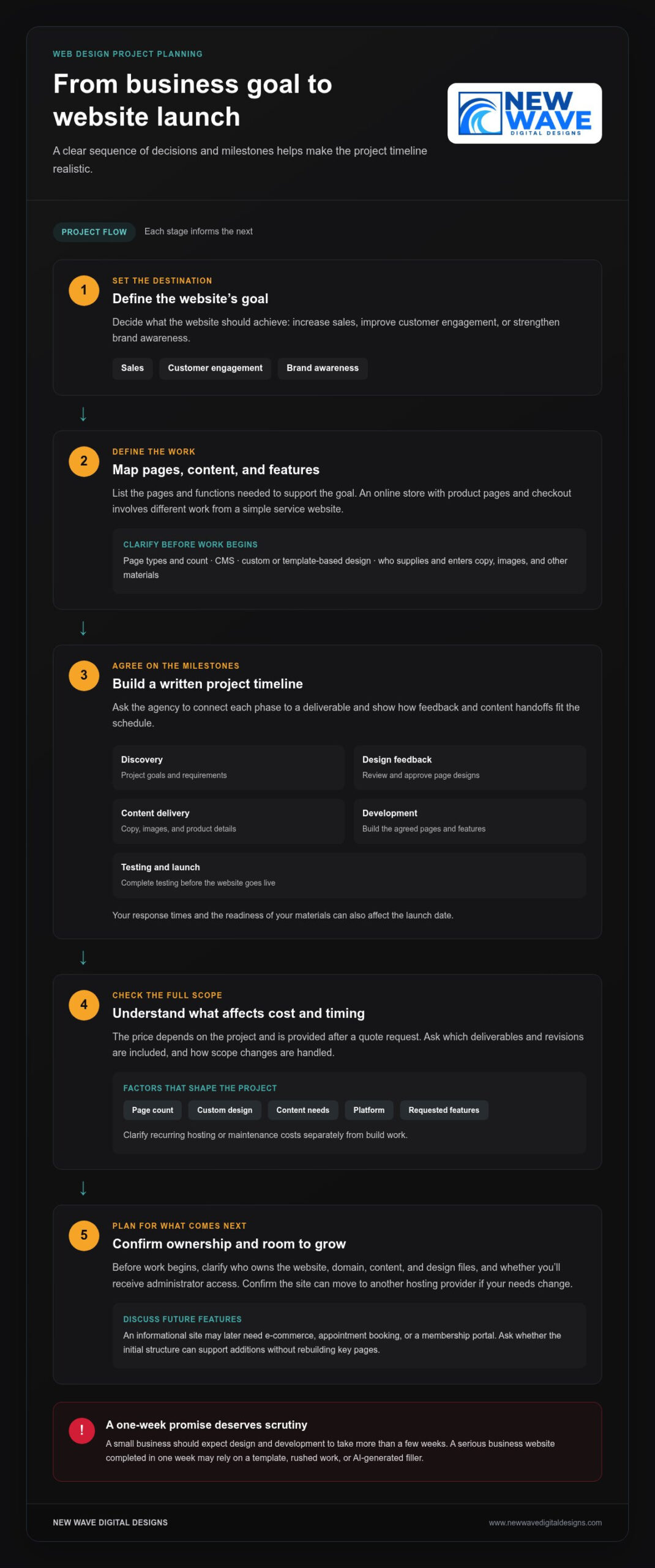
A useful timeline starts with a clear goal, not just a launch date. Decide whether the website should increase sales, improve customer engagement, or strengthen brand awareness. Then identify the pages, content, and features needed to support that goal. An online store with product pages and checkout involves different work from a simple service website. Ask the agency to link each project phase to a deliverable, such as approved page designs, completed development, or launch testing.

Ask how long a comparable project typically takes and what could affect your schedule. A small business should expect design and development to take more than a few weeks. A serious business website completed in one week may rely on a template, rushed work, or AI-generated filler. Request a timeline with milestones for discovery, design feedback, content delivery, development, and testing. Your response times and the readiness of your copy, images, and product details can also affect the launch date.

Clarify the structure before work begins. Ask how many page types the project needs, which content management system (CMS) will manage them, and whether the design is custom or template-based. For example, a reusable service-page layout can keep related pages consistent while allowing distinct content. Identify who supplies and enters the copy, images, and other materials. A written scope makes it easier to see how added pages or features could change the schedule and budget.

Ownership affects your options after launch. Ask who owns the website, domain, content, and design files, and whether you’ll receive administrator access. Confirm that the site can move to another hosting provider if your needs change. Discuss how the platform can grow, too. An informational site may later need e-commerce, appointment booking, or a membership portal. Ask how those features could be added and whether the initial structure can support them without rebuilding key pages.

Pricing transparency makes the timeline easier to assess. The price depends on the project and is provided after a quote request. Key cost factors include page count, custom design, content needs, platform, and requested features. Ask which deliverables and revisions the estimate covers, and how scope changes are handled. Clarify recurring hosting or maintenance costs separately from build work, so your budget reflects the full arrangement.

For a project on Shopify, WordPress, or Squarespace, the platform choice can shape the design and build process. A website design approach should align the platform, required features, and future growth with your business goals.

3. Hosting, maintenance, and post-launch support

A website needs care after launch, so define who handles each technical task. Ask whether hosting is included and what it covers, such as backups, uptime monitoring, and security. Clarify who installs platform, theme, and plugin updates, and who fixes bugs if an update affects a page. For a WordPress site, establish how plugin updates are tested before they reach the live website. A written scope should distinguish hosting responsibilities from maintenance work, so you know where each request belongs.

Ask what post-launch support includes and how long it lasts. Does the project include final testing, launch assistance, and corrections for issues discovered after publication? Clarify whether revisions cover design refinements, broken links, or changes to supplied content. These are different types of work. Ask how ongoing maintenance is arranged, what tasks it covers, and how additional requests are handled. Website maintenance provides a defined process for updates, security patches, and bug fixes, rather than leaving essential upkeep unassigned.

Response expectations matter most when a problem affects customers. Ask how to report a website outage, who receives the request, and what response times apply during the agreed support period. Find out whether requests go through a ticket portal, dedicated email, or another documented channel. A checkout error, for example, needs a clear reporting path and owner, even if it’s discovered outside ordinary project work. Separate routine edits from urgent faults, and make the support terms clear in the agreement.

Also ask who manages hosting support, backups, security, and account access. Confirm who controls the domain and hosting account, and how you can access important credentials. A clear handover should explain where backups are stored and how restoration is handled if a failed update disrupts the site. Hosting and security arrangements should identify responsibilities, not simply name a platform. If you plan to move providers later, ask what files, access, or assistance are needed for a smooth transfer.
Questions to Ask a Web Design Agency About Price and Timing

4. How much will the total cost of the project be and are there any hidden fees?

Compare an agency, freelancer, and in-house team by matching scope, skills, and responsibilities. An agency may coordinate design, development, and project management; a freelancer may handle a narrower scope; an in-house team requires your business to provide direction and capacity. Ask who will complete each task, manage revisions, and keep the work moving. Compare written proposals based on the same audience, page requirements, platform, and launch needs, rather than headline prices alone.

The price depends on the project and is provided after a quote request. Cost factors include page count, custom design, content needs, platform, and requested features. Ask for a written breakdown of deliverables, exclusions, payment milestones, and recurring costs. For example, a WordPress proposal should distinguish design and build work from hosting, maintenance, and ongoing marketing. Confirm how the agency handles scope changes, added pages, and revision rounds. A clear contract connects each cost to specific work and acceptance steps.

A small, fixed-scope project can show how an agency communicates, makes design decisions, and delivers work before you make a larger commitment. For example, commission a landing page or a defined design task with agreed deliverables and a review date. Set the audience, purpose, and approval process in writing. Ask who supplies copy and images, who gives feedback, and how revisions are handled. The trial should be paid or otherwise clearly scoped, with ownership and usage rights documented.

Ask the agency to explain its process from discovery through launch. A proposal should identify milestones for research, design, development, testing, and approval, along with your responsibilities at each stage. Clarify what the project includes, such as page templates, copywriting, image sourcing, SEO setup, training, and post-launch corrections. These items affect both budget and timing. If your team must supply product details or approve page layouts, assign an owner and agree on a response process before work begins.

Ask how SEO, accessibility, mobile responsiveness, and website performance are addressed in the scope. A useful answer describes specific tasks, such as setting page titles and alt text, checking layouts across devices, and testing load behavior. Ask what the agency measures and what final testing includes. Watch for red flags: vague deliverables, pressure to sign before reviewing terms, unclear ownership, or promises of guaranteed rankings. A proposal that can’t explain its process makes it difficult to judge value.

Use the same brief to compare every proposal, then assess communication alongside the finished sample. Ask the agency to explain scope differences, such as a template-based build versus custom page design. Confirm who approves work, how feedback is recorded, and what triggers additional charges. The strongest proposal isn’t necessarily the lowest priced. Look for the clearest agreement between your goals, the work promised, and each party’s responsibilities.

5. Agency organizational structure and team

A polished proposal can hide a complicated handoff. Ask who leads strategy, design, development, and quality checks, then learn how those roles connect. For example, a project manager may gather feedback, while a designer shapes page layouts and a developer builds them. Clarify who has final approval on your behalf and who answers day-to-day questions. A clear structure prevents conflicting instructions and helps decisions move through a defined channel.

Find out who will actually work on your website. The people presenting the pitch may not be the ones producing the pages. Ask whether the work is handled by employees, independent specialists, or a mix, and who coordinates outside contributors. If a developer joins after design approval, learn how that person receives the design decisions and project context. You want continuity between the original brief and the final build, not a fresh interpretation at every handoff.

Ask how the team divides responsibility for details that cross disciplines. A mobile layout, for instance, requires both design decisions and technical testing. Search visibility can involve page structure as well as content decisions. Ask who owns each task, how completion is reviewed, and who resolves disagreements. If the agency also handles graphic design, clarify how visual assets fit the website’s brand and who approves them before development.

Communication is part of the team structure. Ask who your main contact will be, how often you’ll receive progress updates, and where decisions are recorded. A shared project document can track page approvals, content dependencies, open questions, and next steps. If your team works across time zones, agree on overlapping work hours and a practical response window. The goal is a reliable rhythm, not constant meetings or updates from several people.

Ask what happens if a key team member becomes unavailable during the project. Find out who can step in, how project files and decisions are documented, and whether you’ll need to repeat earlier discussions. This matters when a designer’s approved layout needs to pass to a developer or a launch issue needs an owner. Clear documentation and backup responsibilities protect continuity without making you manage the agency’s internal staffing.

Finally, ask how the agency measures team capacity and coordinates parallel projects. Managing 100 or more websites is usually a positive sign when evaluating experience and ongoing support, but the important detail is how work is assigned and maintained. Ask how your project receives attention alongside other commitments, and who monitors progress. A strong team can explain its structure in plain terms and connect each role to a concrete responsibility.

If your next step is aligning website design with search visibility and brand assets, discuss your website goals with a team that can consider those needs together.

New Wave Digital Designs: Shopify Website Design

New Wave Digital Designs offers Shopify website design for businesses planning a new online store or refining an existing storefront. For other projects, the agency also designs websites for WordPress and Squarespace. Its Website Maintenance service supports businesses caring for a site after launch. Consider your platform, project goals, and ongoing needs together when deciding what kind of partnership fits. A clear conversation about your priorities can help shape the next step, whether you’re building a storefront or planning a redesign. Contact New Wave Digital Designs to discuss your website goals.

Turn your priorities into a clear next step

A website project is easier to shape when you define what success should look like for your business. Before moving forward, write down the change you want the site to create, the experience you want visitors to have, and the decisions you need to make with your design partner. That brief gives every conversation a useful starting point. The questions to ask before hiring a web design agency should help you find a partner whose approach fits your priorities, not simply a polished presentation.

New Wave Digital Designs offers Shopify Website Design, WordPress Website Design, and SquareSpace Website Design. If you’re ready to discuss a website project and explore which platform fits your goals, contact New Wave Digital Designs. A thoughtful first conversation can turn your ideas into a focused direction for the next stage of your business.

Frequently Asked Questions

What Questions Should I Ask Before Hiring a Web Designer?

Ask how the designer turns your business goals into page layouts, what you need to provide, and how decisions are approved. Request an example of a project where the original brief changed, then learn how the team responded. Also discuss how success will be assessed after launch. An online store, for instance, might track completed purchases, while a service business might focus on qualified inquiries.

How long will it take to design, develop, and launch the website?

Timelines depend on the number of page types, features, approvals, and how quickly content is ready. A small business website typically takes more than a few weeks, while a one-week build may rely on a template, rushed work, or AI-generated filler. Ask for a schedule showing when you need to supply content or approve designs. These dependencies help explain how your workflow can affect the launch date.

How much will the total cost of the project be and are there any hidden fees?

The total depends on scope, design requirements, content, platform, and requested features. Ask for a written estimate that separates build work from recurring maintenance or marketing expenses. Check whether the agreement covers stock images, third-party tools, payment processing integrations, and additional revisions. A new booking feature, for example, could require work beyond the original page design. Clear definitions help you understand what changes the project cost before approving them.

Next steps: What should I expect after choosing an agency?

Expect the agency to confirm the scope, responsibilities, approvals, and project schedule in writing before work begins. Choose a point person who can gather feedback, provide brand materials, and make decisions. The first working session often turns broad goals into specific audience needs, page priorities, and content requirements. Keep a shared record of approvals and open questions, so the team can act on decisions without revisiting settled details.

What control or ownership do you have as a client over the code?

Your contract should explain what you own, what you license, and what remains tied to a platform or third-party tool. Ask whether you’ll receive access to the website’s administrator account, source files, and any custom code created for the project. Clarify how a future developer could access or transfer those materials. For example, an account owner should know how to manage user permissions without relying on the original designer.

What does their client portfolio look like?

A portfolio should show more than attractive first-page images. Open a case study and look for the business problem, the agency’s role, and the finished site’s practical features. Check whether navigation works, forms submit, and pages remain readable on mobile. Compare the featured projects with your business model rather than expecting identical clients. A project serving a similar audience can reveal how the agency approaches content, user journeys, and conversion paths.

What happens if you need to make significant changes to your website?

Ask how the agency assesses a major request before work begins. It should clarify whether the change affects existing page layouts, integrations, content, or the launch schedule, then document revised deliverables and approvals. Adding online booking, for example, may change both the visitor journey and the information your team must maintain. Establish who can authorize the change and how completed work will be reviewed before it goes live.

What questions should you ask a web design agency before hiring them?

The most useful questions to ask before hiring a web design agency cover decision-making, ownership, communication, and how the work will serve your audience. Ask who leads the project, what you need to provide, how progress is recorded, and what happens when priorities shift. Look for answers that connect tasks to outcomes rather than relying on broad claims. A clear response should explain your responsibilities as well as the agency’s.

Hiring a Web Designer for a Small Business: A 2026 Guide

The most impressive portfolio may not lead to the right website for your business. When hiring a web designer for small business growth, look beyond visual style to the decisions behind the work: what your site needs to accomplish, how customers will use it, and who will maintain it after launch.

It’s understandable to feel unsure when project requirements are still taking shape or proposals are full of unfamiliar design and technical terms. A website is a meaningful investment, so start by identifying the customer actions it should support, the content those customers need, and the tools you’ll use to manage the site. That gives you a practical basis for comparing proposals.

This guide will help you define a project scope tied to your goals, compare freelancers, agencies, and DIY website tools, and assess which approach fits your needs. You’ll also learn what to look for in a collaborative design partner, how to think about platforms such as Shopify, WordPress, and Squarespace, and why maintenance and marketing belong in the plan from the start. The aim is to make a considered choice and build a website that can support your business beyond launch.

Key Takeaways

  • Start with the outcomes your website should support, then shape the project scope around your customers and business priorities.
  • When hiring a web designer for small business, consider relevant experience, clear communication, platform fit, and ongoing needs, not just visual style.
  • Compare DIY tools, freelancers, and agencies by the time, customization, coordination, and continuing support each requires.
  • Choose a platform to suit your site’s structure and business requirements, then plan for content, testing, maintenance, and growth beyond launch.
  • A thoughtful design partnership can align your brand and website strategy while creating a more maintainable digital foundation.

Hiring a Web Designer for a Small Business Starts With the Right Goals

Finding the right designer can feel like one more demanding task on a small-business owner’s already full schedule. Limited time and resources make it important to know what you’re investing in. Hiring a web designer for small business works best as a partnership: you bring knowledge of your customers and operations, while the designer brings creative and technical skills to shape a useful digital experience.

Begin with the outcome, not a list of visual effects. Do you need to generate qualified leads, sell products online, build credibility, or help customers find essential information? A website can serve several purposes, but choosing its primary job helps guide the pages, content, and features. For example, a service business may need clear service descriptions and a straightforward inquiry path, while an online store needs an easy way to browse products and complete purchases. Since web design brings together visual presentation, structure, and usability, exploring what web design entails can clarify the range of decisions involved.

Visual polish can earn attention; a website shaped around customer needs and business goals gives that attention a useful next step.

Identify the business outcome before discussing design

Connect every proposed page or feature to a real customer need. A services page should explain what customers are considering and how to take the next step. An online checkout should make product details, cart review, and purchasing clear. Sort requirements into launch essentials and later enhancements so extra features don’t crowd out the tasks customers need to complete first.

  • Lead generation: Track qualified inquiries, not just form submissions. Review whether inquiries match the services you offer.
  • Online sales: Measure completed purchases and check whether visitors can move from product information to checkout without confusion.
  • Customer information: Look for useful engagement, such as visits to key information pages and whether visitors can find answers without contacting you.

These measures make it easier to assess the site after launch and keep design choices tied to a practical purpose. Pick measures that reflect what the website is meant to do, rather than relying on visits alone.

Recognize when a small business is ready to hire

An outdated experience, cumbersome content updates, or a customer journey that leaves visitors unsure what to do can signal that the current site needs attention. A redesign may suit a business whose brand, services, or priorities have changed. A new site may make more sense when the existing one can’t support core needs, such as explaining services clearly or selling products. Neither situation automatically calls for a fully custom build.

You don’t need every detail settled before defining an initial scope. Identify the main audience, the website’s primary job, the essential launch requirements, and the areas causing friction. Bring examples of sites or features you like, but describe what works about them, such as clear navigation or concise product information, rather than requesting a visual copy. That gives the project a clear starting point while leaving room to refine details collaboratively.

How to Evaluate a Web Designer for Your Small Business

A portfolio can catch your eye, but hiring a web designer for small business success calls for a broader assessment. Look for evidence that the designer can understand your audience, explain their decisions, and shape a site around the outcomes you’ve defined. A polished presentation is only one part of a strong proposal. Ask how the proposed work addresses your project, not just whether you like the examples.

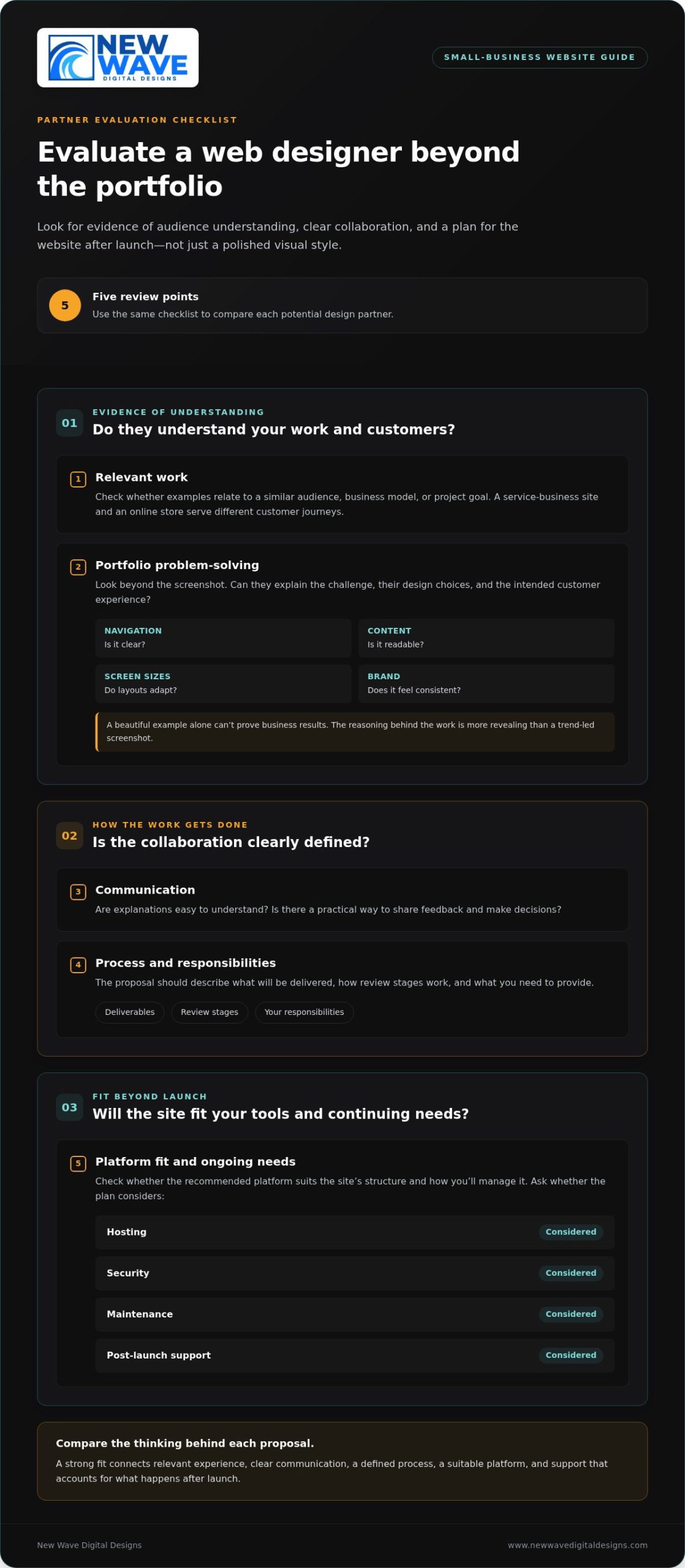
Use this checklist to compare how each potential design partner approaches the work:

  • Relevant work: Do examples speak to a similar audience, business model, or project goal? An online store and a service business site have different customer journeys.
  • Communication: Are explanations clear, and is there a practical way to share feedback and make decisions?
  • Process: Does the proposal describe deliverables, review stages, and responsibilities? Look for a clear account of what you need to provide.
  • Platform fit: Is the recommended platform suited to the site’s structure and the way you’ll manage it?
  • Ongoing needs: Are hosting, security, maintenance, and post-launch support considered?

These points help reveal whether a proposal is built on thoughtful reasoning or simply attractive visuals. The U.S. Small Business Administration’s guidance on marketing and sales strategy can also help you place the website within your broader business efforts.

Read portfolios for problem-solving, not visual trends

Compare portfolio examples by audience, business model, and project goals. A service business site and an online store have different customer journeys, even if both look refined. Notice whether navigation is clear, content is readable, layouts adapt to different screen sizes, and the brand feels consistent. A beautiful example alone can’t prove business results. Look for an explanation of the challenge, the design choices, and the intended customer experience. That reasoning is more revealing than a trend-led screenshot.

Understand scope, communication, and project responsibilities

Read the proposed scope closely. It should identify the pages and features included, who supplies or prepares content, how feedback and revisions work, and what launch support covers. Check whether the proposal names responsibilities for items such as copy, images, and final content approval. Clear responsibilities reduce confusion and help keep decisions aligned as the project takes shape. Make sure you understand how communication will happen and how feedback will be gathered.

Think beyond launch, too. Add hosting, security, website maintenance, and ongoing support to your planning checklist so these needs aren’t an afterthought. New Wave Digital Designs brings brand-aligned website design together with ongoing digital services. Explore its website design services as you consider what a collaborative project could include.

Freelancer, Agency, or DIY: Which Web Design Route Fits?

There’s no single right way to build a small-business website. The best fit depends on how much time you can contribute, how complex the project is, and who will handle the site after launch. Compare the trade-offs in owner time, customization, coordination, and support before choosing a route.

DIY website builder

Owner time: Higher, since you plan, build, and manage updates. Customization: Often suited to straightforward needs, within the builder’s options. Coordination and support: You handle setup and ongoing tasks, using the platform’s available resources. May fit: A simple launch when you’re comfortable learning the tool and maintaining the site yourself.

Independent freelancer

Owner time: You provide direction and feedback, while a designer handles the agreed work. Customization: Can be tailored to the project scope. Coordination and support: Technical and ongoing responsibilities depend on the agreement and the freelancer’s role. May fit: A defined project, such as a focused redesign or a store with clear requirements.

Agency partnership

Owner time: You contribute business knowledge and make decisions, while project work is coordinated through the partnership. Customization: Can address connected design and business needs. Coordination and support: Multiple services may be aligned through one working relationship, depending on the project scope. May fit: A more involved store or a broader growth plan that connects the site with ongoing marketing or maintenance.

These are general patterns, not promises about every provider. A freelancer may handle a complex project, and a DIY site can grow alongside a business. The important question in hiring a web designer for small business is whether the responsibilities match your desired level of involvement and the work your website needs to do.

When DIY website builders may be a practical starting point

A builder can be a sensible route for a straightforward site with a small set of pages, especially if you’re comfortable making updates yourself. You retain direct control, but that means investing your own time in setup, content, and maintenance. Before choosing, list the pages and functions you need, then compare them with the builder’s available design and management options. Don’t assume DIY is automatically limiting or suitable for every project.

When a freelancer or agency partnership may help

Specialist support can help coordinate design, development, and business requirements when the project has more moving parts. An agency relationship may be useful if the website connects with services such as organic SEO, advertising, graphic design, or ongoing maintenance. If you are exploring experienced creative partners, learn more about Studio Murschetz to see how a professional design studio aligns brand identity with digital execution. Clarify roles, deliverables, and post-launch responsibilities so the working model fits the project.

Hiring a Web Designer for a Small Business: A 2026 Guide

Plan the Web Design Project, Platform, and Ongoing Support

A clear project plan turns business priorities into a website customers can use and the owner can maintain. Map the work in sequence: define the brief, choose a suitable platform, prepare content, develop the design, test key tasks, and launch. Keep these stages connected so platform or visual decisions don’t outrun the site’s purpose.

Choose a platform around the business model

Shopify is designed for businesses building an online store and managing product sales. WordPress and Squarespace are additional options to assess against the site’s structure, content needs, and the owner’s preferred workflow. No platform is right for every small business. Consider what customers need to do, what the business needs to manage, and how the site may develop. For example, write down whether visitors primarily need to browse and buy products, read information, or contact you, then use those tasks to guide the platform discussion.

Prepare content and design for real use

Gather the core ingredients before design takes shape: services or products, intended audience, brand assets, page content, and the actions visitors should take. For each page, decide what a visitor needs to understand and what the next step should be. Then build for more than appearance. Responsive layouts should work across screen sizes, navigation should make important information easy to find, and content should be readable and accessible. Search-friendly foundations include clear page structure and descriptive content that helps people and search engines understand what each page offers.

Before launch, test the experience on different devices and check essential journeys, such as finding a service, submitting an inquiry, or completing a purchase. Review links, page content, and forms as part of those tasks. A deliberate review catches confusing navigation, missing information, and layout issues while there’s still time to address them.

Prepare for life after launch

A website needs care beyond its debut. Plan for hosting, security, software and content updates, and ongoing support so the site remains functional as the business changes. A website maintenance services guide can help frame the questions to consider. Organic visibility also develops over time, making an organic SEO strategy guide a useful reference when planning how site content supports discovery.

During hiring a web designer for small business, include these long-term responsibilities in the project conversation. New Wave Digital Designs creates responsive, brand-aligned websites and provides website maintenance, managed hosting and security, and organic SEO. Explore website design and ongoing support to consider how these pieces can work together.

Work With New Wave Digital Designs to Build a Small-Business Website

A strong website brings business goals, brand expression, and customer needs into one coherent experience. New Wave Digital Designs partners with small and medium-sized businesses to create responsive, brand-aligned websites, with design for Shopify, WordPress, and Squarespace. The right platform depends on the project: an online store, a content-rich site, and a straightforward business website can call for different structures and workflows.

That strategic fit matters when hiring a web designer for small business growth. The aim isn’t simply to create attractive pages. It’s to shape a useful customer journey and a digital foundation the business can continue to care for as its needs evolve.

Bring design, platform, and brand into one coherent experience

Responsive design helps make the experience usable across screen sizes, while clear structure guides visitors toward the information or action they need. Shopify website design can support businesses building an online store, with the platform selected to match the project’s requirements. A consistent visual identity matters beyond the website, too. Graphic design can help align digital and print materials, creating a recognizable presence wherever customers encounter the brand.

For businesses considering an online store, exploring a Shopify website design guide can help clarify the questions to bring into a platform and design discussion.

Build a website that can evolve beyond launch

Launch is a beginning, not the end of a website’s life. Ongoing maintenance, managed hosting, and security support the site’s continued functionality and care. Organic SEO and paid search can complement that foundation in different ways: SEO supports visibility through useful, search-friendly content, while Google Ads and Bing Ads provide paid search options. Graphic design can reinforce brand consistency across these efforts. The right mix depends on the business’s goals and priorities.

New Wave Digital Designs brings website design together with ongoing support and digital marketing services, so the plan can account for both the experience customers see and the work that supports it over time. Explore New Wave Digital Designs’ website design and digital marketing services to consider a thoughtful next step for your business.

Set Your Website Up for What Comes Next

A lasting website starts with a clear purpose, a practical scope, and a platform suited to the way your business works. As you consider hiring a web designer for small business growth, look beyond the launch: choose a partner and plan that account for customer needs, ongoing care, and future priorities.

New Wave Digital Designs creates custom websites for Shopify, WordPress, and Squarespace, with each platform considered in light of the project. The work can continue beyond design through website maintenance, managed hosting and security, organic SEO, and Google Ads or Bing Ads management. Together, these services can support a considered digital presence as your business evolves.

Every business has its own story and goals. Take the next step by exploring website design for your small business and start shaping a website that reflects your brand and serves your customers. A thoughtful plan today can give your next stage of growth a stronger foundation.

Frequently Asked Questions

Can a small business afford to hire a web designer?

Affordability depends on the project’s scope, complexity, platform, content readiness, and ongoing requirements. Start by identifying essential pages and functions, such as service information, an inquiry form, or product checkout, then separate launch needs from later enhancements. Consider project fees separately from continuing services like maintenance or hosting. A focused scope makes planning clearer without requiring a predetermined budget or assuming a particular return.

What should I look for when hiring a web designer for a small business?

Look for relevant portfolio work, clear communication, a defined process, experience with a suitable platform, mobile usability, a precise scope, and post-launch support. A useful standard for hiring a web designer for small business projects is whether the designer understands the goal behind the visual choices. Assess how the proposed work addresses your audience and needs. Don’t choose solely on appearance or broad promises that aren’t tied to specific deliverables.

Should a small business hire a freelance web designer or an agency?

Either can be a good fit, depending on the project. A freelancer may offer a flexible, direct working relationship for a clearly defined scope. An agency can coordinate multiple disciplines when a project connects design, development, marketing, or ongoing services. Consider complexity, how involved you want to be, and who will handle responsibilities after launch. Choose the model whose working relationship and capabilities align with the actual work.

How long does it take to design a small-business website?

Timelines vary with the site’s size, custom functionality, content readiness, feedback process, and platform requirements. Rather than assume a standard duration, plan milestones for discovery, content preparation, design, development, testing, and launch. Having materials ready and making decisions promptly can help keep work moving, while changes to scope or delayed feedback may affect the schedule. Agree on project stages and expectations as part of planning.

Which website platform is best for a small business?

The best fit depends on whether you need e-commerce, flexible content management, straightforward owner updates, or particular features. Shopify is suited to businesses building an online store; WordPress and Squarespace are also options to assess against your site structure and workflow. These platforms have different strengths, so start with how customers will use the site and how you’ll manage it, then consider future business needs.

Do small businesses need website maintenance after launch?

Yes. A launched site still needs attention to hosting, security, updates, functionality, and content. The specific maintenance tasks depend on the platform and how the site is set up, but planning for them helps prevent launch from being treated as the finish line. Decide who will manage ongoing care and include it in your website plan. New Wave Digital Designs provides website maintenance, managed hosting, and security services to support sites over time.

Can a web designer help with SEO and online advertising?

Web design can establish useful foundations for search visibility, but organic SEO and paid search require distinct ongoing strategies. New Wave Digital Designs provides organic SEO and manages Google Ads and Bing Ads. These efforts work best when aligned with business goals, relevant landing pages, and clear next steps for visitors. Neither design nor marketing guarantees rankings, traffic volumes, or advertising results, so plan around meaningful objectives and continued evaluation.