
The most impressive portfolio may not lead to the right website for your business. When hiring a web designer for small business growth, look beyond visual style to the decisions behind the work: what your site needs to accomplish, how customers will use it, and who will maintain it after launch.
It’s understandable to feel unsure when project requirements are still taking shape or proposals are full of unfamiliar design and technical terms. A website is a meaningful investment, so start by identifying the customer actions it should support, the content those customers need, and the tools you’ll use to manage the site. That gives you a practical basis for comparing proposals.
This guide will help you define a project scope tied to your goals, compare freelancers, agencies, and DIY website tools, and assess which approach fits your needs. You’ll also learn what to look for in a collaborative design partner, how to think about platforms such as Shopify, WordPress, and Squarespace, and why maintenance and marketing belong in the plan from the start. The aim is to make a considered choice and build a website that can support your business beyond launch.
Key Takeaways
- Start with the outcomes your website should support, then shape the project scope around your customers and business priorities.
- When hiring a web designer for small business, consider relevant experience, clear communication, platform fit, and ongoing needs, not just visual style.
- Compare DIY tools, freelancers, and agencies by the time, customization, coordination, and continuing support each requires.
- Choose a platform to suit your site’s structure and business requirements, then plan for content, testing, maintenance, and growth beyond launch.
- A thoughtful design partnership can align your brand and website strategy while creating a more maintainable digital foundation.
Hiring a Web Designer for a Small Business Starts With the Right Goals
Finding the right designer can feel like one more demanding task on a small-business owner’s already full schedule. Limited time and resources make it important to know what you’re investing in. Hiring a web designer for small business works best as a partnership: you bring knowledge of your customers and operations, while the designer brings creative and technical skills to shape a useful digital experience.
Begin with the outcome, not a list of visual effects. Do you need to generate qualified leads, sell products online, build credibility, or help customers find essential information? A website can serve several purposes, but choosing its primary job helps guide the pages, content, and features. For example, a service business may need clear service descriptions and a straightforward inquiry path, while an online store needs an easy way to browse products and complete purchases. Since web design brings together visual presentation, structure, and usability, exploring what web design entails can clarify the range of decisions involved.
Visual polish can earn attention; a website shaped around customer needs and business goals gives that attention a useful next step.
Identify the business outcome before discussing design
Connect every proposed page or feature to a real customer need. A services page should explain what customers are considering and how to take the next step. An online checkout should make product details, cart review, and purchasing clear. Sort requirements into launch essentials and later enhancements so extra features don’t crowd out the tasks customers need to complete first.
- Lead generation: Track qualified inquiries, not just form submissions. Review whether inquiries match the services you offer.
- Online sales: Measure completed purchases and check whether visitors can move from product information to checkout without confusion.
- Customer information: Look for useful engagement, such as visits to key information pages and whether visitors can find answers without contacting you.
These measures make it easier to assess the site after launch and keep design choices tied to a practical purpose. Pick measures that reflect what the website is meant to do, rather than relying on visits alone.
Recognize when a small business is ready to hire
An outdated experience, cumbersome content updates, or a customer journey that leaves visitors unsure what to do can signal that the current site needs attention. A redesign may suit a business whose brand, services, or priorities have changed. A new site may make more sense when the existing one can’t support core needs, such as explaining services clearly or selling products. Neither situation automatically calls for a fully custom build.
You don’t need every detail settled before defining an initial scope. Identify the main audience, the website’s primary job, the essential launch requirements, and the areas causing friction. Bring examples of sites or features you like, but describe what works about them, such as clear navigation or concise product information, rather than requesting a visual copy. That gives the project a clear starting point while leaving room to refine details collaboratively.
How to Evaluate a Web Designer for Your Small Business
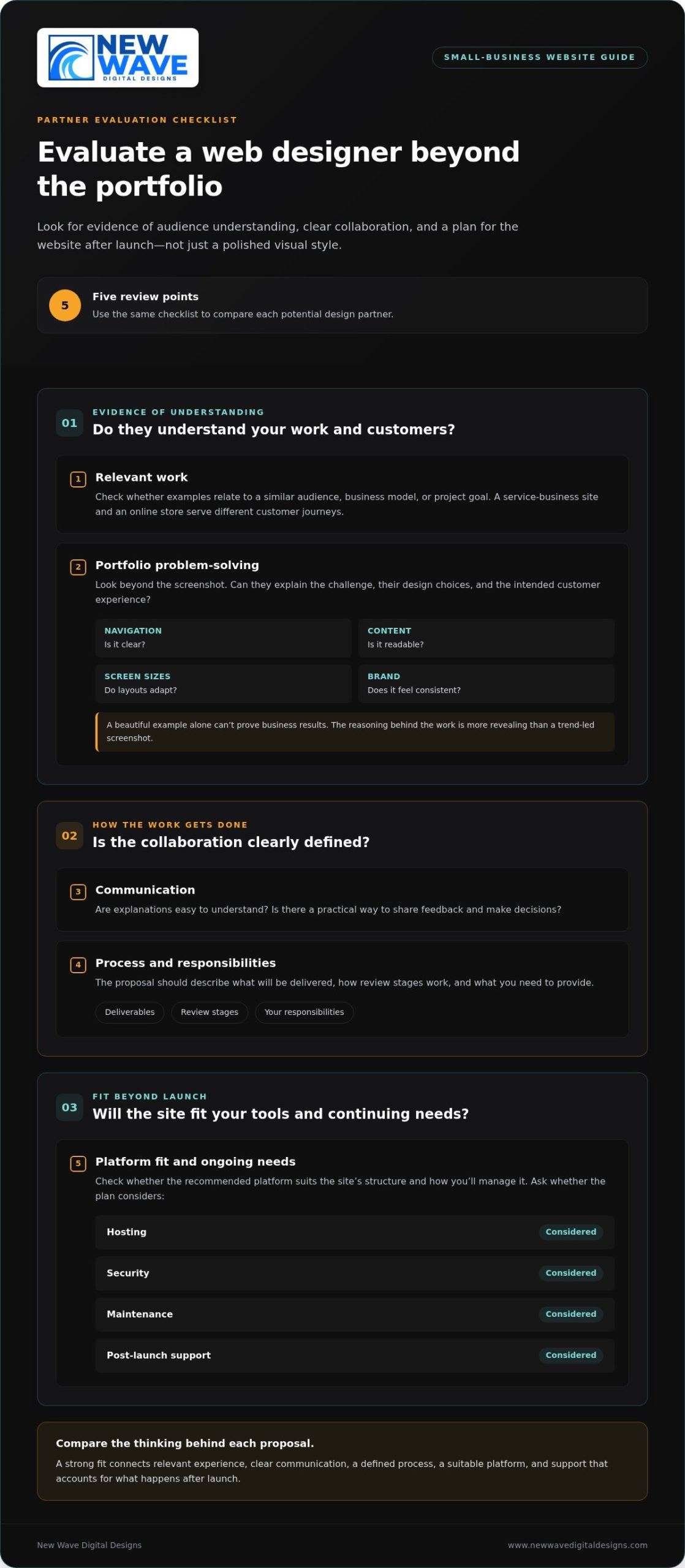
A portfolio can catch your eye, but hiring a web designer for small business success calls for a broader assessment. Look for evidence that the designer can understand your audience, explain their decisions, and shape a site around the outcomes you’ve defined. A polished presentation is only one part of a strong proposal. Ask how the proposed work addresses your project, not just whether you like the examples.
Use this checklist to compare how each potential design partner approaches the work:
- Relevant work: Do examples speak to a similar audience, business model, or project goal? An online store and a service business site have different customer journeys.
- Communication: Are explanations clear, and is there a practical way to share feedback and make decisions?
- Process: Does the proposal describe deliverables, review stages, and responsibilities? Look for a clear account of what you need to provide.
- Platform fit: Is the recommended platform suited to the site’s structure and the way you’ll manage it?
- Ongoing needs: Are hosting, security, maintenance, and post-launch support considered?
These points help reveal whether a proposal is built on thoughtful reasoning or simply attractive visuals. The U.S. Small Business Administration’s guidance on marketing and sales strategy can also help you place the website within your broader business efforts.
Read portfolios for problem-solving, not visual trends
Compare portfolio examples by audience, business model, and project goals. A service business site and an online store have different customer journeys, even if both look refined. Notice whether navigation is clear, content is readable, layouts adapt to different screen sizes, and the brand feels consistent. A beautiful example alone can’t prove business results. Look for an explanation of the challenge, the design choices, and the intended customer experience. That reasoning is more revealing than a trend-led screenshot.
Understand scope, communication, and project responsibilities
Read the proposed scope closely. It should identify the pages and features included, who supplies or prepares content, how feedback and revisions work, and what launch support covers. Check whether the proposal names responsibilities for items such as copy, images, and final content approval. Clear responsibilities reduce confusion and help keep decisions aligned as the project takes shape. Make sure you understand how communication will happen and how feedback will be gathered.
Think beyond launch, too. Add hosting, security, website maintenance, and ongoing support to your planning checklist so these needs aren’t an afterthought. New Wave Digital Designs brings brand-aligned website design together with ongoing digital services. Explore its website design services as you consider what a collaborative project could include.
Freelancer, Agency, or DIY: Which Web Design Route Fits?
There’s no single right way to build a small-business website. The best fit depends on how much time you can contribute, how complex the project is, and who will handle the site after launch. Compare the trade-offs in owner time, customization, coordination, and support before choosing a route.
DIY website builder
Owner time: Higher, since you plan, build, and manage updates. Customization: Often suited to straightforward needs, within the builder’s options. Coordination and support: You handle setup and ongoing tasks, using the platform’s available resources. May fit: A simple launch when you’re comfortable learning the tool and maintaining the site yourself.
Independent freelancer
Owner time: You provide direction and feedback, while a designer handles the agreed work. Customization: Can be tailored to the project scope. Coordination and support: Technical and ongoing responsibilities depend on the agreement and the freelancer’s role. May fit: A defined project, such as a focused redesign or a store with clear requirements.
Agency partnership
Owner time: You contribute business knowledge and make decisions, while project work is coordinated through the partnership. Customization: Can address connected design and business needs. Coordination and support: Multiple services may be aligned through one working relationship, depending on the project scope. May fit: A more involved store or a broader growth plan that connects the site with ongoing marketing or maintenance.
These are general patterns, not promises about every provider. A freelancer may handle a complex project, and a DIY site can grow alongside a business. The important question in hiring a web designer for small business is whether the responsibilities match your desired level of involvement and the work your website needs to do.
When DIY website builders may be a practical starting point
A builder can be a sensible route for a straightforward site with a small set of pages, especially if you’re comfortable making updates yourself. You retain direct control, but that means investing your own time in setup, content, and maintenance. Before choosing, list the pages and functions you need, then compare them with the builder’s available design and management options. Don’t assume DIY is automatically limiting or suitable for every project.
When a freelancer or agency partnership may help
Specialist support can help coordinate design, development, and business requirements when the project has more moving parts. An agency relationship may be useful if the website connects with services such as organic SEO, advertising, graphic design, or ongoing maintenance. If you are exploring experienced creative partners, learn more about Studio Murschetz to see how a professional design studio aligns brand identity with digital execution. Clarify roles, deliverables, and post-launch responsibilities so the working model fits the project.
Plan the Web Design Project, Platform, and Ongoing Support
A clear project plan turns business priorities into a website customers can use and the owner can maintain. Map the work in sequence: define the brief, choose a suitable platform, prepare content, develop the design, test key tasks, and launch. Keep these stages connected so platform or visual decisions don’t outrun the site’s purpose.
Choose a platform around the business model
Shopify is designed for businesses building an online store and managing product sales. WordPress and Squarespace are additional options to assess against the site’s structure, content needs, and the owner’s preferred workflow. No platform is right for every small business. Consider what customers need to do, what the business needs to manage, and how the site may develop. For example, write down whether visitors primarily need to browse and buy products, read information, or contact you, then use those tasks to guide the platform discussion.
Prepare content and design for real use
Gather the core ingredients before design takes shape: services or products, intended audience, brand assets, page content, and the actions visitors should take. For each page, decide what a visitor needs to understand and what the next step should be. Then build for more than appearance. Responsive layouts should work across screen sizes, navigation should make important information easy to find, and content should be readable and accessible. Search-friendly foundations include clear page structure and descriptive content that helps people and search engines understand what each page offers.
Before launch, test the experience on different devices and check essential journeys, such as finding a service, submitting an inquiry, or completing a purchase. Review links, page content, and forms as part of those tasks. A deliberate review catches confusing navigation, missing information, and layout issues while there’s still time to address them.
Prepare for life after launch
A website needs care beyond its debut. Plan for hosting, security, software and content updates, and ongoing support so the site remains functional as the business changes. A website maintenance services guide can help frame the questions to consider. Organic visibility also develops over time, making an organic SEO strategy guide a useful reference when planning how site content supports discovery.
During hiring a web designer for small business, include these long-term responsibilities in the project conversation. New Wave Digital Designs creates responsive, brand-aligned websites and provides website maintenance, managed hosting and security, and organic SEO. Explore website design and ongoing support to consider how these pieces can work together.
Work With New Wave Digital Designs to Build a Small-Business Website
A strong website brings business goals, brand expression, and customer needs into one coherent experience. New Wave Digital Designs partners with small and medium-sized businesses to create responsive, brand-aligned websites, with design for Shopify, WordPress, and Squarespace. The right platform depends on the project: an online store, a content-rich site, and a straightforward business website can call for different structures and workflows.
That strategic fit matters when hiring a web designer for small business growth. The aim isn’t simply to create attractive pages. It’s to shape a useful customer journey and a digital foundation the business can continue to care for as its needs evolve.
Bring design, platform, and brand into one coherent experience
Responsive design helps make the experience usable across screen sizes, while clear structure guides visitors toward the information or action they need. Shopify website design can support businesses building an online store, with the platform selected to match the project’s requirements. A consistent visual identity matters beyond the website, too. Graphic design can help align digital and print materials, creating a recognizable presence wherever customers encounter the brand.
For businesses considering an online store, exploring a Shopify website design guide can help clarify the questions to bring into a platform and design discussion.
Build a website that can evolve beyond launch
Launch is a beginning, not the end of a website’s life. Ongoing maintenance, managed hosting, and security support the site’s continued functionality and care. Organic SEO and paid search can complement that foundation in different ways: SEO supports visibility through useful, search-friendly content, while Google Ads and Bing Ads provide paid search options. Graphic design can reinforce brand consistency across these efforts. The right mix depends on the business’s goals and priorities.
New Wave Digital Designs brings website design together with ongoing support and digital marketing services, so the plan can account for both the experience customers see and the work that supports it over time. Explore New Wave Digital Designs’ website design and digital marketing services to consider a thoughtful next step for your business.
Set Your Website Up for What Comes Next
A lasting website starts with a clear purpose, a practical scope, and a platform suited to the way your business works. As you consider hiring a web designer for small business growth, look beyond the launch: choose a partner and plan that account for customer needs, ongoing care, and future priorities.
New Wave Digital Designs creates custom websites for Shopify, WordPress, and Squarespace, with each platform considered in light of the project. The work can continue beyond design through website maintenance, managed hosting and security, organic SEO, and Google Ads or Bing Ads management. Together, these services can support a considered digital presence as your business evolves.
Every business has its own story and goals. Take the next step by exploring website design for your small business and start shaping a website that reflects your brand and serves your customers. A thoughtful plan today can give your next stage of growth a stronger foundation.
Frequently Asked Questions
Can a small business afford to hire a web designer?
Affordability depends on the project’s scope, complexity, platform, content readiness, and ongoing requirements. Start by identifying essential pages and functions, such as service information, an inquiry form, or product checkout, then separate launch needs from later enhancements. Consider project fees separately from continuing services like maintenance or hosting. A focused scope makes planning clearer without requiring a predetermined budget or assuming a particular return.
What should I look for when hiring a web designer for a small business?
Look for relevant portfolio work, clear communication, a defined process, experience with a suitable platform, mobile usability, a precise scope, and post-launch support. A useful standard for hiring a web designer for small business projects is whether the designer understands the goal behind the visual choices. Assess how the proposed work addresses your audience and needs. Don’t choose solely on appearance or broad promises that aren’t tied to specific deliverables.
Should a small business hire a freelance web designer or an agency?
Either can be a good fit, depending on the project. A freelancer may offer a flexible, direct working relationship for a clearly defined scope. An agency can coordinate multiple disciplines when a project connects design, development, marketing, or ongoing services. Consider complexity, how involved you want to be, and who will handle responsibilities after launch. Choose the model whose working relationship and capabilities align with the actual work.
How long does it take to design a small-business website?
Timelines vary with the site’s size, custom functionality, content readiness, feedback process, and platform requirements. Rather than assume a standard duration, plan milestones for discovery, content preparation, design, development, testing, and launch. Having materials ready and making decisions promptly can help keep work moving, while changes to scope or delayed feedback may affect the schedule. Agree on project stages and expectations as part of planning.
Which website platform is best for a small business?
The best fit depends on whether you need e-commerce, flexible content management, straightforward owner updates, or particular features. Shopify is suited to businesses building an online store; WordPress and Squarespace are also options to assess against your site structure and workflow. These platforms have different strengths, so start with how customers will use the site and how you’ll manage it, then consider future business needs.
Do small businesses need website maintenance after launch?
Yes. A launched site still needs attention to hosting, security, updates, functionality, and content. The specific maintenance tasks depend on the platform and how the site is set up, but planning for them helps prevent launch from being treated as the finish line. Decide who will manage ongoing care and include it in your website plan. New Wave Digital Designs provides website maintenance, managed hosting, and security services to support sites over time.
Can a web designer help with SEO and online advertising?
Web design can establish useful foundations for search visibility, but organic SEO and paid search require distinct ongoing strategies. New Wave Digital Designs provides organic SEO and manages Google Ads and Bing Ads. These efforts work best when aligned with business goals, relevant landing pages, and clear next steps for visitors. Neither design nor marketing guarantees rankings, traffic volumes, or advertising results, so plan around meaningful objectives and continued evaluation.