
When you search for top web design companies, a polished portfolio can be an appealing starting point, but it won’t tell you whether a company understands your goals, recommends a suitable platform, or supports your site after launch. The right partner should be able to explain how its approach fits your business, not just show attractive designs.
Proposals can be difficult to compare. One may emphasize visual design, another technical features, and a third ongoing services, while leaving scope, responsibilities, or ownership unclear. The best fit depends on how well the full project meets your needs, not on a single feature or presentation.
This guide offers a practical framework for evaluating web design partners by strategy, platform fit, process, and ongoing support. You’ll learn how to assess Shopify, WordPress, and Squarespace against your requirements, clarify what a project includes, and understand who handles launch responsibilities and maintenance. With those details in view, you can choose a partner like New Wave Digital Designs with greater confidence and build a site designed to serve your business over time.
Key Takeaways
- Compare agencies by how their strategy supports your business goals, not by portfolio visuals alone.
- Use your site’s purpose, content needs, and preferred level of control to assess Shopify, WordPress, and Squarespace.
- When comparing web design companies, look for clear scope, responsibilities, ownership, and launch planning.
- Confirm who will provide content and images, manage domain access, and coordinate third-party services before committing.
- Consider whether maintenance, hosting, security, SEO, or paid search fits your needs after launch. Don’t assume every service is essential.
What Should a Web Design Company Do for Your Business?
A website should do more than look polished. It should help people understand what you offer, find the information they need, and take a useful next step. A web design company can help plan the site’s structure, visual design, and user journey, then build a website around your business priorities.
Web design is the visual and interactive expression of a website; the website itself is a business tool that guides visitors toward information, inquiry, or purchase. The work can involve user experience, interface design, and development, as outlined in this overview of what web design encompasses. The exact balance depends on your goals and the agreement you make with your provider.
Which business goals can a website support?
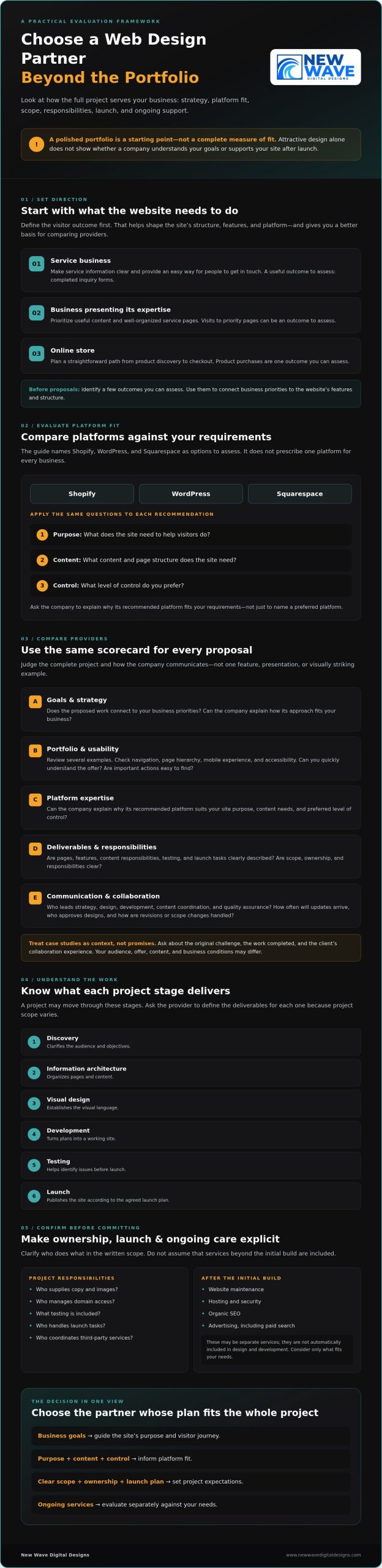
Start with the outcome you want visitors to reach. A service business seeking qualified inquiries needs clear service information and an easy way to get in touch. A company focused on presenting its expertise may prioritize useful content and well-organized service pages. An online store needs a straightforward path from product discovery to checkout.
Before requesting proposals, identify a few outcomes you can assess, such as completed inquiry forms, product purchases, or visits to priority pages. These goals help determine the site’s features, structure, and platform. They also give you a more useful basis for comparing web design companies than appearance alone.
What is included in website design and development?
A project may move through discovery, information architecture, visual design, development, testing, and launch. Discovery clarifies the audience and objectives. Information architecture organizes pages and content. Design establishes the visual language, and development turns those plans into a working site. Testing helps identify issues before launch. Ask the provider to define each stage and its deliverables, since project scope varies.
Be clear about what falls outside the initial build. Website maintenance, hosting, security, organic SEO, and advertising may be available as separate services, but they aren’t automatically included in design and development. A launch plan, for example, might cover publishing the site while leaving future updates or search marketing to a separate agreement.
Review the written scope for who supplies copy and images, who manages domain access, what testing is included, and who handles launch tasks. Clarifying those responsibilities early helps align the design, build, and ongoing care with your business needs.
How to Compare Web Design Companies Beyond Their Portfolios
A portfolio is a useful first impression, not a complete measure of fit. Compare how each company approaches a project, communicates decisions, and designs a site for its audience. Strong work should look considered, but it should also make information easy to find and important actions easy to take.
How can you assess a company’s portfolio?
Review several examples, not just the most visually striking one. Ask who each site serves, what the business needed, and how the structure supports that purpose. Check the navigation, page hierarchy, mobile experience, and accessibility features. Can you quickly understand the offer? Are calls to action easy to find? A compelling visual style shows creative range, but it doesn’t guarantee results for your business.
Consider whether the examples reflect your business model, content, and required functionality. An online store, for instance, has different needs from a service website designed to encourage inquiries. If you can, explore live sites on a phone as well as a desktop. Notice whether menus, forms, and key information remain easy to use.
What should you ask before choosing an agency?
Ask who leads strategy, design, development, content coordination, and quality assurance. Clarify how discovery works, how often you’ll receive updates, who approves designs, and how revisions or scope changes are handled. Before committing, ask what testing and launch support are included and which responsibilities remain yours.
References or case studies can add useful context. Ask what the original challenge was, what work the company completed, and how the client found the collaboration. Treat outcomes as examples, not promises: your audience, offer, content, and business conditions may differ.
Use a simple scorecard to compare providers on the same terms:
- Goals: Does the proposal connect the work to your business priorities?
- Platform expertise: Can the company explain why its recommended platform fits your requirements?
- Deliverables: Are pages, features, content responsibilities, testing, and launch tasks clearly described?
- Communication: Are updates, feedback, approvals, and change requests explained?
- Post-launch support: Is ongoing maintenance or other support available, and what does it include?
Compare the answers, not just the score. A thoughtful partner should explain trade-offs and help you understand what’s included before work begins. If you’re exploring custom website design, review website design services as one point of comparison.
Shopify, WordPress, or Squarespace: Which Platform Fits Your Website?
The right platform is the one that supports your site’s purpose and the way you plan to manage it. Start with your requirements: Are you selling products, publishing a range of content, or building an online presence for your services? Then consider who will update the site, what functions it needs, and how much control you want over its design and administration. Popularity alone isn’t a sound reason to choose.
Platform | May suit | Questions to consider
Shopify | Businesses centered on selling products online | How will the platform support your catalogue, store workflows, and required integrations?
WordPress | Sites with evolving content or specific customization needs | Who will manage updates, and how much flexibility does the site require?
Squarespace | Businesses seeking a managed site to present services, work, or content | Does its editing and design approach suit the way your team will maintain the site?
When might Shopify suit an online store?
If selling products online is central to your business, Shopify is a platform worth evaluating. Map the customer’s path from browsing to purchase, then list what your catalogue and store workflows require. Note any integrations the business depends on. Discuss those requirements with prospective providers rather than assuming a platform or proposed setup will support every need. For a closer look, explore this Shopify website design guide.
When might WordPress or Squarespace be a better fit?
WordPress and Squarespace are both options to consider for content-focused or service-based websites. Compare how each fits your content structure, customization needs, and preferred editing experience. Ask who will make routine updates and whether your team wants to manage the site directly or rely on support. The right choice should remain practical after launch, not simply look appealing in a design preview. If Squarespace is on your shortlist, this guide to custom Squarespace website design offers another perspective.
Before choosing, ask each provider to explain its platform recommendation in relation to your requirements, future content changes, and ongoing maintenance. A clear rationale lets you compare proposals on fit and practical trade-offs, not preference alone.
What Should a Web Design Proposal Include Before You Commit?
A proposal should turn your goals into a clear plan, not leave key decisions hidden behind a headline price. Scope and requirements shape each project, so compare proposals based on the same brief. This makes it easier to see what each provider will deliver, what you’ll need to supply, and what support continues after launch.
How do you clarify scope, timeline, and responsibilities?
Look for a written description of the work, review points, and each party’s responsibilities. Before signing, use this checklist:
- Scope and deliverables: Identify the pages, design work, functionality, and other specific outputs included.
- Content and assets: Confirm who writes or supplies copy, selects images, and prepares other materials.
- Schedule and approvals: Request a project schedule tied to the agreed scope, with milestones, review periods, and approval responsibilities.
- Changes and exclusions: Ask what isn’t included and how additional requests are evaluated, approved, and documented.
- Testing and launch: Clarify what will be tested, who gives final approval, and who is responsible for launch tasks.
Timelines should reflect the actual project plan, not an assumed standard. Ask how delays in feedback, content delivery, or approvals affect the schedule. Clear answers help you compare proposals on substance rather than presentation.
Who owns the website and its accounts after launch?
Confirm how access and ownership will work for the finished website, domain, content, and relevant third-party accounts. Ask which accounts will be created or used in your business’s name, who can access them, and how credentials will be transferred or managed. If training or handover documentation is included, have the proposal describe what you’ll receive.
Give ongoing arrangements the same attention as the build. Check whether hosting, security, updates, maintenance, and support are included or handled separately. Ask what each arrangement covers and who to contact for routine changes. Don’t assume that paying for a site automatically includes its continued care.
Before choosing among web design companies, review each proposal against the same requirements: scope, responsibilities, schedule, ownership, and post-launch arrangements. If an item is vague, request clarification in writing before you commit. To discuss website design and support options, explore New Wave Digital Designs.
Choose a Web Design Partner for Launch and Long-Term Growth
A sound choice brings four elements into alignment: your business goals, a suitable platform, a clearly defined proposal, and a realistic plan for support after launch. Keep that framework in view as you compare partners. A thoughtful design should serve the business now while leaving room to manage and refine the site as needs evolve.
Post-launch services aren’t automatic requirements for every project. Consider what your team can manage, what needs specialist attention, and what responsibilities the proposal assigns to you. New Wave Digital Designs offers website design for Shopify, WordPress, and Squarespace, along with maintenance, hosting and security, organic SEO, Google Ads, and Bing Ads. These are options to discuss based on your requirements, not a checklist every business must buy.
What support might a website need after launch?
Think of maintenance, hosting, and security as distinct needs. Maintenance concerns ongoing care for the website; hosting is where the site is made available online; security involves protecting the site and its access. Ask what each service covers, who handles it, how you request help, and whether it’s included in the proposal or arranged separately.
If you’re planning for ongoing care, read this website maintenance services guide. Before agreeing to support, clarify its scope and communication expectations. Don’t assume a service includes round-the-clock emergency coverage or a specific response time unless the provider confirms that in writing.
How can design connect with search and advertising?
Organic SEO may be relevant if you want your site’s content to support discovery through search. Paid search, such as Google Ads or Bing Ads, is separate from website design. If you’re considering advertising, define its objective and how you’ll assess whether it serves that goal. A coordinated plan can connect the site experience with search activity, but these services should reflect your priorities rather than being added by default.
Before launch, make sure you know who will maintain the site, manage hosting and security, and oversee any search or advertising work you choose. That clarity creates a stronger handoff and helps you plan for the next stage without committing to services you don’t need.
With your scope and priorities in hand, you can explore web design and digital marketing services and discuss which options fit your project.
Choose a Partner for What Comes Next
The strongest web design partnership begins with clear business goals, a platform that fits your needs, and a proposal that spells out scope and responsibilities. Look beyond visual polish: consider how the site will guide visitors, who will manage it, and what support is available after launch. Those details can help you choose a website that works as a business asset, not simply a finished design.
New Wave Digital Designs provides custom website design for Shopify, WordPress, and Squarespace, with website maintenance, managed hosting, and security available for ongoing needs. Organic SEO and Google Ads or Bing Ads management may also be relevant when they align with your goals, but they aren’t automatic requirements for every project.
Ready to explore an approach suited to your business? Explore New Wave Digital Designs’ website services and consider which capabilities fit your project. With a thoughtful brief and clear expectations, you can move forward with confidence and build a digital presence ready to evolve alongside your business.
Frequently Asked Questions
What does a web design company do?
A web design company can plan and build a website’s structure, appearance, and user experience. Depending on the provider and agreed scope, its work may also include development, testing, and launch support. Ongoing maintenance, hosting, security, and marketing may be separate services rather than part of the initial build. Before hiring a provider, clarify the deliverables in writing and match the project scope to your business goals.
How do I choose a web design company?
Start by defining your website’s goals, audience, required features, and support needs. Then compare relevant portfolio work, platform experience, written deliverables, communication practices, and post-launch arrangements. If you’re searching for “web design companies in somerset county nj,” use the same questions to assess each provider rather than relying on visual style alone. Choose a partner whose recommendations fit your requirements and whose proposal makes responsibilities clear.
How much does it cost to hire a web design company?
Project scope and requirements shape the proposal, so there isn’t one amount that applies to every website. An online store, a redesign, and an informational site can involve different platforms, functionality, content needs, and services. Give each provider the same project brief, then compare written proposals by deliverables and exclusions. Ask which ongoing services are separate, and don’t judge a proposal by its headline figure alone.
Which platform is best for a small business website?
No single platform is best for every small business. Shopify may suit a business focused on online product sales, while WordPress or Squarespace may better match other content, customization, or administration needs. Consider the site’s purpose, required functions, and who will update it. Ask a prospective web design company to explain its recommendation in relation to your goals, content, and available resources.
What should a web design proposal include?
A proposal should clearly describe the project scope, deliverables, responsibilities, milestones, and approval process. It should also explain what’s excluded, how additional requests are handled, and whether content, testing, launch, training, or post-launch support is included. Confirm arrangements for website and account access and ownership. If an important detail is unclear, ask the provider to clarify it in writing before you commit.
Do web design companies provide website maintenance?
Some web design companies offer maintenance, while others focus on the initial design and build. The arrangement varies, so ask what ongoing care covers, how requests are handled, and which responsibilities remain yours. New Wave Digital Designs offers website maintenance, managed hosting, and security services. Confirm the specific scope and support arrangements for your website rather than assuming they’re automatically included in a design project.
Should SEO be included in a web design project?
SEO may inform a website’s structure and content, but ongoing search work isn’t automatically included in a design project. Ask which SEO-related tasks are part of the build and which require a separate service. If organic search or paid advertising supports your goals, define the objectives and responsibilities clearly. New Wave Digital Designs offers organic SEO and Google Ads and Bing Ads management as services to consider based on your needs.