Professional Shopify Setup Services: A 2026 Guide to a Launch-Ready Store

A polished Shopify storefront can still be unready for its first order. Product pages may look complete while payment, shipping, inventory, or checkout workflows remain untested. That’s why professional shopify setup services should be judged by more than appearance. The goal is a store that’s ready to serve customers and manageable for the business behind it.

If you’re unsure what setup should include, who owns each task, or how to distinguish expertise from vague promises, you’re asking the right questions. A thoughtful launch takes more than a theme and a collection of products. It calls for clear decisions, careful configuration, and practical checks before customers arrive.

This guide explains what a well-prepared Shopify store may need, how to compare providers by their deliverables, ownership terms, and quality checks, and what to prepare before launch. You’ll also learn how collaborative design can align your store’s structure with your business and its customers, creating a foundation you can manage and grow.

Key Takeaways

  • Learn how setup, custom design, migration, and ongoing maintenance differ so you can define the help your store actually needs.
  • Use the customer journey, from product discovery to order confirmation, to identify where store content and settings need to work together.
  • Evaluate professional shopify setup services by their documented scope, testing approach, communication, and clear division of responsibilities.
  • Prepare for launch with a practical sequence for confirming content, reviewing settings, testing purchases, and checking the mobile experience.
  • Consider Shopify website design alongside separate ongoing needs such as maintenance, hosting, security, and SEO.

What professional Shopify setup services cover before your store goes live

A Shopify store is more than a storefront assembled from pages and products. Professional shopify setup services typically prepare the store’s structure, operational settings, customer journey, and pre-launch checks. The exact work depends on your business, so a useful proposal should explain what’s included, what’s optional, and what remains your responsibility.

In brief: store configuration organizes how a Shopify store operates; a finished, tested customer experience confirms that shoppers can move through it as intended. That distinction matters. Settings can be in place while the store still needs content, design work, or hands-on testing before it’s ready for customers. For neutral background on the platform and its features, see this overview of Shopify.

Which setup tasks belong in the project scope?

A well-defined project starts with discovery: the business’s goals, products, audience, and required functionality. Those decisions guide practical planning, including how shoppers find products, how product information is organized, and how the path to checkout should work. Essential store settings may also be reviewed or configured, depending on the agreed scope and current platform options.

Ask the provider to specify whether the project includes integrations, content creation, product data entry, and post-launch support. These tasks aren’t automatic parts of every setup engagement. Get responsibilities in writing, including what your team must supply, what the provider will configure, and which checks will be completed before launch.

How setup differs from Shopify design and development

Configuration shapes the store’s operating framework. Design shapes its visual presentation, while theme customization adapts a theme’s appearance or behavior to suit the brand. Custom development can involve more specialized functionality, so it may need separate planning, estimates, and specialist work. Migration is another distinct scope: it involves moving store content or data from an existing platform, rather than simply configuring a new storefront.

Ongoing maintenance begins after launch and should be discussed separately from initial setup. New Wave Digital Designs offers custom Shopify website design, but confirm the specific configuration tasks included in the project scope. For a closer look at the visual and strategic side of the work, explore a Shopify website design guide.

How a professional Shopify setup turns store requirements into working customer journeys

A store’s structure only works when each step makes sense to the person shopping. Picture a customer arriving on a collection page, narrowing down options, opening a product page, adding an item to the cart, completing checkout, and receiving an order confirmation. Professional shopify setup services should connect those moments, rather than treat each page or setting as an isolated task.

A launch-ready store connects and tests the customer-facing steps from product discovery through checkout and order confirmation. Use this journey to clarify what shoppers need to see, understand, and do at each stage. A clear value proposition and a suitable platform are also part of the larger picture; Forbes offers a useful overview of comprehensive e-commerce strategy.

How product catalog and navigation choices shape shopping

Product titles, descriptions, images, and variants should help customers identify an item and choose the right option. Collections and menu labels then create a logical route to those products. For example, if a shop groups unrelated items under a broad label customers don’t recognize, shoppers may have to browse several pages to find what they want. Organizing products around familiar categories or shopping needs can make discovery more intuitive.

Agree on who supplies product details and images, who reviews them for accuracy, and who maintains the catalog after launch. A provider may organize supplied content, but don’t assume content creation or entry for every product is included unless the written scope says so.

How payments, shipping, taxes, and policies affect checkout

Reaching checkout is not the finish line. Customers need clear information and working settings that reflect the store’s business model and markets. Confirm which areas are included in setup, and who is responsible for supplying and approving the details behind them:

  • Payments: Which payment methods are intended, and do the selected settings support the store’s needs?
  • Shipping: Do delivery options and charges match the business’s fulfillment approach?
  • Taxes: Have the relevant settings been reviewed for the markets where the business sells?
  • Policies: Are customer-facing policies available and consistent with the business’s practices?

Payment options, tax settings, and third-party integrations can change, so verify current Shopify capabilities and integration requirements before configuration. Store owners should also confirm their current legal and tax obligations with qualified professionals. A provider’s setup work is not legal or tax advice.

A useful scope discussion follows a real shopping journey and asks where each piece of content, setting, or approval comes from. If you’re shaping that journey with a design partner, you can discuss your Shopify store requirements with New Wave Digital Designs.

How to compare professional Shopify setup services without buying more than you need

The right provider isn’t the one promising the longest list of features. It’s the one who can connect specific work to your business needs, explain how decisions will be made, and show how completion will be checked. Professional shopify setup services are valuable when they resolve defined gaps, not simply because extra services are available.

Compare proposals by scope, business fit, communication, testing, documentation, and ownership. A Beginner’s Guide to E-Commerce can help clarify the fundamentals, but a provider’s proposal should explain how the work applies to your store. For visual direction and tailored storefront considerations, see this custom Shopify store design guide.

Area Clearly scoped work Optional or separately scoped Owner responsibility to confirm
Store setup Agreed configuration tasks and documented completion checks Additional functionality or custom development Provide decisions, access, and approvals
Content and products Specific product or content tasks listed in the proposal Photography, copywriting, or extensive data entry Supply and approve accurate business information
Testing and handoff Named checks and handoff documentation Ongoing support or maintenance Retain access to accounts and business assets

Which questions reveal a provider’s process and project boundaries?

Ask how discovery, approvals, revisions, and project communication will work. Find out which tasks depend on your team supplying product details, photography, policies, or account access. Request an example of the documentation or acceptance checks you’ll receive, and ask how the provider records work that falls outside the agreed scope. Examples can help you assess the process, but another store’s experience doesn’t predict yours.

Who owns the Shopify account, content, and connected services?

Confirm that your business will retain appropriate access to its Shopify account and connected assets. Clarify who controls domain access, payment accounts, analytics, and third-party subscriptions, and how access will be handed over when the project ends. Ask which external subscription charges or ongoing service fees are separate from project work. Clear ownership supports a clean handoff and helps you manage the store after launch.

Choose a scope that fits your current requirements, with optional work clearly identified rather than bundled in by default. A strong proposal makes responsibilities visible before the project begins, so you can invest in what the store needs and retain control of what your business owns.

Professional Shopify Setup Services: A 2026 Guide to a Launch-Ready Store

What to prepare and test before launching a professionally set-up Shopify store

A careful launch review turns project decisions into a practical final check. Professional shopify setup services may include some testing, but the business still needs to supply accurate information, make key decisions, and approve the result. Agree on who handles each step before launch so important checks don’t fall between responsibilities.

What store owners should gather before setup begins

Prepare product details, brand assets, business information, shipping requirements, and customer-facing policies. Identify who can approve content and settings, which integrations the store requires, and whether an existing website or data needs to be considered. Share access through an agreed, appropriate method, and don’t send sensitive credentials through insecure channels.

Which checks help catch issues before customers encounter them?

Work through a numbered sequence with the provider. Mark each item complete only after the appropriate person has reviewed or tested it:

  1. Confirm content: Review product details, images, variants, collections, navigation, contact information, and policies. The business should supply and approve accurate content; clarify whether the provider will enter or review it.
  2. Review settings: Check the agreed checkout, payment, shipping, tax, and integration settings. The provider may check configuration against the requirements you’ve supplied, while the business confirms its decisions and obligations.
  3. Test a purchase: Use representative products and purchase scenarios. Check variant selection, intended discount logic, checkout steps, confirmation messages, and the handoff to the fulfillment workflow. Agree in advance who runs the tests and how test orders will be handled.
  4. Inspect mobile and desktop: Follow the shopping path on both screen sizes. Review navigation, links, product information, contact paths, and checkout for errors or confusing details.
  5. Approve the launch: Record completed checks, unresolved issues, owners, and next steps in a shared checklist. Confirm who receives and responds to issue reports after launch.

A storefront isn’t launch-ready just because it’s published; it’s ready when the agreed customer-facing checks have been completed and approved. Testing representative products and purchase paths helps reveal gaps that a visual review alone may miss. The provider can perform agreed technical checks, but only the business can confirm that its content, policies, fulfillment process, and decisions reflect how it operates.

If you’re preparing a store and want to discuss Shopify website design support, talk with New Wave Digital Designs about your store requirements.

How New Wave Digital Designs can support your Shopify setup beyond launch

A clear launch plan can also reveal where you may need support after the store goes live. New Wave Digital Designs offers custom Shopify website design, with a collaborative process that can align the store’s structure and presentation with your business and its customers. Confirm and document the specific configuration tasks, testing, and handoff responsibilities for each project. Professional shopify setup services are most useful when their scope reflects your requirements, rather than an assumed package of features.

What a collaborative Shopify project conversation should establish

Start with the essentials: what you sell, who you serve, what matters most at launch, and what the store needs to do for customers. Then discuss required functionality, available product content and brand assets, account access, and any existing site or data that may affect the work. Be clear about what your team can provide and where you need help.

A written scope can turn that conversation into a shared plan. It should identify what’s included, what depends on your input or approval, and which items remain optional or require separate discussion. This gives both sides a clearer basis for planning and reduces the chance that setup tasks are mistaken for design, custom development, or ongoing support.

How to plan for store growth after the initial setup

Launching the store is one milestone, not a commitment to a particular ongoing arrangement. Website maintenance and security are continuing considerations, while hosting needs should be discussed in relation to your broader website setup. Organic SEO is a separate effort that may help strengthen discoverability over time, but it should be scoped independently from initial store setup. New Wave Digital Designs offers website maintenance, hosting and security, and organic SEO; whether these fit your needs depends on your plans and the support you’re seeking.

Before deciding, clarify what you can manage in-house, what you’d prefer to delegate, and how your needs may change as the store develops. A thoughtful conversation can connect immediate launch priorities with longer-term plans without treating every service as an automatic part of the project.

To discuss your products, customers, current store status, project responsibilities, and the support you need, discuss your Shopify project with New Wave Digital Designs.

Build a Shopify launch you can grow from

A confident launch depends on more than a polished storefront. Define the setup scope in writing, connect the key steps of the customer journey, and test the experience before customers arrive. When comparing professional shopify setup services, look for clear deliverables, responsibilities, ownership, and checks so you can choose support that fits your store rather than paying for work you don’t need.

New Wave Digital Designs provides custom Shopify website design. Website maintenance, hosting, security, and organic SEO are also available as separate areas to discuss and scope based on your needs. The aim is a considered foundation that reflects your business and gives you a clearer path forward.

Ready to explore what your store needs? Discuss your Shopify setup goals with New Wave Digital Designs, including your current store status, priorities, and the responsibilities you’d like support with. Every strong store begins with a clear plan, and yours can start with a focused conversation.

Frequently Asked Questions

What do professional Shopify setup services include?

Professional Shopify setup services may cover store structure, agreed settings, product organization, customer journey planning, and pre-launch checks. The exact scope varies, so ask for a written list of deliverables and responsibilities. Confirm whether content entry, integrations, migration, custom design, testing, or handoff documentation is included or planned separately. A clear scope helps you distinguish a configured store from a complete, tested customer experience.

How long does it take to set up a Shopify store professionally?

There’s no single timeline that applies to every Shopify project. The schedule depends on the agreed scope, store complexity, content readiness, required functionality, and how quickly decisions and approvals are provided. A project involving supplied product information and straightforward configuration differs from one needing custom design, data migration, or additional development. Ask the provider for a proposed schedule, milestones, client dependencies, and how scope changes could affect timing.

Can I hire someone to set up Shopify and manage the store afterward?

Yes, you can arrange setup and ongoing support, but clarify what “manage” means before hiring. Store maintenance or technical support isn’t necessarily the same as handling products, orders, fulfillment, customer service, or day-to-day business decisions. Ask which ongoing tasks are available, how they’re scoped, and who remains responsible for operations. New Wave Digital Designs offers website maintenance and website support; confirm whether those services fit your specific Shopify needs.

Do I need a professional Shopify setup service if I already have a theme?

Not necessarily, but having a theme doesn’t mean the store is fully configured or launch-ready. You may still need help organizing products and navigation, reviewing settings, aligning the customer journey, or testing checkout and order confirmations. First identify what’s already complete and where you need expertise. If the theme meets your visual needs, a clearly scoped setup project may be more suitable than paying for additional design work.

What should I provide before a Shopify setup project begins?

Prepare accurate product details, images and brand assets, business information, shipping requirements, and customer-facing policies. Identify who can approve decisions, what functionality or integrations you need, and whether an existing site or data should be considered. Ask how account access will be shared securely. Also agree on who supplies, enters, reviews, and maintains content, so missing materials or unclear responsibilities don’t impede progress.

Can a professional Shopify setup help improve sales?

A well-planned setup can make it easier for customers to find products, understand their options, and complete a purchase, but it can’t guarantee sales. Results also depend on factors such as the offer, audience, pricing, traffic, and fulfillment experience. Focus on measurable launch-readiness checks, such as working purchase paths, clear product information, and accurate settings. Treat sales performance as something to monitor and improve over time, not a promised setup outcome.

What happens after a Shopify store launches?

After launch, monitor the store’s customer journey and resolve issues through an agreed reporting process. The business still manages operational decisions, including product information and fulfillment, unless other responsibilities are explicitly arranged. Ongoing website maintenance, hosting, security, and organic SEO are separate service areas to discuss and scope. New Wave Digital Designs offers these services, but they aren’t automatically included in Shopify website design or an initial setup project.

Cost of a Professional Shopify Store in 2026: What Shapes Your Quote?

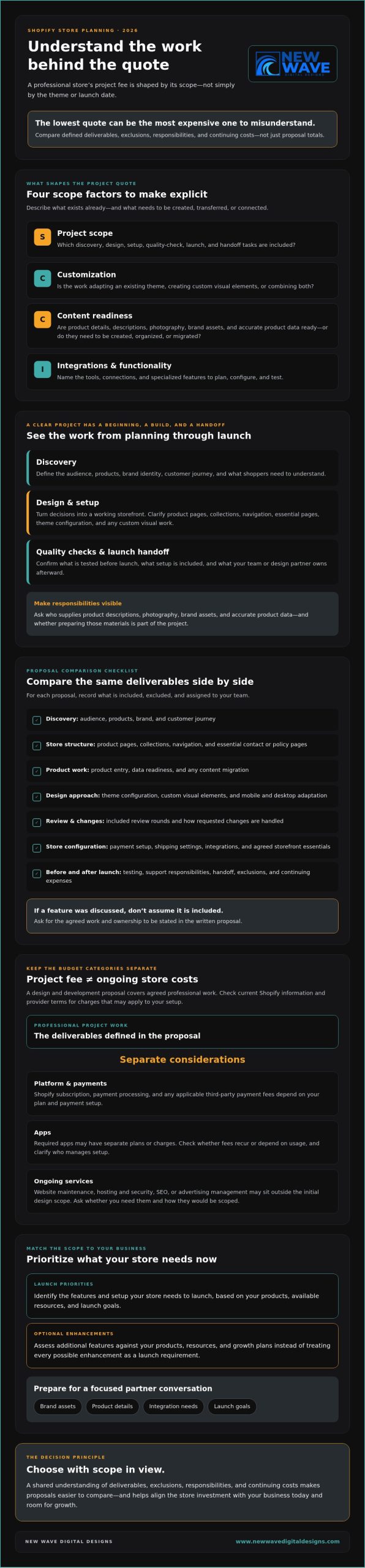
The lowest Shopify quote can be the most expensive one to misunderstand. The cost of a professional Shopify store 2026 depends on more than a template or launch date. When proposals cover different design work, setup tasks, and launch support, comparing totals alone can hide important gaps.

It’s reasonable to want a clear picture of what your investment includes and what may sit outside the project fee. Shopify subscription charges, payment-processing fees, apps, and ongoing maintenance or marketing are separate considerations. Ask what applies to your store rather than assuming these costs are bundled together.

This guide explains the work that can shape a professional Shopify proposal, from brand-led design and store setup to the tasks to confirm before launch. You’ll also find a checklist for comparing deliverables and questions to ask about continuing costs. With a shared understanding of scope, you can choose a design partner and store investment that fit your business today and leave room for growth.

Key Takeaways

  • The cost of a professional Shopify store 2026 is shaped by project scope, customization, content readiness, and integrations, not simply by the theme selected.
  • Before comparing providers, clarify which discovery, design, setup, quality-check, and launch handoff tasks each proposal includes.
  • Use a written checklist to compare product setup, integrations, revisions, testing, and support responsibilities side by side.
  • Prioritize the features your store needs to launch, then assess optional enhancements against your products, resources, and growth plans.
  • Prepare brand assets, product details, integration needs, and launch goals to make conversations with potential design partners more focused.

What Shapes the Cost of a Professional Shopify Store in 2026?

A Shopify proposal reflects the work required to bring your store to life: project scope, customization, content readiness, and integrations. A store built around an adapted theme and prepared content calls for a different level of effort than one requiring a distinct brand-led experience, extensive product setup, or migration from another platform. The cost of a professional Shopify store 2026 is best understood through its defined deliverables, not a template label or headline quote.

Keep the project fee separate from the ongoing costs of operating the store. A design and development proposal covers agreed professional work. Shopify subscription and transaction-related charges, app fees, and optional continuing services belong in a separate part of your budget. Shopify’s Shopify ecosystem includes tools and third-party services, so check current Shopify information and provider terms for charges that may apply to your setup.

Which store requirements can change a project quote?

Theme adaptation uses an existing design foundation. A more customized storefront may require additional design and development to reflect your brand and customer needs. The quote may also depend on how many products need setup, whether descriptions and images are ready, and whether content or product information must be migrated. Requested integrations and specialized functionality can add planning, configuration, and testing work.

To make proposals easier to compare, describe the products, content, and store features you already have. Then identify what needs to be created, transferred, or connected.

Which expenses are separate from design and development?

Agency project fees are distinct from recurring platform and payment-related charges. Your Shopify subscription, payment processing, and any applicable third-party payment fees depend on your plan and payment setup. Apps may also have separate plans or charges, so review current terms before including a feature in your budget.

  • Platform and payments: Confirm current subscription and transaction-related charges with Shopify and your payment provider.
  • Apps: Check whether required apps have recurring or usage-based fees, and clarify who manages their setup.
  • Ongoing services: Website maintenance, hosting and security, SEO, and advertising management may be separate from the initial design scope. Ask whether you need them and how they would be scoped.

Before choosing a partner, request a written proposal that names included work, exclusions, and continuing expenses. That clarity helps you align the store’s design with your business goals and plan for costs after launch.

What Should a Professional Shopify Store Project Include?

A clear project has a beginning, a build, and a considered handoff. Discovery defines the audience, products, brand identity, and customer journey. Design and setup turn those decisions into a working storefront, while quality checks help catch issues before launch. The proposal should describe each stage and state what your team and the design partner are responsible for.

Scope should also make the content work tangible. Ask which product pages, collections, navigation menus, and essential pages, such as contact or policy information, are included. Confirm who provides product descriptions, photography, brand assets, and accurate product data. If those materials need to be created or organized, clarify whether that work is part of the project or remains with your team.

How do planning and design become a usable storefront?

Discovery should connect your brand to practical shopping decisions: what customers need to understand, how they’ll find products, and what steps lead them toward checkout. Ask how the design will adapt across mobile and desktop screens, and how navigation and collections will help shoppers move through the catalog.

Get the design approach in writing. Does the scope involve configuring a theme, creating custom visual elements, or both? How many review rounds are included, and how are requested changes handled? For general context on platform plans, review Shopify’s 2026 pricing plans and keep plan details distinct from the design partner’s deliverables. You can also explore the related topic Shopify website design when considering what you want from a design project.

What should be clarified before launch?

Configuration can involve important decisions, so ask explicitly whether the project includes product entry, payment setup, shipping settings, and other agreed storefront essentials. Don’t assume a feature is covered just because it came up in a conversation. The proposal should name each task, its owner, and any information you need to supply.

Testing and handoff deserve the same precision. Confirm who checks checkout, forms, mobile layouts, and key storefront interactions, and how issues are documented. Then ask what training or handoff materials you’ll receive, whether launch support is included, and what post-launch assistance would be scoped separately.

  • Discovery: Goals, audience, products, brand, and customer journey.
  • Design and setup: Theme or custom work, storefront structure, content responsibilities, and revisions.
  • Quality checks and handoff: Testing roles, launch tasks, training, and ongoing support boundaries.

A well-defined scope gives both sides a shared blueprint. Before a Shopify website design discussion, gather your brand assets, product information, and launch priorities. Explore Shopify website design and note which project responsibilities you want to discuss.

How to Compare Shopify Store Design Proposals Fairly

A headline quote tells you little unless you know what work sits behind it. To compare the cost of a professional Shopify store 2026 fairly, place each written proposal beside the same checklist. One provider may include product entry and testing, while another may leave those tasks to you. That difference matters as much as the quoted fee.

Ask each provider to document assumptions, exclusions, dependencies, and how changes are handled. If your team must supply product descriptions or brand assets, establish when they’re due and what happens if they aren’t ready. A clear scope turns proposals into comparable plans rather than competing headline figures.

Compare Questions to ask Clarify in writing
Scope Which design, development, configuration, and launch tasks are included? Deliverables, exclusions, and owner for each task
Customization Is the work theme configuration, custom visual design, or a mix? What is being tailored to your brand and customer needs
Product setup Who adds products, images, descriptions, and collection details? Product information required and setup responsibilities
Integrations Which apps or third-party services are being connected? Setup limits and any separate provider or app charges
Revisions How many review rounds are planned? How extra feedback or new requests affect scope
Testing Who checks checkout, forms, mobile layouts, and key interactions? Testing responsibilities and issue-resolution process
Support What launch or post-launch help is included? Duration, boundaries, and separately scoped assistance

Which questions reveal what a Shopify proposal really covers?

Ask providers to walk through design, development, store configuration, quality assurance, and launch, naming the deliverable for each stage. Confirm the planned review rounds and how a request outside the agreed scope is assessed and approved. Also ask which Shopify, app, payment, and third-party expenses remain your responsibility. For broader business context, Forbes offers guidance on developing a strong e-commerce strategy, which can help you connect project decisions to commercial priorities.

How can you assess fit beyond the quoted scope?

Cost of a Professional Shopify Store in 2026: What Shapes Your Quote?

How to Match Shopify Store Scope to Your Business Priorities

A strong project scope reflects what your store needs to do at launch, not every feature you might want eventually. Start with your products, customer journey, and available resources. A focused scope can give essential tasks the attention they need while keeping future enhancements visible without making them launch dependencies.

Product complexity can guide that decision. A small catalog with consistent options may need a different setup approach from products with many variants, detailed specifications, or distinct collection structures. Content readiness matters too. If product data, descriptions, and brand assets are prepared, the project can focus more directly on building the storefront. If they’re still being developed, clarify who will prepare them and how that affects responsibilities.

Which requirements belong in the first launch?

Prioritize the essentials that let customers understand your offer and complete a purchase: accurate product information, intuitive navigation, consistent brand presentation, and a functional checkout journey. Then identify integrations that support real operational needs, such as a tool your business already relies on. Don’t add apps or features without a clear purpose and an owner responsible for managing them.

Separate the plan into two lists: launch requirements and later enhancements. A new content feature, expanded automation, or additional customization may be valuable, but it doesn’t necessarily need to delay a usable first release. This distinction helps partners scope the work around your priorities and makes the cost of a professional Shopify store 2026 easier to assess against what the business needs now.

How should you plan for ongoing store care?

Decide who will update storefront content, manage technical changes, and oversee security after launch. These responsibilities may sit with your team or be discussed as separate ongoing services. Keep them distinct from one-time design and development work, and clarify what support you may need as the store evolves.

If you’re considering outside help, review the scope of Website Maintenance Services and confirm what the offering covers rather than assuming it’s included in a store project. Small businesses needing flexible assistance can also look to providers like SaaSy Systems & Designs for website design, automation, and ongoing tech support. Marketing needs such as SEO or advertising management should also be discussed separately from the initial build.

Before requesting a proposal, note your launch-critical features, product and content readiness, required integrations, and available internal resources. New Wave Digital Designs offers custom Shopify website design, and a conversation about your requirements can help clarify the scope to consider. Discuss your Shopify store requirements.

Choosing a Professional Shopify Store Partner and Next Steps

The right partner helps translate business goals into a clear store plan, with responsibilities and continuing needs defined before work begins. A proposal should make it easy to see what the design partner will deliver, what your team must provide, and which services or platform expenses sit outside the project. That clarity matters more than choosing a quote based on its headline alone.

Before requesting proposals, assemble a concise project brief. Include what you sell, what customers need to do in your store, and what resources your team can bring to the work. The more clearly you describe the desired customer experience and launch priorities, the easier it is to discuss a suitable scope instead of defaulting to features you may not need.

What information helps a provider prepare a useful proposal?

Gather a product and content inventory, brand materials such as logos and visual guidelines, and details of any existing store or website. List the integrations your operations rely on, practical constraints, and the customer journey you want the store to support. Also identify who will approve design decisions and who can provide product data, copy, and other materials. These details help surface dependencies early.

What should happen before you approve the project?

Review the proposal together before committing. Confirm the deliverables, exclusions, milestones, client responsibilities, and process for handling changes. Make sure both sides understand what must be ready at each stage and how decisions or feedback will be shared. If a point is vague, ask for it to be clarified in writing.

Then separate project work from ongoing costs. Shopify subscription and transaction-related charges, as well as fees for third-party apps or payment services, should be checked against current provider information. If you may need website maintenance, hosting and security, SEO, or advertising management, discuss those as distinct services rather than assuming they’re included in the initial Shopify design scope.

New Wave Digital Designs provides custom Shopify website design, with related services available to discuss according to your needs. A tailored conversation can connect your goals, brand assets, products, and integration requirements to a clearly defined project scope. If you’re weighing the cost of a professional Shopify store 2026, bring your priorities and questions to the discussion.

Discuss your Shopify store project with New Wave Digital Designs.

Shape a Shopify Investment Around Your Next Chapter

The cost of a professional Shopify store 2026 is shaped by the work your business actually needs, from storefront design and product setup to integrations and launch responsibilities. Compare proposals by written deliverables, exclusions, and who owns each task, not by the headline quote alone. Keep ongoing platform, app, maintenance, and marketing expenses distinct from the initial project scope.

A clear brief makes the next conversation more useful. Gather your product details, brand assets, integration needs, and launch goals, then outline what’s essential now and what can evolve later. The right scope should reflect your business priorities and leave room for thoughtful growth.

New Wave Digital Designs offers custom website design for Shopify, WordPress, and Squarespace. Related services, including maintenance, hosting and security, SEO, paid search, and graphic design, can be discussed separately according to your needs. Discuss your Shopify store project with New Wave Digital Designs and take the next step with a clearer vision for your store.

Frequently Asked Questions

How much does a professional Shopify store cost in 2026?

The cost of a professional Shopify store 2026 depends on the agreed project scope, customization, content readiness, product setup, integrations, and launch support. Shopify subscription charges, payment-related fees, and third-party app expenses may be separate from design services. Since requirements and platform terms vary, request a written proposal that details deliverables and exclusions, then verify current Shopify and app charges directly before setting your budget.

What affects the cost of hiring a Shopify designer?

The amount of work required is a central factor. Custom design, product and content setup, integrations, migration, revisions, testing, and launch assistance can all shape a project. Prepared brand assets and accurate product information may also affect the work involved. Ask each provider to list deliverables, assumptions, exclusions, and your team’s responsibilities. Comparing those details side by side gives you a clearer basis for evaluating proposals than comparing headline quotes alone.

Does a professional Shopify store quote include Shopify fees?

Not necessarily. A design proposal may cover professional design and development, while Shopify subscription charges, payment-related fees, and third-party app expenses are paid separately. Ask the provider to identify what its proposal covers and which costs you’ll pay to Shopify or other vendors. Then verify current plan, payment, and app terms with the relevant providers, since charges and options can change. Don’t assume a platform expense is included unless the proposal explicitly says so.

Are custom Shopify stores more expensive than theme-based stores?

Not automatically. The labels alone don’t explain the work involved. A theme-based project might configure an existing design, while a more customized project could include visual changes and development tailored to your brand and customer needs. Ask providers to describe the requested features, customization, revision process, and support included in each proposal. Comparing these deliverables helps you judge whether the proposed scope suits your needs without relying on broad terms like “custom” or “theme-based.”

What should be included in a professional Shopify store proposal?

A useful proposal defines the project from planning through handoff. Look for details about design, store configuration, product and content responsibilities, requested integrations, testing, launch tasks, and handoff materials. It should also state exclusions, dependencies, planned revision rounds, and how additional requests are handled. Ask whether continuing maintenance or marketing is included or would be scoped separately. Written clarity helps you compare providers and understand what your team needs to prepare.

Are there ongoing costs after a Shopify store launches?

There may be recurring Shopify subscription charges, payment-related fees, third-party app expenses, and separately arranged services such as maintenance or marketing. Which apply depends on your store setup and the providers you choose. Keep these expenses distinct from one-time design and development work when planning your budget. Check current terms directly with Shopify, payment providers, and app vendors, and ask any design partner to clarify which ongoing services, if any, are included in its proposal.

Is hiring a professional Shopify designer worth it for a small business?

It depends on your goals, available time, internal skills, and the store experience you want to create. A professional designer can help shape a storefront around your brand and business requirements, while you remain responsible for tasks assigned to your team. Before deciding, compare the written deliverables and responsibilities with the work you can confidently manage yourself. Consider whether the proposed scope addresses your priorities and clarify any continuing support separately.