Professional Shopify Setup Services: A 2026 Guide to a Launch-Ready Store

A polished Shopify storefront can still be unready for its first order. Product pages may look complete while payment, shipping, inventory, or checkout workflows remain untested. That’s why professional shopify setup services should be judged by more than appearance. The goal is a store that’s ready to serve customers and manageable for the business behind it.

If you’re unsure what setup should include, who owns each task, or how to distinguish expertise from vague promises, you’re asking the right questions. A thoughtful launch takes more than a theme and a collection of products. It calls for clear decisions, careful configuration, and practical checks before customers arrive.

This guide explains what a well-prepared Shopify store may need, how to compare providers by their deliverables, ownership terms, and quality checks, and what to prepare before launch. You’ll also learn how collaborative design can align your store’s structure with your business and its customers, creating a foundation you can manage and grow.

Key Takeaways

  • Learn how setup, custom design, migration, and ongoing maintenance differ so you can define the help your store actually needs.
  • Use the customer journey, from product discovery to order confirmation, to identify where store content and settings need to work together.
  • Evaluate professional shopify setup services by their documented scope, testing approach, communication, and clear division of responsibilities.
  • Prepare for launch with a practical sequence for confirming content, reviewing settings, testing purchases, and checking the mobile experience.
  • Consider Shopify website design alongside separate ongoing needs such as maintenance, hosting, security, and SEO.

What professional Shopify setup services cover before your store goes live

A Shopify store is more than a storefront assembled from pages and products. Professional shopify setup services typically prepare the store’s structure, operational settings, customer journey, and pre-launch checks. The exact work depends on your business, so a useful proposal should explain what’s included, what’s optional, and what remains your responsibility.

In brief: store configuration organizes how a Shopify store operates; a finished, tested customer experience confirms that shoppers can move through it as intended. That distinction matters. Settings can be in place while the store still needs content, design work, or hands-on testing before it’s ready for customers. For neutral background on the platform and its features, see this overview of Shopify.

Which setup tasks belong in the project scope?

A well-defined project starts with discovery: the business’s goals, products, audience, and required functionality. Those decisions guide practical planning, including how shoppers find products, how product information is organized, and how the path to checkout should work. Essential store settings may also be reviewed or configured, depending on the agreed scope and current platform options.

Ask the provider to specify whether the project includes integrations, content creation, product data entry, and post-launch support. These tasks aren’t automatic parts of every setup engagement. Get responsibilities in writing, including what your team must supply, what the provider will configure, and which checks will be completed before launch.

How setup differs from Shopify design and development

Configuration shapes the store’s operating framework. Design shapes its visual presentation, while theme customization adapts a theme’s appearance or behavior to suit the brand. Custom development can involve more specialized functionality, so it may need separate planning, estimates, and specialist work. Migration is another distinct scope: it involves moving store content or data from an existing platform, rather than simply configuring a new storefront.

Ongoing maintenance begins after launch and should be discussed separately from initial setup. New Wave Digital Designs offers custom Shopify website design, but confirm the specific configuration tasks included in the project scope. For a closer look at the visual and strategic side of the work, explore a Shopify website design guide.

How a professional Shopify setup turns store requirements into working customer journeys

A store’s structure only works when each step makes sense to the person shopping. Picture a customer arriving on a collection page, narrowing down options, opening a product page, adding an item to the cart, completing checkout, and receiving an order confirmation. Professional shopify setup services should connect those moments, rather than treat each page or setting as an isolated task.

A launch-ready store connects and tests the customer-facing steps from product discovery through checkout and order confirmation. Use this journey to clarify what shoppers need to see, understand, and do at each stage. A clear value proposition and a suitable platform are also part of the larger picture; Forbes offers a useful overview of comprehensive e-commerce strategy.

How product catalog and navigation choices shape shopping

Product titles, descriptions, images, and variants should help customers identify an item and choose the right option. Collections and menu labels then create a logical route to those products. For example, if a shop groups unrelated items under a broad label customers don’t recognize, shoppers may have to browse several pages to find what they want. Organizing products around familiar categories or shopping needs can make discovery more intuitive.

Agree on who supplies product details and images, who reviews them for accuracy, and who maintains the catalog after launch. A provider may organize supplied content, but don’t assume content creation or entry for every product is included unless the written scope says so.

How payments, shipping, taxes, and policies affect checkout

Reaching checkout is not the finish line. Customers need clear information and working settings that reflect the store’s business model and markets. Confirm which areas are included in setup, and who is responsible for supplying and approving the details behind them:

  • Payments: Which payment methods are intended, and do the selected settings support the store’s needs?
  • Shipping: Do delivery options and charges match the business’s fulfillment approach?
  • Taxes: Have the relevant settings been reviewed for the markets where the business sells?
  • Policies: Are customer-facing policies available and consistent with the business’s practices?

Payment options, tax settings, and third-party integrations can change, so verify current Shopify capabilities and integration requirements before configuration. Store owners should also confirm their current legal and tax obligations with qualified professionals. A provider’s setup work is not legal or tax advice.

A useful scope discussion follows a real shopping journey and asks where each piece of content, setting, or approval comes from. If you’re shaping that journey with a design partner, you can discuss your Shopify store requirements with New Wave Digital Designs.

How to compare professional Shopify setup services without buying more than you need

The right provider isn’t the one promising the longest list of features. It’s the one who can connect specific work to your business needs, explain how decisions will be made, and show how completion will be checked. Professional shopify setup services are valuable when they resolve defined gaps, not simply because extra services are available.

Compare proposals by scope, business fit, communication, testing, documentation, and ownership. A Beginner’s Guide to E-Commerce can help clarify the fundamentals, but a provider’s proposal should explain how the work applies to your store. For visual direction and tailored storefront considerations, see this custom Shopify store design guide.

Area Clearly scoped work Optional or separately scoped Owner responsibility to confirm
Store setup Agreed configuration tasks and documented completion checks Additional functionality or custom development Provide decisions, access, and approvals
Content and products Specific product or content tasks listed in the proposal Photography, copywriting, or extensive data entry Supply and approve accurate business information
Testing and handoff Named checks and handoff documentation Ongoing support or maintenance Retain access to accounts and business assets

Which questions reveal a provider’s process and project boundaries?

Ask how discovery, approvals, revisions, and project communication will work. Find out which tasks depend on your team supplying product details, photography, policies, or account access. Request an example of the documentation or acceptance checks you’ll receive, and ask how the provider records work that falls outside the agreed scope. Examples can help you assess the process, but another store’s experience doesn’t predict yours.

Who owns the Shopify account, content, and connected services?

Confirm that your business will retain appropriate access to its Shopify account and connected assets. Clarify who controls domain access, payment accounts, analytics, and third-party subscriptions, and how access will be handed over when the project ends. Ask which external subscription charges or ongoing service fees are separate from project work. Clear ownership supports a clean handoff and helps you manage the store after launch.

Choose a scope that fits your current requirements, with optional work clearly identified rather than bundled in by default. A strong proposal makes responsibilities visible before the project begins, so you can invest in what the store needs and retain control of what your business owns.

Professional Shopify Setup Services: A 2026 Guide to a Launch-Ready Store

What to prepare and test before launching a professionally set-up Shopify store

A careful launch review turns project decisions into a practical final check. Professional shopify setup services may include some testing, but the business still needs to supply accurate information, make key decisions, and approve the result. Agree on who handles each step before launch so important checks don’t fall between responsibilities.

What store owners should gather before setup begins

Prepare product details, brand assets, business information, shipping requirements, and customer-facing policies. Identify who can approve content and settings, which integrations the store requires, and whether an existing website or data needs to be considered. Share access through an agreed, appropriate method, and don’t send sensitive credentials through insecure channels.

Which checks help catch issues before customers encounter them?

Work through a numbered sequence with the provider. Mark each item complete only after the appropriate person has reviewed or tested it:

  1. Confirm content: Review product details, images, variants, collections, navigation, contact information, and policies. The business should supply and approve accurate content; clarify whether the provider will enter or review it.
  2. Review settings: Check the agreed checkout, payment, shipping, tax, and integration settings. The provider may check configuration against the requirements you’ve supplied, while the business confirms its decisions and obligations.
  3. Test a purchase: Use representative products and purchase scenarios. Check variant selection, intended discount logic, checkout steps, confirmation messages, and the handoff to the fulfillment workflow. Agree in advance who runs the tests and how test orders will be handled.
  4. Inspect mobile and desktop: Follow the shopping path on both screen sizes. Review navigation, links, product information, contact paths, and checkout for errors or confusing details.
  5. Approve the launch: Record completed checks, unresolved issues, owners, and next steps in a shared checklist. Confirm who receives and responds to issue reports after launch.

A storefront isn’t launch-ready just because it’s published; it’s ready when the agreed customer-facing checks have been completed and approved. Testing representative products and purchase paths helps reveal gaps that a visual review alone may miss. The provider can perform agreed technical checks, but only the business can confirm that its content, policies, fulfillment process, and decisions reflect how it operates.

If you’re preparing a store and want to discuss Shopify website design support, talk with New Wave Digital Designs about your store requirements.

How New Wave Digital Designs can support your Shopify setup beyond launch

A clear launch plan can also reveal where you may need support after the store goes live. New Wave Digital Designs offers custom Shopify website design, with a collaborative process that can align the store’s structure and presentation with your business and its customers. Confirm and document the specific configuration tasks, testing, and handoff responsibilities for each project. Professional shopify setup services are most useful when their scope reflects your requirements, rather than an assumed package of features.

What a collaborative Shopify project conversation should establish

Start with the essentials: what you sell, who you serve, what matters most at launch, and what the store needs to do for customers. Then discuss required functionality, available product content and brand assets, account access, and any existing site or data that may affect the work. Be clear about what your team can provide and where you need help.

A written scope can turn that conversation into a shared plan. It should identify what’s included, what depends on your input or approval, and which items remain optional or require separate discussion. This gives both sides a clearer basis for planning and reduces the chance that setup tasks are mistaken for design, custom development, or ongoing support.

How to plan for store growth after the initial setup

Launching the store is one milestone, not a commitment to a particular ongoing arrangement. Website maintenance and security are continuing considerations, while hosting needs should be discussed in relation to your broader website setup. Organic SEO is a separate effort that may help strengthen discoverability over time, but it should be scoped independently from initial store setup. New Wave Digital Designs offers website maintenance, hosting and security, and organic SEO; whether these fit your needs depends on your plans and the support you’re seeking.

Before deciding, clarify what you can manage in-house, what you’d prefer to delegate, and how your needs may change as the store develops. A thoughtful conversation can connect immediate launch priorities with longer-term plans without treating every service as an automatic part of the project.

To discuss your products, customers, current store status, project responsibilities, and the support you need, discuss your Shopify project with New Wave Digital Designs.

Build a Shopify launch you can grow from

A confident launch depends on more than a polished storefront. Define the setup scope in writing, connect the key steps of the customer journey, and test the experience before customers arrive. When comparing professional shopify setup services, look for clear deliverables, responsibilities, ownership, and checks so you can choose support that fits your store rather than paying for work you don’t need.

New Wave Digital Designs provides custom Shopify website design. Website maintenance, hosting, security, and organic SEO are also available as separate areas to discuss and scope based on your needs. The aim is a considered foundation that reflects your business and gives you a clearer path forward.

Ready to explore what your store needs? Discuss your Shopify setup goals with New Wave Digital Designs, including your current store status, priorities, and the responsibilities you’d like support with. Every strong store begins with a clear plan, and yours can start with a focused conversation.

Frequently Asked Questions

What do professional Shopify setup services include?

Professional Shopify setup services may cover store structure, agreed settings, product organization, customer journey planning, and pre-launch checks. The exact scope varies, so ask for a written list of deliverables and responsibilities. Confirm whether content entry, integrations, migration, custom design, testing, or handoff documentation is included or planned separately. A clear scope helps you distinguish a configured store from a complete, tested customer experience.

How long does it take to set up a Shopify store professionally?

There’s no single timeline that applies to every Shopify project. The schedule depends on the agreed scope, store complexity, content readiness, required functionality, and how quickly decisions and approvals are provided. A project involving supplied product information and straightforward configuration differs from one needing custom design, data migration, or additional development. Ask the provider for a proposed schedule, milestones, client dependencies, and how scope changes could affect timing.

Can I hire someone to set up Shopify and manage the store afterward?

Yes, you can arrange setup and ongoing support, but clarify what “manage” means before hiring. Store maintenance or technical support isn’t necessarily the same as handling products, orders, fulfillment, customer service, or day-to-day business decisions. Ask which ongoing tasks are available, how they’re scoped, and who remains responsible for operations. New Wave Digital Designs offers website maintenance and website support; confirm whether those services fit your specific Shopify needs.

Do I need a professional Shopify setup service if I already have a theme?

Not necessarily, but having a theme doesn’t mean the store is fully configured or launch-ready. You may still need help organizing products and navigation, reviewing settings, aligning the customer journey, or testing checkout and order confirmations. First identify what’s already complete and where you need expertise. If the theme meets your visual needs, a clearly scoped setup project may be more suitable than paying for additional design work.

What should I provide before a Shopify setup project begins?

Prepare accurate product details, images and brand assets, business information, shipping requirements, and customer-facing policies. Identify who can approve decisions, what functionality or integrations you need, and whether an existing site or data should be considered. Ask how account access will be shared securely. Also agree on who supplies, enters, reviews, and maintains content, so missing materials or unclear responsibilities don’t impede progress.

Can a professional Shopify setup help improve sales?

A well-planned setup can make it easier for customers to find products, understand their options, and complete a purchase, but it can’t guarantee sales. Results also depend on factors such as the offer, audience, pricing, traffic, and fulfillment experience. Focus on measurable launch-readiness checks, such as working purchase paths, clear product information, and accurate settings. Treat sales performance as something to monitor and improve over time, not a promised setup outcome.

What happens after a Shopify store launches?

After launch, monitor the store’s customer journey and resolve issues through an agreed reporting process. The business still manages operational decisions, including product information and fulfillment, unless other responsibilities are explicitly arranged. Ongoing website maintenance, hosting, security, and organic SEO are separate service areas to discuss and scope. New Wave Digital Designs offers these services, but they aren’t automatically included in Shopify website design or an initial setup project.

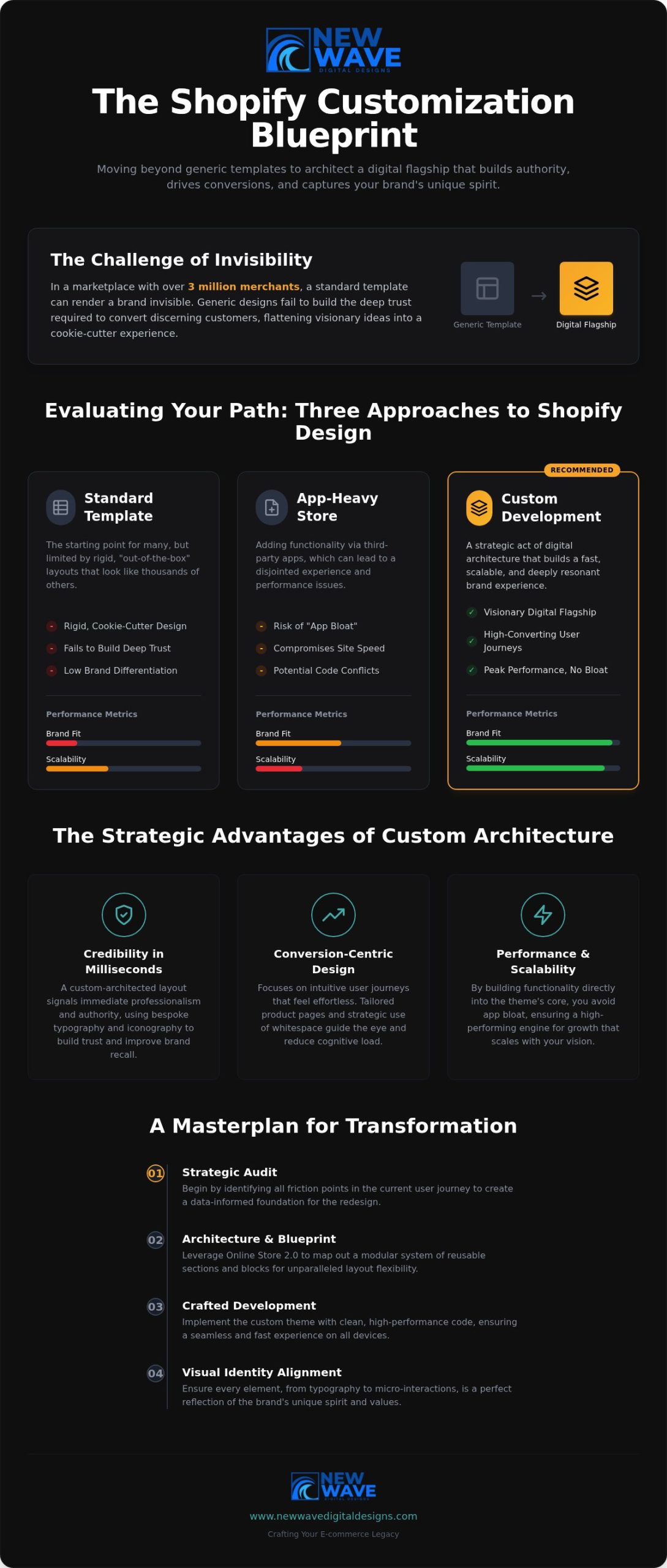
Shopify Theme Customization: A Strategic Guide to Brand Evolution (2026)

Your digital storefront isn’t a static billboard; it’s a living, breathing extension of your brand’s unique spirit. In an era where over three million merchants compete for a fraction of consumer focus, a generic template is often a silent admission of invisibility. You’ve likely felt the limitations of the standard editor, or perhaps you’ve hesitated to pursue Shopify theme customization for fear of compromising site speed with a heavy layer of third-party apps. It’s frustrating to watch your visionary ideas get flattened by the rigid walls of a cookie-cutter design that fails to build the deep trust your business deserves.

True customization is an act of digital architecture that balances artistic inspiration, technical precision, and strategic foresight. This guide promises to transform your perspective, moving you from the realm of mere decoration into a world of purposeful craftsmanship. We’ll explore how to leverage Online Store 2.0, implement immersive 3D models, and utilize Shopify Functions to create a high-converting experience. By the end of this journey, you’ll understand how to build a storefront that’s fast, scalable, and deeply resonant with every visitor who enters your digital world.

Key Takeaways

  • Elevate your storefront from a standard template to a visionary digital flagship that captures your brand’s unique spirit and builds authority.
  • Harness the modular power of Online Store 2.0 architecture to achieve unparalleled layout flexibility through the strategic use of sections and blocks.
  • Avoid the common “app bloat” trap by prioritizing high-quality Shopify theme customization, ensuring a high-converting experience without sacrificing site performance.
  • Navigate a methodical roadmap for transformation, beginning with a strategic audit to identify friction points and ending with a seamless visual identity alignment.
  • Learn how a boutique partnership approach transforms digital development into a form of craftsmanship that supports your long-term evolution.

Beyond the Template: Why Strategic Shopify Customization Matters

A standard template is a starting point, not a destination. For a brand to evolve, it must transcend the boundaries of “out-of-the-box” design. Choosing Shopify theme customization means you’re no longer settling for a generic storefront that looks like a thousand others. You’re building a digital flagship. This distinction is vital. A visionary store captures the essence of your craftsmanship, turning a simple transaction into a brand experience. It’s a strategic investment in your business legacy. By moving beyond the default, you signal to your audience that your brand is permanent, authoritative, and deeply invested in quality. Within the vast Shopify ecosystem, those who treat their site as an architectural feat are the ones who command lasting loyalty. It’s about capturing the true spirit of your business through meticulous attention to detail.

The Psychology of First Impressions

Credibility is earned in milliseconds. When a visitor lands on a custom-architected layout, they perceive immediate professionalism. Standard templates often feel hollow because they lack the specific visual vocabulary of your brand. Strategic design uses visual storytelling to communicate values without a single word of copy. It’s about the deliberate choice of unique typography that carries the right weight and bespoke iconography that mirrors your product’s refinement. These elements improve brand recall. They ensure that when a customer leaves, the memory of your store remains distinct and polished. This emotional resonance is the most effective tool for reducing bounce rates. It builds a bridge of trust that generic designs simply can’t support.

Conversion-Centric Customization

Design must serve a purpose. Great Shopify theme customization focuses on intuitive user journeys that feel effortless. Every click should feel like a natural progression toward the checkout. Custom product pages allow you to address specific buyer objections through tailored layouts that highlight what truly matters to your audience. Whether it’s unique sizing guides or immersive storytelling blocks, these details matter. It’s not just about adding features. It’s about the strategic use of whitespace and architectural balance. These elements give your products room to breathe. They guide the eye, reduce cognitive load, and create a sense of premium calm. This methodical approach ensures your storefront isn’t just beautiful; it’s a high-performing engine for growth that scales alongside your vision.

The Architecture of Customization: Navigating the 2026 Shopify Ecosystem

The modern Shopify ecosystem is defined by a modular philosophy that empowers merchants to think like architects rather than just shopkeepers. In 2026, Online Store 2.0 remains the foundational standard, offering a “sections everywhere” architecture that dismantles the rigid barriers of legacy systems. This flexibility is now augmented by AI-driven personalization, which serves as a core component of Shopify theme customization. These intelligent tools allow for dynamic content adjustments based on user behavior, ensuring your storefront evolves in real-time to meet customer needs. Integrating these technical advancements requires a deep foundation in strategic digital commerce, where every design choice aligns with broader business KPIs and international scaling goals. It’s a marriage of logic, artistry, and foresight.

Mastering Sections and Blocks

Layout flexibility is achieved through the meticulous orchestration of sections and blocks. By creating reusable elements, you ensure a consistent brand experience across every page, from the homepage to custom landing zones. This “drag-and-drop” foundation is liberating for non-technical teams, but it requires a “Digital Architect” to build the initial framework correctly. We focus on mapping dynamic data to specific blocks, allowing for a personalized shopping experience that feels bespoke yet remains incredibly easy to manage. If you’re looking to build this level of technical scalability, our team provides professional Shopify design that balances administrative ease with visual excellence. This methodical approach prevents the clutter of “app bloat” by building functionality directly into the theme’s core.

Advanced Data with Metaobjects

Metaobjects represent the next frontier of data organization in 2026. They allow us to move beyond simple text fields to build complex, structured stories within your theme architecture. Imagine a “Brand Story” section that pulls from a centralized Metaobject, or “Expert Profiles” that link automatically to specific product categories across your entire site. These custom data structures do more than just organize content; they improve long-term SEO by creating a clear, logical hierarchy for search engines to crawl. We use these tools to create immersive Bento Grid layouts and interactive 3D models that engage the modern consumer. This strategic use of data ensures your site remains clean, fast, and ready for the next stage of your brand’s evolution. It’s about building a digital legacy that is both beautiful and technically sound.

Evaluating the Path: DIY Editor, App Integration, or Custom Development?

Deciding on the right path for your storefront is a fundamental strategic choice that influences your brand’s trajectory for years. It’s a crossroads where technical health meets visionary design. While the native Shopify editor serves as a functional starting point, ambitious brands quickly encounter its structural limits. You might feel pressured to bridge these gaps with a patchwork of third-party tools, but sophisticated Shopify theme customization demands a more cohesive, architectural mindset. Your development strategy has a direct impact on marketing strategy and how deeply customers trust your professional presence. It’s the difference between a fragile, superficial facade and a resilient digital flagship. For brands arriving from another platform, understanding this distinction is especially critical — a well-executed Squarespace to Shopify migration sets the architectural foundation that makes all future customization more powerful and sustainable.

The Risks of Over-Apping

The vast library of the Shopify App Store offers a seductive promise of instant functionality, but it often leads to the “app bloat” trap. Every third-party script you install adds weight to your site’s foundation, frequently degrading the mobile user experience and frustrating potential buyers. This isn’t just a matter of performance. It’s also a matter of security. Unmanaged integrations can open doors to vulnerabilities that put your customer data at risk. To maintain an elite level of site speed, you must prioritize lean, integrated solutions. Building features directly into your theme’s architecture ensures that your site remains fast, secure, and entirely under your control.

The Artisan’s Choice: Custom Liquid and CSS

Custom Liquid and CSS represent the artisan’s path to e-commerce excellence. This approach offers a level of design freedom and technical precision that standard settings simply cannot match. By choosing bespoke development, you’re investing in a storefront that is uniquely yours, unburdened by the generic constraints of popular templates. This isn’t just about aesthetics; it’s about future-proofing. Custom-coded solutions are more resilient to platform updates and don’t require the ongoing monthly costs of heavy app subscriptions. When you work with Shopify experts, you’re hiring digital architects to build a legacy. It’s a strategic shift from temporary fixes to a high-converting, visionary storefront that captures your brand’s true spirit.

Shopify Theme Customization: A Strategic Guide to Brand Evolution (2026)

The Masterplan: A Step-by-Step Roadmap for Theme Transformation

Evolution is never accidental; it’s meticulously engineered. To move your brand from a standard template to a visionary digital flagship, you need a process that respects both the artistry of design and the cold logic of conversion. This roadmap isn’t a checklist but a strategic journey. It begins with deep introspection, moves through technical craftsmanship, and concludes with a rigorous pursuit of perfection. By treating Shopify theme customization as a multi-phase evolution, you ensure that every pixel serves your business legacy. This methodical approach builds trust, authority, and long-term scalability.

Conducting a Strategic Store Audit

Transformation starts with a clear understanding of your current friction points. We analyze heatmaps and user recordings to see exactly where customers hesitate or abandon their journey. This data-driven audit reveals design flaws that copy alone cannot fix. Before any code is written, we evaluate site speed and performance to establish a technical baseline. Finally, we define your “North Star” goals. This singular vision guides every subsequent choice, ensuring the final storefront design isn’t just a collection of features but a resonant brand statement. It’s about identifying what’s broken so we can build something unbreakable.

Executing the Visionary Build

The build phase is where abstract values become tangible digital assets. We prioritize a mobile-first design philosophy, recognizing that for the 2026 consumer, the smartphone is the primary window into your brand. Risk management is central to this stage; we utilize a staging environment for all development. This ensures your live store remains stable while we implement custom sections, blocks, and Liquid logic. Integrating custom Shopify store design with your overarching marketing strategy ensures that every visitor experience is consistent and high-converting. We test for responsiveness and performance with meticulous care, ensuring the final product is as fast as it is beautiful.

Your brand deserves a digital home that is as unique as your vision. If you are ready to move beyond the limitations of standard templates, our team can help you navigate a professional Shopify design journey that prioritizes your long-term growth and digital craftsmanship.

The New Wave Approach: Crafting Your E-commerce Legacy

At New Wave Digital Designs, we believe that an e-commerce platform should be more than a functional tool; it should be a digital sanctuary for your brand’s ambitions. We view every project as an architectural feat, requiring a delicate balance of structural integrity, aesthetic beauty, and emotional resonance. Unlike high-volume service factories that prioritize speed over substance, our boutique partnership model ensures that your business receives the meticulous attention it deserves. We don’t just apply superficial fixes. We build foundations that protect your creative and technical investment for the long term.

A Partnership Built on Trust

Our collaboration begins with a deep discovery process. We listen intently to the spirit of your business, understanding your history, your values, and your ultimate vision. This empathetic approach allows us to translate your brand’s essence into a high-performing digital reality. We believe that true Shopify theme customization must be holistic. This means we naturally integrate organic SEO, graphic design, and digital marketing strategy into the very fabric of your theme. Our Shopify website design services are crafted to support sustainable growth, ensuring your storefront remains a powerful asset as your market influence expands. It’s a journey of mutual investment and shared success.

Continuous Evolution and Maintenance

The digital landscape is in a state of constant flux, and your storefront must evolve to stay relevant. Launching your site is simply the first milestone in a much larger narrative of growth. We provide ongoing website maintenance and security hardening to ensure your technical foundation remains impenetrable. Our team helps you pivot, scale, and refine your experience as consumer behaviors shift. We offer a steady hand through the complexities of professional growth:

  • Regular technical updates to leverage the latest platform innovations.
  • Strategic security audits that protect your customer data and brand reputation.
  • Performance optimization that keeps your visionary storefront fast and responsive.

Your business is a legacy in the making. It deserves a partner that values depth, strategy, and meticulous craftsmanship over quick fixes. Begin your brand’s digital transformation with us today.

Architecting Your Digital Future

Your storefront is the most visible manifestation of your brand’s spirit. It’s time to move beyond the limitations of generic templates. By treating Shopify theme customization as a strategic architectural feat, you create a digital sanctuary that builds trust, drives conversion, and secures your legacy. We’ve navigated the technical landscape of 2026, from the modular power of Online Store 2.0 to the precision of custom Liquid code, all with one goal: your brand’s evolution.

New Wave Digital Designs offers a boutique agency approach that prioritizes personal care and meticulous detail. With deep expertise across Shopify, WordPress, and Squarespace, we focus on the marriage of emotional resonance and technical performance. We’re here to be your digital architect, translating your visionary ideas into a high-converting reality that scales with your ambition.

Elevate your brand with visionary Shopify customization

The path toward an extraordinary digital presence is clear. Let’s build something that truly reflects the artistry of your business.

Frequently Asked Questions

Can I customize my Shopify theme without knowing how to code?

Yes, the Online Store 2.0 architecture allows for significant changes through a drag-and-drop interface. You can adjust colors, fonts, and layout sections without touching the underlying Liquid code. However, deep strategic customization that captures a brand’s unique spirit often requires professional development. For high-growth stores, the standard editor’s limitations can eventually stifle the visionary design needed to stand out in a competitive national market.

Will customizing my theme prevent me from receiving future Shopify updates?

Standard customizations made through the theme editor don’t interfere with platform updates. If you modify core theme files directly with custom Liquid, those specific files may not auto-update when the theme developer releases a new version. We recommend using a staging environment and a methodical approach to ensure your technical foundation remains secure. Proper architectural planning allows you to enjoy bespoke features while maintaining the long-term health of your storefront.

How does theme customization affect my store’s loading speed?

Strategic Shopify theme customization actually improves loading speed by replacing bloated third-party apps with lean, native code. While adding heavy unoptimized images or excessive scripts can slow a site down, a digital architect focuses on performance-first development. By building functionality directly into the theme’s architecture, we reduce external requests. This ensures your high-converting storefront remains fast, responsive, and efficient for every visitor regardless of their device.

What is the difference between a theme setting and a custom Liquid change?

Theme settings are the built-in toggles and fields provided by the theme developer for basic adjustments like logo placement or primary colors. Custom Liquid changes involve writing bespoke code to create entirely new functionality or unique layout structures that don’t exist in the standard template. While settings are convenient for minor tweaks, Liquid development is the path to true digital craftsmanship. It allows for a level of brand-aligned visionary design that settings alone cannot achieve.

Should I use a page builder app or a custom-coded section?

Custom-coded sections are almost always superior for long-term growth and site performance. Page builder apps often inject heavy code and “app bloat” that can degrade your mobile user experience and slow down page loads. A custom-coded section is integrated directly into your theme’s core, offering a seamless administrative experience without the recurring monthly costs. This methodical approach protects your technical investment and ensures your storefront remains scalable as your business evolves.

How much does professional Shopify theme customization typically cost?

The investment for professional customization varies based on the complexity of your vision and the depth of the strategic audit required. Simple layout refinements represent a different tier of craftsmanship than a ground-up architectural build. We treat every project as a boutique partnership, focusing on the long-term ROI of a distinctive brand identity. Rather than providing a single number, we look at the specific technical and creative requirements needed to capture your brand’s unique spirit.

How do I ensure my custom theme is mobile-responsive?

We utilize a mobile-first design philosophy, ensuring that your storefront is architected for the smartphone experience from the very first line of code. This involves testing across multiple viewports and using flexible CSS grid systems to maintain architectural balance on any screen size. Meticulous QA testing in a staging environment allows us to identify and fix responsiveness issues before they impact your customers. A truly visionary design must feel effortless on every device.

What are Metaobjects and how do they help with customization?

Metaobjects are advanced data structures that allow you to manage complex content, such as brand stories or expert profiles, outside of standard product fields. They are a cornerstone of modern Shopify theme customization, enabling us to build structured, reusable data that search engines can easily crawl. By decoupling content from specific pages, Metaobjects offer unparalleled flexibility for scaling your store. They transform your site from a simple shop into a sophisticated, data-driven digital flagship.