
If you’re searching for local seo services, you likely want to understand what this work involves, which deliverables matter, and how to assess progress without relying on promises of instant rankings. A useful starting point is to look at how your business information, website, and measurement work together.
Local SEO is an ongoing process, not a quick fix. A clear strategy connects the information people see in search with a website that explains your services and helps visitors decide what to do next. Organic SEO can also work alongside thoughtful website design, maintenance, and paid search to create a more coordinated digital presence.
This practical framework from New Wave Digital Designs covers the core elements of local discoverability, signals that can reveal meaningful progress, and why visibility is about more than website visits. You’ll also learn how to connect organic SEO with broader business goals and choose practical next steps.
Key Takeaways for a Search Like “local seo services branchburg nj”
- Local SEO supports discovery by connecting accurate business information, relevant website content, and a sound digital foundation.
- Assess an SEO strategy by its clear priorities, useful reporting, and collaboration, not ranking guarantees.
- Use a flexible framework to review your current digital presence, prioritize work, measure results, and refine the approach.
- Match organic SEO with your business goals and internal capacity. Website design, maintenance, or paid search may complement the work.
What Local SEO Services Do for a Business Seeking Nearby Customers
Local SEO helps a business become easier to discover when people search for relevant products or services in a particular area. Unlike broader organic SEO, which can support visibility for searches from anywhere, local SEO focuses on searches with geographic intent. A query such as “local seo services branchburg nj” shows how a searcher may pair a service with a location to find relevant options.
Local SEO improves how a business is represented and discovered in search results for relevant, location-focused queries. It brings together signals from a business’s online presence and website, while supporting a useful experience for people deciding where to turn. For a neutral introduction to the discipline, see Local search engine optimization.
How local search visibility differs from general SEO
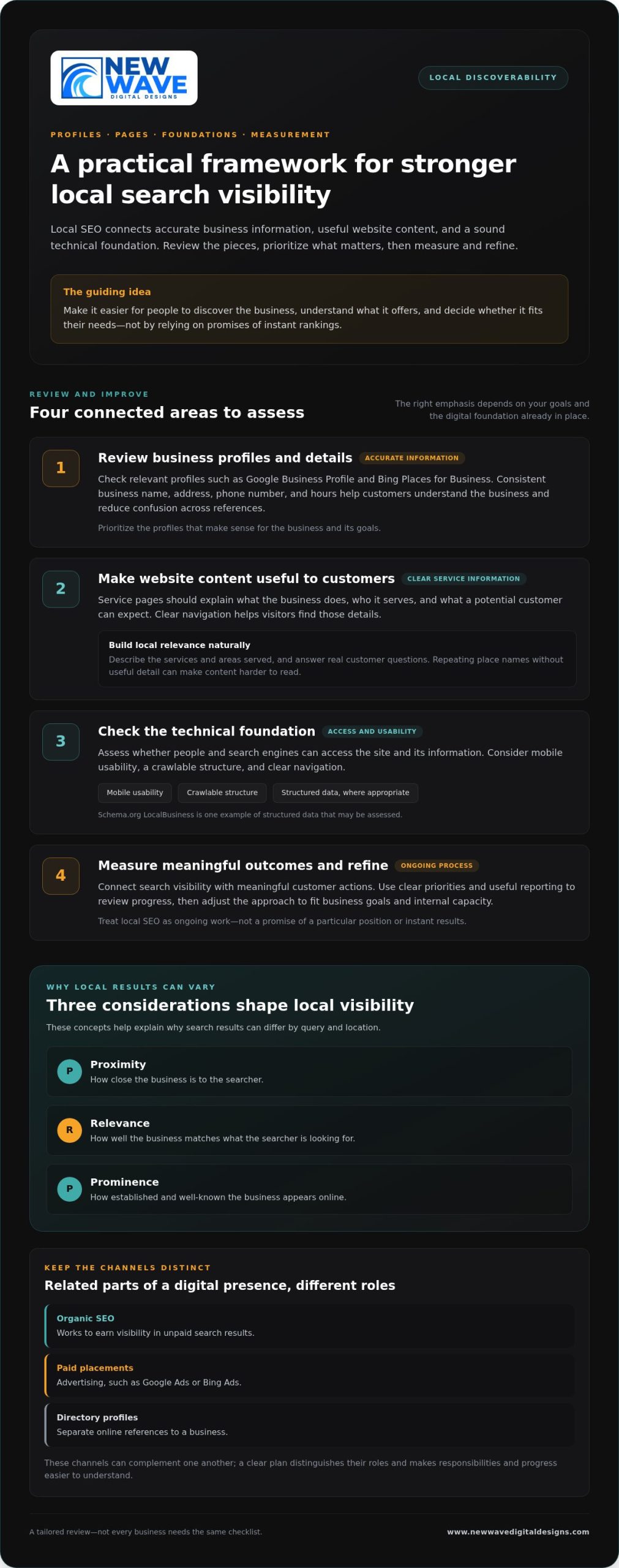
Local search can reflect three broad considerations: proximity to the searcher, relevance to the query, and prominence, or how established and well-known a business appears online. These concepts help explain why results can vary by search and location. Google Search and Google Business Profile are part of this ecosystem, alongside a business’s own website.
Compare “how does roof insulation work?” with “roof insulation company near me.” The first is largely informational; the second suggests someone is looking for a relevant business nearby. A query like “local seo services branchburg nj” also expresses local intent. A sound approach considers what the searcher wants instead of treating every query as a broad keyword to target.
Which businesses may benefit from local SEO
Service-area businesses, professional firms, and organizations that serve customers face to face may all have reason to consider local visibility. Someone might search for an accountant or a repair service nearby. In either case, accurate, helpful information makes it easier to assess whether a business fits the need.
Local SEO isn’t automatically the same priority for every organization. Consider how customers search, where the business serves them, and what the business wants its digital presence to accomplish. A business serving a broad market may emphasize general organic SEO, while one seeking nearby customers may benefit from a strategy shaped around local intent. The right balance depends on its goals and starting point.
Visibility isn’t determined by one profile or page alone. Relevance, local competition, website quality, and consistent attention can all influence discoverability over time. Treat organic SEO as an ongoing part of a considered digital presence, not a promise of a particular search position.
What Local SEO Services Include: Profiles, Pages, and Technical Foundations
A local SEO strategy is a set of priorities shaped around the business, not a one-size-fits-all checklist. It considers how clearly a business is represented online, whether its website answers customer questions, and whether the site is accessible to search engines and visitors. The right emphasis depends on business goals and the digital foundation already in place. Mailchimp’s overview, Why Local SEO Matters, offers additional context on local discoverability.
Organic SEO focuses on earning visibility in unpaid search results. Paid placements, such as Google Ads or Bing Ads, are advertising. Directory profiles are separate online references to a business. These channels can complement one another, but they serve different roles. A clear plan distinguishes them so responsibilities and progress are easier to understand.
Business profiles and consistent business information
Google Business Profile and Bing Places for Business are among the profiles people may encounter while searching. Accurate, complete information helps customers understand what a business does and how to reach it. Consistency across relevant profiles and directories can also reduce confusion when details such as the business name, address, phone number, or hours appear in multiple places. Prioritize the profiles that make sense for the business and its goals.
Website content, technical SEO, and local relevance
A website gives searchers more context than a brief profile can provide. Useful service pages explain what a business does, who it serves, and what a potential customer can expect. Clear navigation helps visitors find those details. Mobile usability and a crawlable structure help people and search engines access the site. Where appropriate, structured data such as schema.org LocalBusiness can also be assessed as part of the technical picture.
Build local relevance with meaningful information, not repeated place names. Explain the services offered and the areas served in natural language, and answer real customer questions. Repeating location phrases without adding useful detail can make content harder to read.
A coordinated review may consider:
- Business profile accuracy and consistency across relevant references
- Service pages that address customer needs and business goals
- Navigation, mobile usability, crawlability, and relevant technical foundations
- Measurement that connects search visibility with meaningful customer actions
These are areas to assess, not a checklist that every business needs to follow in the same way. Organic SEO can work alongside website design, ongoing maintenance, and paid search when they support shared business objectives. To explore how those capabilities can fit together, visit organic SEO and digital design.
How to Evaluate Local SEO Services Without Ranking Guarantees
A credible SEO conversation should make the work understandable. Look for a strategy that connects business goals with clear priorities, useful reporting, and ongoing collaboration rather than a promised position in search.
Measurable progress means seeing useful changes in visibility and customer behavior, not receiving a guarantee of a specific search position. Rankings can fluctuate as search results and competitors change, so a particular spot cannot be responsibly promised. Evaluate several indicators over time and ask whether they relate to the outcomes that matter to your business.
| Evaluation area | What to look for |
|---|---|
| Strategic clarity | Priorities explained in relation to your goals, audience, website condition, and competitive environment. |
| Deliverables | A clear description of the planned work, why it matters, and how it supports the strategy. |
| Reporting | Reporting that distinguishes search visibility and site activity from inquiries, conversions, and other business measures. |
| Collaboration | Open communication, clear explanations, and room to adjust priorities as your needs evolve. |
Questions that reveal whether a strategy is tailored
Ask how proposed priorities connect to your goals and customers. What does your current website make easy or difficult? Which services or audiences matter most? How might competition affect the plan? Clear answers should explain the reasoning behind the strategy, rather than rely on jargon or apply an identical checklist to every business.
New Wave Digital Designs provides organic SEO as a collaborative effort tied to business goals and a well-crafted digital presence. The focus is on what the work is intended to support, not on presenting rankings as a guaranteed outcome.
Reports that connect search activity to business goals
Different metrics answer different questions. Impressions indicate how often a page appears in search results; clicks show visits from those results. Engagement measures what visitors do on the site, while conversions track meaningful actions defined for the business, such as submitting an inquiry. Google Search Console can help assess search visibility and clicks, while Google Analytics 4 can help examine site activity and conversions.
Interpret these signals in context. A rise in impressions may indicate broader visibility, but it doesn’t by itself show that more qualified customers are getting in touch. Look for trends across reporting periods, relate them to the work completed, and compare them with business measures. A single ranking snapshot offers a narrow view; a consistent, well-explained report can reveal a more useful picture of progress.
How a Local SEO Strategy Develops From Audit to Ongoing Improvement
A useful organic SEO strategy develops in stages. First, understand the business and its current digital presence. Then decide which changes deserve attention, put them into practice, and review the resulting signals. This creates a shared framework for thoughtful decisions instead of a collection of disconnected tasks.
From discovery and audit to a prioritized plan
Start with context: business goals, audience needs, website structure, and current search visibility. An audit can reveal technical or content issues that make it harder for people to find useful information or for search engines to understand the site. Turn findings into a clear, practical order of work.
- 1. Discovery: Clarify business objectives, audiences, services, and the role organic search should play.
- 2. Audit: Review the existing site structure, content, technical foundations, and available visibility information.
- 3. Prioritization: Weigh potential actions by relevance to customer needs, effort, and contribution to business goals.
- 4. Implementation: Make agreed-upon improvements, which may include refining website content or addressing site issues.
- 5. Measurement: Review changes in search visibility, qualified visits, and meaningful conversions.
- 6. Refinement: Use what the data and business context reveal to adjust priorities and guide the next round of work.
This is a planning framework, not a fixed timeline or a promise of a particular result. The pace and emphasis depend on the website, available resources, and business priorities. Website updates and stronger content can support organic SEO when they help visitors understand services and find relevant information. Design and maintenance can also help when the site needs attention to support that experience.
Measurement, learning, and refinement
Review results over time to distinguish a brief fluctuation from a broader pattern. For example, search visibility or qualified visits may shift alongside seasonal customer demand. Interpreting those changes in context can guide sensible next steps. Conversion signals, such as meaningful inquiries, offer another perspective, but consider them alongside visibility and site activity rather than in isolation.
New Wave Digital Designs takes a collaborative, goal-led approach to organic SEO, connecting the work to business objectives and the wider digital presence. The framework supports informed adjustments, not guarantees of growth. For a closer look at how this work can fit your goals, explore organic SEO services.
Choosing Local SEO Services That Fit Your Digital Growth Goals
The right SEO direction starts with your business, not a standard package of tasks. Consider what you want organic search to support, which services matter most, how much time your team can contribute, and whether your website gives visitors a clear next step. A location-specific search query reflects a searcher’s intent; it does not define where a business must operate.
When organic SEO should work alongside other digital services
Organic SEO can support visibility over time by strengthening the connection between what people search for and the information your website provides. Paid search, including Google Ads or Bing Ads, offers campaign-based visibility. The two can complement each other, but they play distinct roles and should be assessed against the goals they’re meant to serve.
A site that’s difficult to use or maintain may need attention alongside SEO. Website design can establish a clear structure and customer journey, while ongoing maintenance can help keep the digital foundation in good order. New Wave Digital Designs brings organic SEO together with website design, maintenance, hosting, security, and paid search as related digital capabilities. To consider how organic search fits into your plans, think about what an organic SEO strategy should accomplish.
A practical readiness checklist before starting
A little preparation can make planning more focused. Before work begins, outline:
- Business goals: What should organic visibility help you achieve?
- Priority services: Which offerings are most important to feature?
- Target audiences: Who are you trying to reach, and what information do they need?
- Website constraints: Are there structural, content, or maintenance needs that could affect the work?
- Meaningful measures: Which signals, such as qualified visits, inquiries, or conversions, would help you judge progress?
Your answers can help shape priorities around your internal capacity and existing site, rather than pushing every possible task into the plan. If the website needs a stronger foundation, reviewing its structure and customer journey through the lens of website design foundations may clarify what to address alongside SEO.
Thoughtful local SEO services connect visibility with the wider digital experience while keeping the work aligned with your goals and realistic measures of progress. If you’re ready to explore how organic SEO and related digital services can fit your plans, discuss your digital growth goals.
Build a Stronger Foundation for Lasting Visibility
Sustainable local visibility comes from connected work: clear business information, useful website content, and sound technical foundations. A thoughtful organic SEO strategy starts with your goals and current digital presence, then uses relevant indicators to guide ongoing improvement. Rankings can shift, so assess progress through a broader view of visibility, qualified visits, and customer actions.
The right approach should also fit the rest of your digital experience. New Wave Digital Designs offers organic SEO alongside website design, maintenance, hosting, security, and paid search, bringing these capabilities together in support of broader goals without promising a particular search position.
Your next step is to identify what you want your digital presence to accomplish and which priorities make sense for your business. Discuss your digital growth goals with New Wave Digital Designs and plan a considered approach to stronger discoverability.
Frequently Asked Questions
What do local SEO services include?
Local SEO services can involve reviewing business profile information, website relevance, technical foundations, and how progress is measured. The work may assess whether business details are clear and consistent, whether website pages answer customer needs, and whether search engines can access important content. Priorities depend on business goals and the site’s current condition. Measurement should distinguish search visibility from visits and meaningful customer actions.
How long does local SEO take to show results?
There isn’t a guaranteed timeline for local SEO results. The pace depends on factors such as competition, the website’s current condition, the scale of needed updates, and how consistently agreed-upon improvements are implemented. Search visibility can shift as the digital environment changes, so an isolated ranking snapshot offers limited insight. Reviewing trends over time helps show whether visibility, qualified visits, and customer actions are moving in a useful direction.
Can local SEO help a business without a storefront?
Local SEO may be relevant to a business without a customer-facing storefront, but eligibility for specific business profiles depends on the business model and current platform guidelines. Service-area businesses should represent their operations accurately and follow the rules that apply to their profile. A suitable strategy also depends on how customers find and engage with the business. The goal is to communicate relevant information clearly, not to imply a storefront exists.
How do you measure whether local SEO is working?
Measure local SEO through distinct signals: visibility, qualified traffic, and business conversions. Google Search Console can show search impressions and clicks, while Google Analytics 4 can help examine site activity and configured conversions, such as inquiry submissions. Profile interactions may provide additional context. No single metric tells the whole story, so compare trends over time and connect search activity with the customer actions that matter to the business.
Is local SEO different from regular SEO?
Local SEO focuses on searches that suggest a person wants a relevant business or service in a particular area. It considers local context, including business profile information, alongside the website. Broader organic SEO can target informational or national searches without a nearby-business intent. The disciplines overlap: useful website content and technical foundations can support both. The right emphasis depends on customer behavior, business goals, and the audiences a company wants to reach.
How much do local SEO services cost?
The cost of local SEO services depends on the scope of work, business goals, website condition, competitive environment, and priorities identified for the strategy. A business with an established website may need a different level of support from one whose digital foundations need attention. A clear proposal should explain the planned work and how it relates to objectives. There isn’t one scope or fee that fits every business.
Can local SEO work alongside paid search?
Yes. Organic SEO and paid search can support shared business goals while serving different roles. Organic SEO builds a considered foundation for visibility in unpaid search results over time, while campaigns on platforms such as Google Ads or Bing Ads provide paid placements. They can be planned together as part of a broader digital presence, with performance assessed according to each channel’s purpose rather than treating them as interchangeable.