
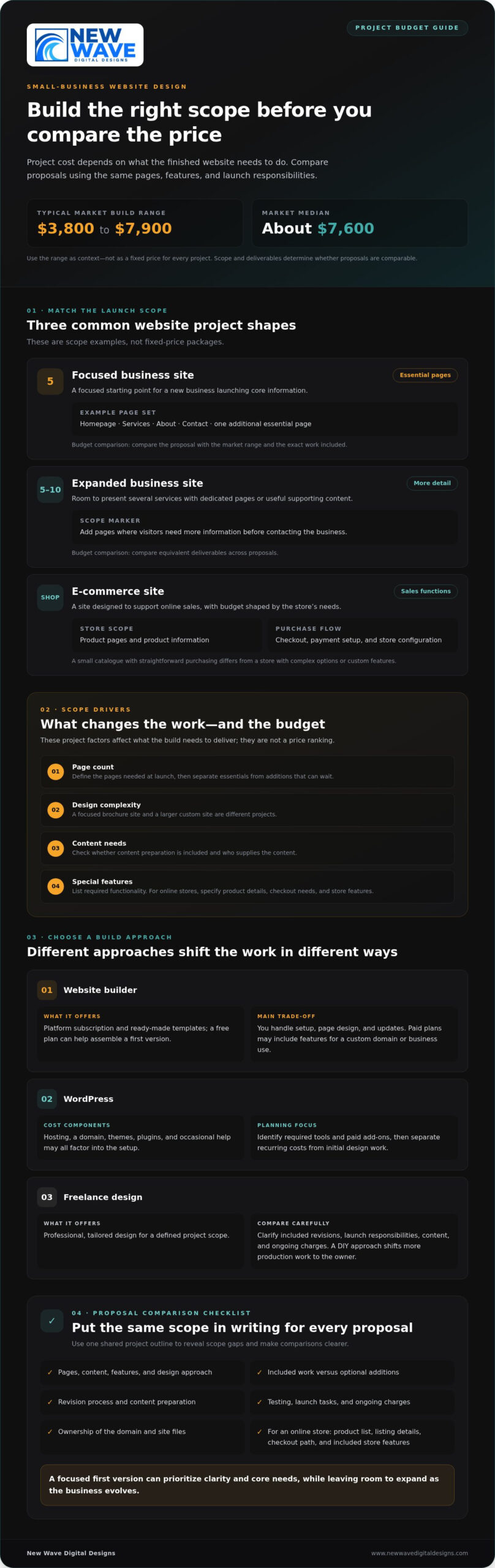
On the market, a small-business website build typically costs between $3,800 and $7,900, with a median of about $7,600. If you’re weighing how much a small business website should cost in 2026, the right budget depends on what the site needs to do and how much design and development it requires.
It’s reasonable to want a clear figure before committing, especially when a project quote may not show what you’ll spend to keep the site running. A useful comparison separates the initial build from recurring expenses, so you can see what’s included and plan for the long term.
This guide explains the factors that shape design costs, then covers hosting, domains, SSL certificates, and WordPress upkeep. You’ll have a practical framework for comparing options and matching your budget to the website your business needs.
Key Takeaways
- Set your budget around the site’s purpose, required features, and content needs, not just the number of pages.
- Compare website builders, WordPress, and freelance design by weighing both upfront work and ongoing commitments.
- A starter project can focus on essential pages first, leaving room to expand as your business evolves.
- Plan separately for hosting, domain renewal, SSL, and WordPress care so recurring expenses don’t catch you by surprise.
- Use the cost breakdowns to identify which parts of a website project matter most for your business.
How much should a full website design cost?
In the United States, a small-business website build typically falls within the market range of $3,800 to $7,900, with a median of about $7,600. To limit hidden costs and contract risks, define the deliverables, revision process, ownership terms, launch responsibilities, and any ongoing charges in writing before work begins.
New Business Budget Recommendations
For a new business, begin with the essential pages and functions needed to explain the offer and help visitors take the next step. A five-page site can provide a focused starting structure, while a 5-10-page site allows room for additional services or useful supporting content. Compared with a larger custom build, a lean launch prioritizes clarity and core needs over extra features.
Before setting a budget, list the pages, content, and features you need at launch. Separate essentials from additions that can wait, then use the same written scope to compare proposals. This keeps the first version focused and makes future expansion easier to plan.
Small Business Website Budget Examples
Consider a local service business that needs a homepage, service information, an about page, and a contact page. That five-page example offers a clear baseline for comparing design proposals. A business with several distinct services may need a 5-10-page version, adding dedicated pages where visitors need more detail before reaching out.
These examples differ mainly in scope, not in a universal fixed price. The market range of $3,800 to $7,900 provides a comparison point for a build, while the median is about $7,600. Use your page list and required functionality to judge whether a proposal fits the project.
Website Project Budgets and Ranges
A project budget reflects what the finished site needs: page count, design complexity, content, and special features. A focused brochure site and a larger custom site are different projects, even if both serve a small business. Compare proposals against the same written scope, including what the design and development work will deliver.
For a practical comparison, ask each proposal to separate included work from optional additions and ongoing charges. Check whether content preparation, revisions, testing, and launch tasks are covered. General price ranges offer context, but the clearest comparison is between proposals based on identical deliverables.
E-commerce Website Budgets
An e-commerce site has a different budget profile because it needs to support sales, not just introduce a business. Product pages, checkout, payment setup, and store configuration all shape the work. A small catalogue with straightforward purchasing needs differs from a store with complex product options or custom features.
To scope an e-commerce launch, prepare a product list, note the information each listing needs, and map the customer journey from product selection to checkout. Then compare proposals by their included store features and launch tasks. This shows whether the design supports the shop you need, without treating every online store as the same project.
| Option | Scope | Budget comparison | Best suited to |
|---|---|---|---|
| Focused business site | Five essential pages | Compare against the market range | New businesses launching core information |
| Expanded business site | 5-10 pages | Compare equivalent deliverables | Businesses presenting several services |
| E-commerce site | Product and checkout functions | Assess store scope and launch work | Businesses selling online |
Choose an option by matching its written scope to the pages and features your business needs at launch.
DIY builders trade hands-on setup for platform fees, WordPress separates hosting and upkeep, and freelance design covers professional project work. Each approach balances your time, control, and support differently.
Website Builder Costs
Website builders offer a platform subscription and ready-made templates, making them a lower-cost route for businesses willing to build their own pages. A free plan can help you assemble a first version, while paid plans may include features needed for a custom domain or business use.
Compare the plan’s monthly price with its included features before choosing. The main trade-off is time: you handle setup, page design, and updates yourself.
WordPress Costs
WordPress costs can combine hosting, a domain, themes, plugins, and occasional help, rather than a single builder subscription. The final setup depends on which tools the site needs and how much work you manage yourself.
WordPress offers flexibility, but owners need to account for the components behind the platform. List the required features, identify paid add-ons, and separate recurring costs from initial design work. This breakdown makes it easier to compare a WordPress proposal with a builder plan.
At this budget, define a focused scope: page count, design approach, included revisions, and launch responsibilities. A freelancer can provide a tailored design without the broader structure of a full-service agency project, while a DIY approach shifts more production work to the business owner.
Compare build methods by separating project fees from recurring site costs:
Before choosing a template or signing a freelance agreement, write down the pages, features, and launch tasks you expect. Clarify who supplies the content, how revisions work, who controls the domain and site files, and which charges recur after launch. These details can reveal scope gaps and contract risks hidden by a headline price.
If you’re weighing a custom build against a platform-led approach, explore a website design approach that fits your project’s scope.
Website pricing for starter projects
A starter project can establish a polished online presence while keeping the initial scope focused. Prices can vary by state or city as provider rates and project requirements differ, but the deliverables remain central to comparing quotes.
Factors That Affect Website Pricing
Page count, custom design, functionality, and content shape a website quote. The amount of design, development, and writing required varies from project to project.
Platform choice matters, too. A Squarespace template-based build can use an existing design structure, while custom functionality adds development work. Before requesting proposals, list the pages, features, content responsibilities, and launch tasks your business needs. A shared scope makes estimates easier to compare.
Freelancer and Agency Pricing
The right comparison depends on the work each quote includes.
Review proposals line by line: identify who handles planning, design, development, revisions, and launch. A lower quote may cover fewer deliverables, while a larger agency project may include a broader set of services. Compare the scope and responsibilities, not just the total.
Custom Website Pricing
Custom builds suit businesses that need a distinct design or features beyond a standard template.
For a starter build, define which custom elements are essential now and which can wait. For example, prioritize core service pages and the contact journey, then plan additional functionality for a later phase. A written scope helps prevent optional features from becoming unexpected project costs.
Ongoing care is a separate budget line from the initial build. Confirm which tasks and support each plan includes.
| Project option | Typical market range | Compare by |
|---|---|---|
| Landing page | Page scope and launch tasks | |
| Freelancer build | Deliverables and responsibilities | |
| Boutique agency build | Strategy, design, and development | |
| Custom agency project | Custom functionality and scope |
Choose a starter project by matching its deliverables to your launch priorities, then budget separately for ongoing care.
Hosting, domain names, and SSL certificates
Domain registration, hosting, SSL, and business email are recurring expenses, often billed on different schedules.
Budget for each separately: the domain identifies your site, hosting keeps it available online, SSL supports a secure connection, and email provides business addresses.
Domain and Hosting Expenses
A domain and hosting serve different roles, so compare their renewal periods and service levels separately. A .com domain generally falls within the same annual domain range.
Before selecting a plan, list the domain renewal, hosting term, and any introductory pricing separately. Then note what the hosting plan covers and when regular billing begins.
SSL and Security Costs
SSL certificate costs can vary substantially, so include renewal terms in your budget rather than assuming a certificate is always a separate paid purchase.
For a clear annual budget, record SSL renewal and email billing alongside domain and hosting dates. Identify who handles security and updates, and whether that work is included in hosting or billed separately. This separates infrastructure charges from ongoing website upkeep.
Use a simple cost ledger to avoid mixing monthly and annual amounts. Record each item, its billing period, and its next renewal date. For example, list a domain as an annual cost, shared hosting as a monthly cost, and email by user and month. This makes expenses easier to review without confusing one-time setup with recurring fees.
- Domain: Record the annual registration and renewal cost.
- Hosting: Compare shared and managed plans by monthly rate and included service.
- SSL: Track certificate cost and renewal period separately.
- Email: Multiply the per-user monthly charge by the number of business accounts you need.
Hosting promotions can make the first bill differ from later renewals, so distinguish introductory rates from standard charges. A shared plan and a managed WordPress plan also offer different service levels; compare features rather than choosing on price alone. Include updates and security responsibilities in your plan, especially when they are not part of hosting.
For a practical final check, group expenses into setup and recurring costs, then note the billing period for each. A domain may renew annually while hosting and email are billed monthly. Keeping those schedules visible helps you prepare for renewals and understand the cost of maintaining the site beyond its initial build.
WordPress themes, plugins, and maintenance
Ongoing WordPress costs combine software, hosting, and care for the site. Typical maintenance and support costs depend on whether the plan covers updates, security monitoring, fixes, and hands-on help; those service prices aren’t included here.
Treat that as a planning range, not a maintenance-plan price.
Theme and Plugin Expenses
A WordPress theme shapes the site’s visual framework, while plugins add specific functions.
Before purchasing, map each plugin to a site requirement, such as a form or booking feature. Avoid overlapping tools, and check whether each subscription renews annually or monthly. This inventory helps keep software costs visible as the site grows.
Maintenance and Support Budgeting
Maintenance is separate from web design or a custom design project. It covers work that keeps an existing site current and functioning, including software updates, security, and technical fixes. The cost of a plan depends on its tasks and level of support.
To build a useful budget, note which updates happen regularly, who handles problems, and whether performance work is included. Then compare that checklist with the care plan’s scope. This shows whether the plan fits your site’s needs, rather than covering tasks you don’t require.
Planning for Ongoing Care
A lean WordPress site with few paid plugins has different upkeep needs from a site relying on several subscriptions and custom features. Track hosting, domain renewal, add-ons, and support separately. For example, don’t mistake an annual plugin renewal for a monthly maintenance charge.
Use this short review to shape your budget:
- Inventory: List themes, plugins, and software subscriptions, including each renewal period.
- Assign: Decide who handles updates, security checks, and troubleshooting.
- Compare: Match each care plan’s included tasks to your list before selecting a service level.
As the site changes, revisit the list after adding a plugin or custom feature. New software can bring renewals and extra upkeep, so update the budget as the site grows. A clear record helps distinguish essential care from optional enhancements.
For help planning WordPress website maintenance, identify the updates and support your site needs, then align the service scope with that checklist.
New Wave Digital Designs: Shopify Website Design
New Wave Digital Designs offers Shopify Website Design for small businesses planning to sell online. When comparing website budgets, decide whether your project needs an online store, a business information site, or ongoing care. The right scope depends on your platform and required features.
For store projects, New Wave Digital Designs offers Shopify Website Design; for other platform needs, it also provides WordPress Website Design and SquareSpace Website Design. Website Maintenance supports businesses planning for ongoing site care after launch. Outline your goals, required pages, key features, and maintenance needs so the conversation can focus on scope.
Contact New Wave Digital Designs to discuss your website project and the approach that fits your business.
Shape a website budget around your next move
A website budget is most useful when it reflects what your business needs next, not every feature it might someday add. As you decide how much a small business website should cost in 2026, focus on the experience you want customers to have, the work required to create it, and the care needed after launch.
Turn your vision into a practical brief: describe your audience, outline what you want visitors to do, and identify a platform that suits your plans. New Wave Digital Designs offers Shopify Website Design, WordPress Website Design, and SquareSpace Website Design to shape a site around those priorities.
A well-considered project starts with clear goals and a scope that can evolve with your business. Contact New Wave Digital Designs today to discuss your website plans and take the next step with confidence.
Frequently Asked Questions
What should a small business expect to pay for a website?
For a small-business website build, the collected market range is $3,800 to $7,900, with a median of about $7,600. Treat that as a reference point, not a fixed quote: a five-page informational site and an online store have different scopes. To judge a proposed budget, compare the same pages, functions, content tasks, and launch responsibilities across estimates.
What will it actually cost?
To answer how much a small business website should cost in 2026, first separate the initial build from recurring expenses. Your actual total depends on the build method and the work the finished site requires. For example, a DIY platform has a different cost structure from a custom project. List required features, then sort expenses by whether they are one-time, monthly, or annual.
Can I build my own website?
Yes. DIY can suit a business with a straightforward site and someone available to create the pages. Start by listing the required content and features, then decide whether you can maintain the site as well as build it.
Is a More Expensive Website Worth It?
It can be, if the added investment supports requirements your business genuinely has. Custom design, additional service pages, or e-commerce features can require more planning and development than a simple template site. For instance, an online shop needs a customer journey that supports browsing and checkout. Compare the added deliverables with your business goals rather than assuming a higher quote is automatically a better fit.
Is professional web design still worth paying for in 2026?
Professional design can be worthwhile when you need cohesive branding, custom features, or a site structure that is difficult to create yourself. It also shifts design and development tasks away from your team. Before choosing, define what you want visitors to do, such as request a service or explore products. Then assess whether professional support addresses a real project need.
So what should you actually budget?
How much a small business website should cost in 2026 depends on the work and expenses your site needs. Set out the pages, functions, content, and launch tasks first. Then add recurring costs for hosting, domain renewal, email, paid plugins, and maintenance where applicable. A simple spreadsheet with separate one-time and recurring columns can show which expenses affect launch and which continue afterward.
Want a Real Number for Your Site?
A project-specific price depends on scope and is provided after a quote request. To make the estimate useful, prepare a brief with your audience, required pages, desired features, platform preference, and content responsibilities. Include ongoing care needs, too. Clear inputs help define the project and clarify what the proposed work covers.
What is the cost of hiring a freelancer to build a small business website in 2026?
In the United States, a small-business website built by a freelancer typically costs in 2026. The project scope shapes where an estimate falls within that range: page count, custom design, content work, and required functions all affect the build. Compare proposals using one shared list of deliverables, and distinguish project work from recurring hosting or maintenance expenses.