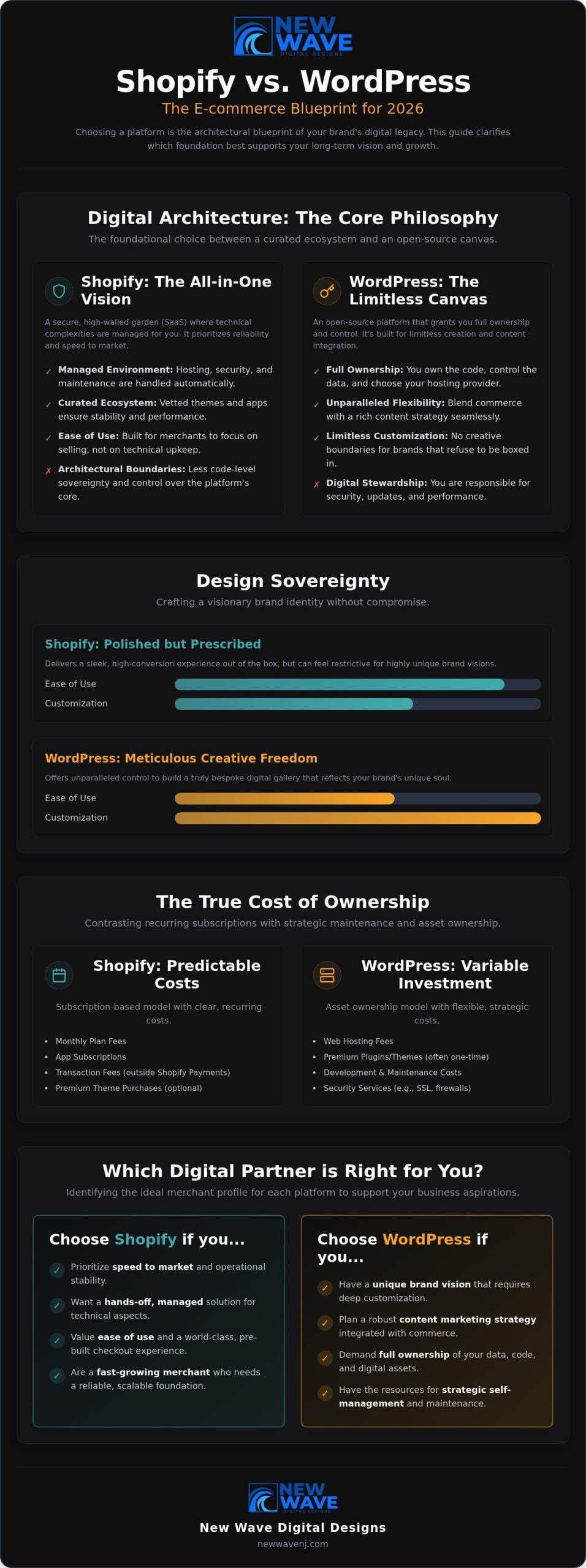
Selecting a digital platform is not merely a technical checkbox; it’s the architectural foundation upon which your entire brand legacy will rest. You likely feel the weight of this decision, balancing the immediate need for a functional site against the persistent fear of outgrowing a rigid system or drowning in hidden maintenance fees. When evaluating Shopify vs WordPress for New Jersey businesses, the choice often feels like a gamble between perceived simplicity and total creative control. It’s a strategic crossroad where your brand’s future performance, security, and scalability are all at stake.
We understand that you’re looking for more than a website; you’re seeking a digital masterpiece that reflects your premium brand. This guide provides the definitive architectural framework to help you navigate this comparison, ensuring your foundation is built for scalability and visionary growth. We’ll explore the nuances of technical requirements, the reality of platform maintenance, and the strategic advantages of each ecosystem in a landscape of shifting data privacy regulations. By the end, you’ll have a clear vision of which path aligns with your long-term goals, backed by the expertise of partners who value digital craftsmanship, strategic thinking, and continuous evolution.
Key Takeaways
- Understand why your platform choice is the definitive architectural foundation for brand resonance and emotional connection in an increasingly crowded digital landscape.
- Analyze the technical nuances between Shopify’s streamlined SaaS environment and the boundless creative freedom offered by the WordPress open-source ecosystem.
- Navigate the hidden economy of web development by comparing visible subscription fees against the long-term investment required for maintenance and security when choosing Shopify vs WordPress for New Jersey businesses.
- Discover a strategic selection matrix designed to map your unique SKU volume and marketing objectives to the platform that best supports your visionary growth.
- Explore how partnering with a digital architect ensures your website is a meticulously crafted masterpiece that integrates professional graphic design with high-performance SEO.
The Crossroads of Commerce and Content: Why Your Platform Choice Matters
By 2026, the digital marketplace has matured into a space where mere functionality is no longer a competitive advantage; it’s the bare minimum. For sophisticated brands, a website must transcend the role of a digital brochure to become a living, breathing vessel for brand authority and emotional resonance. It’s the primary touchpoint where your vision meets the customer’s reality. When evaluating Shopify vs WordPress for New Jersey businesses, you’re making a choice that defines your operational philosophy for the next decade. This decision determines whether you’ll operate within a polished, managed ecosystem or command a bespoke, open-source territory.
The distinction often comes down to a ‘Rent vs. Own’ mentality. Shopify’s platform functions much like a premium commercial lease in a high-end district. You gain immediate access to world-class security, streamlined commerce tools, and a reliable infrastructure, all maintained by the provider. WordPress, by contrast, is the equivalent of owning the land and the building. It offers total sovereignty, allowing for intricate customizations that are only limited by your imagination. A strategic choice today prevents the technical debt and exhausting expense of a mid-growth migration in the future. It ensures your foundation is built to support your evolution rather than restrict it.
The Visionary Approach to Digital Architecture
In highly competitive markets, professional design is the silent ambassador of your brand’s quality. While a basic site might process a transaction, a meticulously crafted digital architecture builds deep trust and invites long-term loyalty. This is where the role of a digital partner becomes indispensable. We don’t just write code; we act as architects who navigate the technical complexities of performance, security, and scalability. Your platform choice also dictates your long-term organic SEO strategy. Whether it’s the structured, clean code of a managed system or the limitless metadata control of an open-source framework, your choice must align with how you intend to be discovered by the world.
Defining Your Business Objectives
Success begins with a clear understanding of your core identity. Are you a ‘Product-First’ business focused on high-volume transactions and logistical efficiency? Or are you a ‘Brand-Story-First’ entity that requires a layered, immersive experience to convey your value? Each model thrives on a different foundation. You must also assess your internal capacity for technical stewardship. Many businesses find that the #1 bottleneck to scaling isn’t a lack of customers; it’s a rigid website that can’t adapt to new marketing goals or sudden shifts in the market. By choosing a platform that matches your technical capacity and visionary needs, you eliminate friction and clear the path for continuous, inspired growth.
Architectural Foundations: A Technical Comparison of Shopify and WordPress
The architectural choice between a Software-as-a-Service (SaaS) model and an Open Source ecosystem is the most critical technical decision you’ll make for your brand. While both platforms can produce stunning visual results, their underlying structures dictate your daily operations, security posture, and ability to pivot. For an in-depth comparison of these frameworks, one must look past the surface-level aesthetics to the core of how they handle data and delivery. Evaluating Shopify vs WordPress for New Jersey businesses requires a balance between the desire for creative sovereignty and the need for a reliable, high-performance engine.
Platform architecture directly influences site speed and mobile responsiveness, which are the twin pillars of modern user experience. Shopify provides a closed, optimized environment where every element is tuned for performance. WordPress offers a vast, modular landscape where speed is a result of meticulous orchestration and professional management. If you’re unsure which path fits your vision, our team can help you define your digital strategy through a lens of technical excellence.
Shopify: The Polished Engine of E-commerce
Shopify operates as a fully hosted environment, providing a sanctuary of security, speed, and zero server management. This SaaS model removes the burden of technical infrastructure from your shoulders, allowing you to focus entirely on brand growth. The ecosystem is designed to streamline the checkout experience, utilizing a proprietary stack that maximizes conversion rates and handles sudden traffic surges with ease. By leveraging professional Shopify website design New Jersey, businesses can achieve rapid scaling without the fear of technical bottlenecks. It’s a system built for momentum, where built-in features offer a level of reliability that third-party plugins often struggle to match.
WordPress: The Unbound Canvas of Digital Expression
WordPress 7.1, released in August 2026, continues to redefine what’s possible in the open-source world. With the power of the Block Editor and bespoke themes, it serves as an unbound canvas for unique brand storytelling. This platform offers unrivaled SEO flexibility and content management capabilities, making it the preferred choice for brands that prioritize deep narrative and complex information architecture. However, this creative freedom requires a disciplined approach to stability. The necessity of professional WordPress maintenance services cannot be overstated. Without expert oversight to manage security hardening and plugin updates, the very flexibility that makes WordPress powerful can become a source of technical vulnerability.
The Hidden Economy: Evaluating Total Cost of Ownership and Scalability
The financial architecture of your digital presence extends far beyond the initial invoice. For many, the comparison of Shopify vs WordPress for New Jersey businesses begins and ends with the monthly subscription fee, yet this surface-level view ignores the hidden economy of technical debt and maintenance. Shopify offers a transparent, tiered structure: the ‘Grow’ plan costs $105 per month, while the ‘Advanced’ tier reaches $399 per month. These figures represent a managed peace of mind. Conversely, WordPress presents a decentralized cost model where hosting, security licenses, and premium plugins are sourced individually. While the entry price may appear lower, the long-term investment often converges as your brand scales and complexity increases.
Scalability introduces what many architects call a ‘scaling tax.’ On Shopify, this manifests as transaction fees for third-party payment providers, ranging from 2% on the Basic plan to 0.6% on Advanced. In the WordPress ecosystem, the tax is paid in technical debt; as you add more functionality through plugins, the risk of conflict and performance degradation rises. Investing in professional design over DIY templates provides a significant ROI by ensuring your foundation is clean, cohesive, and ready for growth from day one. A meticulously built site avoids the ‘Frankenstein’ effect of mismatched templates that eventually require a total rebuild.
Security and Hosting: The Silent Pillars of Success
In 2026, generic hosting has become the primary vulnerability for businesses. With New Jersey’s enactment of laws A4085 and A5328 in July 2026, the legal stakes for data privacy have never been higher. Violations regarding the sale of sensitive data now carry civil penalties of $50,000 for each record. Shopify’s built-in security architecture alleviates much of this anxiety by handling compliance and encryption natively, though it adds to your fixed monthly overhead. For WordPress users, managed hosting and proactive security hardening are no longer optional luxuries; they’re essential safeguards against the catastrophic costs of a data breach and legal non-compliance. To ensure your broader business infrastructure is equally resilient, consulting with experts like Trinity Networx, LLC for managed IT support can help establish a secure and compliant foundation.
Digital landscapes are in a state of perpetual flux. The release of WordPress 7.1 on August 19, 2026, brought critical updates and new AI integrations, highlighting why a ‘set it and forget it’ approach leads to rapid obsolescence. Maintenance is the act of continuous evolution, keeping your site functional, secure, and aligned with modern standards. Professional support prevents the sudden site crashes and data loss that often plague unmanaged platforms. By viewing maintenance as a strategic investment rather than a recurring expense, you ensure your digital storefront remains a high-performing asset that grows alongside your vision. It’s the difference between a building that weathers the storm and one that requires constant, emergency repairs.

Strategic Selection: Mapping Your Business Model to the Right Platform
Choosing the right environment requires an honest assessment of your operational DNA. When evaluating Shopify vs WordPress for New Jersey businesses, we look at three primary metrics: SKU complexity, content volume, and your specific marketing objectives. Many local brands find themselves at a strategic crossroad after outgrowing the limitations of Squarespace. They seek a foundation that can support more than just a basic layout. A custom Shopify store design bridges the gap between ease of use and artistic excellence, providing a high-performance engine that doesn’t sacrifice brand soul. For some, a hybrid approach offers the ultimate solution, utilizing WordPress for deep narrative storytelling while deploying Shopify to manage the transactional nuances of commerce.
The E-commerce Powerhouse Profile
For high-volume retailers, Shopify is the undeniable leader. It is a platform built for momentum, designed to handle thousands of transactions without a stutter. In 2026, success in this space requires more than just a product listing; it demands a seamless integration of Google Ads and Bing Ads to drive targeted traffic. High-performance commerce thrives on visibility and speed. Professional graphic design ensures your store stands out in a saturated market, turning a commodity into a premium experience. If your goal is rapid expansion and logistical efficiency, Shopify provides the most direct path to realization. It allows you to focus on your customers while the platform handles the weight of the infrastructure.
The Content-Driven Authority Profile
Service providers, educators, and boutique consultants often find their strategic edge in WordPress. This platform offers a level of architectural flexibility that is essential for maximizing organic SEO and managing complex information hierarchies. Custom theme design allows you to forge a lasting brand identity that resonates with a sophisticated audience. Unlike a rigid template, a bespoke WordPress site evolves with your expertise. It serves as a digital headquarters where your brand story takes center stage, supported by the technical depth required to rank for high-value search terms. This environment is for the visionary who views their website as a medium for deep engagement and authoritative expression.
Ready to build your legacy? You can start your architectural discovery with our team today to ensure your digital foundation is built for the future.
Partnering for Excellence: How New Wave Digital Designs Crafts Your Vision
At New Wave Digital Designs, we believe that your digital presence should be a testament to your brand’s soul. We don’t view website creation as a mere technical task; we treat it as a form of high craftsmanship. As your Digital Architect, our methodology begins with deep listening, moves through strategic discovery, and culminates in a meticulously built foundation. Whether you are weighing Shopify vs WordPress for New Jersey businesses, our goal is to ensure your choice isn’t just functional, but visionary. We provide a sanctuary where technical competence meets creative inspiration, ensuring your business is built for long-term scalability and emotional resonance.
Our process is holistic. We seamlessly integrate professional graphic design, high-performance SEO, and rigorous technical development into a single, cohesive strategy. This synergy ensures that your brand identity remains consistent across every touchpoint, from the first search result to the final checkout. For businesses looking to bridge the gap between their digital and physical presence, BRAND NEW Promotions | Top Promo Supplier in North Texas offers expert custom branding solutions that maintain this high standard of quality. We don’t simply hand over the keys and vanish. We are committed to a long-term partnership, offering robust website maintenance and support to protect your investment from technical obsolescence. We invite you to evolve your brand from a digital task into a visionary asset that commands attention and drives sustainable growth.
Every line of code and every pixel serves a specific purpose in our architectural framework. We focus on creating responsive, brand-aligned designs that resonate with your audience on any device, ensuring a premium experience for every visitor. In a landscape where digital safety is paramount, our builds prioritize technical protection and secure hosting. We understand the nuances of the shifting regulatory environment, ensuring your site remains a fortress of reliability. By bridging the gap between creative spark and technical execution, we deliver a digital environment that is as robust as it is beautiful.
Realizing Your Digital Potential
The journey with us is a logical, steady progression from initial discovery to final realization and ongoing growth. Businesses choose us as their boutique partner because we reject the high-volume service factory model in favor of personal care and meticulousness. We act as forward-thinking guides, passionate about your continuous evolution in a crowded marketplace. Your website should be a reflection of your true spirit, crafted with the care and strategic thinking it deserves. It’s time to build a foundation that doesn’t just house your business but propels it forward.
Connect with our visionary designers today to begin the transformation of your digital presence into a masterpiece of commerce and content.
Architecting Your Brand’s Future
Choosing the right digital environment is the first step in a journey toward long-term resonance and growth. Whether you embrace the streamlined efficiency of a managed ecosystem or the boundless creative sovereignty of an open-source framework, your decision must reflect your brand’s true spirit. The strategic comparison of Shopify vs WordPress for New Jersey businesses underscores that a website is more than a tool; it’s the architectural foundation of your visionary legacy. Success lies in the meticulous orchestration of design, security, and performance.
We invite you to step away from commodity solutions and embrace a partnership built on craftsmanship. As specialists in Shopify, WordPress, and Squarespace, we integrate custom artistic brand identity design with comprehensive managed hosting and security. Our team listens intently to your needs before applying the technical expertise required to realize your digital potential. Your brand deserves a home that is as sophisticated and forward-thinking as your business goals.
Design Your Visionary Digital Foundation with New Wave Digital Designs
Let’s begin the process of transforming your digital presence into a masterpiece that inspires trust and commands authority.
Frequently Asked Questions
Is Shopify better than WordPress for SEO in 2026?
Neither platform is inherently superior; rather, they offer different paths to visibility. Shopify provides a structured, high-performance environment that handles technical basics like site speed and mobile responsiveness natively. WordPress offers a deeper level of architectural control, allowing for granular metadata adjustments and complex internal linking. When comparing Shopify vs WordPress for New Jersey businesses, the best choice depends on whether your strategy prioritizes high-volume product listings or deep, narrative-driven content authority.
How much does a professional WordPress site cost compared to Shopify annually?
Shopify utilizes a transparent subscription model with plans ranging from $39 to $399 per month when billed annually, plus transaction fees for third-party payment providers. WordPress carries a decentralized cost structure where you invest in managed hosting, security licenses, and premium plugins individually. While the entry price for WordPress can be lower, the total cost of ownership often converges as your brand scales. Both platforms require a strategic investment in professional maintenance to ensure long-term performance and security.
Can I migrate my existing WordPress site to Shopify if my business grows?
Yes, migrating from WordPress to Shopify is a common evolution for businesses seeking a more managed commerce environment. This process involves a meticulous transfer of product data, customer records, and historical content while preserving your established search engine rankings. It’s an architectural shift that requires careful planning of URL redirects and metadata mapping. Our team acts as a guide through this transition, ensuring your brand’s digital legacy remains intact while moving to a more scalable foundation.
Do I really need a maintenance package for my Shopify or WordPress site?
Professional maintenance is an essential investment for any visionary brand. For WordPress users, proactive support prevents the “crash” scenario caused by plugin conflicts or outdated security protocols. Shopify users benefit from continuous optimization, ensuring that new features and app integrations don’t degrade site performance. A maintenance package transforms your website from a static digital task into a living asset that evolves alongside your business. It provides the peace of mind that your foundation is always protected.
Which platform is more secure against hacking and data breaches?
Shopify offers a closed, managed environment where security and compliance are handled natively by the platform. WordPress is an open-source ecosystem that requires professional hardening and managed hosting to reach the same level of protection. With New Jersey’s 2026 data privacy laws imposing significant penalties for breaches, security is no longer optional. We prioritize technical protection in every build, implementing rigorous security layers to ensure your client data remains a fortress against evolving digital threats.
How does platform choice affect my Google Ads and SEM performance?
Platform choice dictates how effectively you can track conversions and deliver a seamless landing page experience. Shopify is engineered for transactional speed, making it an ideal engine for high-volume Google Ads and Bing Ads campaigns. WordPress offers unparalleled flexibility for content-led SEM, allowing you to build immersive storytelling pages that drive long-term organic authority. Both platforms thrive when integrated with a professional marketing strategy that aligns your technical foundation with your specific brand goals.
Is WordPress or Shopify easier to manage for a small business team?
Shopify is often more intuitive for teams focused on daily inventory management and order fulfillment. Its dashboard is designed for streamlined commerce operations. WordPress provides a more flexible canvas for teams that prioritize content creation and bespoke brand expression, though it requires a slightly higher degree of technical familiarity. When evaluating Shopify vs WordPress for New Jersey businesses, we help you assess your team’s internal capacity versus your need for professional support to ensure operational fluidness.
Can New Wave Digital Designs handle the graphic design for my new site?
Yes, we provide professional graphic design services to ensure your visual identity is consistent and impactful across your entire digital presence. We believe that digital architecture and artistic expression are inseparable. By integrating custom design directly into the web development process, we create a cohesive brand experience that resonates emotionally with your audience. This holistic approach ensures that your website is not just a functional tool, but a true reflection of your brand’s craftsmanship.