
Choosing a platform isn’t just a technical box to check; it’s the architectural blueprint of your brand’s digital legacy. As we look toward the shifting landscape of 2026, the debate over wordpress vs shopify for ecommerce has evolved beyond simple features into a question of long-term vision. You want a storefront that feels like a bespoke gallery, yet you’re likely haunted by the fear of outgrowing your foundation, the anxiety of data ownership, or the frustration of hidden maintenance costs. It’s a delicate balance to strike between creative freedom and operational stability.
We understand that your business is a living entity that requires room to breathe and evolve. This guide promises to strip away the confusion, revealing which platform serves as the optimal digital foundation for your brand’s unique evolution. We’ll examine the sophisticated AI integrations of WordPress 7.1, the streamlined efficiency of Shopify’s latest retail updates, and the true cost of scaling a high-converting, beautiful, and secure storefront. By the end, you’ll have the clarity needed to choose a partner that supports your long-term organic growth and captures the true spirit of your craft.
Key Takeaways
- Understand the fundamental differences between a curated, hosted ecosystem and an open-source canvas to determine which digital architecture aligns with your vision.
- Evaluate the true cost of ownership by contrasting Shopify’s recurring subscriptions with the strategic maintenance and hosting required for a robust WordPress site.
- Master the nuances of wordpress vs shopify for ecommerce to ensure your platform choice supports long-term organic SEO growth and superior site performance.
- Discover how to maintain design sovereignty, ensuring your storefront reflects your brand’s unique artistry without being constrained by rigid templates.
- Identify the ideal merchant profile for each platform, helping you select a digital foundation that evolves seamlessly alongside your business aspirations.
The E-commerce Crossroads: Understanding the Digital Architecture
The decision you face today isn’t merely about choosing a software; it’s about selecting the cornerstone of your brand’s digital legacy. When evaluating wordpress vs shopify for ecommerce, you’re deciding between two distinct philosophies of growth. One offers a polished, all-inclusive environment, while the other provides an expansive, open territory for limitless creation. This architectural choice dictates how you engage with customers, how you scale your operations, and who truly holds the keys to your digital assets. A foundational understanding of e-commerce architecture is vital because this decision impacts your site’s speed, security, and soul.
At the heart of this crossroads lies the concept of digital stewardship. It’s a question of ownership and control over your most valuable resource: your data. While one path offers a streamlined journey where the heavy lifting is done for you, the other grants you the deed to the land itself. Choosing your digital partner is the most critical architectural decision a modern brand can make, as it defines the boundaries of your future evolution.
The All-in-One Vision of Shopify
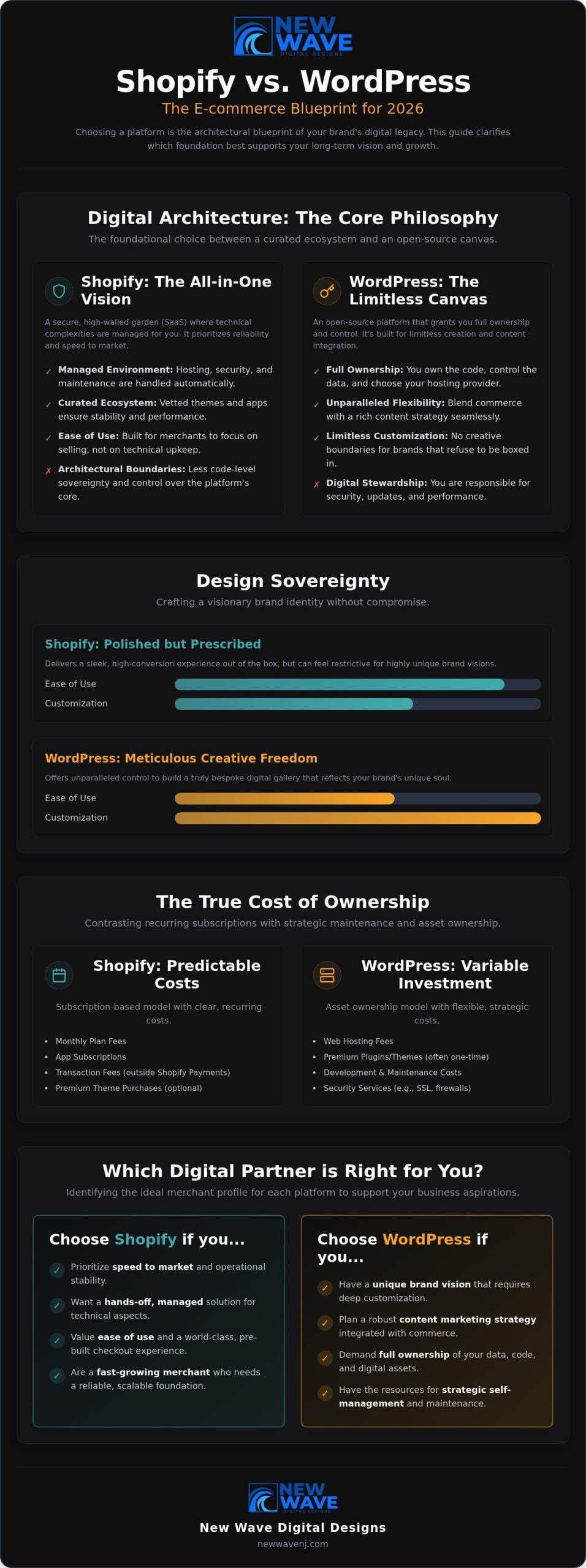
Shopify operates as a Software as a Service (SaaS) model, providing a secure, high-walled garden where technical complexities are handled by the platform. It’s a curated ecosystem where themes and apps undergo rigorous vetting to ensure stability and performance. For many, this refined environment offers peace of mind, especially with recent updates like the mandatory shift to checkout extensibility and Web Pixels by August 26, 2026. This model ensures that security patches and server maintenance happen silently in the background, allowing you to focus on your craft. However, this ease comes with architectural boundaries. You trade deep code-level sovereignty for a predictable, managed experience that prioritizes speed to market, reliability, and ease of use over total structural freedom.
The Limitless Canvas of WordPress
WordPress, powered by WooCommerce, stands as an open-source canvas designed for brands that refuse to be boxed in. It empowers you to weave commerce into a broader content strategy, turning every blog post and gallery into a potential point of sale. With the release of WordPress 7.1 and its integrated AI Abilities API, the platform continues to push the boundaries of personalized digital experiences. This freedom requires a commitment to digital stewardship. You own the code, you control the data, and you choose the hosting. While this grants you unparalleled flexibility, it also means you embrace the responsibility of meticulous self-management, ensuring that your digital estate remains secure, updated, and performing at its peak.
Design Sovereignty: Crafting a Visionary Brand Identity
Design is the silent ambassador of your brand. It transforms a digital storefront from a cold interface into a warm, inviting gallery where every element reflects your business’s soul. Achieving this level of visual excellence is paramount, as it serves as the primary bridge for consumer trust. When evaluating wordpress vs shopify for ecommerce, you must consider how each platform interprets and protects your creative vision. A store is no longer just a place to buy; it’s a destination where consumers seek resonance, authenticity, and a seamless journey. Research from this Shopify vs. WordPress comparison highlights that while both offer aesthetic potential, the path to achieving a unique identity varies significantly between the two digital architectures.
Shopify: Polished but Prescribed
Shopify excels at providing a sleek, high-conversion environment right out of the box. Its Liquid-based templating ensures that even the most basic storefronts maintain a professional polish that feels modern and trustworthy. The checkout experience is particularly noteworthy. It’s a world-class, optimized flow that prioritizes speed and security, which directly fuels higher conversion rates. However, this structure can occasionally feel like a gilded cage for brands with unconventional visual identities. You might find yourself hitting architectural ceilings when trying to depart from standard layouts or rigid grid systems. This is where professional Shopify website design becomes essential, as skilled craftsmen can push these boundaries to ensure your brand doesn’t look like every other store on the block.
WordPress: Meticulous Detail and Customization
WordPress, especially with the latest version 7.1, offers a block-based freedom that acts as a digital architect’s playground. It allows for a meticulous level of detail where every pixel serves a specific purpose in your brand’s story. This platform is ideal for brands that view their website as a living portfolio or a deep content hub. By integrating WooCommerce 11.0, you can seamlessly blend complex storytelling, such as long-form blogs and interactive portfolios, with your product catalog. The synergy between a rich content strategy and a high-performing shop is where WordPress truly shines. It requires a more deliberate commitment to professional graphic design to maintain brand consistency, but the result is a bespoke digital estate that you own entirely. Both platforms now demand mobile-first thinking, as mobile responsiveness is no longer a feature but a fundamental requirement for conversion. While Shopify offers a “set it and forget it” mobile reliability, WordPress grants you the power to fine-tune the mobile experience with surgical precision.
This degree of customization is a hallmark of high-end digital craftsmanship; for instance, שי דוד משרד פרסום focuses on creating these types of result-oriented websites where UI/UX design is central to the user journey.
The True Cost of Ownership: Subscriptions vs. Maintenance
Financial clarity is the bedrock of a sustainable digital estate. When analyzing wordpress vs shopify for ecommerce, it’s essential to look beyond the surface level of monthly bills. You aren’t just paying for software; you’re funding the infrastructure that protects your brand’s reputation and customer data. Understanding these e-commerce definitions helps clarify that while Shopify offers a “rented” ecosystem with predictable fees, WordPress represents a “deeded” property that requires strategic investment in maintenance. The choice between them often hinges on whether you prefer the convenience of a managed service or the long-term ROI of total ownership.
Shopify: The Predictable Premium
Shopify provides a transparent, tiered pricing model that simplifies budgeting for many brands. As of August 2026, the Basic plan sits at $39 monthly, while the Advanced tier reaches $399. This predictability is a premium service. It shields you from the technical burden of server management and security patches. However, hidden costs often lurk beneath the surface. If you don’t use Shopify Payments, you’ll face additional transaction fees of up to 2% on the Basic plan. Scaling also brings the “App Tax.” What starts as a simple storefront can quickly balloon into a $200 monthly expense as you add premium apps for loyalty programs or advanced SEO features. For high-volume merchants, these costs eventually justify a move to Shopify Plus, where starting rates begin at $2,300 per month.
WordPress: Investing in Infrastructure
The narrative that WordPress is “free” is a common misconception that ignores the artistry of professional development. While the WooCommerce plugin costs nothing, a secure and high-performing store requires a robust foundation. This means budgeting for managed hosting and security services, which typically start around $25 monthly for professional environments. We view this as a “Maintenance Dividend.” By investing in professional website support, you mitigate the risk of vulnerabilities and ensure your site evolves with the latest standards, such as the August 2026 security release of WordPress 7.0.3. This path offers a superior long-term ROI. Once your custom architecture is built, you own the asset entirely. You aren’t subject to platform-wide price hikes or forced migrations. You have the freedom to choose your own payment processors without penalty. This level of control is why many visionary brands prefer a custom-built digital home. If you’re ready to build on solid ground, our team offers expert WordPress website design to bring your vision to life.
Marketing Synergy: SEO and Paid Search Performance
Marketing is the pulse of your digital presence. It requires a harmonious blend of technical precision, creative storytelling, and strategic visibility. The debate over wordpress vs shopify for ecommerce often centers on which platform better amplifies your voice in a crowded marketplace. While one offers a streamlined, automated path to visibility, the other provides a deep, structural canvas for those who view search rankings as a form of long-term brand equity. Your choice here determines how easily you can bridge the gap between initial discovery and final conversion.
When choosing between wordpress vs shopify for ecommerce, the impact on Core Web Vitals cannot be ignored. Site speed and performance are no longer just technical metrics; they are essential components of the user experience that search engines reward. Shopify manages the server environment to ensure consistent delivery, while WordPress allows for a more bespoke optimization strategy. This level of control is vital for brands that prioritize meticulous performance and want to fine-tune every aspect of their site’s loading sequence to perfection.
Search Engine Visibility: The Technical Foundation
Shopify offers an elegant, automated approach to technical SEO. It generates sitemaps, manages canonical tags, and ensures a clean URL structure without requiring manual intervention. This allows you to focus on your products while the platform handles the foundational requirements. WordPress, conversely, serves as a deeper architectural playground. It empowers you to fine-tune every meta tag, schema markup, and internal link with surgical accuracy. This is particularly vital for content-heavy strategies where blog leadership and organic authority are paramount. With WordPress now powering 41.2% of all websites as of July 2026, its dominance in search visibility remains a testament to its structural integrity. Both platforms demand a commitment to responsive web design, as search engines prioritize mobile-first experiences that feel fluid, intuitive, and consistent on every device.
Paid Acquisition: Google Ads and Beyond
Immediate visibility often requires the precision of Google Ads and Bing Ads. Shopify simplifies the integration of tracking pixels, allowing you to monitor conversions with minimal friction. WordPress offers a similar level of depth but requires a more methodical setup to ensure data accuracy across complex site structures. The quality of your landing page design is the primary driver of your Quality Score. A beautiful, high-performing storefront reduces bounce rates and lowers your cost-per-click. We view search engine marketing not as a standalone tactic, but as a bridge that sustains your brand while your organic SEO efforts take root. If you’re ready to amplify your reach, our team provides comprehensive Organic SEO and Google Ads services tailored to your platform of choice.
The Final Verdict: Choosing Your Digital Partner
The journey through the nuances of wordpress vs shopify for ecommerce reveals a fundamental truth: your platform is not merely a tool but the digital soil in which your brand grows. Whether you seek the polished efficiency of a managed ecosystem or the limitless sovereignty of an open-source canvas, the decision must align with your long-term aspirations. It’s about finding the perfect balance between creative freedom, operational stability, and technical security. This choice serves as the cornerstone of your brand’s digital legacy, dictating how you scale, how you connect, and how you evolve in an ever-shifting marketplace.
When to Choose Shopify
Shopify is the premier choice for merchants who prioritize speed, reliability, and a streamlined retail experience. It’s built for those who want to focus on their craft rather than the underlying infrastructure. With the recent Spring Edition ‘26 updates, the platform has solidified its position as a powerhouse for high-volume retail. It’s ideal if you want a hands-off approach to server security and silent background updates. If your goal is a rapid scale-up with a focus on straightforward transactions, Shopify provides the refined, high-conversion environment you need.
When to Choose WordPress
WordPress remains the definitive foundation for the creative visionary who demands total control. It’s the optimal path for businesses that view their website as a complex, living extension of their identity. If your strategy relies on deep content storytelling, unique user journeys, or the sophisticated AI integrations found in WordPress 7.1, this open-source landscape is your home. It supports a meticulous, long-term Organic SEO strategy that builds enduring brand equity. You own the code, you own the data, and you own the future of your digital estate. This commitment to owning and curating your environment often extends to physical spaces; to see how bespoke, low-maintenance landscapes are designed with the same level of care, click here.
Regardless of the path you choose, the true artistry of your storefront depends on a professional touch. We believe that custom website design is the vital differentiator that elevates a store from a simple transaction point into a resonant brand experience. Our approach goes beyond the initial build. We provide dedicated website maintenance and support to eliminate technical anxiety, ensuring your site remains secure and performant. With our robust technical security solutions, you can focus on your vision while we serve as the digital architects of your success. Let’s architect your digital future together.
Architecting Your Digital Legacy
Your storefront is more than a point of sale; it’s a living testament to your brand’s artistry and ambition. We’ve explored how the choice between wordpress vs shopify for ecommerce hinges on your desire for either streamlined efficiency or absolute architectural sovereignty. Success in 2026 requires a foundation that balances immediate performance with the freedom to evolve. Whether you choose the curated elegance of Shopify or the expansive potential of WordPress, your digital home deserves a meticulous level of care that prioritizes security, speed, and soul.
At New Wave Digital Designs, we bridge the gap between technical complexity and visionary growth. As specialists in both architectures, we provide boutique agency care backed by national-scale expertise. We don’t just build websites; we craft enduring partnerships through comprehensive maintenance and secure hosting packages that eliminate technical anxiety. Your brand’s spirit deserves a platform that supports its highest evolution. Elevate Your E-commerce Vision with New Wave Digital Designs and let’s begin the journey of realizing your digital future today.
Frequently Asked Questions
Is Shopify or WordPress better for small business SEO?
Both platforms offer robust tools, but the choice depends on your strategy. WordPress provides granular control over metadata and schema, which is ideal for content-heavy brands. Shopify offers automated sitemaps and clean technical structures that work immediately. When comparing wordpress vs shopify for ecommerce, remember that organic SEO success relies more on your content quality and architectural precision than the platform itself. We help you refine these elements to ensure your brand resonates in search results.
How much does it really cost to maintain a WordPress e-commerce site?
While the core software is free, a professional WordPress store requires a strategic budget. Managed WordPress hosting typically starts around €25 per month to ensure performance and stability. A realistic annual investment for a high-performing store, including premium plugins and security, ranges between $1,800 and $3,000+. This expenditure represents an investment in your own digital estate, providing a level of ownership and flexibility that recurring subscription models don’t offer.
Can I migrate my store from Shopify to WordPress (or vice versa) later?
Yes, you can migrate between platforms, though it requires meticulous planning to protect your data and SEO equity. Transitioning involves moving product databases, customer records, and order histories without disrupting the user experience. It’s a complex architectural task that shouldn’t be rushed. We approach migrations as a transformative evolution, ensuring your brand’s spirit remains intact while moving to a foundation that better serves your unique e-commerce growth.
Do I need a professional designer for Shopify, or can I do it myself?
While Shopify is designed for accessibility, a professional designer elevates your store from a transaction point to a brand experience. DIY stores often suffer from a “cookie-cutter” aesthetic that lacks emotional resonance. Professional Shopify website design ensures your storefront captures your brand’s true spirit through custom layouts and visual excellence. This craftsmanship builds deep trust with your audience, which is essential for converting visitors into long-term partners in your business journey.
Which platform is more secure against hacking and data breaches?
Security is a shared responsibility on WordPress but a managed service on Shopify. Shopify provides a high-walled garden where security patches are handled automatically by the platform. WordPress requires a more proactive approach, utilizing managed hosting and security services to mitigate vulnerabilities. With WordPress 7.0.3 recently addressing security needs in August 2026, staying updated is vital. We provide technical security solutions that allow you to focus on your vision without technical anxiety.
How do transaction fees work on Shopify compared to WooCommerce?
Transaction fees vary significantly based on your chosen gateway. Shopify charges a transaction fee if you don’t use Shopify Payments, ranging from 2% on the Basic plan to 0.6% on Advanced. WooCommerce doesn’t charge its own transaction fees, though payment processors like Stripe still apply their standard rates, typically 2.9% + $0.30. When evaluating wordpress vs shopify for ecommerce, consider how these recurring costs impact your margins as your sales volume scales.
Can WordPress handle the same high-volume traffic as Shopify?
WordPress can absolutely handle high-volume traffic when built on a robust, scalable architecture. With over 4 million live stores using WooCommerce as of July 2026, the platform’s capacity for scale is well-documented. Success depends on high-quality managed hosting and meticulous site optimization. By treating your website as a form of digital craftsmanship, we ensure your WordPress foundation remains steady and performant even during significant surges in customer interest and sales activity.
What kind of ongoing support does a professional agency provide?
A professional agency provides a holistic partnership that extends far beyond the initial build. We offer comprehensive website maintenance and support to ensure your storefront remains secure, updated, and high-performing. This includes managing hosting, monitoring security, and refining your organic SEO strategy. We also integrate paid search performance through Google Ads and Bing Ads, providing a methodical journey from discovery to realization. Our goal is to support your long-term success with meticulous care.