
Common Website Security Threats in 2026 and How to Spot Them

The biggest website threats often exploit ordinary gaps, not dramatic flaws. The common website security threats in 2026 include denial-of-service attacks, malware, unpatched vulnerabilities, phishing, and risky third-party access. Each can disrupt a site, expose information, or provide attackers with a foothold.

Keeping a website online and business data private matters, but recognizing early warning signs is important too. Unusual traffic, unexpected changes, suspicious login requests, or unfamiliar activity from tools and accounts connected to your site all warrant attention.

This guide explains how these five threats work, which clues to watch for, and practical ways to strengthen your website’s defences. Routine maintenance, careful access controls, and a considered approach to updates and third-party tools can help protect the digital foundations your business relies on.

Key Takeaways

  • Learn to spot unusual traffic, unexpected site changes, and suspicious account activity that may signal a security issue.
  • Distinguish common malware types by what they do, then use the warning signs to guide your response.
  • Make software and plugin updates part of routine maintenance to reduce exposure to known vulnerabilities.
  • Recognize phishing cues such as impersonation, unexpected requests, and links or attachments that prompt hurried action.
  • Review third-party tools and access permissions so connections to your website don’t create overlooked security gaps.

1. Denial-of-service and distributed denial-of-service attacks

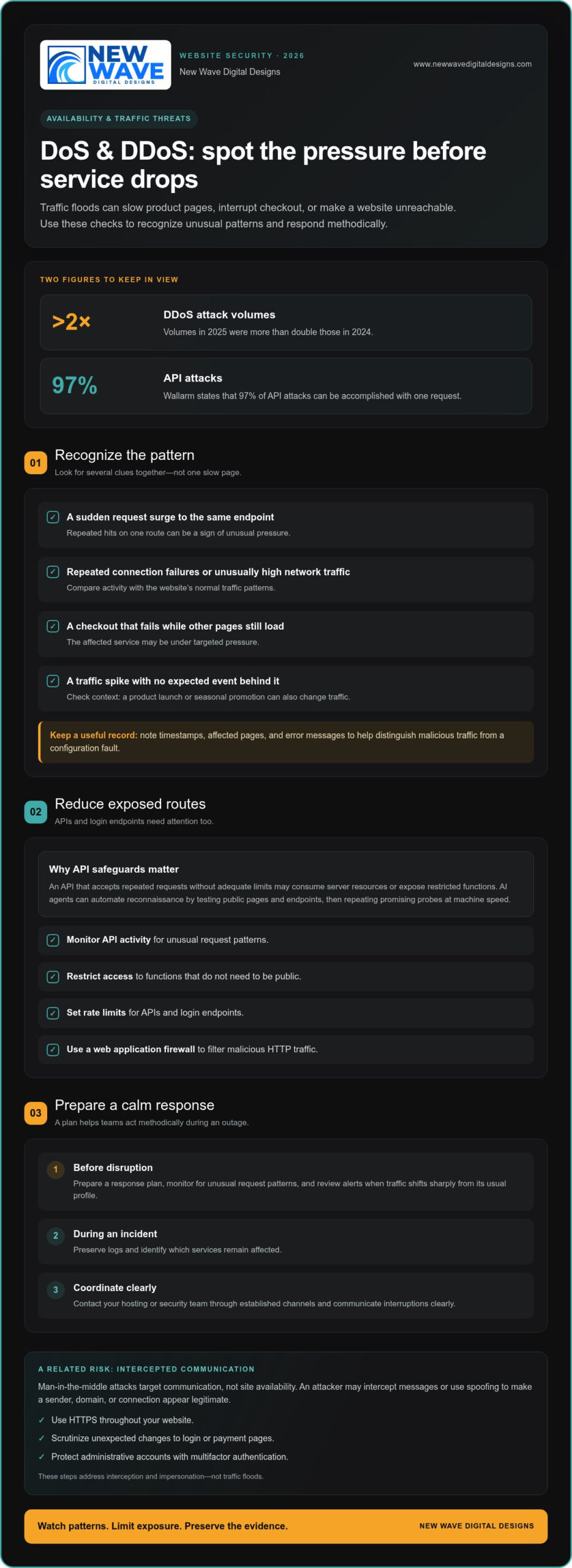
Among the common website security threats in 2026, denial-of-service attacks stand out for their ability to interrupt access. A denial-of-service (DoS) attack overwhelms a website or system until it cannot function properly. A distributed denial-of-service (DDoS) attack uses traffic from multiple sources to create that pressure. DDoS attack volumes in 2025 more than doubled compared with 2024. For an online store, a surge of requests can slow product pages, interrupt checkout, or make the site unreachable.

Look for patterns rather than a single slow page. A sudden surge of requests to the same endpoint, repeated connection failures, or unusually high network traffic can indicate an attack. Compare activity with normal patterns, such as a product launch or seasonal promotion. If checkout fails while other pages load, the affected service may be under targeted pressure. Record timestamps, affected pages, and error messages to help distinguish malicious traffic from a configuration fault.

DDoS remains one of the common website security threats in 2026, and APIs can provide another route to disruption. An API that accepts repeated requests without adequate limits may consume server resources or expose restricted functions. Wallarm states that 97% of API attacks can be accomplished with one request. AI agents can automate reconnaissance by testing public pages and endpoints, then repeating promising probes at machine speed. Monitor API activity and restrict access to functions that don’t need to be public.

Man-in-the-middle attacks target communication rather than site availability. An attacker intercepts messages between parties who believe they’re communicating directly, potentially exposing data in transit. Spoofing can make a sender, domain, or network connection appear legitimate. For example, a fake login page may imitate a real service. Use HTTPS throughout your website, scrutinize unexpected changes to login or payment pages, and protect administrative accounts with multifactor authentication. These steps address interception and impersonation, not just traffic floods.

Prepare a response before an outage occurs. A web application firewall can filter malicious HTTP traffic, while monitoring can reveal unusual request patterns. Set rate limits for APIs and login endpoints, and review alerts when traffic shifts sharply from its usual profile. During an incident, preserve logs and identify which services remain affected. Contact your hosting or security team through established channels, and communicate interruptions clearly. A tested response plan helps teams act methodically instead of making rushed changes that cause further disruption.

2. Malware types, including Trojans, adware, spyware, and ransomware

Malware is software designed to disrupt systems, access information without permission, or monitor online activity. A Trojan may disguise itself as a legitimate download; adware can push unwanted advertisements, while spyware secretly gathers information. Ransomware encrypts files and may demand payment for their release. Microsoft reported an average of 4.5 million net new malware file blocks per day in 2025, illustrating the scale of malicious files security tools must identify.

Some malware targets the browser directly. A compromised advertisement, injected script, or deceptive download can take visitors to a malicious page or attempt to install unwanted software. Infostealers aim to collect credentials, session tokens, or other sensitive data. If an employee signs in through a fake login page, stolen credentials may let an attacker access business accounts without installing malware on the website itself.

Credential theft can turn one infected device into a wider incident. Reports estimated that more than 15 billion sets of compromised credentials were available on the internet. An infostealer may capture saved passwords or browser data, then send them to an attacker for remote use. Watch for unfamiliar logins, unexpected password-reset messages, and changes to administrator accounts. If credentials may be exposed, reset them, revoke active sessions, and review account activity.

Ransomware can halt an organization’s work by encrypting files and disrupting access to essential systems. Some crews shifted toward data theft during 2024–2025, creating pressure to pay even when files can be restored. Cryptojacking takes another route: malicious code secretly uses a device’s processing power to mine cryptocurrency. Unexpectedly high resource use, sluggish performance, or unfamiliar processes can be clues. Preserve relevant logs and isolate affected devices before investigating further.

AI-assisted and polymorphic malware add a layer of adaptability. The Beckage Firm identifies AI-powered and AI-adaptive malware and attacks as emerging cybersecurity threats for 2026. Polymorphic malware changes parts of its code to evade signature-based detection, so relying on a single scanner can leave blind spots. Keep software and security tools updated, limit administrator privileges, and maintain tested backups. A recognizable visual system can help customers distinguish official messages from imitations; professional graphic design can support that consistency, while technical controls address malware itself.

3. Patch management and vulnerability exploitation

An unpatched application leaves a known weakness available for attackers to exploit. More than 30,000 vulnerabilities were disclosed in the year before publication, and the average time from disclosure to exploitation had decreased to five days. That narrow window makes routine patch management essential. Keep an inventory of website software, plugins, themes, server components, and connected services, then prioritize updates that address vulnerabilities attackers are already exploiting.

The CISA Known Exploited Vulnerabilities catalog added 245 vulnerabilities in 2025 and ended the year with 1,484 entries. Use such catalogs to help identify urgent fixes, then apply them in a controlled order: assess the affected component, back up critical data, test the update, and deploy it. Record what changed and confirm the website still works. A legacy system that no longer receives updates needs particular attention because its flaws can remain exposed.

SQL injection shows how a vulnerable application can put sensitive information at risk. If an application handles untrusted input poorly, attackers may alter database queries to view, change, or delete stored data. The OWASP Top 10:2025 injection category included more than 14,000 SQL injection CVEs. Review forms, search fields, and other inputs that pass data to a database. Developers can reduce exposure by validating input and using parameterized queries instead of building database commands from raw user text.

Patch management must also cover software in the supply chain. A vulnerable plugin or library can introduce risk even when the website’s own code hasn’t changed. Keep an up-to-date list of dependencies, remove components the site no longer uses, and watch for security updates from their maintainers. Social engineering can complicate this process: a fake update notice may persuade an administrator to install a malicious file. Use trusted software channels and verify update instructions through established account controls.

Connected devices add another layer. Statista projects more than 40.6 billion Internet of Things devices by 2045, expanding the range of systems that may connect to networks and website services. A vulnerable camera, router, or other device can provide an entry point if it shares access with business systems. Change default credentials, restrict device access to necessary functions, and install available updates. To detect recurring gaps, schedule regular reviews of software versions, access permissions, and unresolved vulnerability alerts.
Common Website Security Threats in 2026 and How to Spot Them

4. How do you recognize a phishing attack?

Phishing uses impersonation to trick people into sharing sensitive information or downloading malware. A message may use a familiar supplier’s name, imitate a sign-in page, or claim an account needs immediate attention. Check the sender’s full email address, unexpected links, and requests to reveal passwords. Criminals often exploit trust and urgency rather than a technical flaw in the website itself.

Business email compromise can resemble a routine workplace request. For example, a message that appears to come from an executive may ask an employee to change payment details or share account credentials. Verify unusual requests through a separate, established communication channel before acting. Treat unexpected changes to supplier payment information as a warning sign, even when a message includes familiar names, signatures, or project details.

Text-message scams use the same social engineering through SMS. A message might impersonate a delivery company, bank, or website administrator and direct the recipient to a counterfeit login page. The Department of Homeland Security estimated that the Smishing Triad made over $1 billion from U.S. text scam victims over three years. Don’t use the message’s link; open the organization’s known app or type its established address yourself.

AI can make impersonation messages sound polished and context-aware, while voice-cloning tools can imitate a familiar speaker. That doesn’t mean every unusual message is an attack, but it does make a familiar tone less reliable as proof. Assess the request itself: does it demand secrecy, bypass normal approval, or pressure someone to act immediately? Confirm sensitive instructions using a previously known phone number or internal process.

Social engineering can also target people who manage website infrastructure. An attacker might pose as a hosting or security provider, then request administrator access or persuade staff to disable protections. A fake outage alert could encourage hurried changes during a traffic disruption. Keep a clear escalation process, limit account permissions, and have staff report suspicious requests through a designated channel instead of replying directly.

Practical protection combines phishing-resistant multifactor authentication, staff awareness training, and email filtering. For a suspicious message, don’t click links or open attachments. Report it, verify the sender independently, and alert the team responsible for website accounts. If someone has entered credentials, reset them promptly, revoke active sessions, and review sign-in activity. These steps can help contain an incident before stolen access affects customer accounts or site operations.

5. Supply-chain and third-party access risks

Website defenses can be weakened through a trusted plugin, cloud service, or vendor account. Alongside denial-of-service attacks, malware, unpatched vulnerabilities, and phishing, supply-chain compromise is a major website security concern in 2026. A third party may introduce vulnerable software or hold credentials that grant access to customer data, site settings, or connected systems.

Software supply-chain risks arise when attackers compromise code, dependencies, or distribution channels before updates reach a website. In December 2024, a campaign compromised at least 36 Chrome extensions. An extension with broad browser permissions may expose activity or data even though users installed it for a legitimate purpose. Review the software and extensions connected to your site, remove tools no longer needed, and limit permissions to essential functions.

The OWASP Top 10:2025 software supply chain failures category recorded 215,248 total occurrences. OWASP’s score table lists an average incidence rate of 5.72% for this category. These measures underline why software components and update paths deserve regular review. Keep an inventory of plugins, libraries, hosting integrations, and vendor connections. For each, record its purpose, access level, and update source, then remove components that no longer support a business need.

Cloud services can create a separate exposure if storage or access settings are misconfigured. An open storage bucket, default password, or over-permissioned account may expose private data without a sophisticated attack. Require unique credentials and multifactor authentication for third-party accounts, restrict access to what’s necessary, and remove access when a vendor relationship ends. Review account activity for unfamiliar logins, unexpected permission changes, or new integrations.

In the United States, the CCPA and HIPAA are relevant data-protection frameworks, with HIPAA governing healthcare data handling. GDPR also imposes data-protection requirements where it applies. The rules relevant to a website incident depend on the organization, the data involved, and the applicable jurisdiction. There isn’t one universal reporting rule for every website.

Strengthen supply-chain defences by reviewing vendor access, software updates, and cloud configurations as a connected process. Keep a record of who can access sensitive data, which systems each account can reach, and how credentials are managed. Include third-party access in incident response planning so teams can identify affected integrations and revoke compromised credentials promptly. A security review should also assess whether vendors’ software still serves a necessary purpose.

If a website’s vendor access, software, or hosting setup needs a closer security review, explore website security support as a practical next step.

New Wave Digital Designs: Shopify Website Design

New Wave Digital Designs helps businesses create and maintain websites with Shopify Website Design, WordPress Website Design, SquareSpace Website Design, and Website Maintenance. If a security review shows that your site needs structural updates, a platform redesign, or ongoing maintenance, these services can help you address its design and upkeep together. A clear, well-maintained site is easier to manage as your business and digital needs evolve. Contact New Wave Digital Designs to discuss a new Shopify store, a WordPress or SquareSpace redesign, or ongoing website maintenance.

Build Security Into Your Website’s Next Chapter

Understanding the common website security threats in 2026 is a starting point, not a one-time task. As your website changes, its design, connected tools, and access needs change too. Make security part of future decisions: consider how new features will be maintained, who needs access, and how updates fit into your regular website care.

If your next step is creating or reshaping a website, New Wave Digital Designs offers Shopify Website Design, WordPress Website Design, and SquareSpace Website Design. Thoughtful platform design can provide a clearer foundation for ongoing maintenance, while security practices remain essential to managing the site.

Bring your website goals and questions together, then explore a next step that suits your business. Contact New Wave Digital Designs to discuss your website needs and shape a considered path forward.

Frequently Asked Questions

What are the biggest cyber threats in 2026?

Key threats include credential-based attacks, ransomware, software supply-chain compromise, and attacks that use AI to adapt or scale. The Beckage Firm also identifies identity-provider compromise and AI-powered attacks as emerging cybersecurity concerns for 2026. For a business, the most pressing risk depends on what attackers could reach through stolen accounts, connected software, or exposed systems. Start by mapping critical accounts and data, then prioritize protections around those entry points.

How do you recognize a phishing attack?

Look for a mismatch between the sender’s identity and the requested action. For example, a supplier’s familiar display name paired with an unfamiliar reply address deserves scrutiny, especially if the message asks for a password or changed payment details. Don’t reply or use its links. Contact the sender through a previously established channel, report the message internally, and preserve the original email so security staff can examine the sender details and headers.

How has AI changed the cyber threat landscape?

AI can help attackers create convincing messages, automate reconnaissance, and adapt malicious code to evade familiar detection patterns. It also creates risks inside organizations: the Beckage Firm identifies prompt injection, model poisoning, and attacks on AI systems as emerging concerns for 2026. Businesses using AI-connected tools can reduce exposure by limiting sensitive data in prompts, restricting system permissions, and reviewing how model outputs connect to applications and business accounts.

What are Cyber Security Trends?

Cybersecurity trends are shifts in attacker methods and defensive priorities. In 2026, concerns include identity compromise, AI-assisted attacks, supply-chain weaknesses, and unpatched legacy systems, according to the Beckage Firm’s emerging-threat analysis. On the defensive side, organizations are focusing on continuous verification, stronger authentication, and visibility into third-party connections. Treat trends as prompts to review your own systems, not as proof that every business faces the same risks.

What are Web Security Threats?

Web security threats are actions or weaknesses that can affect a website, its users, or the systems connected to it. Examples include data exposure from misconfigured storage, unauthorized access through weak controls, and attacks that misuse application inputs. In OWASP Top 10:2025 data, all tested applications had some form of broken access control and security misconfiguration. Review who can access administrative functions and whether services expose data beyond their intended audience.

What are the most common types of cybersecurity threats?

Common categories include malware, ransomware, phishing, denial-of-service attacks, vulnerable software, and unauthorized access. OWASP’s Top 10:2025 also highlights security misconfiguration and cryptographic failures, showing that risk can stem from both attack techniques and implementation weaknesses. To make the categories useful, connect each one to a real asset: customer accounts, payment functions, staff email, or stored data. That mapping helps teams decide which safeguards and incident procedures deserve attention first.

What do 2026 reports say about website attacks and data breaches?

Reports point to sustained attack activity, but broader cyber incident figures shouldn’t be mistaken for website-only counts. In New Jersey, the NJCCIC received 954 cybersecurity incident reports in 2025, a 92 percent increase over 2024. These figures provide context, not a forecast for any individual website or business.

How do SQL injection and cross-site scripting threaten websites?

SQL injection targets the way an application queries its database, while cross-site scripting (XSS) places malicious scripts in content a browser displays. Injection flaws can allow attackers to manipulate application inputs and affect data or system behavior. Developers can reduce these risks by using parameterized database queries, validating input, and encoding output before displaying it. Test forms, search results, and user-submitted content because each can pass data into application code.

Website Security & Hosting: A Practical Guide for 2026

What if your website’s weakest security link isn’t a flaw in its design, but a gap between where it’s hosted and how it’s cared for? Website security and hosting services work together to keep a site available and better protected, but their roles are different. Hosting provides the foundation; security controls and ongoing maintenance help keep that foundation resilient.

If you’re unsure what protection your site needs, start by listing the tasks someone must handle: updates, account access, backups, monitoring, and recovery. A hosting plan, maintenance service, and security support can cover different responsibilities, so check what is included and who owns each task. This guide explains the protections to evaluate, practical questions to ask providers, and how to compare self-managed hosting with managed support. Use the guidance to choose an approach that suits your platform, your site’s needs, and the expertise available to you.

Key Takeaways

  • Clarify which responsibilities belong to your hosting provider, maintenance support, and security process.
  • Assess several layers of protection, including access controls, software updates, encrypted connections, monitoring, and recovery.
  • Compare website security and hosting services by their written scope and assigned responsibilities, not just by plan names.
  • Before comparing providers, note your platform, business needs, traffic, and current technical capacity.
  • Decide whether managed support fits your site’s complexity, available time, and need for continuity, then confirm the exact deliverables.

Website Security and Hosting Services: What Each One Does for Your Site

A business website needs to stay accessible, function as intended, and earn visitors’ trust. It’s reasonable to ask who is responsible if the site goes offline, software becomes outdated, or an account is compromised. Hosting and security are connected, but they address different needs: hosting provides the environment for the site, while security practices and controls help reduce risks to the site, its accounts, and its data.

What do website hosting services actually provide?

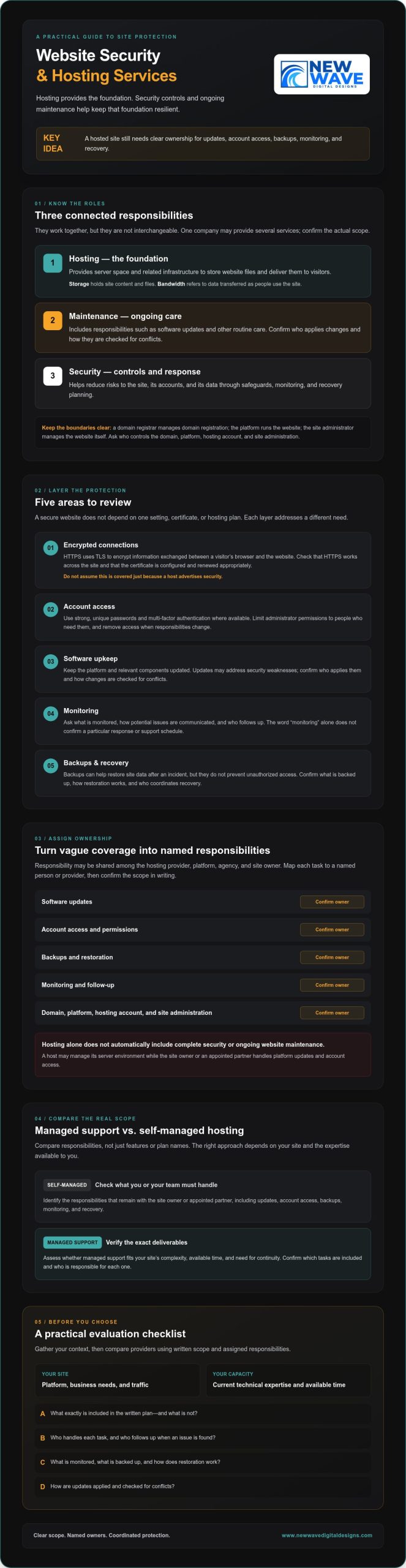
Hosting provides server space and related infrastructure to store a website’s files and deliver them to visitors over the internet. Storage holds site content and files; bandwidth refers to the data transferred as people use the site. A domain connects a memorable web address to the services that direct visitors to the site. Providers package these services differently, so check the written plan details rather than relying on a feature name. For a foundational overview, see Web hosting service.

Hosting is distinct from the domain registrar, which manages domain registration; the website platform, such as WordPress, Shopify, or Squarespace; and the site administrator, who manages the website itself. One company may provide several of these services, but that doesn’t make their responsibilities interchangeable. When comparing providers, ask who controls the domain, platform, hosting account, and site administration.

Why hosting and security need to work together

A hosted site still needs safeguards and ongoing care. Software updates can address known weaknesses, account protections help limit unauthorized access, and encrypted connections help protect information exchanged between a site and its visitors. Monitoring and recovery planning are separate considerations. Ask what each service includes, who handles the task, and what happens if a problem affects availability or data.

Responsibility may be shared among the hosting provider, platform, agency, and site owner. For example, a host may manage its server environment while the site owner or an appointed partner handles platform updates and account access. Hosting alone doesn’t automatically include complete security or ongoing website maintenance.

To understand how routine updates and other care fit into the picture, see the guide Website Maintenance Services. When comparing website security and hosting services, map each responsibility to a named person or provider, then confirm the scope in writing. New Wave Digital Designs offers managed hosting and security alongside website maintenance and support for WordPress, Shopify, and Squarespace sites. Confirm which deliverables fit your platform and needs.

How Website Security Layers Protect a Hosted Site

A secure website doesn’t depend on one setting, certificate, or hosting plan. It relies on coordinated controls and consistent maintenance, with clear responsibility for each layer. Protections included in a hosting or support plan vary, so distinguish general good practice from features a provider has confirmed in writing. IBM’s overview of What is web hosting offers context on the infrastructure beneath a site, but the site’s wider security needs still require attention.

Which security controls should site owners understand?

Think of security as several connected areas, each addressing a different risk:

  • Encrypted connections: HTTPS uses TLS to encrypt information exchanged between a visitor’s browser and the website. Check that HTTPS works across the site and that its certificate is configured and renewed appropriately. Don’t assume this is covered just because a host advertises security.
  • Account access: Use strong, unique passwords and multi-factor authentication where available. Limit administrator permissions to people who need them, and remove access when responsibilities change.
  • Software upkeep: Keep the platform and relevant components updated. Updates may address security weaknesses, but confirm who applies them and how changes are checked for conflicts.
  • Monitoring: Ask what is monitored, how potential issues are communicated, and who follows up. The word “monitoring” alone doesn’t confirm a particular response or support schedule.
  • Backups and recovery: Backups can help restore site data after an incident, but they don’t prevent unauthorized access. Confirm what is backed up, how restoration works, and who coordinates recovery.

How platform choice changes security responsibilities

With WordPress, a site may rely on separately maintained core software, themes, and plugins. Those components can have different update schedules, so establish who reviews and applies updates and how changes are managed. Hosting support may cover some tasks, but confirm the scope for your specific arrangement.

Shopify and Squarespace manage their platform infrastructure, which changes what the site owner needs to oversee. It doesn’t remove every security responsibility: account access, staff permissions, content, and connected services still need thoughtful management. Across platforms, ask where the provider’s responsibility ends and yours begins.

These distinctions make website security and hosting services easier to assess: look for coordinated care, not a promise that risk can be eliminated. To discuss how hosting, security, and maintenance responsibilities fit your platform, explore managed hosting and security support with New Wave Digital Designs, then confirm the specific scope that meets your site’s needs.

Managed Hosting vs. Self-Managed Hosting: Compare Responsibilities, Not Just Features

A site can appear to run smoothly while still relying on updates, access reviews, and recovery plans that nobody has clearly taken ownership of. Managed support may seem unnecessary if nothing is wrong, but the useful comparison isn’t simply which plan has more features. Consider who has the time and expertise to handle essential tasks consistently, and what happens when a problem needs attention.

The labels “managed” and “self-managed” don’t guarantee a standard set of services. Use this table as a starting point, then check the provider’s written scope. The CISA website security guidelines also offer context on the different areas that contribute to protecting a website.

Responsibility Self-managed hosting Managed hosting
Infrastructure Owner selects and oversees the hosting environment. Provider may manage some infrastructure tasks; confirm which ones.
Updates and security checks Owner or appointed administrator schedules and carries them out. May be included in the service scope, but frequency and coverage vary.
Troubleshooting Owner investigates issues or coordinates with separate providers. Provider may assist within agreed responsibilities and channels.
Backups and recovery coordination Owner arranges backup processes and identifies who will restore the site. Confirm whether backups, restoration, and recovery coordination are included.

When can self-managed hosting be a reasonable fit?

Self-management can suit an owner or team with the technical skills, time, and documented process to care for the site. Assign responsibility for applying updates, reviewing alerts, managing account access, and coordinating recovery. If those tasks have clear owners and aren’t left until something breaks, self-managed hosting may be practical. It isn’t inherently unsafe; the quality of the operating plan matters.

What should managed website support clarify?

Ask which hosting, maintenance, and security tasks are included, excluded, or billed separately. Confirm support channels and expectations, responsibility boundaries, and how backups and recovery are handled. Get the details in writing instead of assuming a plan name describes the service. The guide Website Maintenance Services can also help clarify how ongoing care fits alongside hosting.

Choose the model that fits your site’s complexity and your team’s capacity. For website security and hosting services, clear ownership is as important as the feature list.

Website Security & Hosting: A Practical Guide for 2026

How to Evaluate Website Security and Hosting Services: A Practical Checklist

Start with your website as it exists today, not with a provider’s feature list. Identify your platform, what the business needs the site to do, expected traffic patterns, and which technical tasks someone already handles. This context helps you compare website security and hosting services against real responsibilities rather than assumptions.

Questions to ask before choosing a hosting provider

Ask the provider where its service scope, availability commitments, support hours, and exclusions are documented. Request specific details about backups and restoration, migration steps, and tasks relevant to your platform. Don’t infer backup frequency, performance, or response times from a plan name or general marketing language.

  • 1. Map your platform and requirements. Record whether the site uses WordPress, Shopify, Squarespace, or another platform. Note essential functions, expected traffic needs, and any technical responsibilities your team wants to retain or delegate.
  • 2. Clarify what the service covers. Ask who manages hosting infrastructure, platform or software updates, security checks, troubleshooting, and recovery coordination. For each task, identify what’s included, excluded, or handled separately.
  • 3. Verify support and availability terms. Find the written commitments, support hours, contact channels, and escalation process. Ask how the provider communicates planned changes or issues that could affect the live site.
  • 4. Understand backup and migration procedures. Ask what data is backed up, how restoration requests are handled, and what steps a migration involves. Confirm who coordinates platform-specific tasks and how the process is planned to limit avoidable disruption.
  • 5. Create a secure site record. Document administrator accounts, domain and hosting renewal dates, backup arrangements, and support contacts. Store this information securely, restrict access to people who need it, and keep credentials in an appropriate password manager rather than an open document.
  • 6. Review the current security posture. Inventory administrator access, active themes, plugins, and other software, then note who manages hosting and domain access. Check whether HTTPS is active and whether update and recovery procedures are documented. Direct unresolved questions to the relevant host, platform provider, or qualified website professional.
  • 7. Coordinate changes before they go live. Agree who will make technical changes, when they’ll happen, and how the site will be checked afterward. Updates, migrations, and access changes should be coordinated to reduce avoidable disruption to a working site.

Use the completed checklist to compare providers or uncover gaps in your current arrangement. If you’d like a partner to help assess hosting, security, and ongoing site-care responsibilities, explore hosting and security support from New Wave Digital Designs and confirm which services fit your platform and needs.

When Managed Website Security and Hosting Support Makes Sense

Managed support isn’t automatically the right choice for every website. The decision depends on whether your team can reliably handle ongoing responsibilities, how complex the site is, and how important continuity is to your business. A simple site with a capable owner and a documented care routine may be manageable in-house. A site that supports sales or daily operations may need clearer ownership and coordinated help, especially if downtime would interrupt important work.

Signs your site may benefit from ongoing support

Consider a review if nobody is clearly responsible for site updates, administrator access, or recovery planning. The same applies if essential website tasks compete with other work and are often postponed. These aren’t reasons to panic; they’re signs to establish who does what.

Start by asking whether your current arrangement gives you a dependable way to maintain the site and address issues. If the website plays a meaningful role in sales or operations, assess how an interruption would affect customers and staff. A measured review can reveal real gaps without assuming every site needs the same level of support.

What to discuss with a managed hosting and security partner

Bring a clear picture of your site: its platform, current host, key functions, and any concerns you’ve noticed. Explain what technical knowledge and time your team can contribute. This gives a potential partner context to discuss a workable division of responsibilities rather than offering a generic plan.

Ask for a written scope that separates hosting, website maintenance, and security tasks. Clarify what’s included and excluded, how communication works, and who is responsible for updates, backups, restoration, and recovery coordination. Confirm that the proposed arrangement fits your platform. Managed services may help align hosting and ongoing care, but the service name alone doesn’t explain what will be delivered.

New Wave Digital Designs provides managed hosting and security alongside website maintenance and support for WordPress, Shopify, and Squarespace sites. The next step is a practical conversation about your setup and responsibilities, followed by confirmation of the specific scope that fits your needs.

Discuss website hosting and security support

Build a Care Plan That Fits Your Website

A resilient website starts with clear ownership. Hosting provides the foundation, while security and maintenance require coordinated attention to access, updates, and recovery. The right balance depends on your platform, your team’s expertise, and the responsibilities you’re prepared to manage.

As you compare website security and hosting services, look beyond a plan’s label. Ask what’s included, who handles each task, and how support fits your site’s needs. Written answers make it easier to spot gaps and choose a practical approach, whether you manage the work in-house or bring in a partner.

New Wave Digital Designs offers managed hosting and security alongside ongoing website maintenance and support for WordPress, Shopify, and Squarespace websites. Confirm the specific scope for your platform and requirements. If you’re ready to review your setup, discuss website hosting and security support.

With clear responsibilities and thoughtful ongoing care, you can give your website a steadier foundation for what comes next.

Frequently Asked Questions

What is the difference between website hosting and website security?

Hosting provides the infrastructure that stores website files and makes them available to visitors. Website security refers to practices and controls that help reduce risks to the site, its accounts, and its data. For example, a host may provide server space, while account permissions, software updates, encrypted connections, and recovery planning involve additional responsibilities. One provider may handle some of both, so check the actual scope instead of assuming they’re one service.

Do website hosting services include security automatically?

Not necessarily. A hosting plan may include certain safeguards, but features and responsibilities differ by provider and plan. Ask specifically whether security checks, software updates, monitoring, backups, and recovery support are included, and who performs each task. Also clarify what’s excluded or handled by your platform provider, agency, or site administrator. A general “secure hosting” label doesn’t tell you which protections are active or how issues are handled.

Can a website be secure without managed hosting?

Yes. A website can be cared for without managed hosting if you or a qualified administrator can consistently manage the necessary responsibilities. Assign clear ownership for updates, account access, security checks, and recovery planning. Keep a record of procedures and review it as the site changes. Managed support can be useful when time or expertise is limited, but the right choice depends on your site’s needs and who can maintain it reliably.

How do I know whether my website hosting is secure?

Review the provider’s written scope and check your site’s current setup. Confirm that HTTPS is active, identify who manages software updates and administrator access, and ask what monitoring, backups, and recovery options are included. Check that you know how to contact the relevant provider and where support expectations are documented. These checks can reveal unanswered questions, but no single indicator proves that a site is fully protected.

What happens if my website is hacked while it is hosted?

The response depends on your platform, provider, and support agreement. Contact the host and platform provider through their documented channels, then follow their guidance. Avoid making uncoordinated changes that could complicate investigation or recovery. Review account access and preserve relevant messages or incident details. Ask in advance who investigates, who can restore the site, and whether recovery assistance is part of the service, since hosting alone doesn’t establish those responsibilities.

Does managed hosting include website backups and updates?

Sometimes, but the label “managed” doesn’t confirm that backups or updates are included. Ask whether backups cover your site’s relevant files and data, how restoration requests work, and who handles platform, theme, or plugin updates. Confirm the details in writing, including exclusions and any separate responsibilities. New Wave Digital Designs offers managed hosting and security alongside website maintenance and support, but confirm the specific deliverables for your site.

Are WordPress, Shopify, and Squarespace security responsibilities different?

Yes. WordPress sites may use separately maintained core software, themes, and plugins, so clarify who manages their updates. Shopify and Squarespace manage their platform infrastructure, but site owners still need to manage account access, staff permissions, content, and connected services. Each setup has different responsibility boundaries. Ask your platform provider, host, or website professional which tasks they handle and which remain yours, then document the division.

Secure Website Hosting Services: The Visionary Foundation for Small Business Growth

Did you know that 43% of all cyberattacks target small businesses, yet less than 14% of these enterprises are adequately prepared to defend their digital assets? For the visionary entrepreneur, a website is far more than a collection of code; it’s a digital sanctuary, a brand legacy, and a primary touchpoint for customer trust. You’ve poured your passion into your business, but the looming threat of data breaches and the confusion of technical jargon can make the digital landscape feel like a minefield rather than a playground for growth.

We believe that your online presence deserves the same level of craftsmanship as the products or services you provide. You need a partner who views security as an art form and performance as a promise. This article explores how secure website hosting for NJ small businesses provides the meticulous protection and architectural stability required to scale with confidence. You’ll learn how to safeguard your digital artistry, replace technical anxiety with peace of mind, and leverage superior loading speeds to delight your audience. Let’s build a foundation that is as resilient as it is beautiful.

Key Takeaways

  • Learn to recognize the hidden risks within high-volume, discount hosting environments and how these shared vulnerabilities can compromise your brand’s digital craftsmanship.
  • Understand how secure website hosting for NJ small businesses acts as a multi-layered architectural shield, protecting your creative assets with meticulous encryption and hardened protocols.
  • Evaluate the strategic benefits of a managed hosting partnership, which liberates you from technical burdens so you can focus entirely on your visionary growth.
  • Gain a strategic checklist for hardening your digital sanctuary, from implementing multi-factor authentication to verifying your provider’s rigorous security standards.
  • Discover how integrating secure hosting into a holistic maintenance strategy ensures your brand’s continuous evolution and builds lasting trust with your audience.

The Hidden Vulnerabilities of Standard Small Business Hosting

Many entrepreneurs believe their digital presence is safe simply because they’ve purchased a standard package from a high-volume provider. This is an illusion. Standard web hosting service models often prioritize density over depth, packing thousands of sites onto a single server to maximize profit. For your brand, this isn’t just a technical compromise; it’s a structural risk to your digital craftsmanship. When your site is treated as a commodity, its unique spirit is left vulnerable to the flaws of others. Actually, 43% of all cyberattacks now target small businesses. This isn’t a coincidence; it’s a strategy. Cybercriminals seek the path of least resistance, and discount hosting environments provide exactly that: vulnerability, instability, and risk.

The Risk of Shared Digital Environments

In these high-volume environments, you’re essentially living in a digital tenement. The “bad neighbor” effect is a very real threat to your brand’s integrity. If another site on your shared server has weak code, an outdated plugin, or a compromised password, an attacker can leap from their vulnerability into your sanctuary. This cross-site contamination bypasses your individual security efforts because the breach happens at the server level. True secure website hosting for NJ small businesses requires an isolated architecture where your data exists in a dedicated, meticulously hardened space. Without this isolation, your brand’s integrity depends on the weakest link in a chain you don’t control. You deserve a foundation that offers:

  • Resource Isolation: Ensuring that one site’s traffic spike or security breach doesn’t impact your performance.
  • Dedicated Security Layers: Moving beyond generic filters to implement site-specific protection.
  • Architectural Integrity: Building a digital home that is private, secure, and resilient.

The Evolution of Modern Cyber Threats

The landscape has shifted dramatically as we move through 2026. Automated scripts and AI-driven bots have made small businesses the primary target for sophisticated attacks. These threats don’t discriminate based on your company’s size; they simply look for open doors. We’re seeing a rise in complex database injections and phishing schemes that target the very heart of your customer data. When your site goes down or your data is leaked, the cost isn’t just financial. It’s the loss of customer resonance, the erosion of trust, and the fracturing of your professional image. Holistic security goes beyond a simple firewall. It involves continuous evolution, proactive monitoring, and a deep understanding of how technical protection supports your long-term vision. It’s about preserving the artistry you’ve worked so hard to create.

The Architecture of Technical Protection: Defining Secure Hosting

Secure website hosting is a multi-layered architectural shield that preserves the integrity, availability, and confidentiality of your digital assets through continuous, proactive defense. It transforms your online presence from a vulnerable page into a fortified digital sanctuary. This isn’t just about installing a plugin; it’s about a holistic strategy that anticipates threats before they manifest. When your hosting is treated as craftsmanship rather than a utility, every technical detail serves to protect your brand’s unique spirit and long-term vision.

Layers of a Secure Hosting Shield

A visionary hosting environment begins at the hardware level. We prioritize data centers with rigorous physical security and redundant power systems to ensure your brand’s foundation is unshakable. Beyond the physical, a Web Application Firewall (WAF) serves as a sophisticated digital sentry. It inspects incoming traffic in real-time, blocking malicious requests and mitigating DDoS attacks that could otherwise silence your voice. For those seeking secure website hosting for NJ small businesses, this level of technical guardianship is essential to maintain customer trust. Finally, automated daily backups provide the ultimate safety net, ensuring your creative investment can be restored instantly if a disruption occurs. This redundancy isn’t just a backup; it’s your insurance against the unpredictable.

Encryption and Identity Verification

Meticulous protection requires moving beyond the basic Domain Validation (DV) SSL certificates that have become a commodity. While the majority of small business websites now use HTTPS, the depth of that encryption varies significantly. Data from 2026 shows that 6% of small business websites still lack basic encryption, leaving them exposed to simple interceptions. We utilize advanced SSL/TLS protocols to create a private, encrypted tunnel for all data transmission. This commitment to security extends to how we manage your files. By exclusively using SFTP (Secure File Transfer Protocol) instead of standard FTP, we eliminate the risk of credentials being intercepted in plain text. This methodical approach ensures that every interaction on your site remains a private dialogue between you and your client. If you’re ready to elevate your digital infrastructure, our team can help you design a customized security strategy that reflects your brand’s excellence. It’s about ensuring that your database integrity is never compromised and your customer data remains a private sanctuary.

Managed vs. Unmanaged Hosting: Evaluating the Strategic Investment

Choosing a hosting environment is a pivotal moment in your brand’s journey. It’s the decision between being a tenant who must also act as the building’s janitor, or being a visionary resident in a meticulously curated estate. While unmanaged hosting is often marketed as a budget-friendly option, it demands a significant sacrifice of your most precious resource: time. When you invest in secure website hosting for NJ small businesses, you aren’t just buying server space; you’re securing a partnership that protects your creative energy from being consumed by technical minutiae.

The Hidden Labor of Unmanaged Solutions

Unmanaged hosting places the full weight of technical maintenance on the business owner. You become the one responsible for the architecture. Who handles the critical security patches when a new vulnerability is discovered? Who manages the server updates to ensure compatibility with PHP 8.5? In an unmanaged environment, these tasks often fall by the wayside, leading to digital stagnation and increased risk. A single manual error during a routine update can shatter your site’s functionality, causing downtime that erodes customer resonance and trust. The “cheap” price tag of these services rarely accounts for the hidden costs of stress, security lapses, and the missed opportunities that occur when you’re stuck in the technical weeds rather than focusing on your brand’s evolution.

Managed Services as a Growth Catalyst

Managed hosting functions as a sophisticated extension of your own creative team. It’s a boutique approach where a “Digital Architect” listens to your needs and applies technical expertise to ensure your site evolves alongside your business. This partnership includes proactive hardening of your environment, performance optimization that keeps your site fluid, and the peace of mind that comes from expert oversight. By integrating these hosting solutions with comprehensive website maintenance services, you create a holistic defense system for your brand. Investing in managed secure website hosting for NJ small businesses ensures that your performance, security, and scalability are always evaluated in tandem by professionals who care about your long-term success. This allows you to step away from the server logs and return to the visionary work that truly moves the needle. Secure hosting should be a catalyst for your growth, not a barrier to it, ensuring your digital presence remains as resilient as it is beautiful.

Secure Website Hosting Services: The Visionary Foundation for Small Business Growth

A Strategic Checklist for Hardening Your Digital Presence

A visionary digital presence requires more than just a beautiful facade; it demands a structural integrity that withstands the tests of the modern web. Think of this checklist as your architectural blueprint for fortification. By moving beyond passive observation and into active guardianship, you ensure your brand’s story remains uninterrupted and its data remains a private sanctuary. High-quality secure website hosting for NJ small businesses provides the essential foundation, but your ongoing strategy determines the height of your digital resilience. It’s about creating a culture of security that mirrors the excellence of your brand.

Core Security Fundamentals

The first step in any hardening process is the verification of your hosting provider’s technical protocols. While secure website hosting for NJ small businesses handles much of the heavy lifting at the server level, your internal administrative policies must be equally robust. You must ensure your provider prioritizes hardware-level security, real-time threat detection, and isolated server environments. Beyond the provider, administrative access is your site’s most sensitive entry point. Implementing multi-factor authentication (MFA) is no longer optional; it’s a fundamental requirement for any serious enterprise. This single layer of identity verification can prevent the vast majority of automated credential attacks. Additionally, your brand benefits from:

  • Malware Scanning: Regularly scheduled deep scans to identify and remove malicious code before it can take root.
  • Password Governance: Enforcing complex password policies that prevent brute-force entry across all user accounts.
  • Plugin Audits: Meticulous reviews of third-party software to eliminate outdated or vulnerable components that could compromise your craftsmanship.

For those utilizing specific platforms, our specialized WordPress maintenance services provide the deep-level security hardening required to protect your digital artistry from evolving threats. For a comprehensive approach to platform-specific protection, our WordPress security solutions guide offers a visionary roadmap to digital hardening that addresses 2026’s most sophisticated threats.

Performance and Speed as Security

Speed is often discussed in the context of SEO resonance, but it’s also a critical component of your security architecture. Slow, bloated websites are frequently the result of inefficient code or unoptimized assets, making them easier targets for bot-driven attacks. When a site responds slowly, it can mask the early signs of a DDoS attempt or a database injection. By using Content Delivery Networks (CDNs), you distribute your brand’s presence across a global network of servers. This doesn’t just improve loading times for your audience; it provides a distributed shield that absorbs and mitigates malicious traffic before it ever reaches your core hosting environment. Meticulous code optimization ensures your site is leaner, faster, and inherently safer. If you’re ready to audit your current infrastructure, we invite you to request a comprehensive security consultation to ensure your foundation is truly visionary.

Elevating Your Brand with Visionary Hosting and Maintenance

Transforming your digital foundation into a fortress of innovation requires a shift in perspective. You’ve worked tirelessly to build a brand that resonates with your audience, and your hosting strategy should reflect that same level of commitment. We position ourselves as your boutique digital architect, ensuring that your technical infrastructure is as inspiring as your creative vision. Integrating secure website hosting for NJ small businesses into a holistic brand evolution strategy isn’t just a safety measure; it’s a strategic move that empowers you to scale without fear. We craft partnerships built on trust, meticulousness, and expertise, allowing you to reclaim your time and focus on the future.

Our Meticulous Approach to Protection

We understand that every platform has its own unique spirit and structural requirements. Whether your brand lives on Shopify, WordPress, or Squarespace, our security solutions are customized to meet the specific demands of your digital environment. We reject the high-volume service factory model, opting instead for a boutique approach that treats every project with personal care. In an era of digital volatility, having a dedicated partner means your security is never static. We focus on continuous evolution, constantly hardening your defenses and optimizing your performance to stay ahead of emerging threats. For e-commerce brands in particular, pairing your secure hosting environment with the right Shopify maintenance packages ensures your storefront remains both resilient and conversion-ready as the digital landscape evolves. This meticulous attention to detail ensures your digital sanctuary remains uncompromised and your brand’s integrity stays intact.

The Next Step in Your Digital Realization

Visionary hosting is the silent engine behind your long-term SEO and marketing goals. When your site is secure, fast, and resilient, search engines reward that stability with higher visibility and better conversion rates. More importantly, the peace of mind that comes from expert-managed security allows you to lead with confidence. You don’t have to worry about technical jargon or the threat of downtime; instead, you can focus on capturing the true spirit of your business. True secure website hosting for NJ small businesses provides the architectural stability needed for continuous growth and customer trust. It’s time to elevate your digital presence and ensure your brand’s longevity. Secure your vision with New Wave Digital Designs and begin your journey toward a more resilient digital future. We invite you to transform your foundation into a lasting legacy of excellence.

Securing Your Digital Legacy and Future Growth

Your digital presence is the living heart of your business vision. We’ve explored how standard environments can compromise your brand’s integrity and why a multi-layered shield is essential for long-term resilience. By choosing a managed path, you move beyond the daily struggle of server maintenance and step into a space of strategic growth. This transition ensures that your performance, security, and scalability remain in perfect harmony, allowing your creative energy to remain focused on your brand’s evolution.

True secure website hosting for NJ small businesses isn’t just a technical necessity; it’s the invisible craftsmanship that preserves your artistry. At New Wave Digital Designs, we combine sophisticated security hardening protocols with a visionary approach to digital craftsmanship. Our meticulous technical support for Shopify and WordPress ensures your foundation is as resilient as it is beautiful. For Shopify store owners seeking to protect their e-commerce investment, exploring dedicated Shopify maintenance packages is an essential next step in building a truly fortified digital presence. Don’t let your digital sanctuary remain vulnerable to the generic risks of high-volume environments.

Partner with a Digital Architect for Secure Hosting today to transform your infrastructure into a fortress of innovation. Your brand’s evolution is a journey, and we’re here to ensure every step is taken with confidence and poise.

Frequently Asked Questions

What is the difference between standard and secure website hosting?

Standard hosting often prioritizes server density, packing thousands of sites into a single environment with minimal isolation. Secure hosting provides a multi-layered architectural shield that includes hardware-level security, real-time threat detection, and hardened server configurations. It’s the difference between a high-volume tenement and a private digital sanctuary. Secure website hosting for NJ small businesses focuses on structural integrity and proactive defense to ensure your creative assets remain uncompromised and resilient.

Why do small businesses need managed hosting services in 2026?

Small businesses have become the primary targets for automated, AI-driven cyberattacks that exploit minor technical oversights. In 2026, the complexity of modern threats requires expert oversight that most business owners cannot manage while running their companies. Managed hosting acts as a sophisticated extension of your creative team, handling critical security patches and software updates. This partnership allows you to focus on your brand vision while digital architects maintain your foundation.

Does secure hosting help with my website’s Google ranking?

Security is a confirmed ranking signal because search engines prioritize sites that provide a safe experience for users. Google favors websites that utilize HTTPS and maintain stable uptime without malicious interruptions. Secure website hosting for NJ small businesses prevents the injections that could lead to your site being blacklisted. Fast, resilient foundations also improve Core Web Vitals, which are essential for long-term search engine visibility and audience resonance.

Is an SSL certificate enough to make my website hosting secure?

No, an SSL certificate only encrypts data in transit between the server and the visitor’s browser. While this is essential for privacy, it doesn’t protect your site from server-side vulnerabilities, brute-force attacks, or malware injections. True security requires a holistic strategy, including Web Application Firewalls, regular software audits, and secure file transfer protocols. Think of an SSL as a locked front door; you still need a perimeter fence and a monitoring system.

How often should my website be backed up by my hosting provider?

Your website should be backed up automatically every single day to ensure your creative investment is always protected. These backups must be stored in an isolated, off-site location so they remain untainted if a server-level event occurs. In a visionary hosting environment, redundancy is treated as a core architectural principle. Having a fresh restore point ensures that your brand can be recovered instantly, preserving your professional continuity and customer trust.

Can I migrate my existing site to a more secure hosting environment?

Migration is a standard part of evolving your digital infrastructure and can be handled with meticulous attention to detail. A professional partner can transition your Shopify, WordPress, or Squarespace site to a hardened environment without data loss or significant downtime. This process involves a full audit of your current assets followed by a strategic move to a safer server. It’s an opportunity to rebuild your foundation on a platform that supports growth.

What happens if my website is hacked while on a secure server?

A secure environment significantly reduces risk, but no system is entirely impenetrable. If a breach occurs, a managed provider acts immediately to isolate the threat and restore your site from a clean, daily backup. Proactive monitoring often catches anomalies before they escalate into full crises. Your partner will then conduct a forensic audit to identify the entry point and implement additional hardening to prevent future vulnerabilities, ensuring your digital sanctuary remains protected.

How does secure hosting impact my website’s loading speed?

Secure hosting often improves speed by utilizing high-performance hardware and Content Delivery Networks. By filtering out malicious bot traffic at the firewall level, your server resources remain dedicated to serving legitimate customers rather than processing attacks. Lean, optimized code and advanced caching protocols further enhance this fluidity. This synergy between protection and performance ensures that your audience enjoys a seamless, fast experience that builds brand authority and increases customer conversion.