
More channels do not automatically make marketing more connected. Integrated digital marketing solutions bring channels, tools, workflows, and SEO together around a consistent message and shared business goals, so each part of a campaign supports the others.
It is easy to see why businesses invest in several forms of digital marketing: search, advertising, content, and email can each help reach potential customers. The challenge is making them parts of one considered strategy, rather than separate efforts competing for attention.
This article explains how integrated marketing works, how SEO fits into the broader system, and what an agency should coordinate across platforms and teams. You will also learn what to look for when choosing an agency and how to assess whether its approach connects your digital presence with your business goals.
Key Takeaways
- See how SEO, paid ads, content, email, and social media can reinforce one another through a consistent message.
- Understand how connected platforms, data, and workflows help campaigns work as a coordinated system.
- Learn how to align marketing goals and performance measures with the outcomes that matter to your business.
- Recognize how SEO supports visibility by matching useful content to what people are looking for.
- Assess an agency’s strategic fit by looking at how its services, communication, and approach support your business goals.
What Is Integrated Digital Marketing?
Integrated digital marketing coordinates channels around a consistent message and shared business goals. SEO, paid advertising, content, email, and social media each play a distinct role, but their timing and purpose are planned together.
Coordinating Channels and Marketing Timelines
Channel coordination connects campaign activities so they support the same audience journey. A person, for example, may discover a brand through search, see a paid ad, then read an email before taking action.
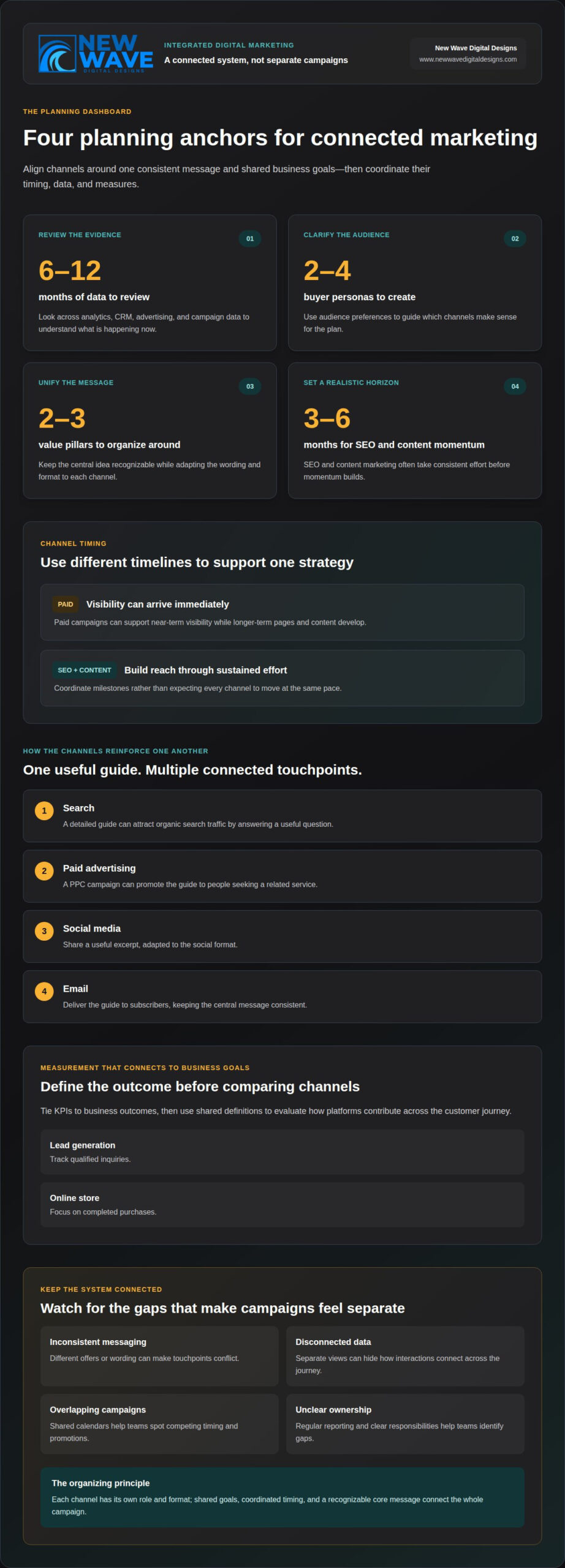
For example, a detailed guide can attract organic search traffic, while a PPC campaign promotes it to people seeking a related service. Social media can share a useful excerpt, and email can deliver the guide to subscribers. Each channel adapts the message to its format while preserving the central idea.
Timing matters, too. Paid campaigns may produce results immediately, while SEO and content marketing often need consistent effort; SEO and content marketing typically take 3-6 months to build momentum. A coordinated timeline can use paid visibility while useful pages and content develop longer-term reach.
Messaging Frameworks and Content Planning
A messaging framework defines the central message, audience, and value pillars that guide campaign content. A consistent brand voice helps each channel feel connected without forcing identical wording everywhere.
A practical framework can organize a brand’s message around 2-3 value pillars. For example, a home-services business might focus on reliability, clear communication, and convenient scheduling. A blog post can explain one pillar in depth, while a social post highlights a single tip from that article.
Content planning maps subjects to formats and campaign dates. A detailed guide can inspire smaller pieces, such as email content, social posts, and paid-ad copy. This builds a coherent presence and helps establish authority by offering useful answers, rather than relying on promotional messages alone.
Consistency does not mean repeating the same copy. A search page can answer a detailed question, an email can guide a subscriber to the page, and social media can introduce its key insight. The shared message stays recognizable as each channel serves its own purpose.
Rules, Planning Steps, and Common Challenges
In the United States, privacy, advertising, and email obligations depend on the data collected, audience, and campaign. Integrated planning accounts for privacy practices, truthful advertising, and responsible email handling across channels.
Professionals build a plan by reviewing 6-12 months of analytics, CRM, advertising, and campaign data; defining business goals; creating 2-4 buyer personas; selecting channels based on audience preferences; and tying KPIs to business outcomes. These steps give each channel a clear role and provide a basis for measuring progress.
Common challenges include inconsistent messaging, disconnected data, overlapping campaigns, and unclear ownership. An email promotion may conflict with a paid ad if each uses different offers or timing. Shared campaign calendars and regular reporting help identify those gaps.
Resource limits and different channel timelines can also complicate planning. Paid activity may move quickly, while SEO and content need sustained attention. Coordinating milestones lets teams adjust campaign timing without abandoning the broader strategy.
Connecting digital tools, channels, platforms, and workflows
A coordinated marketing strategy connects platforms, campaign data, and team workflows across the customer journey. This helps businesses align channel activity while adapting each message to its audience.
Integrated and Multi-Channel Marketing
Multi-channel marketing uses several platforms, while integrated marketing connects their messages, timing, and goals. Simply appearing across channels does not create a seamless customer journey.
A customer might see a paid search ad, visit a landing page, and later receive an email. A multi-channel setup can treat these as separate interactions; an integrated approach considers how each touchpoint supports the next. Teams align campaign calendars and shared objectives while letting each channel use formats suited to its audience.
Cross-Channel Measurement and Analytics
Cross-channel measurement evaluates how platforms contribute to shared outcomes, rather than judging each channel in isolation. It matters because a final click may not show where a customer first discovered a brand or what encouraged further consideration.
Professionals can bring campaign and customer data into a shared reporting view, then compare interactions across the journey. Predictive analytics can help identify patterns in past activity and inform decisions about campaign timing or audience focus. Teams still need clear measures: a lead-generation campaign might track qualified inquiries, while an online store may focus on completed purchases. Consistent definitions make comparisons more meaningful.
Customer Experience and Consistent Messaging
Cross-channel messaging adapts a consistent brand idea to each platform and customer interaction. Conflicting offers or visual styles can make a customer journey feel disjointed.
Consider a seasonal promotion: a landing page, email, and social media post should share its core offer and visual identity. Each channel can emphasize a different detail without changing the underlying message. Coordinated design elements, including typography and imagery, help reinforce recognition. Thoughtful graphic design for consistent campaigns can support that cohesion across digital touchpoints.
Agency Solutions and Separate Specialists
An integrated agency aligns channel planning and measurement, while separate specialists focus on individual disciplines. The right structure matters because coordination requires shared priorities, clear ownership, and communication between contributors.
Separate specialists can offer focused expertise, but the business may need to manage the handoffs between them. An integrated approach brings campaign planning, platform activity, and reporting under a shared strategy. The key difference is coordination: whichever structure you choose, someone must connect channel plans, data, and customer-facing messages.
That connection also depends on technology and workflow. APIs can let software systems communicate, helping teams move information between platforms. For instance, campaign data may feed a reporting dashboard, while agreed naming conventions help teams identify related activity. Tools support integration only when data definitions and responsibilities are clear. Documented processes for campaign approvals, updates, and reporting give teams a reliable structure for collaboration.
Definition and goals of integrated digital marketing
Integrated digital marketing connects channels and business decisions through one coordinated strategy. Its scope depends on the audience, desired outcome, and role assigned to each channel.
Definition and Scope
Integrated digital marketing aligns a brand’s channels, content, and campaigns around shared goals. Without coordination, separate activities can send disconnected messages or compete for attention.
Its scope can include SEO, paid advertising, email, social media, website content, design, and reporting. A campaign might use a search-focused article to answer a customer question, then support that article through paid promotion and an email. The channels remain distinct, but each contributes to the same business objective.
Integration also involves decisions beyond publishing. Teams establish how campaigns relate, what information should be shared, and which outcomes matter. For example, a retailer planning a seasonal offer can coordinate its landing page, ad creative, and follow-up email. The resulting strategy provides a structure for presenting the brand across customer touchpoints.
Goals and Target Audiences
Goal-setting defines the business result a campaign should influence and the audience it needs to reach. This matters because channel choices should follow customer needs and business priorities, not habit.
A professional plan begins by clarifying the company’s mission, then translating it into measurable objectives and suitable indicators. A hypothetical B2B SaaS goal might be increasing subscription MRR by 25% by Q4 2026. That objective can guide channel selection and campaign messaging, while avoiding activity that lacks a clear connection to the target.
Understanding the audience adds context. A marketing team can examine customer questions, purchase behavior, and feedback to identify different needs. A first-time buyer may need an introductory guide, while an existing customer may value information about a related product. These distinctions shape content topics, channel formats, and calls to action.
Business Benefits
The benefits come from coordinating activity around shared priorities and customer needs. Teams can then see how individual campaigns contribute to broader goals.
A service business can align a website page, search content, and paid advertising around one offer. Consistent messaging helps customers recognize the brand, while shared goals make it easier to assess whether each channel supports the intended conversion. The plan also clarifies priorities when resources are limited.
Integration can improve decision-making by giving teams a connected view of campaign activity. If a Google Ads campaign attracts clicks but few inquiries, the audience, message, and destination page can be examined together. That diagnosis is more useful than judging one channel alone. A coherent approach also gives brands a foundation for refining messages as customer needs and business priorities evolve.
Search engine optimization
Search engine optimization helps a website appear for relevant searches by making its pages useful, understandable, and easy to navigate. In an integrated strategy, SEO informs content priorities and works alongside paid advertising to support visibility at different stages of discovery.
Match Content to Search Intent
Strong SEO begins with understanding what a searcher wants to accomplish. Someone looking for “how to choose a standing desk” needs guidance, while someone searching “buy standing desk” is closer to a purchase. The page should meet that intent rather than simply repeat a target phrase.
Professionals can group searches by informational, navigational, and transactional intent, then map each group to a suitable page. An informational query may call for a detailed guide; a transactional query may need a clear product or service page. This structure helps search engines understand each page’s purpose.
Semantic optimization uses related terms, synonyms, and natural phrasing to clarify a topic. A guide about standing desks, for example, might discuss desk height, posture, and workspace setup. These concepts give readers useful context and help search engines interpret the page beyond a repeated keyword.
Build Useful, Connected Search Content
Content architecture gives important topics a clear home. A business can create a central page, then connect it to focused pages covering related questions. A landscaping company, for example, might organize its lawn-care information around seasonal care, soil preparation, and watering guidance.
Internal links help readers move between related resources and show how those pages fit together. Page titles, headings, and copy should clearly communicate each page’s subject. Quality matters throughout: a page should answer the question it targets, not merely attract a visit.
SEO also depends on the website experience. If visitors reach a mobile page with difficult navigation or unclear next steps, discovery may not lead to meaningful engagement. Responsive design and clear page structure support a smoother path from search result to relevant information.
Connect Search and Display Advertising
Search and display advertising can play complementary roles. Search ads respond to active queries, while display ads can introduce a brand or reinforce recognition before someone searches again. Coordinating creative and landing pages creates a more consistent experience.
A display ad can introduce an idea, while a later search result leads to a detailed guide on the same subject. Campaign teams can compare search activity, landing-page engagement, and conversions to understand how those touchpoints relate. That view is more informative than evaluating each ad in isolation.
SEO and paid search also serve different timelines. A paid campaign can provide visibility while an organic content library develops through ongoing optimization. Together, search advertising and useful organic pages can address immediate demand and build a durable foundation for future discovery.
Choosing an integrated marketing agency
Choose an agency by how well it connects business goals, campaign planning, execution, and reporting. A polished presentation matters less than a clear explanation of how the work supports your audience and business priorities.
Start with strategic fit. An agency should understand what the business wants to achieve, such as qualified inquiries, online sales, or stronger brand presence. A service company seeking more appointments needs a different campaign structure from an online retailer introducing a product. The proposed channels, creative work, and measures should reflect that distinction.
Next, assess how the agency connects communications across the customer journey. Its approach should show how a consumer might move from discovery to consideration and action. A sample campaign plan can demonstrate whether landing pages, advertising, and follow-up messages share a coherent purpose. Look for clear ownership of coordination, so planning doesn’t stop at separate channel recommendations.
Reporting should connect activity to meaningful outcomes. A useful report distinguishes reach, engagement, inquiries, and completed sales, then explains what those signals suggest. If an ad attracts clicks but few inquiries, analysis should consider the audience, message, and landing-page experience together. This shows whether the agency can interpret performance, not merely present platform metrics.
Before beginning, a well-structured engagement should establish:
- Goals: the business outcomes and audience the work will serve.
- Scope: the channels, creative responsibilities, and campaign deliverables.
- Communication: who approves materials and how decisions are shared.
- Measurement: which indicators will be reported and how they relate to goals.
These details clarify how work will proceed and where responsibilities sit. A practical example is a campaign calendar that identifies the landing page, ad creative, publication timing, and reporting owner. Clear planning reduces missed handoffs and makes changes easier to discuss.
In the United States, the cost of integrated digital marketing services depends on scope, channel mix, campaign complexity, and ongoing support; pricing is provided after a quote request. Define the intended work first, since a focused campaign and a broader ongoing program involve different resources.
Finally, consider whether the agency’s recommendations fit the business. A suitable plan should explain why particular channels suit the audience, how communications will stay aligned, and what the team will learn from results. Generic promises or disconnected deliverables may not provide the coordination an integrated strategy requires.
New Wave Digital Designs
New Wave Digital Designs helps businesses strengthen the website at the center of their digital marketing. When a website needs to better support campaign goals, customer journeys, or a consistent brand presence, professional design and maintenance can provide a considered foundation.
Whether you need a new Shopify, WordPress, or Squarespace website, or ongoing website maintenance, New Wave Digital Designs can shape the work around your business needs. A clear, well-maintained site gives visitors a coherent place to explore your services, respond to campaign messages, and take the next step.
If you’re ready to discuss how your website can support your marketing, contact New Wave Digital Designs.
Shape the Next Stage of Your Digital Growth
Turn a broad marketing ambition into a focused direction for your business. Consider what you want your digital presence to make easier: reaching a new audience, explaining your value, or helping visitors take meaningful action. A clear priority gives future decisions a stronger foundation.
Integrated digital marketing solutions are most useful when strategy and execution reflect the character of the business, not a generic template. That includes giving your website a purposeful role in the customer experience and ensuring its design supports how people encounter your brand. The direction can evolve as your priorities and audience needs change.
If you’re ready to explore how your website can support your next stage of growth, start a conversation with New Wave Digital Designs. A thoughtful next step can bring greater clarity to the digital presence you’re building.
Frequently Asked Questions
How long does it take to see results?
Paid campaigns may produce results quickly, while SEO and content marketing typically take 3-6 months to build momentum. The timing depends on the channel and the outcome being measured. For example, an ad can generate early visits, while improved organic visibility develops through sustained content and optimization. A useful evaluation separates early indicators, such as visits or inquiries, from longer-term outcomes, such as qualified leads.
What are integrated digital marketing solutions?
Integrated digital marketing solutions connect marketing activity around shared goals, so each interaction contributes to a coherent customer experience. The work can link a search result, website page, advertisement, and follow-up communication without making every channel identical. For example, a customer researching a service might discover an educational page, then encounter a related offer. The strategy gives each touchpoint a role and keeps the brand’s central promise recognizable.
Which services are included in an integrated digital marketing strategy?
The services depend on the business goal and audience, rather than following a fixed package. A strategy may coordinate organic SEO, paid search, website design, content, email, social media, and graphic design. New Wave Digital Designs provides website design for Shopify, WordPress, and SquareSpace, along with website maintenance, Google Ads, Bing Ads, organic SEO, and graphic design. A plan should define which activities serve the goal and who handles each one.
How do integrated digital marketing solutions work across channels?
They connect channel roles, campaign timing, and shared performance information. A business might use an educational page to address a customer question, promote that resource through advertising, then use campaign data to understand which visits lead to inquiries. Each platform contributes a different interaction. Coordinated reporting helps the team assess whether the sequence works, rather than treating every click or impression as an isolated result.
How do you choose an integrated digital marketing agency or platform?
Choose based on strategic fit, clear responsibilities, and useful reporting. An agency should explain how its recommendations connect to your business goals, while its platforms should support the data and workflows your team uses. A business that needs website improvements and paid search, for example, should understand how the work is coordinated. Look for clear deliverables, defined measures, and communication that helps decision-makers act on campaign findings.
Which metrics measure the success of integrated digital marketing campaigns?
Choose metrics that reflect the campaign’s business objective. Lead-generation work can track qualified inquiries and lead conversion rates; an online store can monitor completed purchases and customer lifetime value. Supporting measures, such as impressions, clicks, and page engagement, help explain how people respond before converting. Reviewing these measures together can reveal whether a campaign attracts the right audience and where the customer journey may need refinement.