
A website redesign can look polished and still fall short if support, analytics, or hosting were never discussed. Knowing how to write a website design request for proposal means clearly setting out your goals, audience, scope, and expectations so agencies can prepare useful, comparable proposals.
It’s natural to focus first on appearance and launch day. But a strong RFP also explains what the website needs to do, what resources are available, and how the site will be supported and evaluated after launch.
This guide covers how to define project needs, describe technical requirements in plain language, and set a practical budget and schedule. You’ll also learn to ask about design, integrations, hosting, analytics, maintenance, and support, then compare proposals using consistent criteria. The result is a clearer path from your first brief to a website designed for launch and ongoing use.
Key Takeaways
- Match the detail in your RFP to the project’s complexity, making the goals and scope clear without overloading the brief with technical jargon.
- Describe your audience, desired actions, key features, integrations, and accessibility needs; the Centers for Disease Control and Prevention reports that 1 in 4 U.S. adults lives with a disability.
- Set consistent evaluation criteria and submission instructions so you can compare each proposal’s approach, experience, schedule, and fit.
- Include your budget range, launch timing, brand guidelines, and required integrations to help agencies shape realistic proposals.
- Address post-launch support, analytics, and hosting in the RFP so the plan covers what happens after the site goes live.
What is a request for proposal (RFP) for web design?
To understand how to write a website design request for proposal, start with its purpose: explain your organization’s goals, needs, constraints, and selection process. An RFP invites agencies to propose a solution, schedule, and pricing in response to the same project brief.
A website design RFP typically covers organizational background, project goals, audience, scope, technical needs, timeline, budget, deliverables, and proposal instructions. Match its level of detail to the project’s complexity and your team’s knowledge, so agencies understand the desired result and where expert recommendations are welcome.
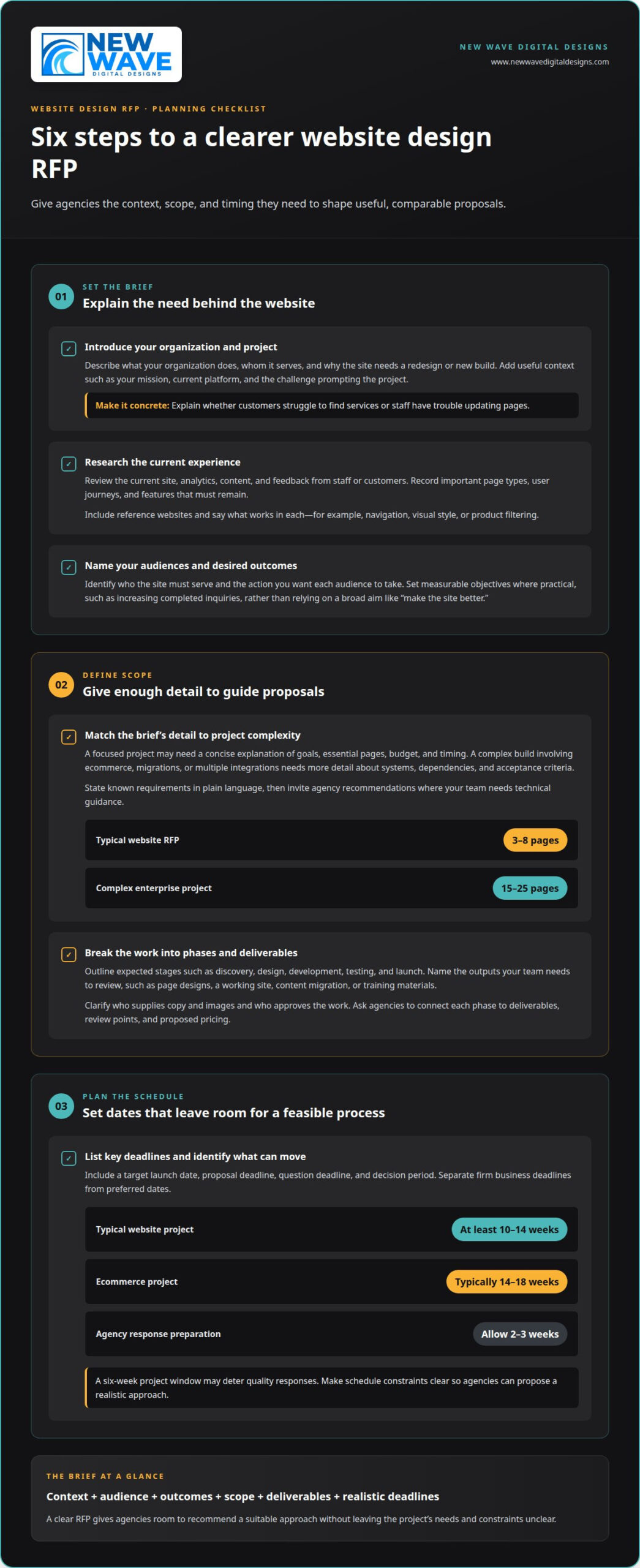
- Introduce the organization and project. Explain what your organization does, whom it serves, and why the website needs a redesign or a new build. Include useful context, such as your mission, current site platform, and the challenge prompting the project. For example, describe whether customers have trouble finding services or staff struggle to update pages. This helps agencies connect design decisions to real needs.
- Research the project before writing. Review the current site, analytics, existing content, and feedback from staff or customers. Record the kinds of pages, important user journeys, and features that must remain. Include a few reference websites and explain what works in each, such as navigation, visual style, or product filtering. Specific observations make a brief more useful than general preferences.
- Define outcomes and audiences. Identify who the site must serve and the action you want each audience to take. A membership organization, for example, might want visitors to find events, understand its mission, and join. Set measurable objectives where practical, such as increasing completed inquiries, instead of relying on broad aims like “make the site better.” This gives agencies a basis for recommending structure and functionality.
- Match detail to complexity and your team’s expertise. A focused project may need a concise explanation of goals, essential pages, budget, and timing. A complex build involving ecommerce, migrations, or multiple integrations needs more detail about existing systems, dependencies, and acceptance criteria. Explain known requirements in plain language, then invite agencies to recommend solutions where your team lacks technical knowledge. A typical website RFP is 3-8 pages long, while complex enterprise projects may need 15-25 pages.
- Break the work into phases and deliverables. Outline expected stages, such as discovery, design, development, testing, and launch. Name the outputs your team needs to review, including page designs, a working site, content migration, or training materials. Clarify who provides copy and images and who approves the work. Ask agencies to tie each phase to deliverables, review points, and proposed pricing so you can compare bids more easily.
- Set deadlines that support a feasible process. Give a target launch date, proposal deadline, question deadline, and decision period. A typical website project takes at least 10-14 weeks, while ecommerce projects typically take 14-18 weeks. Allow agencies 2-3 weeks to prepare RFP responses, and identify schedule constraints that can move. A six-week project window may deter quality responses, so separate firm business deadlines from preferred dates.
Knowing how to write a website design request for proposal also means giving agencies enough context to recommend a suitable approach without dictating every design decision.
How do you write technical requirements that invite expertise?
Describe the site’s design, functions, integrations, content, and accessibility needs in plain language. Explain what visitors need to accomplish, identify known technical constraints, and invite recommendations wherever your team needs expert guidance.
Specify Website Design and Functionality
Describe the visual direction and user experience you want, using examples such as a clear member directory or simpler event registration. Explain your brand guidelines, including existing logos, colors, typography, and content standards, then identify the most important pages and actions. Avoid prescribing the full design when you want agencies to propose a considered approach.
List Technical Needs and Integrations
List the systems the website needs to connect with, such as a customer relationship management platform, email service, payment tool, or analytics account. For each integration, explain what information it should exchange and what task it should support. Identify the current platform, domain requirements, and any migration needs, then ask agencies to describe their technical approach in accessible language.
Set Accessibility and Compliance Requirements
State the accessibility outcome you want and invite agencies to explain their approach. The Centers for Disease Control and Prevention reports that 1 in 4 U.S. adults lives with a disability, making accessible navigation, readable content, and clear forms important considerations. WCAG 2.2 can serve as an example standard, while Section 508 is often applied to government and public websites.
- Separate essential functions from preferences. Distinguish required features, such as searchable services or online donations, from desired refinements, such as animation or personalized recommendations. This helps agencies explain trade-offs without confusing a visual preference with a technical requirement. Include sample content or a page outline when it clarifies how the website should serve your mission.
- Describe technical constraints and success criteria. Note relevant systems, existing content, and known URL changes. If a redesign changes page addresses, request a migration plan that includes 301 redirects from old pages to new pages. For SEO, describe the outcomes you need, such as preserving useful search visibility and making key information easy to find, rather than prescribing tactics you may not understand.
- Set submission instructions that invite considered answers. Specify the proposal format, required sections, contact person, question deadline, and final submission deadline. Allow agencies 2-3 weeks to prepare responses, and ask them to outline their recommended solution, technical assumptions, project phases, and anticipated delivery points. Clear instructions make proposals easier to compare while leaving room for expertise.
If you’re shaping a redesign brief, website design planning can help turn technical needs into a coherent project scope.
Proposal evaluation criteria and submission format
Set submission rules and evaluation criteria before inviting proposals. A shared format helps your team assess every response against the same goals, evidence, and decision process.
-
Set Proposal Submission Guidelines
List the required proposal sections, file format, submission method, deadline, and contact for questions. For example, request an overview of the proposed approach, project phases, schedule, itemized costs, relevant experience, and assumptions. Specify whether agencies should submit a PDF or complete a response template, and provide a subject line or file-naming convention.
Explain how to submit the proposal, such as by email to a designated contact, and identify who will acknowledge receipt. Set a deadline for questions and explain how answers will be shared with all participants. This keeps information consistent and gives every agency the same opportunity to prepare a complete response.
-
Define Evaluation Criteria
Choose criteria that reflect the project’s priorities, then describe what strong evidence looks like for each one. A sample scoring model might assign 30% to design creativity, 30% to technical approach, and 40% to alignment with budget and goals. Treat these percentages as an example, then adjust the weight of each criterion to match your organization’s needs.
Explain how reviewers will assess each section. For design, they might consider how the proposed experience serves the target audience; for the technical approach, they might assess how it addresses integrations and migration. Name the review team or its roles, such as marketing, operations, and leadership, so agencies know which perspectives matter.
- Request comparable evidence. Ask each agency for 3-5 relevant project examples and a short explanation of the challenge, solution, and outcome. Specify what makes an example relevant, such as a similar audience, content structure, or required functionality. You can also request 4-6 client references, with a brief description of the relationship and the work completed.
Request the same evidence from every respondent. If case studies affect scoring, ask all agencies to explain their role rather than relying on visual samples alone. This helps reviewers distinguish an agency’s contribution from the client’s existing brand, content, or internal resources.
- Plan a consistent review. Create a score sheet that mirrors the RFP criteria and gives reviewers space to record evidence, questions, and scores. Decide how the team will resolve differences before making a final selection, and document the reason for its decision. If you invite presentations, give every agency the same agenda and time to discuss its proposal.
Tell agencies what happens after submission, including the review stages and expected decision window. A defined process helps respondents prepare for a presentation or follow-up discussion and helps your team move from written proposals to an informed selection.
Asking about budget, launch schedule, brand guidelines, and integrations
Request a budget range and project-specific pricing, and explain the schedule, brand resources, and integrations agencies should account for. These details help respondents build proposals around your needs rather than make assumptions about scope.
-
Set Budget Expectations
Share an estimated budget or range, even if tentative, and clarify whether it covers design and development alone. State whether content, hosting, analytics, or ongoing maintenance are also part of the scope. A defined budget helps agencies propose feasible solutions and explain trade-offs instead of recommending work beyond your resources.
Invite agencies to state assumptions that could affect their proposals. For example, explain whether your team can provide product photography or needs it included in the project. Being clear about available resources helps separate project requirements from optional enhancements.
-
Request Line-Item Pricing
Ask agencies to separate costs by phase and deliverable, such as discovery, design, development, content migration, testing, and launch. Request a clear description of what each item includes, along with any recurring charges and optional services. This lets your team compare proposals without treating a single total as a full account of value.
Ask respondents to identify assumptions, exclusions, and factors that could change the final scope. For instance, a proposal might depend on your team supplying final copy or product data. Ask agencies to explain how changes to those inputs could affect the work, rather than burying uncertainty in a broad estimate.
- Set a practical launch schedule. Share your target launch date, key business deadlines, and milestones that cannot move. Say whether the date is fixed or preferred, and ask agencies to map their proposed phases against it. A product launch, seasonal campaign, or membership drive can make timing especially important. Ask about dependencies that could affect progress, including content approvals, access to the current platform, and stakeholder reviews.
Ask agencies how they would manage schedule pressure. A useful response identifies which decisions need timely input and which deliverables can be staged. This helps your team judge whether the proposed plan supports the launch goal without overlooking essential work.
- Provide brand and integration context. Name the brand guidelines, logos, typography, and image assets available for the project. If those materials need refinement, describe the outcome you want rather than assuming every agency interprets “refresh the brand” in the same way. List each required platform or third-party integration, such as a payment processor or email system, and explain the task it must support.
For example, specify whether an online store needs to send order details to an inventory platform. Ask agencies to flag dependencies, explain their integration approach, and distinguish required connections from future possibilities. This gives proposals a consistent foundation while leaving room for informed recommendations.
Ongoing support, analytics, and hosting
Plan for the website after launch by defining who will maintain it, how you’ll measure performance, and what hosting responsibilities are included. Clear post-launch expectations help agencies address ongoing operations, not just the redesign.
- Define post-launch support. Describe the help your team expects after launch, such as fixing defects, troubleshooting forms, or helping staff update content. Ask agencies to distinguish ongoing support from project delivery and explain how requests are submitted, prioritized, and handled. For example, separate routine copy changes from an issue that prevents customers from submitting an inquiry.
- Clarify update responsibilities. State which team will update pages, add products, and maintain plugins or platform components. Ask agencies to describe the process for routine changes and identify what falls outside the proposed support scope. If staff will edit content, request a handoff plan that explains how they’ll use the relevant tools after launch.
- Specify hosting expectations. Ask agencies to explain the hosting arrangement, account ownership, security responsibilities, and dependencies on third-party services. Clarify who manages renewals, access, and technical changes, and how your organization receives account credentials. If the site uses WordPress, Shopify, or Squarespace, ask how the proposed hosting setup works with that platform.
- Set analytics goals before launch. Name the actions you want to measure, such as completed contact forms, purchases, newsletter sign-ups, or visits to key service pages. Ask which analytics tools the agency proposes and how tracking will be configured and tested. State who will have access to reports and how your team plans to use the information when deciding on future updates.
- Request a practical reporting plan. Ask agencies what their reports will show, how often they recommend reviewing results, and which decisions the insights can inform. For example, a report might show that visitors reach a service page but don’t complete its inquiry form. Connect that finding to a possible action, such as revising the page or simplifying the form.
- Make continuity part of the proposal. Ask respondents to explain how support, hosting, analytics access, and platform updates fit together after launch. Request clear responsibilities for your staff and the agency, along with a process for escalating issues that affect essential tasks. This makes post-launch expectations visible alongside design and development deliverables.
For a site that needs a considered plan for ongoing hosting and security, discuss website hosting and security.
New Wave Digital Designs
New Wave Digital Designs turns clear website briefs into purposeful digital experiences, designing for Shopify, WordPress, and Squarespace. Once your RFP clarifies the audience, scope, and priorities, it gives you a focused starting point for discussing the right platform and design direction.
Consider reaching out when you’re ready to move from comparing proposals to planning a website, or when your existing site needs ongoing care after launch. Website maintenance can support your site’s next phase, while a well-defined brief keeps its goals and expectations in view.
Contact New Wave Digital Designs to discuss your website project and the direction you have in mind.
Shape the next stage of your website
A well-prepared RFP does more than organize agency selection. It can serve as a shared reference as your team moves from initial direction to a digital experience that reflects your organization and serves its audience. Keep it useful after selection by returning to its goals as project decisions take shape.
If you’re considering Shopify, WordPress, or Squarespace for your website, New Wave Digital Designs can help bring your project into focus with platform-specific website design. Your brief is a strong starting point for discussing your goals and the experience you want to create.
Knowing how to write a website design request for proposal helps turn a broad ambition into a clear foundation for collaboration. When you’re ready to discuss what comes next, contact New Wave Digital Designs. Your next step can begin with a thoughtful conversation and a clearer vision for the site ahead.
Frequently Asked Questions
What Is a Web Design RFP?
A web design RFP is a structured invitation for agencies to propose how they would plan and deliver a website project. Unlike an internal design brief, it also explains how proposals should be submitted and assessed. For example, a nonprofit could invite agencies to propose approaches to membership pages, event information, and online donations, then compare responses against shared priorities.
Should I include a budget in my RFP?
Yes. Include an estimated budget or range, even if tentative, so agencies can tailor proposals to your financial boundaries. You can distinguish essential work from optional enhancements, such as a required redesign and a later content expansion. Ask respondents to explain their assumptions and how their recommendations fit the available budget. This makes each proposal’s priorities easier to understand.
How can a template make your proposal creation easier?
A template gives your team a repeatable structure for collecting project details and presenting them consistently. Start with a Word document if several people need to edit it, or use a fillable PDF or Canva template for a guided layout. Add prompts for business goals, audiences, required functions, and submission instructions. Tailor each prompt to the project instead of keeping irrelevant sections.
How do you choose which agencies receive your RFP?
Send the RFP to 3-5 qualified agencies whose experience appears relevant to your project’s platform, audience, and required functionality. For example, an online store with a complex product catalog calls for experience with ecommerce structures, while a membership site has different priorities. Review their public project examples and service focus before inviting proposals, then give every selected agency the same document and deadlines.
How do you define project scope without being prescriptive?
Describe the problem, intended result, and boundaries of the work, while leaving room for agencies to recommend a method. For example, say customers struggle to find support information and ask for a clearer path to answers, rather than dictating the exact navigation. Separate fixed requirements from preferences so proposals can offer creative solutions while meeting essential needs.
How long should I give agencies to respond to an RFP?
Allow agencies 2-3 weeks to prepare responses, giving them time to understand the project and develop a considered approach. The response window should reflect the RFP’s complexity: a project with several systems or content needs requires more preparation than a focused redesign. Set the question deadline before the submission deadline, and share answers consistently so every agency works from the same information.
How do you define website goals, scope, and requirements in an RFP?
Connect each audience to a clear action, then describe the pages and functions that support it. Prospective members, for example, might need to understand benefits, find eligibility details, and complete an application. Separate the required launch scope from future ideas, and explain how you’ll assess success. This helps agencies design a connected experience instead of treating each page as a separate deliverable.
What questions should a website design RFP ask vendors?
Ask agencies to explain their proposed approach, relevant project experience, schedule assumptions, and the people involved. Include questions about content migration, integrations, testing, and handoff when these matter to your project. You can also request references and ask agencies to identify delivery risks or decisions. Keep questions consistent across respondents to make comparisons fair.