
A website with the lowest launch quote can cost more to own over time. The initial fee is only part of the picture. Knowing how to calculate the total cost of ownership for a website means looking beyond the build to the recurring work and future changes that keep it useful.
When comparing proposals, it’s easy to overlook platform subscriptions, hosting, security, maintenance, and support. Marketing can blur the picture, too. SEO and paid advertising may help a website grow, but they’re better tracked separately from the cost of owning and operating the site. A clear model puts each expense in the right category.
This guide shows you how to build a practical website budget over a defined time horizon, compare options on fair terms, and separate ownership costs from growth investments. You’ll map setup, ongoing operations, and future updates, while considering how scope and platform choice affect the total. Whether you’re evaluating Shopify, WordPress, or Squarespace, you’ll have a clearer basis for choosing a website that fits your business now and as it evolves.
Key Takeaways
- Calculate website TCO by combining setup, recurring, and planned variable costs across a consistent time horizon.
- Compare DIY, platform-led, and custom-designed websites using equivalent requirements, including internal effort and future changes.
- Use a practical worksheet to organize costs by amount, frequency, time horizon, and confidence level.
- Separate website ownership expenses from marketing investments to keep your budget transparent and useful for decision-making.
- Account for how design, platform choice, hosting, maintenance, and support shape a website plan that can evolve with your business.
What website total cost of ownership includes, and why the launch price is not enough
A website’s total cost of ownership (TCO) is the cost of owning and operating it over a chosen period. A launch quote captures a specific scope of work, such as design, development, and tasks agreed for launch. It may not cover the infrastructure, care, and improvements the site needs afterward.
Website TCO is the combined cost of the initial build, recurring operations, maintenance, and planned changes across a defined ownership period. This applies the wider TCO principle, which considers direct and indirect costs throughout a product or service’s lifecycle, to the costs of running a website. Total Cost of Ownership (TCO) is a financial estimate that includes direct and indirect costs over an entire lifecycle.
A useful model clarifies how to calculate the total cost of ownership for a website. Rather than treating the first invoice as the whole budget, list the work and expenses the site is likely to require from setup through the end of your chosen time horizon.
Which website costs belong in the ownership model?
Start with the costs required to create and launch the site, then add what it needs to keep operating. Include expenses relevant to your project rather than assuming every possible website cost applies.
- Initial work: Design and development, platform setup, migration from an existing site, and initial copy, graphics, or other assets.
- Recurring operation: Domain registration, platform subscriptions, hosting, security, and website maintenance. Record each expense at its billing frequency so monthly and annual charges can be compared over the same period.
- Planned changes: Expected content work, integrations, feature updates, or a redesign. If a change is likely during the analysis period, include it as a planned cost instead of leaving it out.
Check for overlap. A platform plan may bundle services that could otherwise appear as separate line items. Hosting and security may also be accounted for in different ways. Record what each charge covers, and avoid counting the same service twice.
What TCO does not automatically measure
TCO describes the cost of owning and operating the website. It does not, by itself, show whether the site generates revenue, delivers a return on investment, or improves wider business performance. Those outcomes matter, but they answer different questions and require separate measures.
Keep growth spending visible without folding it into ownership costs. Organic SEO and paid advertising, including Google Ads or Bing Ads, can be tracked as separate marketing investments and reviewed alongside TCO. If your analysis deliberately includes marketing, label it clearly and apply the same approach to every website option. This distinction helps you see what it costs to operate the site, what you’re investing to attract an audience, and how each category supports your business goals.
How to calculate website TCO: build a complete lifecycle cost model
Start with one rule: assess every website option over the same period. Choose a horizon that suits your planning needs, such as three years, and apply it consistently. Comparing one option’s first-year expenses with another’s longer-term costs can distort the result.
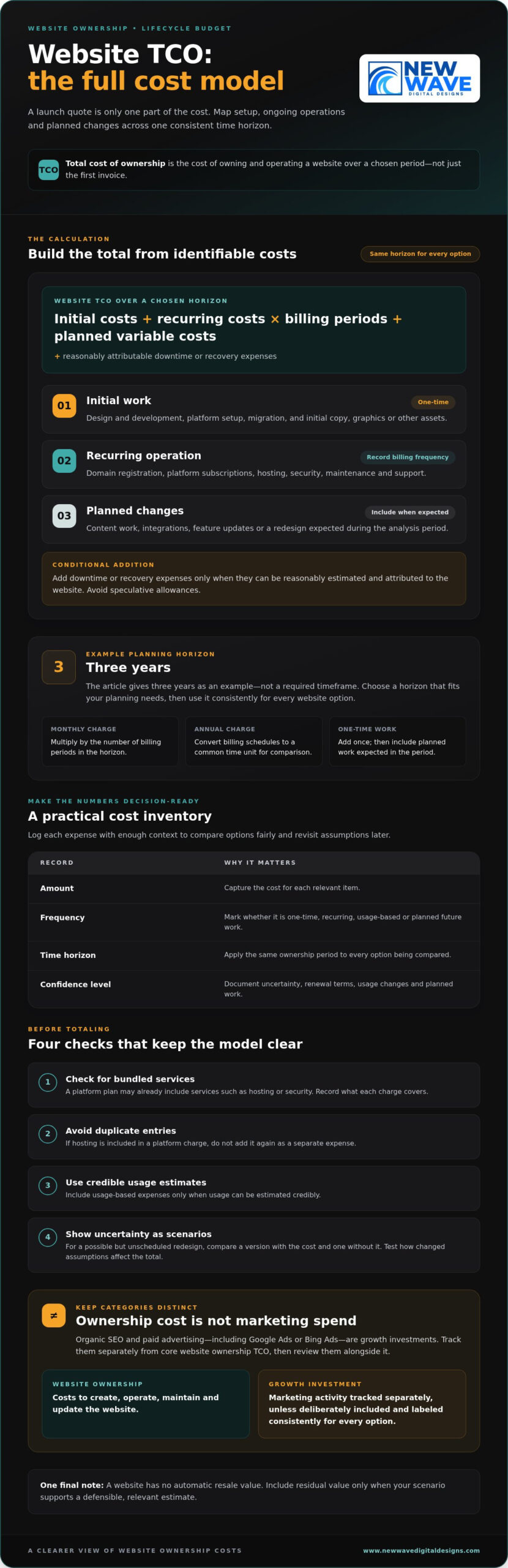
Website TCO over a chosen horizon equals one-time initial costs, plus recurring costs multiplied by the number of billing periods, plus planned variable costs and reasonably attributable downtime or recovery expenses. This formula makes the time frame explicit and ties the total to identifiable expenses.
Gather initial and recurring website expenses
Build an inventory before calculating. Record design, development, setup, migration, and launch work as one-time costs. Then list platform, domain, hosting, security, maintenance, and support costs with their billing periods. Mark each item as one-time, recurring, usage-based, or planned future work. This makes it easier to bring different billing schedules into a common comparison.
For example, if a platform subscription is billed monthly and a domain renews annually, convert both to the same time unit before projecting costs across your chosen horizon. Include usage-based expenses only when you can estimate usage credibly. Keep optional SEO and paid advertising outside core ownership TCO unless your analysis deliberately includes marketing. Label those expenses separately so they remain visible.
Calculate the total and document assumptions
Multiply each recurring expense by the number of billing periods in the chosen horizon. Add one-time costs once, then include planned variable work expected during that period. Check for bundled services and duplicate entries. If hosting is included in a platform charge, for example, don’t add it again as a separate expense.
Include downtime or recovery costs only when you can reasonably estimate them and attribute them to the website. Avoid adding a speculative allowance. Likewise, don’t subtract a residual value simply because a formula used for equipment does so. A website has no automatic resale value. Include one only if your scenario supports a defensible, relevant estimate.
Assumptions are part of the calculation, not fine print. Note uncertain renewal terms, possible changes in usage, and planned work. Then test how the total changes when an assumption changes. If a redesign is possible but not scheduled, show a version with it and one without it rather than presenting uncertainty as a fixed expense. This gives decision-makers a range to discuss without treating estimates as confirmed costs.
To keep the process practical, define the horizon, gather and classify expenses, convert recurring costs to matching periods, then total only the items included in your stated scope. A website planning conversation with New Wave Digital Designs can help define project scope and identify the operating needs to include in your model.
Compare website options fairly: DIY, platform-led, or custom-designed
A comparison is useful only when each approach is measured against the same business needs. First define the required pages, content, functions, ownership period, and expected updates. Then assess DIY, platform-led, and custom-designed options against that shared brief. A lower estimate may simply reflect less scope, fewer responsibilities, or more work left for your team.
Compare Shopify, WordPress, and Squarespace against your requirements rather than treating them as interchangeable. An online store, a content-led site, and a service-business website may need different capabilities. Set the requirements first, then note how each option handles design, setup, maintenance, and future updates.
Compare the work, responsibilities, and internal effort
Use a side-by-side table to show what each scenario requires from your business. Keep the analysis period and content volume consistent, and distinguish cash expenses from staff time. If you assign a value to internal labor, apply the same method to every option. Otherwise, report estimated hours separately rather than implying that the time has no cost.
| Approach | Initial work | Recurring costs | Internal effort | Planned changes |
|---|---|---|---|---|
| DIY | Build and setup completed in-house | Platform, domain, hosting, security, and maintenance as applicable | Learning, content entry, and routine tasks | Updates the team expects to make |
| Platform-led | Platform configuration and design work | Platform and other ongoing site expenses | Content management and assigned upkeep | Feature, content, or design adjustments |
| Custom-designed | Scoped design, development, setup, and launch work | Hosting, security, maintenance, and platform expenses as applicable | Content coordination and internal approvals | Integrations, new content, or redesign work |
Fill each cell with your project’s actual scope, not assumptions about what an approach usually includes. A DIY route may reduce external build work but require more staff time. A custom design may move more initial work outside the business, while future costs still depend on the platform, support needs, and planned changes. The lowest upfront estimate is not automatically the lowest lifecycle total.
Keep ownership and marketing investments distinct
Website ownership costs and marketing budgets answer different questions. Keep organic SEO and paid search, such as Google Ads or Bing Ads, as separate lines in the comparison. If you’re evaluating the broader digital investment, show marketing alongside website TCO instead of blending it into the ownership figure. This keeps the site’s operating needs clear and lets you assess growth spending on its own terms.
For a fair view of ongoing technical responsibilities, include the work covered by website maintenance services in the relevant scenarios. With scope, time periods, and labor assumptions held constant, you can compare the total cost of ownership for each website option without confusing a smaller initial commitment with a better long-term fit.
Use this website TCO worksheet to make the numbers decision-ready
A worksheet turns a list of expenses into a comparison you can review and refine. Start by defining the project scope: pages, content, functions, platform, and expected changes. These professional web design considerations can help you decide what the project needs to include before you enter figures.
Follow a repeatable calculation workflow
Use the same scope and evaluation period for each option. Put initial, recurring, and expected variable costs in separate rows, then record the assumptions behind each estimate. The example below uses fictional planning units, not currency or a market benchmark. It demonstrates the worksheet structure and calculation only.
| Cost item | Amount | Frequency | Horizon | Confidence |
|---|---|---|---|---|
| Initial design and setup | 100 units | One-time | 3 years | High |
| Platform and hosting | 10 units | Monthly | 36 months | Medium |
| Maintenance | 5 units | Monthly | 36 months | Low |
| Planned content update | 20 units | Once in year 2 | 3 years | Medium |
In this hypothetical example, the total is 100 + (10 × 36) + (5 × 36) + 20, or 660 planning units. Keep the math visible and place the confidence label beside each estimate so readers can distinguish firm figures from assumptions. If the scope includes an online store, include its specific design and operating requirements. Custom Shopify store design is one example of a project scope that should be represented accurately.
Interpret the result before selecting an approach
After totaling each option, identify the rows that create the largest differences. Then run a sensitivity check: recalculate with maintenance one step lower and higher, adjust an uncertain platform expense, or include and exclude a possible future change. This shows whether the result depends on one uncertain assumption or stays similar across plausible scenarios.
Use the result to understand trade-offs, not to promise a specific return. A lower projected total may involve different scope, internal effort, or planned capabilities. If the figures are close, those distinctions may matter more than the headline total.
To calculate website TCO usefully, make the inputs clear, show the assumptions, and compare like with like. For guidance on your website scope and cost model, explore website planning with New Wave Digital Designs.
Plan website ownership around design, maintenance, and measured growth
A TCO model is valuable when it informs a practical project plan. Use the figures to decide what the website must do, which platform fits its requirements, and who will handle the work after launch. Design, platform, hosting, security, maintenance, and marketing each have a place in the plan, but they are not one undifferentiated expense.
New Wave Digital Designs creates websites for Shopify, WordPress, and Squarespace. The right scope depends on your business goals, content, and required functionality. A clear comparison identifies those needs first, then assigns setup and ongoing responsibilities so the budget reflects the intended website, not just the bare requirements for launch.
Turn TCO findings into a website project brief
Bring the model into a concise brief that records business goals, essential site functions, content requirements, and the evaluation period. Mark each cost as fixed, recurring, variable, or an assumption, and note who owns each responsibility. For example, specify whether hosting, security, and content updates are part of the ongoing operating plan. Website maintenance planning makes continued technical care a deliberate part of the scope.
Separate operating choices from growth choices. Hosting and security support site operations, while maintenance covers ongoing care. Organic SEO and paid search are distinct investments in visibility. These activities may all contribute to a broader digital plan, but keeping their roles and budgets visible makes it easier to identify what the website itself requires.
Build a website that can evolve with the business
Design and development establish the site’s foundation. Plan future content, integrations, platform needs, and maintenance as separate decisions rather than assuming they are included in the initial build. For an online store, define commerce requirements and expected content alongside the design scope to give Shopify project planning a clearer basis.
Choose support arrangements that match the site’s operating needs. Decide who will maintain it, manage hosting and security, and coordinate future updates. These responsibilities can vary by platform and project scope, so documenting them keeps the ownership model useful as the business changes.
With goals, scope, and responsibilities documented, you have a stronger basis for calculating website TCO and comparing it with the value you expect the site to provide. The model does not promise a particular business return, but it can clarify trade-offs and guide a measured next step.
Discuss your website goals with New Wave Digital Designs to shape a project scope around your business needs and ongoing website plans.
Make your website budget a foundation for what comes next
A website budget can do more than guide a launch decision. Treat it as a working guide and revisit priorities as your business, content, and customer needs change. Knowing how to calculate the total cost of ownership for a website gives you a clearer basis for those decisions without mistaking a forecast for a promise of business results.
The next step is to connect your budget to a considered digital plan. New Wave Digital Designs creates custom websites for Shopify, WordPress, and Squarespace, and provides website maintenance, hosting, and security to support ongoing site needs. Organic SEO and Google Ads and Bing Ads management can be planned as separate investments in visibility.
Bring your goals and scope together, then build a website plan around the work that matters to your business.
Frequently Asked Questions
What is the formula for calculating a website’s total cost of ownership?
Add initial costs to recurring expenses and expected variable costs across a defined period. Initial work might include design, development, setup, and migration. Recurring expenses could include a platform subscription or hosting renewal. To calculate the total cost of ownership for a website, match every expense to the period you’re evaluating. Keep assumptions visible, remove duplicate charges, and leave out costs that do not belong to the website scenario you’re comparing.
Which costs should I include when calculating website TCO?
Include expenses required for the website scenario you’re assessing, such as launch work, migration, and initial content creation, followed by relevant recurring services and planned changes. If staff will maintain pages or manage content, note the time involved. You can keep labor hours separate from cash expenses or assign them a value if your business uses a consistent method. Label marketing costs clearly so it’s obvious whether they are included.
Should SEO and advertising be included in website total cost of ownership?
Not by default. Organic SEO and paid advertising support visibility and growth, while core website TCO focuses on the costs of building and operating the site. For a broader digital investment comparison, add SEO or advertising as separate lines rather than folding them into platform or maintenance expenses. This lets you compare a site’s operating budget with a separate Google Ads campaign without confusing their purposes or assuming either guarantees revenue.
How many years should I use to calculate website TCO?
Choose a time horizon that fits the decision, then use the same period for every option. A shorter window may suit a near-term launch decision, while a longer window can reveal more renewals and planned work when you’re comparing ongoing commitments. There is no universal period for every business. Document your chosen horizon and assumptions so another person can understand how you formed the total.
How do I compare website TCO when one option has a lower upfront cost?
Check that both options deliver the same essential functions, content, and level of support over the same period. Compare setup expenses, recurring costs, internal effort, and expected changes separately. A lower initial quote may leave more work with your team or exclude a capability covered by another scope. For a fair decision, identify those differences and test whether the lower-cost scenario still meets your business requirements.
Is website TCO the same as website ROI?
No. TCO estimates the expense of owning and operating a website over a stated period. ROI evaluates returns in relation to an investment’s costs using a chosen method. TCO may inform the cost side of an ROI calculation, but it cannot establish revenue, savings, or business performance on its own. Keep the calculations distinct and state how you define returns so readers do not mistake a cost estimate for a forecast.
How can I estimate website maintenance costs in a TCO model?
List the maintenance work your site is expected to need, such as planned updates, security care, technical support, or content changes. Separate scheduled recurring work from occasional fixes, and note how often you expect each. If the future workload is uncertain, document a reasonable assumption or compare multiple scenarios. This is more useful than a single unsupported figure and clarifies what ongoing care the budget is meant to cover.