
What if the best way to recover abandoned carts isn’t a discount, but a clearer checkout? If you’re wondering how to reduce shopping cart abandonment, start by finding out why shoppers leave. Unexpected delivery costs, limited payment options, confusing forms, or simply browsing can all lead to an unfinished order. Treating every exit as a request for a discount can cut into margins without addressing the friction that matters.
It’s understandable to look for one quick fix, especially when cart exits are difficult to explain. But checkout is part of the wider ecommerce experience, shaped by the information shoppers see and the steps they’re asked to take. The most useful improvements begin with evidence, not assumptions.
This guide shows you how to identify where shoppers drop off, form testable explanations, and prioritize changes by customer impact, effort, and evidence. You’ll also learn how to test checkout improvements and measure what changes, from making delivery details easier to find to simplifying payment and form choices. The goal is a repeatable process that makes buying clearer and easier without relying on blanket discounts.
Key Takeaways
- Learn how to reduce shopping cart abandonment by tracing exits across cart, checkout, and purchase steps instead of treating every unfinished order alike.
- Use analytics, customer feedback, and usability observations to investigate potential friction before choosing a fix.
- Separate checkout improvements that prevent barriers from recovery efforts that invite shoppers back, then measure each by its intended outcome.
- Follow a repeatable test process: establish a baseline, form a hypothesis, prioritize a change, and review the results.
- Shape checkout as part of the wider ecommerce experience, aligning product, delivery, payment, and policy information with customer needs.
How to Reduce Shopping Cart Abandonment Starts with Measuring the Problem
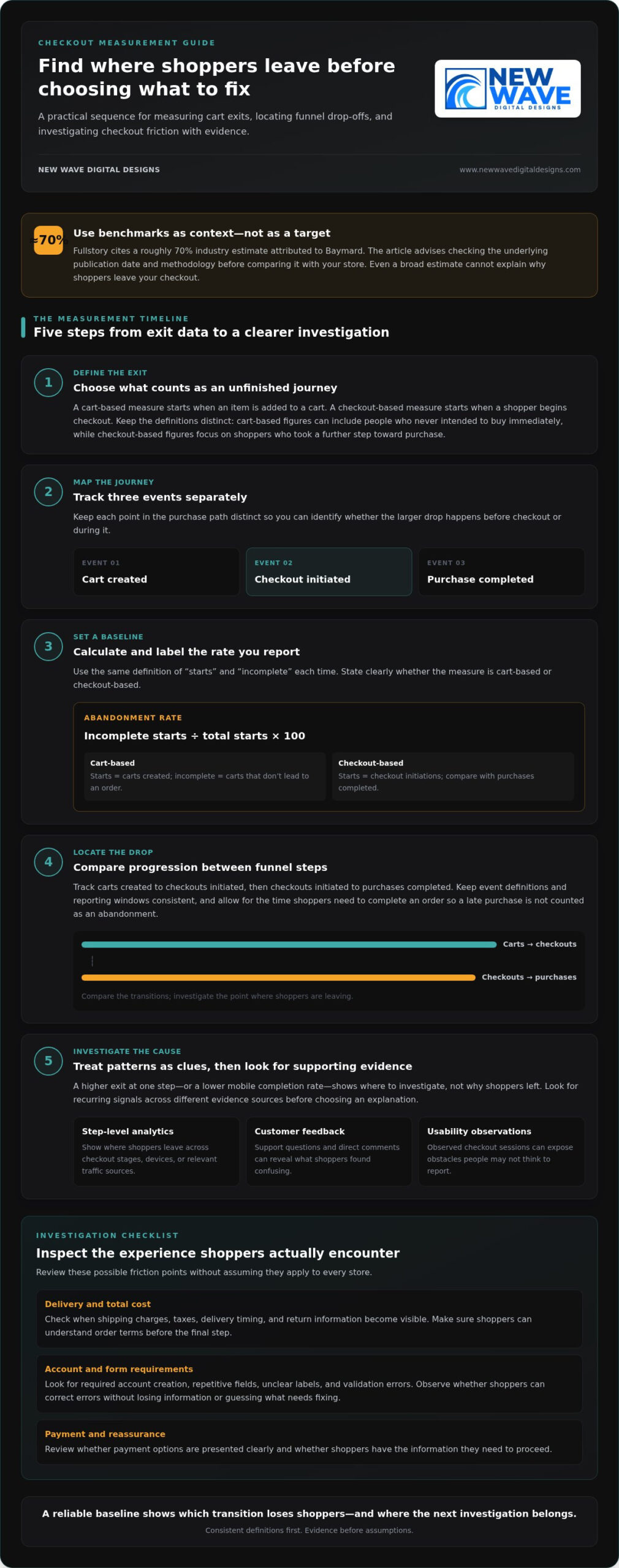
Cart exits are common, but the reasons behind them differ from store to store. A shopper may add an item and leave to compare options, or begin checkout and stop when a required step creates friction. Those actions can look alike in an overall abandonment figure, yet they raise different questions. To learn how to reduce shopping cart abandonment, first define what counts as an exit and measure the same events consistently.
Map the path from a shopper’s first cart action to a completed order. Keep cart creation, checkout initiation, and purchase completion as distinct events. This makes it easier to see whether the larger drop happens before checkout or during it, rather than treating every incomplete journey as the same problem.
What does shopping cart abandonment mean?
Shopping cart abandonment is when a shopper leaves without completing the intended transaction. The rate depends on where you begin counting. A cart-based measure starts when an item is added to a cart; a checkout-based measure starts when a shopper begins checkout. The first can include people who never intended to buy immediately, while the second focuses on shoppers who took a further step toward purchase.
Benchmarks can mislead if they use different definitions, time windows, or analytics events. Fullstory cites a roughly 70% industry estimate attributed to Baymard. Treat it as context, not a performance target: check the underlying publication date and methodology before comparing it with your store’s data. Baymard’s broader estimate aggregates 50 studies, but it still can’t explain why shoppers leave your particular checkout.
Which numbers reveal where shoppers leave?
Abandonment rate is the share of carts or checkouts that don’t result in a completed purchase, calculated as incomplete starts divided by total starts, multiplied by 100. For a cart-based rate, define “starts” as carts created and “incomplete” as those that don’t lead to an order. For a checkout-based rate, use checkout initiations and the purchases completed from them. State which version you report.
Track that overall trend alongside progression between funnel steps. For example, measure carts created to checkouts initiated, then checkouts initiated to purchases completed. Use consistent event definitions and a consistent reporting window, and allow for the time it takes shoppers to complete an order. Otherwise, a late purchase may be incorrectly counted as an abandonment.
- Compare rates by device, traffic source, and product category to spot patterns worth investigating.
- Check that each segment uses the same events, attribution rules, and time window.
- Treat a difference as a clue, not proof of cause. A lower mobile completion rate, for instance, signals where to investigate, not why shoppers left.
A reliable baseline shows which transition loses shoppers and helps direct your next investigation to the right part of the journey.
Find the Checkout Friction Behind Shopping Cart Abandonment
A sharp drop at a checkout step can point to friction, but it doesn’t identify the cause on its own. Shoppers may be comparing prices, waiting to decide, or interrupted before they can finish. Treat each possible explanation as a hypothesis to test. That distinction is central to how to reduce shopping cart abandonment without changing parts of checkout that aren’t causing the problem.
Look for patterns across different kinds of evidence. Step-level analytics show where shoppers leave; support questions and direct feedback reveal what they found confusing; usability observations can expose obstacles people may not think to report. When the signals point in the same direction, you have a stronger basis for choosing what to investigate next.
How do you identify the point where shoppers hesitate?
Compare exits across checkout stages, devices, and relevant traffic sources. If a particular step has higher exits on mobile, inspect how it appears and works on a smaller screen. Then look for supporting evidence in shopper comments, support conversations, and observed checkout sessions. A single session or segment difference is a lead, not proof that every shopper faces the same issue.
Keep alternative explanations in view. A shopper who leaves after viewing delivery options may have found the information unclear, or may simply be comparing delivery choices. Look for recurring signals before deciding which explanation is more likely.
Which checkout barriers deserve a closer look?
Review checkout as a shopper experiences it. Note when essential details appear and what shoppers must do before placing an order. The aim isn’t to assume a familiar issue applies to your store, but to spot where the journey may create uncertainty or unnecessary effort.
- Delivery and total cost: Check when shipping charges, taxes, delivery timing, and return information become visible. Make sure shoppers can understand the order’s terms before they reach the final step.
- Account and form requirements: Look for required account creation, repetitive fields, unclear labels, and validation errors. Observe whether shoppers can recover from an error without losing information or having to guess what needs correcting.
- Payment and reassurance: Review whether payment options are presented clearly and whether shoppers can find relevant security and policy information. Don’t assume that adding a payment method or trust message will solve exits without evidence.
- Performance and interruptions: Check for slow-loading steps, buttons that don’t respond as expected, and disruptions that may be more pronounced on particular devices or traffic sources.
Use your findings to describe a specific, testable concern, such as “shoppers may be leaving because delivery timing appears too late to inform their decision.” That’s more useful than labeling the whole checkout “confusing.” A thoughtfully arranged custom ecommerce website design can bring product, delivery, payment, and policy information into a more coherent experience, guided by evidence about what shoppers need.
Compare Cart-Abandonment Fixes: Prevent Checkout Friction or Recover Shoppers?
Once you have a plausible explanation for where shoppers leave, match your response to the evidence. Prevention removes a barrier from the active buying journey. Recovery uses a later reminder or return visit to re-engage someone who left. The approaches can work together, but recovery shouldn’t replace fixing a checkout obstacle that continues to affect shoppers.
When should you improve checkout rather than launch recovery marketing?
Prioritize prevention when step-level exits, feedback, or usability observations point to recurring friction during checkout. If shoppers struggle to understand delivery details or correct form errors, address that experience first. Consider recovery when the checkout is clear and functional but some shoppers still leave. A reminder may create another opportunity to complete a purchase, but it won’t remove the original barrier.
Guest checkout or simpler forms
Friction addressed: Unnecessary account steps or repetitive fields.
Evidence required: Exits at account creation or observed difficulty completing forms.
Measurement: Compare checkout completion and form-step exits.
Clearer order and delivery details
Friction addressed: Uncertainty about shipping, taxes, delivery timing, or returns.
Evidence required: Feedback or exits around the point those details appear.
Measurement: Track progression past that step and completed purchases.
Payment presentation or usability fixes
Friction addressed: Confusing payment choices, unclear errors, or a technical obstacle.
Evidence required: Payment-step exits, error patterns, or observed usability issues.
Measurement: Monitor payment completion, errors, and checkout progression.
Abandoned-cart email
Friction addressed: A shopper may need a reminder to return.
Evidence required: Available contact details and appropriate consent under applicable rules and platform requirements.
Measurement: Measure return visits and purchases attributed to the message.
Retargeting
Friction addressed: Re-engagement after a shopper leaves the site.
Evidence required: Suitable audience data, permissions, and platform eligibility.
Measurement: Assess return visits and completed purchases against campaign exposure.
How do common interventions differ in effort and trade-offs?
Guest checkout and form simplification change the steps a shopper must complete. Clearer delivery or payment information changes what shoppers understand before deciding. Recovery email and retargeting instead depend on being able to reach eligible shoppers later. Their requirements differ: email needs usable contact information and appropriate permission, while retargeting depends on audience data and platform rules. Implementation effort varies by store, platform, and the change involved.
Discounts aren’t a default solution. First establish that price is a verified barrier, then weigh any offer against its effect on margin. A discount may encourage a return without correcting unclear terms or a difficult checkout. Choose the smallest change that addresses the evidence, then measure its intended outcome. Custom ecommerce website design can align checkout details with the broader customer journey.
How to Test Shopping Cart Abandonment Improvements Step by Step
A checkout change is a hypothesis, not a result. A clear testing sequence helps you learn whether an improvement addresses the friction you observed and prevents competing changes from obscuring the lesson. This is how to reduce shopping cart abandonment through deliberate iteration rather than guesswork.
Use this workflow to move from a customer signal to a measured decision:
- Set a baseline. Record current checkout progression and completed purchases before making changes. Keep event definitions, reporting windows, and relevant audience segments consistent so you can make a fair comparison.
- Gather evidence. Bring together analytics, shopper feedback, support questions, and usability observations. Look for a recurring issue, not just one unusual session or an isolated comment.
- Write a hypothesis. State the suspected barrier, the change you propose, and the outcome you expect. For example: “If delivery timing is easier to find before payment, more shoppers will progress from delivery selection to purchase.”
- Prioritize the change. Rank possible improvements by customer impact, strength of evidence, and implementation effort. Start with a repeated issue supported by multiple signals, especially if it affects a meaningful checkout step.
- Run a focused test. When practical, change one meaningful element at a time, such as the placement of delivery information. If a change necessarily affects several connected elements, document what changed and avoid introducing unrelated updates during the test.
- Review and record. Compare the results with the baseline, note any changes in checkout progression and purchases, and record what the test can and can’t tell you. Keep supported improvements, revise weak hypotheses, and plan the next test.
How do you prioritize which checkout change to test first?
Choose the test with the clearest connection between observed friction and a measurable checkout outcome. A repeated form error backed by session observations may deserve attention before a speculative redesign. Balance likely customer impact against effort, then define success in advance. Clicks can help explain interaction, but they don’t establish that more shoppers completed an order.
How should you interpret and maintain test results?
Measure completed purchases alongside the relevant step-to-step progression, using the same event definitions as your baseline. Give a test enough time and shopper activity to produce useful evidence. The required duration and sample depend on traffic and conversion volume, so avoid arbitrary cutoffs. Don’t declare a winner from a small sample or changes made simultaneously.
An inconclusive result is still useful if you capture what was tested, the evidence behind it, the outcome, and any limitations. Revisit the assumption, check whether the change worked as intended, and continue monitoring the journey after implementation. A disciplined testing process can turn each result into a clearer foundation for the next improvement.
Build a More Resilient Ecommerce Checkout with Thoughtful Website Design
Checkout isn’t a standalone form. It’s the final part of a connected ecommerce experience, shaped by what shoppers learn about a product, delivery, payment, and store policies before they’re ready to buy. Thoughtful design brings those details together, helping the journey feel coherent while reflecting the brand behind the store.
What does a considered ecommerce redesign address?
A considered redesign reviews the whole journey, from product discovery through purchase completion. It asks whether shoppers can find essential information, understand their choices, and move between pages without losing context. Clear headings, well-placed details, and consistent page patterns help customers make sense of each step. The aim is a more usable experience, not a promised conversion lift or guaranteed reduction in abandonment.
Design decisions should respond to what measurement and customer evidence reveal. If shoppers hesitate before selecting delivery, make relevant details easier to locate. If a form creates difficulty, examine its labels, sequence, and error messages. Custom website design for Shopify, WordPress, or Squarespace can bring brand presentation and practical usability into alignment. Organic SEO also supports the wider journey by helping shoppers discover relevant products and reach useful pages.
How can ongoing digital support sustain improvements?
Design changes need attentive site stewardship after launch. Website maintenance provides ongoing care, while managed hosting and security support the technical environment the site relies on. These are distinct responsibilities that help keep a website cared for as content and business needs evolve. Ongoing website maintenance services can support that continuity, while regular review helps identify when a once-clear journey needs refinement.
Improving checkout is a continuing practice. Measure the journey, make evidence-led changes, and keep the wider store experience in view. If you’re considering checkout refinements or a broader ecommerce design project, New Wave Digital Designs can help shape a website around your store’s needs.
Make Your Next Checkout Improvement Count
The next step doesn’t need to be a sweeping redesign. Choose one customer need your evidence has brought into focus, then shape an improvement that fits the store as a whole. That steady, considered approach turns learning into lasting progress and makes how to reduce shopping cart abandonment an ongoing part of building a more thoughtful ecommerce experience.
When the opportunity calls for a broader design perspective, New Wave Digital Designs creates custom ecommerce websites for Shopify, WordPress, and Squarespace, with ongoing maintenance, managed hosting, security, organic SEO, and Google Ads and Bing Ads management. Together, these services can support a cohesive path from discovery through purchase and continued site care.
Explore ecommerce website design from New Wave Digital Designs and take the next step toward a clearer, more customer-centered checkout experience.
Frequently Asked Questions
What is shopping cart abandonment?
Shopping cart abandonment happens when a shopper adds a product or starts checkout but leaves before placing an order. Someone might add an item while comparing options, while another shopper might reach payment and stop there. Those journeys have different implications, so define the starting event your report uses. Keeping that definition consistent helps you interpret changes over time instead of mistaking a shift in tracking for a change in shopper behavior.
How do you calculate the shopping cart abandonment rate?
Divide the number of carts or checkouts that don’t lead to a purchase by the total number of carts or checkouts started, then multiply by 100. If you begin counting at checkout initiation, use completed purchases from those initiated checkouts as the comparison. Apply the same event rules and reporting window each time. Before comparing your figure with an industry benchmark, check that its starting event and calculation are comparable.
What is a good shopping cart abandonment rate?
There isn’t one ideal abandonment rate for every store. Product type, shopping behavior, device mix, and measurement choices can all affect the figure. Rather than treating a published average as a target, build a reliable baseline for your own store and monitor it consistently. A more useful goal is to identify a specific step where shoppers are leaving, test a relevant improvement, and see whether that pattern changes.
Why do customers abandon shopping carts?
Customers may leave because of unclear delivery details, difficult forms, account requirements, unavailable payment choices, confusing policies, or technical problems. They may also be browsing, comparing options, or interrupted by something unrelated to checkout. For example, a spike in exits at a particular step is a reason to investigate that point, not proof of a single cause. Combine analytics with shopper feedback and usability observations to find stronger clues.
Can abandoned-cart emails reduce shopping cart abandonment?
Abandoned-cart emails can remind eligible shoppers to return, but they don’t repair a confusing or faulty checkout. Their use depends on having suitable contact information and meeting applicable consent requirements and platform rules. If you send them, assess whether they lead to completed purchases, not just opens or clicks. A shopper who returns but encounters the same obstacle may still leave, so consider recovery messages alongside improvements to the buying experience.
How can I reduce cart abandonment without offering discounts?
To learn how to reduce shopping cart abandonment without discounts, first connect shopper exits to a specific point in the journey. If customers hesitate before confirming delivery, make those details easier to understand earlier. If they struggle with a form, remove unnecessary fields or clarify error messages. Then monitor the relevant checkout step and completed orders. This focuses effort on reducing friction instead of lowering the order value without evidence that price is the issue.
Does a slow website cause shopping cart abandonment?
A slow or unreliable page can disrupt shopping, but speed shouldn’t be assumed to explain every incomplete order. Look for performance problems on product, cart, or checkout pages, then compare those findings with where shoppers leave. For instance, repeated loading issues during payment would give you a concrete area to investigate. After addressing a confirmed issue, track the same checkout events and purchase outcomes to see whether the pattern changes.
How long should I run an A/B test for checkout changes?
There’s no fixed test length that suits every store. The time needed depends on how much relevant traffic and purchase activity your checkout receives, as well as how often the measured outcome occurs. Decide what you’ll measure before the test begins, and avoid stopping because of a brief favorable fluctuation. If the result is unclear, record that limitation and gather more evidence instead of treating a small or inconclusive sample as a decisive answer.