
A larger basket isn’t automatically a better result. The goal is to raise order value without making an offer feel irrelevant or eroding profit. Average order value (AOV) is the average amount spent per order, calculated by subtracting discounts from gross sales and dividing by the number of orders. To understand how to increase average order value on Shopify, first measure your baseline, then test offers that give shoppers a clear reason to add something useful.
It’s natural to focus on bringing more visitors to your store, but helping each order go further can also support growth. This guide explains AOV and how to measure it, then explores practical ways to encourage larger baskets with free-shipping thresholds, cross-sells, upsells, bundles, and relevant personalized recommendations. The best offer isn’t simply the one that raises cart value: conversion and margin matter, too. A considered offer should fit the shopping journey rather than interrupt it.
Key Takeaways
- Calculate average order value by subtracting discounts from gross sales and dividing by the number of orders.
- Set a free-shipping threshold that gives shoppers a relevant reason to add another item, then assess its effect on both order value and conversion.
- Use cross-sells for complementary products and upsells for a more valuable version or option of the item a shopper is considering.
- Place personalized recommendations where they support the shopping decision, and keep each offer relevant and easy to understand.
- Test one offer at a time and assess order value alongside conversion and profitability to see whether it strengthens the overall result.
1. Free-shipping thresholds
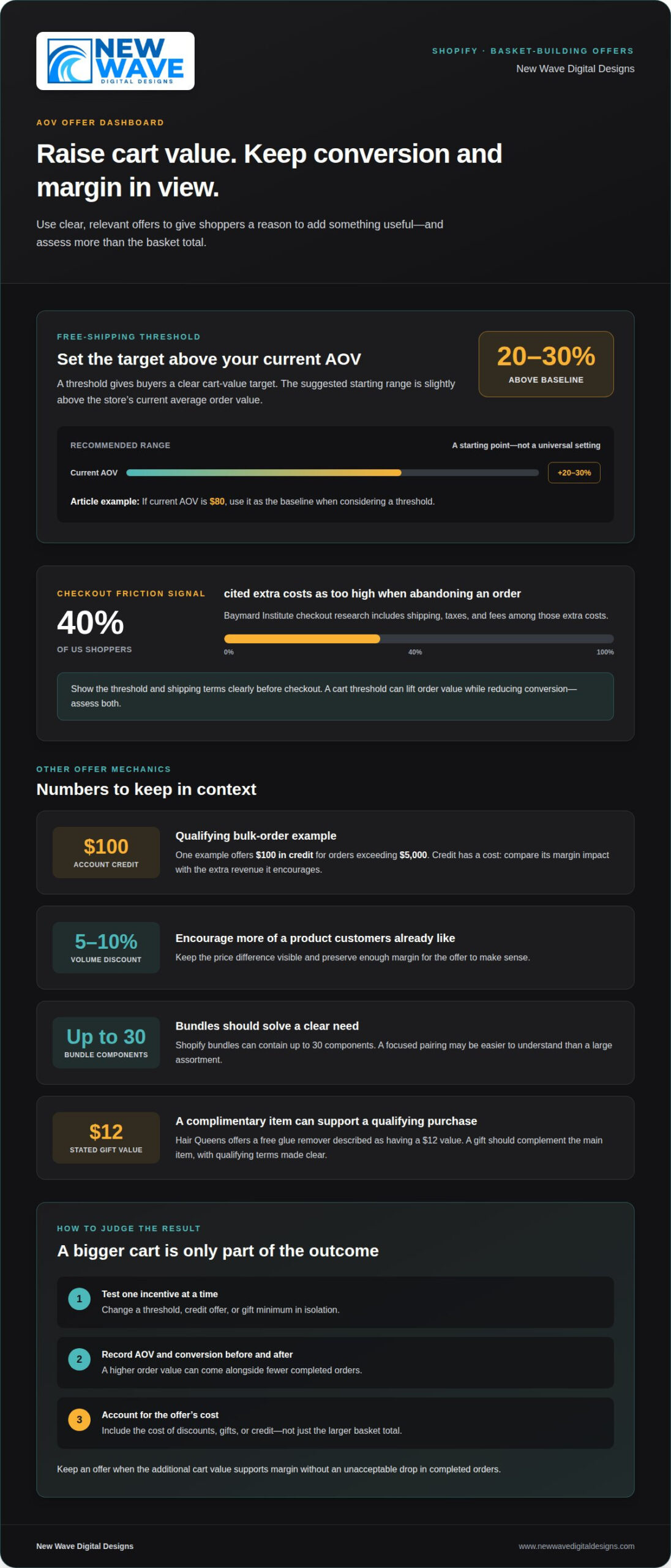
A free-shipping threshold gives buyers a clear target: reach a stated cart value, and shipping is free. Set it slightly above the store’s current average order value, or use the recommended range of 20–30% above that baseline. For example, if the average order value is $80, a threshold in the recommended range encourages shoppers to add products before qualifying. Treat this as a starting point, not a universal setting.
Shipping costs and delivery speeds shape how attractive an offer feels. Show the threshold and shipping terms clearly before checkout so buyers understand what qualifies and which delivery choices are available. Free shipping can encourage purchases, while clearly presented paid options can suit shoppers who prioritize speed. Don’t present free shipping as unconditional when a minimum cart value applies.
Free shipping can give shoppers a reason to add another item, but a larger cart isn’t the only measure of success. Baymard Institute checkout research found that 40% of US shoppers who abandoned an order cited extra costs, including shipping, taxes, and fees, as too high. At the same time, a cart threshold can raise order value while reducing conversion. Assess both metrics when testing the offer.
Other incentives can use a minimum purchase amount without waiving shipping. For example, a store might offer account credit for qualifying bulk orders. One example uses $100 in credit for orders exceeding $5,000. This structure can suit larger purchases, but the added credit still has a cost. Compare its effect on margin with the extra revenue it encourages.
A gift threshold gives shoppers another reason to increase cart value. Offer a relevant complimentary item when a cart reaches the stated minimum. The gift should suit the products being purchased and feel useful, not like an unrelated extra. Show the qualifying amount and gift conditions near the cart total.
Discounts can raise order value while weakening margin, especially when shoppers get a price reduction on products they would have bought anyway. Frequent promotions can also teach buyers to wait for discounts, shaping their expectations for future purchases. To protect profitability, account for the cost of the discount or gift, not just the higher basket total.
Test one incentive at a time. Record AOV and conversion before and after changing a free-shipping threshold, account-credit offer, or gift minimum. Keep the offer only if larger carts support the store’s margin without an unacceptable drop in completed orders. This helps show whether the threshold attracts more valuable orders or simply shifts buying behavior.
2. What’s the difference between upselling and cross-selling?
An upsell invites a buyer to choose a higher-value version of the product they’re considering. A cross-sell recommends a complementary item. For example, a skincare store might offer a larger size as an upsell, then recommend a cleanser as a cross-sell. The distinction matters: one deepens the original purchase, while the other adds a related product.
Bundles combine products that appeal to the same customers, usually at a lower price than buying each item separately. A camera store could pair a camera with a compatible accessory, while a gift shop could group products for a shared occasion. A bundle should solve a clear need, not simply combine unrelated stock. Grouping products into a solution can make buying easier.
A bundle can also act as an upsell when it adds useful products to an item the customer already wants. Shopify bundles can contain up to 30 components, but a focused pairing may be easier to understand than a large assortment. A volume discount of 5–10% can encourage customers to buy more of a product they already like. Keep the price difference visible, and preserve enough margin for the offer to make sense.
Multipacks and quantity breaks suit products with repeat use, refill cycles, gifting potential, or shared household use. A store could show single-item and multipack options together, then explain the savings on the larger quantity. Tiered pricing can offer a stronger incentive at each quantity level. A buy-two-items, get-one-free promotion can also encourage a larger purchase, but calculate the free item’s effect on margin first.
A gift with purchase adds a complimentary product when an order meets a stated condition. Hair Queens, for example, offers a free glue remover described as having a $12 value. A useful gift can make a bundle or qualifying purchase more appealing, especially when it complements the main item. State the qualifying terms clearly so customers understand what they need to add.
There isn’t one best Shopify app for every store. Choose an app that supports the offer you need, such as bundles, upsells, or quantity discounts. Costs depend on the app’s pricing and plan, so compare them with the offer’s effect on margin and completed orders before adopting it.
To make these offers feel coherent, present bundle choices and savings clearly on product pages. A considered Shopify website design can help organize product information and offer placement around the buying journey. Keep each recommendation relevant, easy to understand, and limited enough to avoid overwhelming shoppers.
3. Cross-sells, upsells, and personalized merchandising
Before checkout, cross-sells suggest useful companions, while upsells present a more capable version of the selected product. After checkout, a relevant offer can invite an additional purchase without interrupting product selection. These offers can increase AOV by adding items buyers value, rather than relying on discounts alone.
Start on product pages, where shoppers are already weighing a specific choice. For a coffee maker, show compatible filters or a premium model and explain what distinguishes it. Place complementary recommendations near the Add to cart button, where they can support the decision. Make the connection clear so buyers understand why each suggested item pairs with their selection.
Personalized merchandising can make suggestions more useful. Shape recommendations around products a shopper views, adds to the cart, or has bought before. Someone browsing running shoes might see suitable socks, while a returning buyer could see a refill for a previously purchased product. Tie each recommendation to an identifiable need, not browsing activity alone.
In the cart, a cross-sell should fit the items already selected. Someone buying a notebook might appreciate a compatible pen, while a laptop buyer could consider a protective sleeve. Keep the offer reasonably priced and easy to understand, with concise details about compatibility or use. A cluttered cart or unrelated suggestion can distract buyers and undermine trust.
Checkout add-ons need extra restraint because customers are completing their purchase. Offer a relevant, low-priced item and limit the choices. For example, a store selling art supplies could suggest a small brush cleaner alongside paint. Avoid stacking discounts, upgrades, and unrelated extras at the final step. Each option should make its value clear and preserve a smooth checkout.
Post-purchase offers create another merchandising moment after the initial transaction. Post-purchase one-click upsell offers can add 15–25% to average order value. A customer who just bought a camera, for instance, could see a compatible accessory. Keep the offer connected to the completed order, and make its terms and additional charge clear before the customer accepts.
Product recommendations at key shopping touchpoints can increase Shopify order values by 10–30%. Treat that range as potential, not a promise for every store. Begin with one placement, such as recommendations on a product page, then assess sales alongside conversion and margin. If a premium version, cart cross-sell, or checkout add-on distracts more than it helps, refine its relevance or placement before adding more offers.
4. What is average order value (AOV)?
Average order value, or AOV, is the average amount customers spend each time they place an order. For Shopify stores, calculate it by subtracting discounts from gross sales, then dividing by the number of orders. This gives sales per order, not per buyer or product. Understanding how to increase average order value on Shopify starts with knowing what the baseline measures. Use the same calculation period when comparing weeks or months.
For example, a store with $2,000 in product revenue after discounts from 100 orders has a $20 AOV. Divide $2,000 by 100 to get that result. A store with $50,000 in revenue from 1,000 orders has a $50 AOV. These examples show why revenue alone doesn’t describe the typical order. Order volume changes the result.
In Shopify Analytics, use sales after discounts and order count for the same date range. Divide the sales figure by the order total, and keep the period consistent when reviewing a campaign or comparing months. Mixing sales from one period with orders from another produces an unreliable average, even if both source figures are accurate.
B2B stores should also segment AOV by customer type or purchasing group. A wholesale portal with a $500 AOV can have a very different order pattern from a direct-to-consumer store. Segmenting shows whether larger orders come from wholesale buyers, repeat customers, or another group. That distinction helps stores interpret the overall average without assuming every buyer spends similarly.
Order value and order size describe different things. AOV describes spending per order, while average order size describes how many items customers typically buy in an order. A customer could order several low-priced items and produce a different AOV from someone buying one premium item. Track the metric that matches your question.
Use AOV as a measure of basket value, not as a direct measure of profit. Discounts can increase the amount customers buy while reducing revenue retained per order. For store owners asking how to increase average order value on Shopify, a 10% lift in AOV alone doesn’t show whether profit improved. Read the metric alongside margin and conversion to understand its wider effect.
A single average can conceal uneven order values. If a small number of large purchases lift the mean, the typical customer may spend less than the headline figure suggests. Compare AOV across customer segments and periods, and examine order values alongside repeat purchasing. This context gives store owners a clearer baseline before evaluating offers or merchandising changes.
5. Measuring average order value
Measure AOV alongside conversion and gross margin, not in isolation. A promotion can raise the amount per order while fewer shoppers complete checkout or discounts reduce profitability. Shopify stores should also consider customer acquisition cost, returns, and repeat purchases. Together, these measures show whether a larger basket supports a healthier business.
Start with a clean baseline before changing an offer. Record AOV, conversion rate, and gross margin for four weeks, using the same date range and calculation method. A store can also establish its AOV baseline with at least 30 days of data. Consistent periods make comparisons more meaningful, especially when weekly sales fluctuate.
Change one promotion at a time. For example, test a product recommendation without also changing discounts or shipping terms. Compare AOV before and after the change, then review conversion and gross margin over the same periods. Run an AOV test for at least two full weeks to give the offer time to gather useful results.
Average order value can hide the shape of your orders. Consider five Shopify orders valued at $25, $50, $50, $75, and $200. Their mean is $80, while the median and mode are both $50. The $200 order pulls the mean upward, so the median may better represent a typical order in this example. Review both measures when a few unusually large orders influence the result.
Define success before launching. If a recommendation aims to lift AOV, decide how much movement in conversion or margin the store can accept. A higher average alone isn’t a complete win if fewer shoppers buy or discounts consume the added revenue. Track order value and the trade-offs together, then keep a promotion only when its broader effect fits the store’s goals.
Segment results where customer behavior differs. Compare new and repeat shoppers, mobile and desktop orders, or product categories when there’s enough data. A recommendation may help one group and distract another. Use these comparisons to refine placement, offer eligibility, and minimum purchase conditions instead of applying the same tactic to every buyer.
Keep a simple experiment record: note the offer, launch and end dates, baseline metrics, and results. Add recommendations or reward incentives only after the previous test is understood. For a structured review of Shopify storefront design and measurement, discuss your Shopify design needs.
New Wave Digital Designs: Shopify Website Design
New Wave Digital Designs provides Shopify Website Design for stores ready to shape product pages and shopping journeys around relevant offers. If shoppers struggle to find complementary products, compare options, or understand a bundle, a considered storefront structure can make those choices clearer. Product recommendations, cart details, and offer messaging should reflect the store’s identity while supporting the buying experience.
Turn to New Wave Digital Designs when your Shopify store needs a more deliberate design or a refresh that brings merchandising and presentation into alignment. The team also provides website maintenance to support ongoing site needs. To discuss your store’s design goals, contact New Wave Digital Designs.
Build a storefront that grows with your customers
Make merchandising an intentional part of your store’s design. Consider how shoppers move from discovery to decision, where they need clearer product information, and which moments could support a relevant offer. This turns learning how to increase average order value on Shopify into an ongoing design and testing practice, rather than a collection of disconnected promotions.
As your business evolves, your website platform and presentation can evolve with it. New Wave Digital Designs offers Shopify Website Design, WordPress Website Design, and SquareSpace Website Design to shape a digital storefront around your business and customer experience.
Bring your ideas, goals, and storefront challenges into the next conversation. Contact New Wave Digital Designs to discuss a thoughtful direction for your website. A clearer shopping journey can be the beginning of meaningful growth.
Frequently Asked Questions
What is average order value (AOV)?
Average order value is a storewide measure of the revenue each order brings in, on average. It describes transactions, not a customer’s total value over time or the number of products in a basket. A store can use AOV to compare orders during a product launch with a usual sales period, then investigate what changed in the shopping experience.
Why is AOV important?
AOV helps store owners understand the value of completed orders and assess whether merchandising changes are working. Read it alongside conversion, profit margin, and repeat purchases. For example, a new bundle may increase order value but also lead shoppers to choose discounted products instead of full-price items. These paired signals help show whether the change supports the store’s wider commercial goals.
Can AOV growth be automated?
Ecommerce tools can automate parts of AOV testing by displaying recommendations or applying offers when carts meet set conditions. Automation delivers an offer consistently, but it can’t determine by itself whether that offer suits a particular product or customer. Review the results and shopping experience. For example, an automated accessory recommendation should match the cart item and be easy to dismiss.
Ready to Boost Your Shopify Store’s AOV?
A thoughtful storefront helps shoppers understand product options and discover relevant offers without adding friction. If your Shopify pages need clearer structure or more considered merchandising, New Wave Digital Designs offers Shopify Website Design. Contact the team to discuss your store’s design goals and the customer journey you want to create. A focused conversation can help shape a practical next step for your online store.
What is AOV?
AOV stands for average order value, a metric that summarizes sales revenue per order during a chosen reporting period. It can help answer questions such as whether shoppers are buying higher-value combinations or placing smaller orders. It doesn’t reveal the cause by itself, so compare it with product mix, promotion timing, and customer segments to interpret changes in context.
What’s the difference between upselling and cross-selling?
An upsell encourages a shopper to choose a higher-value version of the product they’re considering. A cross-sell suggests a separate, complementary item. For instance, someone choosing a desk lamp could see a brighter model as an upsell or a matching desk organizer as a cross-sell. Connect each suggestion to the shopper’s likely use rather than presenting unrelated products.
How can Shopify merchants use a cart progress bar or free-gift threshold to increase AOV?
A cart progress bar can show shoppers how much more they need to spend to qualify for a free gift. Pair it with a clear description of the gift and eligibility terms, then recommend relevant products that help close the gap. A store selling baking supplies, for example, could feature a useful decorating tool. Keep the progress message accurate as cart contents change so shoppers can make an informed choice.