A troubled web design partnership often reveals itself in the details, not just in the finished design. The clearest signs of a bad web design agency include unclear ownership and account access, weak performance tracking, poor communication, overlooked technical SEO, a frustrating mobile experience, and little support after launch. These are practical warning signs, not just differences in creative taste.
It’s reasonable to expect a website partner to explain decisions, keep you informed, and help maintain your site over time. This article shows you how to spot when those expectations aren’t being met and what to look for instead. Use the guidance on transparency, measurement, communication, mobile design, technical SEO, and maintenance to assess whether your partnership still supports your business.
Key Takeaways
- Keep clear access to your analytics, advertising accounts, website platform, and domain so your digital assets remain under your control.
- Look for reporting that connects website and campaign activity to meaningful business outcomes, not just surface-level metrics.
- Assess whether the agency communicates clearly, sets a workable timeline, and responds constructively to feedback.
- Check that technical SEO and mobile usability are considered alongside the visual design.
- Clarify what maintenance and support will continue after launch to keep your website secure, functional, and current.
1. Why is a lack of transparency and account access a fatal red flag?
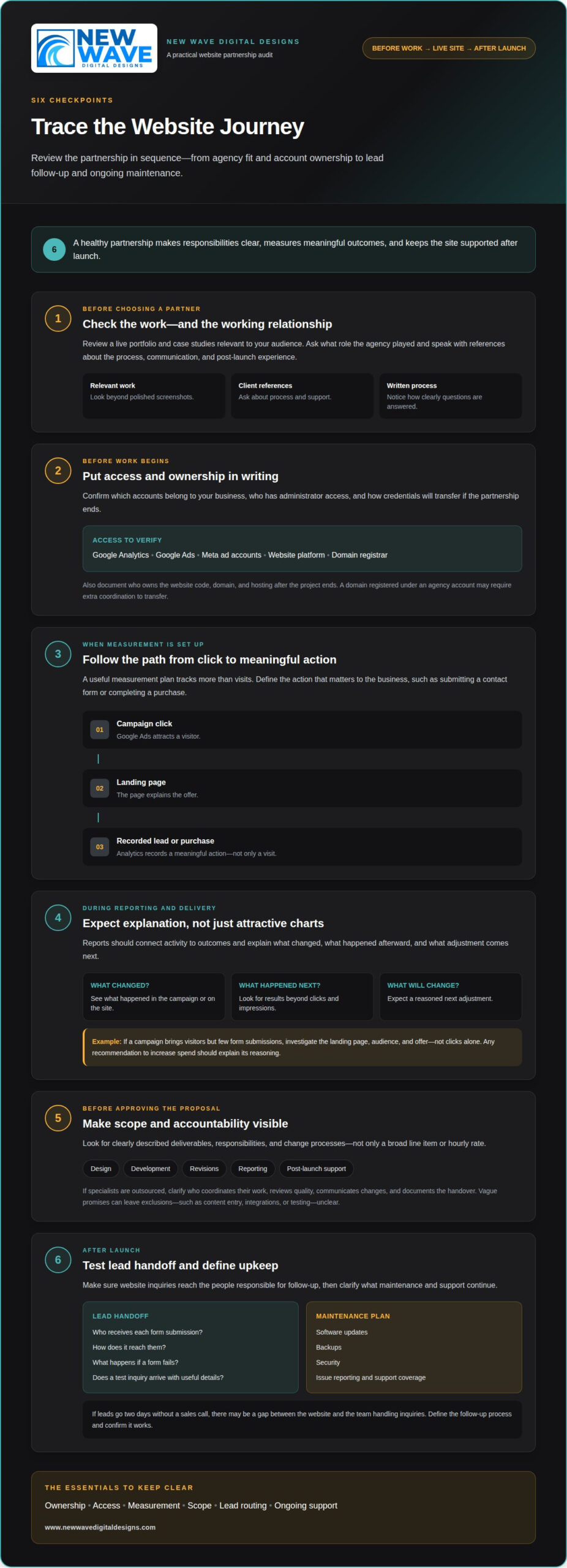
Your website, domain, analytics, and advertising accounts are valuable digital assets. You should be able to access your Google Analytics, Google Ads, Meta ad accounts, website platform, and domain registrar directly. If an agency controls every login, you may struggle to review results or make changes independently. Treat access requests as routine project governance, not a challenge to the agency’s expertise.
Before work begins, document who owns the website code, domain, and hosting after the project ends. Confirm which accounts are registered to your business, who has administrator access, and how credentials will transfer if the partnership ends. For example, if your domain is registered under an agency account, transferring it may require extra coordination. Written ownership terms clarify responsibilities before a disagreement arises.
Review a live portfolio and case studies relevant to your audience, then ask what role the agency played in each project. A polished screenshot alone can’t show whether a site works, loads clearly, or guides visitors toward an action. Ask for client references who can describe the process, communication, and post-launch experience. A pattern of these signs of a bad web design agency matters more than a single design preference.
A capable agency also brings an independent perspective. If you suggest a complex navigation menu, the agency should explain how it could affect the visitor journey and offer a reasoned alternative when appropriate. Agreement isn’t the only measure of a successful partnership. Look for recommendations tied to your business goals, audience needs, and each page’s purpose.
To compare an agency with a freelancer or in-house team, assess the same factors: relevant work, account access, clear ownership terms, communication, and responsibility for design and development. An agency may coordinate several disciplines, while a freelancer or in-house team may have a different working structure. The right choice depends on your project’s needs and each team’s documented responsibilities.
To review a business’s reputation, search its name on Google Reviews and the Better Business Bureau, then look for patterns in recent feedback. Match its legal business name against the relevant state business registry, and search that name with terms such as “complaint.” Treat individual reviews as personal accounts, then compare recurring concerns with references and the agency’s written process.
Notice how clearly the agency communicates before you sign. A proposal should identify deliverables, ownership, account access, and who will answer questions during the project. If these basics remain vague after you ask direct questions, resolve them in writing before work starts.
2. Tracking, offer, website, and sales follow-up problems
A polished homepage can still conceal a weak marketing system. Trace the path from a campaign click to a completed inquiry: Google Ads attracts a visitor, a landing page explains the offer, and a form records the lead. If Google Analytics tracks visits but not meaningful actions, reports may show traffic without revealing whether the site supports sales. A useful measurement plan defines the important action, such as submitting a contact form or completing a purchase.
Look beyond attractive charts. Reports should explain what changed, what happened afterward, and what the next adjustment will be. For example, if a campaign brings visitors but few form submissions, the agency should investigate the landing page, audience, and offer instead of celebrating clicks alone. Ask how it uses Google Analytics, Google Ads, and Google Business Profile when relevant. A recommendation to increase marketing spend should explain the reasoning, not just promise more impressions.
A proposal should make the project scope easy to understand. A broad line item or hourly rate alone makes it difficult to tell what the budget covers. Look for separate descriptions of design, development, revisions, and post-launch support, with deliverables and responsibilities clearly defined. Vague promises such as “custom website” can hide exclusions, including content entry, integrations, or testing. Be wary of pressure to approve a proposal before you understand what happens if the project changes.
Outsourcing isn’t automatically a problem; unclear accountability is. If outside specialists handle development or advertising, the proposal should define who coordinates their work, reviews quality, and communicates changes. It should also explain how completed work is documented and handed over. This helps you understand the agency’s process without assuming every task must be completed by one person.
After launch, ask how the maintenance plan addresses software updates, backups, and security. A site without a defined upkeep process can become harder to manage as tools and content change. Website maintenance should specify which tasks are handled, how issues are reported, and what support covers. Website maintenance can help keep these ongoing responsibilities part of the broader website plan.
Examine how website leads connect to sales follow-up. If leads go two days without a sales call, there may be a gap between the website and the team handling inquiries. Define who receives each submission, how it reaches them, and what happens if a form fails. A test inquiry can show whether the message arrives, includes useful details, and reaches the right person.
Warning signs in a contract or proposal include vague deliverables, unclear revision terms, no defined post-launch support, and no explanation of reporting. Before signing, make sure the scope, tracking responsibilities, maintenance tasks, and process for changes are described in plain language.
3. Agency communication and missed deadlines
A clear project process turns a creative vision into scheduled work. Before design begins, the agency should outline stages, decision points, and the information it needs from you. A timeline that names milestones, such as content approval and design review, makes delays easier to explain. No schedule can prevent every challenge, but repeated missed dates without an explanation or revised plan are warning signs.
Communication should follow a predictable rhythm. During a website project, agree on how often you’ll receive updates based on the work underway. Updates should identify completed tasks, current blockers, and the next milestone. If a design review is waiting on your feedback, the agency should say so clearly. If its team is behind, it should explain why and propose an adjustment.
Response patterns matter, too. A web design agency should respond to non-urgent queries in around 24 hours, and failing to answer a contact-form inquiry within a week is a warning sign. These are useful expectations for assessing communication, not a substitute for the response terms in your agreement. Notice whether answers address the question, name an owner, and give a next step.
Be cautious of promises to compress work without explaining the process. A promise to build an SEO-optimized website in one week is unrealistic because technical setup, content, design, and review all require coordination. Ask for the sequence of work and the dependencies behind each delivery date. A realistic timeline makes revisions and approvals visible instead of presenting launch as an unexplained finish line.
Feedback should move the project forward. A responsive agency listens to concerns, clarifies what it understood, and explains how it will address them. Keep a shared record of requested changes, decisions, and due dates; this helps distinguish an overlooked revision from a new request. If progress remains unclear, agree on specific measures and a review window. One recommendation is to allow 60 to 90 days for requested changes and delivery against those measures.
If deadlines slip or work misses the agreed scope, document the gap against the proposal, then request a written recovery plan with revised dates and named responsibilities. For poor work, identify the specific deliverable and explain what needs correction. Give the agency a defined opportunity to respond under the contract, then review the agreement’s remedies if the problem continues. This measured process helps address costly delays without letting frustration replace evidence.
4. Technical SEO and mobile responsiveness
Strong visual design can still conceal technical gaps. A website build should account for site structure, page speed, and mobile optimization as part of its SEO strategy. If these are left until after launch, navigation, layouts, and content may need reworking. For example, a service page buried several clicks deep can be harder for visitors to find and for search engines to understand.
Test the mobile experience as a visitor would. Open key pages on a phone and check whether text is readable, menus work, and buttons are easy to tap. Responsive design uses fluid grids and flexible images to adapt layouts to different screen sizes. If a desktop page simply shrinks on mobile, visitors may have to zoom, scroll sideways, or struggle to complete a form.
Give page speed the same practical attention. A website that takes more than three seconds to load risks losing visitors. Oversized images, slow server response, and missing caching can all affect load time. A capable agency should identify which pages feel slow and explain what it will change, such as optimizing images, reducing server response time, or using caching.
Test important tasks on both phone and desktop. Can a visitor find a product, submit a form, or locate contact details without obstacles? For an online store, follow the path from a product page through the cart. For a service business, try completing the inquiry form with one hand. These tests reveal friction a desktop preview can miss and help connect usability to conversions.
Ask how the agency tests technical details before launch. The plan should include checking that key pages load, navigation links work, mobile layouts display correctly, and page titles and headings match their content. If the agency treats SEO as an add-on after design, ask how site structure and mobile performance fit into the overall build. Each element should support a clear goal, not sit on a disconnected checklist.
Be cautious of promises of a specific Google ranking. Google controls its search algorithms, so an agency can improve technical foundations but cannot credibly guarantee a particular position. Ask which improvements it plans to make and how it will assess progress. Clear answers connect the work to site health and visitor experience, rather than promising a ranking beyond the agency’s control.
Mobile testing should continue after launch. A content change, new image, or added form field can affect how a page displays. A useful review checks representative pages across screen sizes and confirms that key actions still work. When technical SEO and responsive design are built into the process, the site’s structure, speed, and usability support a coherent digital experience.
5. Post-launch maintenance and support
Launch day is a handoff, not the end of a website’s working life. WordPress, Shopify, and Squarespace sites rely on software, content, and connected services that can change over time. A useful support plan explains who handles updates, backups, security, and reported problems. If the agency treats these responsibilities as someone else’s concern, the partnership may end before the site’s ongoing needs are addressed.
Start by defining what maintenance includes. For example, the plan can specify whether software updates, backup checks, and security tasks are covered. It should also explain how to submit requests, who handles them, and what falls outside the agreed work. A broad promise to “keep the site running” doesn’t tell you whether anyone will review a broken form or outdated page.
Security needs a practical process, not a vague assurance. Ask how the agency handles updates and backups and responds to reported site issues. If a checkout stops working or a contact form fails, you need to know who owns the next step. Clear responsibilities can prevent a small technical problem from disrupting sales or inquiries.
Maintenance also protects the experience visitors see. A new promotion, revised service, or added product can leave behind old links, images, and page details. A planned review can catch these inconsistencies and confirm that key actions still work. For an online store, that might mean checking product pages and the checkout journey after a content change.
Design should evolve with the business, not remain frozen in its launch template. An agency should be able to discuss whether a page looks outdated, whether navigation still reflects the current offer, and whether changes serve a clear purpose. Updating a site doesn’t mean chasing every trend. It means keeping the structure and presentation aligned with the business and its audience.
Reporting can make ongoing work more meaningful. Website traffic and advertising impressions show activity, but not whether visitors can complete important tasks. A maintenance review can flag a broken page, slow-loading image, or form that needs attention, then record the action taken. That gives you a clearer view of what changed and why.
Before an engagement begins, agree on the post-launch support plan, its scope, and cost in writing. Name the tasks covered, the process for submitting requests, and the responsibilities retained by your team. If you need continuing care for your site, arrange ongoing website maintenance as part of your support plan.
New Wave Digital Designs
New Wave Digital Designs can help when your website needs a clearer design direction, a dependable build, or support beyond launch. Its services include Shopify, WordPress, and Squarespace website design, along with website maintenance. Whether you’re planning a new site or addressing ongoing issues, the focus is on shaping a digital experience around your business and audience.
If the warning signs point to gaps in design or ongoing care, discuss your website’s needs and priorities with New Wave Digital Designs. Contact the team to talk about your website and the next steps.
Choose a Website Partnership Built for What’s Next
Recognizing the signs of a bad web design agency gives you a clearer basis for deciding what your website needs next. The goal isn’t simply to replace a provider; it’s to create a digital foundation that can adapt as your business evolves. Consider what you want visitors to understand, which actions matter most, and what kind of support will help your site keep pace.
New Wave Digital Designs offers Shopify Website Design, WordPress Website Design, and SquareSpace Website Design for businesses seeking a thoughtful design partner. A conversation can help you define priorities and consider a direction that suits your site and goals. You don’t need every answer before taking that step. Start with what’s working, what isn’t, and what you want the experience to become.
Contact New Wave Digital Designs to discuss a considered next step for your website.
Frequently Asked Questions
What are the biggest red flags when hiring a web design agency?
The biggest warning signs are promises without a clear method, evasive answers, and reluctance to document responsibilities. Notice how the agency handles disagreement during discovery: does it explain trade-offs or dismiss your concern? Ask for a sample project schedule and a description of how approvals work. These details reveal whether the team can turn creative direction into an accountable working relationship.
Why is a lack of transparency and account access a fatal red flag?
Without direct access, you can’t independently review key accounts or maintain continuity if the relationship ends. Beyond login access, clarify who can change settings, export reports, and approve account-level actions. For example, ensure your business retains an administrator role while the agency has the access needed to do its work. A written access and handover process reduces dependence on one person’s inbox or password manager.
What are the most common signs of a bad web design agency?
Common signs of a bad web design agency include unclear scope, weak explanations, and a site that doesn’t serve its intended audience. Look for less obvious gaps, too: no clear process for approving content, no documented handoff, or recommendations disconnected from your business goals. One concern may have a simple explanation; repeated patterns across the proposal, project, and launch deserve closer assessment.
How can I verify a web design agency’s portfolio and client references?
Review a live site, not just a screenshot, and test its pages on the devices your audience uses. Check what role the agency played in each project, since a portfolio may include work by several contributors. Ask a reference about collaboration, decision-making, and what happened after launch. Choose examples that resemble your project’s needs, such as an online store if you need e-commerce design.
What are typical web design agency payment terms, and what fees are red flags?
Payment schedules vary, so the proposal should state when invoices are issued and which project milestones they relate to. Review recurring charges, revision limits, cancellation terms, and expenses described only as “additional services.” A separate fee isn’t automatically improper; the concern is a charge with no defined purpose or approval process. Ask for unclear terms to be explained in writing before agreeing.
Who should own the website, domain, hosting, design files, and source code after a project?
Ownership and usage rights should be stated in your agreement, including what transfers at completion and what remains licensed. Consider each asset separately: domain registration, hosting account, website files, custom code, fonts, and stock imagery may have different terms. A handover checklist can name who is responsible for transferring each item and identify any third-party licenses that continue after the project ends.
What accessibility, SEO, security, and mobile standards should a web design agency meet?
Ask the agency to explain how its build addresses accessibility, search visibility, security, and mobile usability. WCAG 2.2 is the current version of the Web Content Accessibility Guidelines. A practical review can include keyboard navigation, readable contrast, page titles, working links, secure hosting, software updates, and responsive layouts. The exact checks depend on the site’s features, such as whether visitors use forms, make purchases, or access member content.